

Month: March 2019

Islamic Astronomy
This article was originally published as: “Islamic Astronomy”, in Christopher Walker, ed., Astronomy before the Telescope, London: British Museum Press, 1996, pp. 143-174.

Figure 1. An illustration of the stars of one of the lunar mansions (al-haq`a) in an Egyptian treatise on folk astronomy. The table on the right identifies the mansions culminating, rising and setting, and the mansions opposite them (at 180°) at different times of the night when the sun is in that mansion; it also gives the date in the Coptic, Western and Syrian calendars and the midday solar altitude when the sun is in each of the 13 degrees of the mansion (360 ÷ 28 Ft 13). The associated text repeats some of this information and adds the midday shadow length. (Chester Beatty Library, Dublin, MS 4538)
From the ninth century to the fifteenth, Muslim scholars excelled in every branch of scientific knowledge. In particular their contributions to astronomy and mathematics are impressive. There are an estimated 10,000 Islamic astronomical manuscripts and close to 1,000 Islamic astronomical instruments preserved in libraries and museums in the Near East, Europe and North America, but it is clear that even if all of them were properly catalogued and indexed – and we are still very far from this state of affairs- the picture that we could reconstruct of Islamic astronomy, especially for the eight, ninth and tenth centuries, would be quite deficient.
Most of the available manuscripts and instruments date from the later period of Islamic astronomy, that is, from the fifteenth to the nineteenth century, and although some of these are based or modelled on earlier works, many of the early works are extant in unique copies and others have been lost almost without trace, that is, we sometimes know only of their titles.


Figure 2. A non-Ptolemaic planetary model for the moon, found in a copy of the treatise on planetary astronomy (al-Till* altiiillriyya) written by Qutb al-Din al-Shirazi in Sivas (Anatolia) in AD 1285. Only since the 1950s have these models been investigated by modern scholars; the discovery that a series of Muslim astronomers concerned themselves with such models from the eleventh to the sixteenth centuries and developed models without the problems inherent in the Ptolemaic ones has promoted considerable interest in medieval Islamic planetary theory. (Egyptian National Library, Cairo, MS K3758)
Figure 3. The front of the universal astrolabe of Ibn al-Sarraj, dated AD 1329. This remarkable instrument not only represents the culmination of Islamic astrolabe-making, but has no equal in sophistication amongst instruments from the European Renaissance. Whereas the standard astrolabe requires a different plate for each latitude, that of Ibn al-Sarraj has plates that serve all latitudes; indeed, the various components can be used in five different ways to solve all the problems of spherical astronomy for any latitude. IC no. 140 (Benaki Museum, Athens)
Al-Khalili and the Culmination of Spherical Astronomy in 14th-Century Damascus
[This feature was prepared by Prof. David A. King of Frankfurt. His research since about 1970 has focussed on what he calls “astronomy in the service of Islam“, a topic mainly neglected by other historians more interested in planetary astronomy or theoretical astronomy or transmission or…

Ibn Yunus and The Pendulum: A History of Errors
Foucault’s Pendulum, Leonardo da Vinci National Museum of Science and Technology, Milan, Italy Photo by Ben Ostrowsky *** [Note of the Editing Manager] This article was originally published as: David A. King, “Ibn Yūnus and the Pendulum: A History of Errors” in “Archives…

The renaissance of astronomy in Baghdad in the 9th and 10th centuries
Introductory remarks “The ancients distinguished themselves through their chance discovery of basic principles and the invention of ideas. The modern scholars, on the other hand, distinguish themselves through the invention of a multitude of scientific details, the simplification of difficult (…

astronomy-david-a-king
Professor of the History of Science and Director of the Institute since 1985. Specialist on medieval Islamic science, Arabic scientific manuscripts and medieval Islamic and European scientific instruments. Lectures and seminars on aspects of medieval astronomy, astronomical instruments, Arabic scientific texts and manuscripts


Astronomy in Medieval Jerusalem
Various medieval Arabic manuscripts preserved in libraries around the world – Leipzig, Cairo, Princeton, and not least Jerusalem – attest to activity in astronomy in Mamlūk Jerusalem, mainly in the 14th century and thereafter into the Ottoman period, the most recent manuscript having been copied ca. 1900

Figure 1. Article Banner
 Figure 2. The plan of the city of Jerusalem from a manuscript collection of various religious, astronomical and historical works dated 1589 |
This activity was contemporaneous with cultural renewal after the devastating Crusades and with large-scale architectural developments, much of which has survived and is still visible in the city.
The main figures in this astronomical activity are the Cairo astronomer al-Rashīdī and his Jerusalem contemporary al-Karakī. There can be no comparison with the established sophisticated astronomical traditions in Mamlūk Cairo and Damascus and Aleppo, with substantial numbers of capable astronomers, but since the Jerusalem tradition is virtually unknown, it is surely worth documenting separately, and for this the time is perhaps ripe.
The manuscripts are concerned with an important branch of Islamic astronomy, namely, astronomical timekeeping and the regulation of the astronomically-defined times of the five daily prayers, as well as the determination of the qibla or sacred direction toward the sacred Kaʿba in Mecca. Most of the astronomers associated with mosques who practiced such applied astronomy for religious purposes were called muwaqqits, literally “those concerned with time-keeping”, others simply mīqātīs, specialists in the discipline ʿilm al-mīqāt, “the science of astronomical timekeeping”. In the central lands of Islam this activity is attested in Cairo from the 13th century onwards, and in Damascus from the 14th. Prior to that similar tables were compiled all over the Islamic world (except al-Andalus) but on a less organized basis.
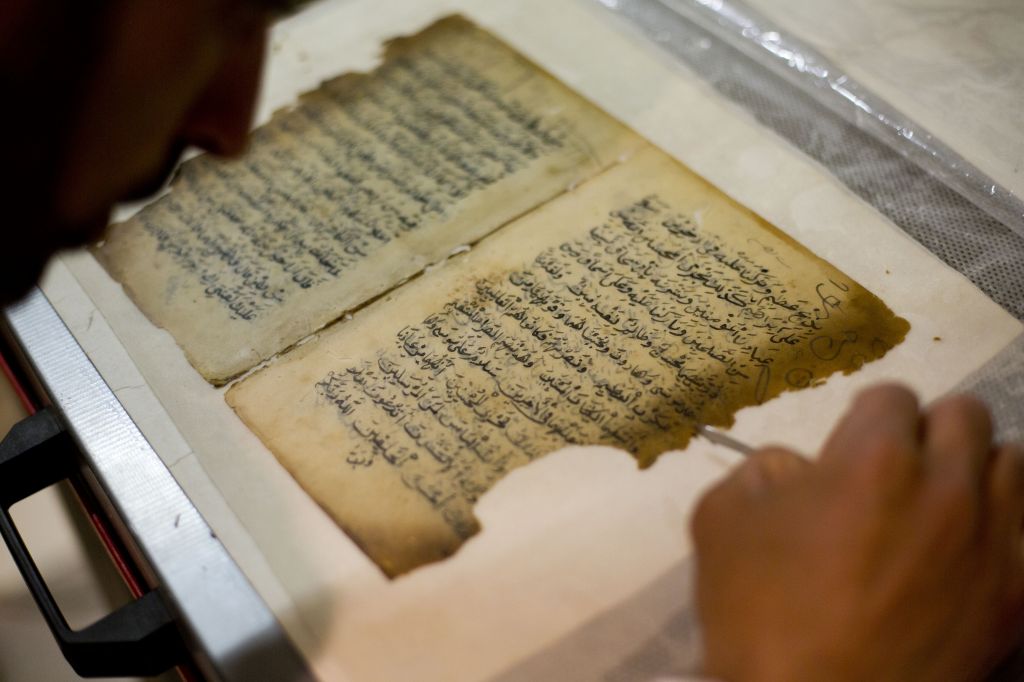
Figure 3. An employee works on a restoration of an old manuscript at the al-Aqsa mosque compound library in Jerusalem
Our manuscripts present a corpus of tables, containing over 20,000 entries for finding the time of day from the altitude of the sun throughout the year and for regulating the astronomically-defined times of prayer. Thus the muwaqqits associated with mosques in Jerusalem were involved in the same colourful activities as their colleagues in the better-known astronomical centres as Cairo and Damascus. More modest tables are attested for Ramla and Nablus, and the most sophisticated treatise that we have come across was copied by in the early 14th century by a muwaqqit at the Sacred Mosque in Hebron who was clearly conversant with the finer points of the astronomical tradition in Cairo.

Figure 4. Old manuscripts laid out at the al-Aqsa mosque compound library in Jerusalem
More specifically, the Leipzig manuscript (Universitätsbibliothek 808, copied 1402) contains extensive tables for Jerusalem by the 14th-century Jerusalem muwaqqit al-Karakī. These tables display for each degree of solar longitude (corresponding roughly to each day of the year) and for each degree of solar altitude above the horizon, (1) the time since rising (morning) or the time until sunset (afternoon), and (2) the time before or after midday. Values are expressed in degrees and minutes of time, where 1° equals 4 minutes (since 360° corresponds to 24 hours). There are 20,000 entries in the table, mainly accurately computed.
In addition, the Princeton manuscript (University Library, Special Collections, Yahuda 861,1, copied ca. 1600), contains a set of individual tables for Jerusalem, probably also by al-Karakī, displaying for each degree of solar longitude the following functions (in degrees and minutes):
- half the length of daylight; half the length of night;
- altitude of the sun at midday;
- altitude of the sun at the ʿasr prayer and the time after midday;
- solar altitude and time remaining to midday when the sun is in the direction of Mecca;
- duration of morning twilight and evening twilight;
- duration of darkness of night.
This corpus of tables was used by Jerusalem muwaqqits over the centuries. Late copies in Cairo manuscripts are datable as late as ca. 1900.
With these tables an astronomer would have control over the time of day and the times of the five prayers: sunset, nightfall, daybreak, midday and mid afternoon. He could instruct the muezzin when to announce to call to prayer. In this way in medieval Jerusalem the faithful were served by the muwaqqits.
Other means of regulating the passage of time were available. As for sundials, attention has already been drawn to a vertical sundial on the wall of a mosque in Jerusalem and a remarkable polar sundial in the courtyard of a mosque in Acre. Islamic astrolabes often included Jerusalem in their lists of localities, and some medieval European astrolabes included the city as the goal for pilgrims. One 14th-century Syrian astrolabe was deliberately designed to serve the major Mamlūk cities of Mecca, Cairo, Jerusalem, Damascus and Aleppo. There is no evidence that instruments were constructed in Jerusalem.
The English and Arabic versions of the same original article on timekeeping in Syria and beyond, published in 1979 when, as the author says, “Aleppo was the centre of the world for the history of Arabic and Islamic science”.
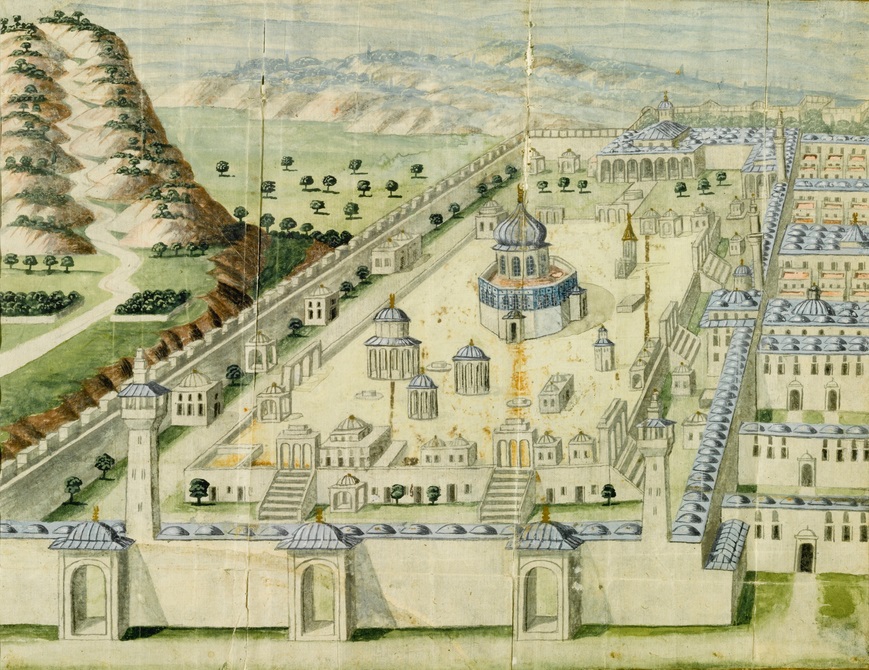
Figure 5. An Ottoman illustration of the al-Aqsa Mosque in Jerusalem 18th century
 Aal-e-Qutub Aal-e-Syed Abdullah Shah Ghazi