


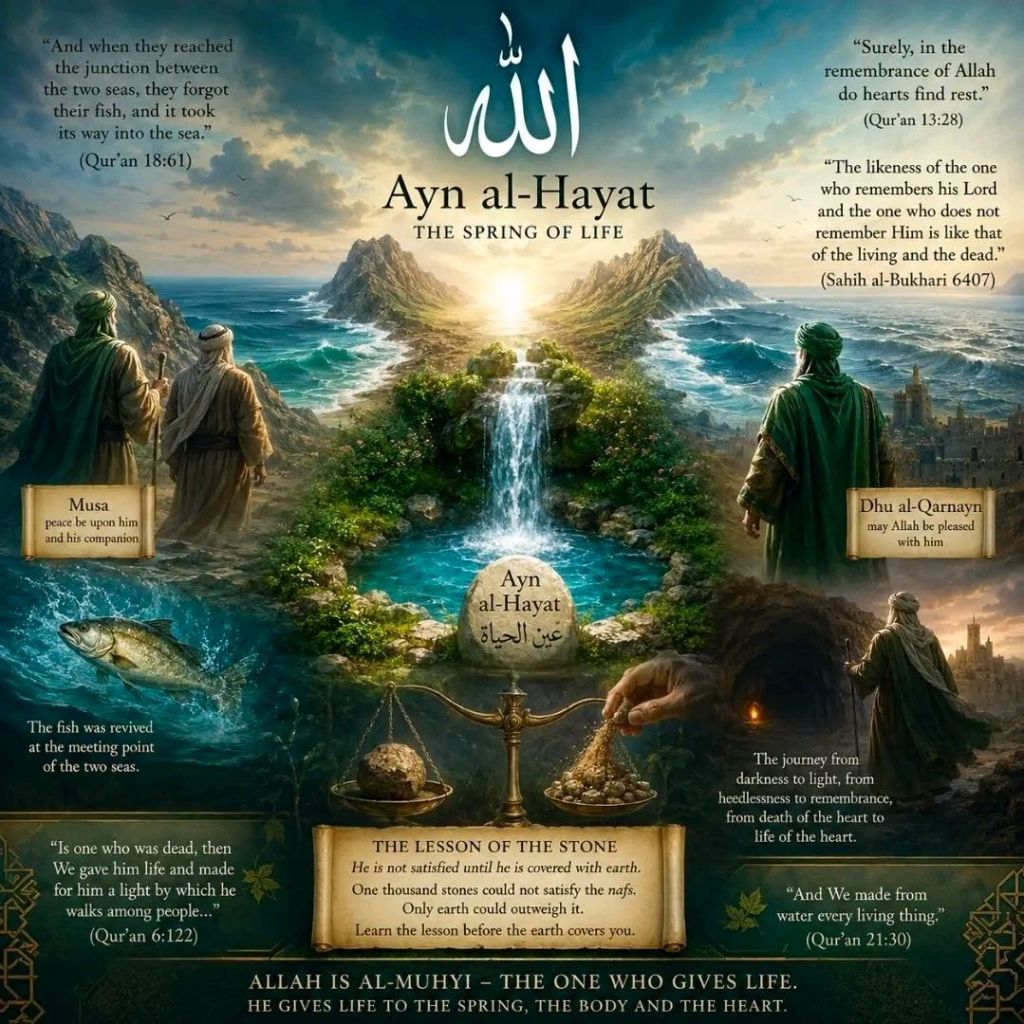
■ Ayn al-Hayat — The Spring of Life
Ayn al-Hayat means “The Spring of Life” or “The Fountain of Life.” Its story appears in the classical Islamic tradition surrounding Prophet Musa, peace be upon him; Prophet al-Khidr, peace be upon him; and Dhu al-Qarnayn, may Allāh be pleased with him.
The Qur’ān does not explicitly use the name Ayn al-Hayat, but Allāh Almighty, the Most High describes the remarkable event in which the fish carried by Sayyidunā Mūsa’s companion came back to life at the meeting point of the two seas:
“And when they reached the junction between the two seas, they forgot their fish, and it took its way into the sea.” (Qur’ān 18:61)
■ Ibn Kathir’s Account of the Spring of Life
In al-Bidayah wa’l-Nihayah, Imam Ibn Kathir, may Allāh have mercy upon him, records a lengthy report transmitted by Ibn Asakir through the chain of Waki his father Mutamir ibn Sulayman Abu Ja‘far al-Baqir and his father Zayn al-Abidin, may Allāh have mercy upon them all.
According to this report, Dhu al-Qarnayn, may Allāh be pleased with him, had a companion from among the angels named Ranaqil, peace be upon him. Dhu al-Qarnayn, may Allāh be pleased with him, asked him:
“Do you know of a spring on earth called the Spring of Life?” The angel described its location to him. Dhu al-Qarnayn, may Allāh be pleased with him, then set out in search of it and appointed Prophet al-Khidr, peace be upon him, at the head of his advance party.
Al-Khidr, peace be upon him, eventually reached the spring in a valley within the Land of Darkness. He drank from the Spring of Life, whereas Dhu al-Qarnayn, may Allāh be pleased with him, was unable to find it.
Imām Ibn Kathir, may Allāh have mercy upon him, then relates another remarkable episode from the same report.
Dhu al-Qarnayn, may Allāh be pleased with him, encountered some angels in a palace in that region, and one of them gave him a stone.
When Dhu al-Qarnayn returned to his army, he asked the scholars about the stone.
They placed it on one side of a balance and placed one thousand stones like it on the other side. Yet the single stone outweighed them. Eventually, they asked al-Khidr, peace be upon him.
Al-Khidr, peace be upon him, placed another stone opposite it and then placed a handful of earth upon it. The earth caused the balance to outweigh the stone. Al-Khidr, peace be upon him, then said:
“This is the likeness of the son of Adām: he is not satisfied until he is covered with earth.”
The scholars then prostrated before al-Khidr, peace be upon him, according to the report, as an act of honour and reverence.
Imām Ibn Kathir, may Allāh have mercy upon him, concludes the account with:
“And Allāh knows best.”
This is the account as Imam Ibn Kathir, may Allāh have mercy upon him, records it in his discussion entitled “The Statement Concerning Dhu al-Qarnayn’s Seeking of the Spring of Life.”
■ The Spring and the Fish of Musa, Peace Be Upon Him
Interestingly, Imam Ibn Kathir, may Allah have mercy upon him, also mentions Ayn al-Hayat when commenting on Qur’ān (18:61)
He reports that at the meeting point of the two seas there was a spring known as Ayn al-Hayat, and that when the fish was touched by the water, it became alive and escaped into the sea. Thus, in Ibn Kathir’s presentation, the miraculous revival of the fish and the tradition of the Spring of Life are closely connected.
■ The Spiritual Meaning
For the people of the spiritual path, the story carries a profound inward meaning. The Land of Darkness may be contemplated as an image of the darkness of heedlessness, the nafs, attachment and spiritual blindness.
The journey toward the Spring therefore becomes an image of the journey of the seeker toward the life of the heart.
▪︎ Allāh Almighty, the Most High, says:
“O you who believe, respond to Allāh and to
the Messenger when he calls you to that which gives you life.” (Qur’ān 8:24)
▪︎ Allāh Almighty, the Most High, says:
“Is one who was dead, then We gave him life and made for him a light by which he walks among people…” (Qur’ān 6:122)
The physical body requires water.
The spiritual heart requires iman, dhikr, repentance and Divine guidance.
▪︎ Allāh Almighty, the Most High, says:
“Surely, in the remembrance of Allah
do hearts find rest.” (Qur’ān 13:28)
▪︎ Prophet Muhammad, peace and blessings of Allāh be upon him, likewise said:
“The likeness of the one who remembers his Lord and the one who does not remember Him is like that of the living and the dead.”
(Sahih al-Bukhari 6407)
■ The Lesson of the Stone
The stone in Ibn Kathir’s account carries another profound lesson. No matter how much wealth, knowledge, power or worldly possession a person acquires, the nafs continues to desire more.
One thousand stones could not satisfy it.
Only earth could finally outweigh it.
The grave therefore becomes the final reminder that worldly appetite has no natural end.
The wise person learns this lesson before the earth covers him.
■ The True Spring of Life
The seeker should therefore not become obsessed merely with finding a physical fountain hidden somewhere in the world.
The deeper search is for the revival of the heart. The greatest tragedy is not that the body dies. It is that the heart may become dead while the body is still walking.
And the greatest gift is not merely long life.
It is that Allāh Almighty, the Most High, gives a servant a living heart.
Allāh is al-Muhyi, the One who gives life.
Every spring is His creation. Every drop of water is by His command. Every living soul receives its life from Him. And every awakened heart is awakened by Him.
Thus the deepest meaning of Ayn al-Hayat may be contemplated as the journey from darkness to light, from heedlessness to remembrance, from the domination of the nafs to surrender to Allāh Almighty, the Most High, and ultimately from spiritual death to the life of the heart.
“And We made from water every living thing.”
Qur’ān (21:30)
Ayn al-Hayat is the Spring of Life, but the One who gives life to the spring, the body and the heart is Allāh Almighty, the Most High, alone.
And only with Almighty Allāh is true success.
▪︎ References: Imam Ibn Kathir, may Allah have mercy upon him, al-Bidayah wa’l-Nihayah, vol. 2, section “The Statement Concerning Dhu al-Qarnayn’s Seeking of the Spring of Life”; Imam Ibn Kathir, may Allah have mercy upon him, Tafsir al-Qurʾān al-Azim, commentary on Qur’ān (18:61)


