


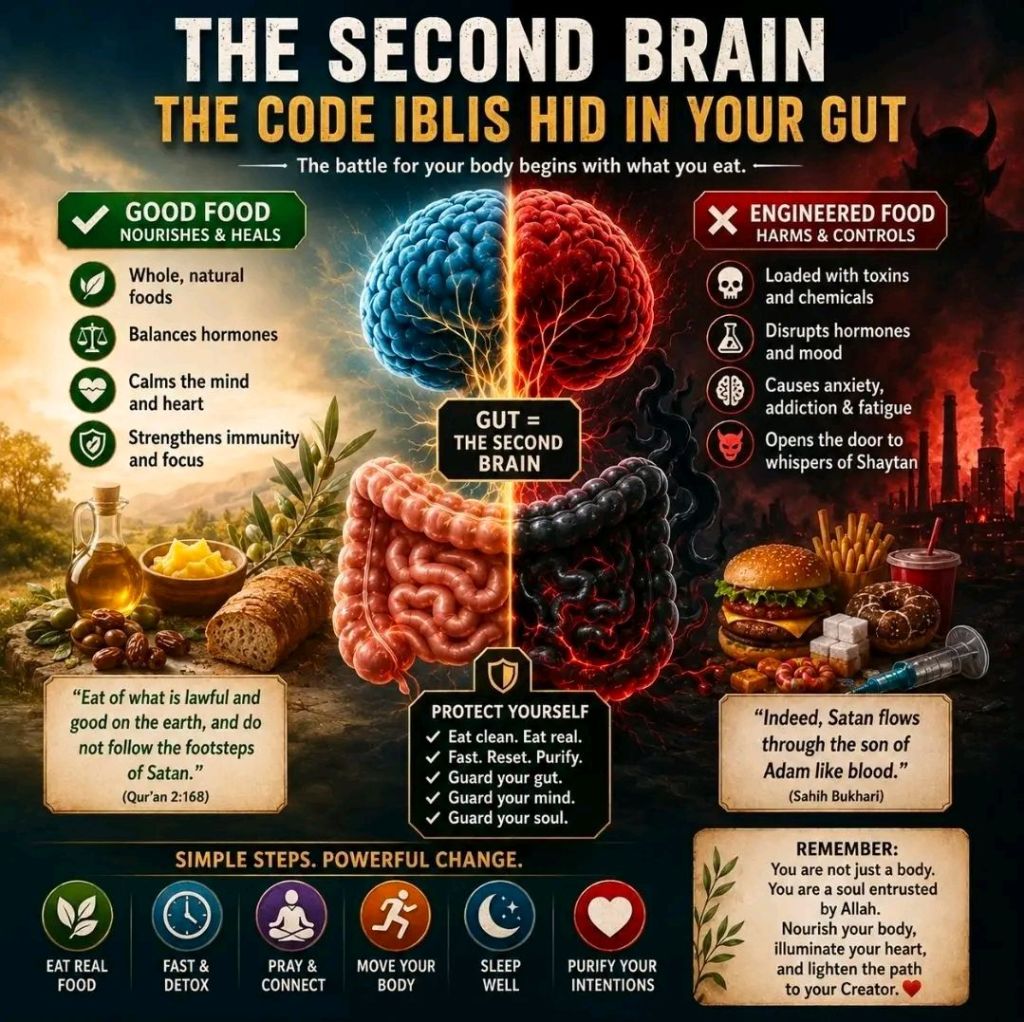
■ The Second Brain: Health, Spirituality,
and Psychology;
The idea of the “second brain” has become increasingly common in modern discussions about health, spirituality, and psychology.
In the text above, this concept is presented
not merely as a medical theory, but as part of
a larger spiritual struggle between the human being and Shayṭān.
The battle over the soul begins with food, claiming that what enters the stomach eventually shapes the heart, mind, emotions, and even one’s spiritual state.
The discussion begins with the story of Sayyidinā Ādam, peace be upon him, and the first act of disobedience.
According to the text, Shayṭān initiated his war against humanity through “a bite,” suggesting that food became the first doorway through which human weakness was exposed.
The body of Ādam is described as originally luminous and pure, but after the forbidden act it became bound to material needs, desires, and bodily functions.
From this perspective, the stomach is not simply an organ of digestion, but a gateway capable of influencing the entire human condition.
Central to the argument is the role of the vagus nerve, described as the bridge between the digestive system and the brain.
Because the nervous system and digestive tract develop together in the womb, the intestines are often referred to metaphorically as the “second brain.”
The text uses this idea to claim that disturbances in the gut can directly influence emotional and mental states. Modern scientific discussions about the microbiome and serotonin production are woven into a spiritual framework, suggesting that harmful eating habits do not merely damage physical health, but also weaken spiritual clarity and inner peace.
This connects this concept to contemporary food production. Modern industrial foods are portrayed as part of a broader corruption of the natural order. Refined sugar, hydrogenated oils, altered grains, and chemically processed foods are described as substances that disrupt the body’s natural balance.
These foods contribute to anxiety, emotional instability, exhaustion, and spiritual heaviness. The argument goes further by claiming that such disturbances create openings for satanic whisperings, drawing upon the Prophetic statement that Shayṭān “flows through the son of Ādam like blood.”
Traditional foods, by contrast, are presented as being closer to the natural state upon which the human being was created. Natural fats, simple grains, and wholesome nourishment are described not only as physically beneficial, but also spiritually stabilizing.
This frames the return to traditional eating as
a reclaiming of sovereignty over the body and mind. In this understanding, food becomes part of spiritual discipline rather than mere consumption.
The essay also highlights fasting as a means of purification and resistance. Hunger is portrayed as weakening unhealthy cravings and quieting the constant distractions that dominate modern life.
By reducing attachment to continuous eating, fasting becomes both a physical and spiritual shield. This reflects a broader Islamic understanding in which restraint of the nāfs strengthens awareness of Allāh and increases inner clarity.
Ultimately, the text presents the human body as an amānah, a sacred trust from Allāh.
The issue, therefore, is not simply nutrition or dieting, but the preservation of the body as a vessel for worship, tranquility, and nearness to the Divine.
Whether or not one accepts all of the scientific or metaphysical claims made in the discussion, the underlying message remains clear: what a person consumes affects not only physical health, but also emotional balance, spiritual focus, and the condition of the heart.
The essay concludes with a call to mindfulness and responsibility. Human beings are reminded that they are more than creatures driven by appetite.
They are souls honored by Allāh, entrusted
with intellect, spirit, and moral choice.
In this view, caring for one’s body through wholesome living becomes part of preserving dignity, clarity, and spiritual well-being.


