
Month: April 2021
Quran and Modern Science :JOURNEY TO THE MOON
18- And the Moon when it is full
19- You will surely ride from stage to stage
20- So, why do they not believe?
84-The Splitting, 18-20
The moon is associated in our minds with beautiful scenes and romantic landscapes. For those who use the lunar calendar, it is a precision
calculator. The ebb and tide it causes have always been a mystery for
men. It is used to symbolize mathematics, astronomy, art and romanticism. Throughout history the moon has been the symbol of the
unattainable. All these features also existed at the time of the Prophet.
For 1400 years the meaning of the above quoted verses remained
unravelled. In the Quran, the conjunction “and” (wa) is frequently
used to stress a point; sometimes it is rendered in English by the
preposition “by” when making serious promises, taking an oath or
calling someone to witness. Commentators dealt differently with the
“ride from stage to stage.” The reason was the inaccessibility of the
moon at the time. Going to the moon was beyond imagination.
This “riding from stage to stage” had the association for some of
spiritual ascension, symbolizing the passage from this world to the
other world, the stages of development of man from an embryo to
adolescence and senescence. Yet, the verse foresees that human beings
will pass from stage to stage in the future. Spiritual ascension and
man’s biological development were nothing new. Therefore, I am of
the opinion that these interpretations of the past do not reflect reality. The context of the verse connotes the anticipation that a particular phenomenon will take place in the future and the verse questions the reason why the people do not believe when this event takes place.
The Arabic word “tabaq” (stage) also mentioned in the sura 67, 3rd
verse, and the sura 71, 15th verse, refers not to spiritual, but concrete
things. The use of the word “ride” clearly connotes a journey.
Having thus explained the 19th verse in this fashion, the thing that
our attention is drawn to, the moon in the 18th verse, supports the
idea that “riding from stage to stage” is done by means of a shuttle
from the earth to the moon.
WHY DO THEY NOT BELIEVE?
The Russian spacecraft Luna 2 was the first probe to hit the moon
(September 12, 1959), and Luna 3 took the first photographs of the
far side of the moon. But the most important event was the landing
on the moon on July, 21, 1969 by Neil Armstrong and his companions aboard the Apollo 11. The scene of landing on the blurred TV
screen was surely one of the most spectacular events in human history. What had been thought impossible had come true. There were
positivists, however, who pointed to this event as a scientific achievement and used it as an argument against religion. Certain bigoted
scholars of Islam contended that it was a lie that there had been such
an event, and that anybody who claimed that man was on the moon
would be cursed.
The miraculous prediction had come true, showing once again
God’s art and power. Photographs taken from the moon reflect once
more the splendour of God’s design. The mass of the moon, the
moon’s distance from the earth point to God’s splendid design. Had
the mass of the moon been larger or had the moon been nearer the
earth, the continents would be flooded following the tide, rendering
our survival impossible.
Verse 20 that comes after verses 18 & 19 in which the journey to the
moon is predicted, which reads: “So, why do they not believe?” may
refer to the unbelievers and atheists who remained blind to God’s splendour and wisdom, considering this a victory of science over religion. This
misconception accounts for the misinterpretation of God’s ways, namely the fact that science is nothing but the entirety of rules He infused
into matter. They labor under the delusion that science and religion vie
for supremacy. The origin of science and religion is God. Two things that emanate from God cannot be contradictory. Any contradiction may
have been due either to scientific errors or to bigoted theologians who
dared to make announcements in the name of God. Verse 21, coming
after the verses that I have analysed in this section, is as follows:
21- And when the Quran is read to them, they do not fall
prostrate.
84-The Splitting, 21
THE MOON HAS SPLIT
1- The Hour has come closer and the moon has split
(shaqqa).
54-The Moon, 1
There is another indication in the Quran in the above verse referring
to the landing on the moon. In order to have a better insight into this,
let us dwell on the connotation of the Arabic word “shaqqa” which,
among its multifarious meanings, signifies “rending asunder,” “splitting,” “fissuring;” it may also signify plowing the soil.
25- We pour forth water in abundance.
26- And We split (shaqqa) the earth in fragments.
80-He Frowned, 25-26
As we see, to describe the fissures made by water on the earth’s
soil, the same word “shaqqa” is used. One of the most important
events that occasioned man’s visit to the moon was the sampling of
the soil on the surface of the moon. The surface of the moon was fissured by man for the first time in history. The term “shaqqa” may
refer to this cleavage.
We have examined the 1st verse of the sura “The Moon.” The 2nd
verse of the same sura addresses the wrongdoers who preferred to
ignore the evidences of God.
2- Yet if they see a sign they turn away and they say, “A
continuous sorcery!”
54-The Moon, 2

The story of Ashab ar-rass (DWELLERS OF AR-RASS)
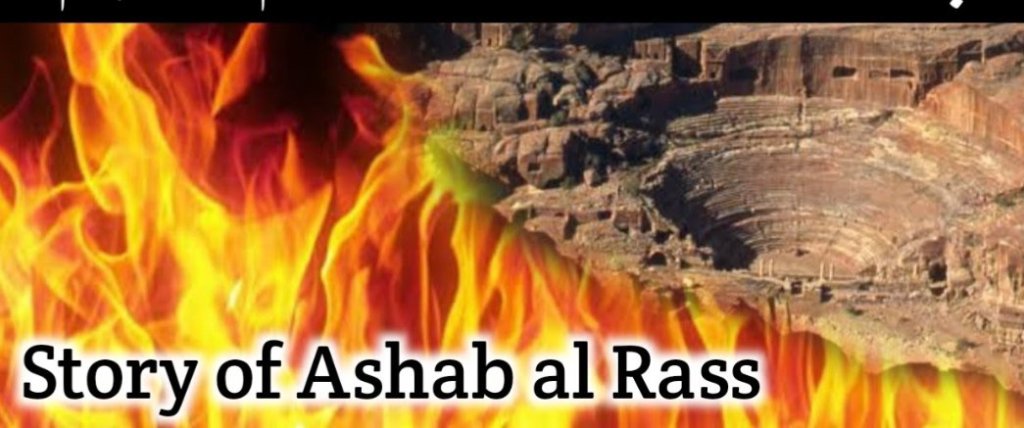
ASHAB AR-RASS (DWELLERS OF AR-RASS)
Allah has said,
And the ‘Aad and the Thamud and the dwellers of Ar-Rass, and many generations in between and for each of them We struck similitude, and each We ruined with an utter ruin. (Al-Furqan, 25:38-39) And Allah has also said, Belied before them the people of Nuh and the dwellers of Ar-Rass and the Thamud, and the ‘Aad and Fir’awn and the brethren of Lut and the dwellers of the Thicket, and the people of Tubba’. Each one belied the Messengers, so My threat came true. (Qaf, 50:12-14)
These verses say explicitly that the dwellers of Ar-Rass were destroyed. Ibn Jarir opines that they are the Ashab Al-Ukhdud who are named in Surah Al-Buruj but the context of the Qur’an rejects that opinion because those people came after Sayyidina ‘Eesa AlaihisSalam.
Ibn Jarir has cited Ibn Abbas Radiallahu anhoo saying that the dwellers of Ar-Rass lived in one of the villages of the Thamud.
According to Ibn ‘Asakir, Allah sent to the dwellers of Ar-Rass the Prophet Hanzalah bin Safwan AlaihisSalam. But they belied him and killed him. On that ‘Aad bin ‘Aws bin Iram bin Sam bin Nuh departed from Ar-Rass with their children and settled in Ahqaf, their descendant dispersed all over Yaman. Meanwhile the dwellers of Ar-Rass were destroyed. Jabrun bin Sa’d bin ‘Aad went to Damascus and built a city which he called Jabrun, and that is the Iram, the one with pillars. And pillars are not found in such a large number anywhere as in Damascus. Allah sent Sayyidina Hud others to the descendants of ‘Aad in Ahqaf but they denied him and suffered destruction. This evidence is enough that the dwellers of Ar-Rass preceded the people of ‘Aad by a long period of time. But Allah knows best.
Ibn Abbas has said that Ar-Rass is a well in Azerbaijan while ‘Ikrimah has said that the dwellers of Ar-Rass were the people of Yass of Falaj. But I say that these were different people.
Abu Bakr Muhammad bin Al-Hasan Al-Naqqash has said that these people (of Ar-Rass) had a well whose water they drank and used for irrigation. They had a just king over them whom they loved very much. When he died, they were grieved beyond repair. Taking advantage of their emotions, the devil appeared to them in the form of the dead king and pretended that he had not died but had disappeared from them to see how they conducted themselves in his absence. They evinced great happiness at that and he commanded them to erect barrier between him and them so that he could speak to them from behind that barrier. He assured them that he would never die. Many of them believed him, they even worshipped him. So, Allah sent to them a Messenger who explained to them that it was the devil who was deceiving them, and he forbade them from worshipping him and commanded them to worship Allah, the One, Who has no partner. His name was Hanzalah bin Safwan. Those people displayed their antagonism for the Prophet and killed him and hurled his corpse in the well. The well then dried up and they became thirsty and their trees did not get their water, as also their fruit and gardens. Their homes became desolate and all of them were destroyed. Nothing was heard of them after that. Jinns occupied their dwellings and haunted their town. Only the roar of the lion and the call of the hyena was heard.
Imam al-Ridha mentioned that one of the nobles of the Tamim tribe approached Amir al-Mu’minin ‘Ali (AlahisSalam) and requested him to relate the facts regarding the People of Ras; where they lived, in what period, who were their rulers, whom did Allah send as a Prophet for guiding these people, how they were destroyed? etc. The inquirer told ‘Ali that though they are mentioned in the Holy Qur’an no details available.The People of Ras were a particular group. They worshipped the pine tree and called it the ‘King of Trees’. It had been planted by Yafith the son of Nuh besides a spring. The spring was known as Rooshtaab and had formed after the deluge. They were known as ‘People of Ras’ because they had buried alive a Prophet who came after Sulayman The People of Ras inhabited twelve cities on the bank of the river Ras in the eastern hemisphere. The area was known as Aras and the people were named after the river Ras. During that time it was the best fresh water river in the world and the Kingdom of Ras was the most prosperous nation of its time. The nation consisted of cities named as Abaan, Aazar, Dee, Bahman, Isfandaar, Farwarrdeen, Urdi-Behisht, Khordaad, Mardaad, Teer and Shaharpoor. Isfandar was the largest city and the seat of the ruler Tarkooz son of Ghaboor son of Yarish son of Saazan son of Narmood son of Canaan. Nimrod was the contemporary of Ibrahim. The spring and the tree called Sanobar were situated in this city. The people of Ras had taken some seeds from that tree to other towns and sowed them near streams. Then they took some water from the original spring and mixed it in the spring of each town. It irrigated the saplings that gradually grew into thick trees laden with sour fruits. The people prohibited themselves and their animals from partaking in any of the products of these trees. They also refrained from drinking the water of those springs and claimed that it was the cause of existence of their gods.
Thus it did not befit them to drink this water that would result in the decrease of their god’s lives. They used the water from the river Ras that flowed by their cities for themselves and their animals. Every month one of the towns celebrated ‘Id. On this day, people of that particular town gathered near the Sanobar tree situated there. They covered the tree with a silk curtain embroidered with pictures. Cows and sheep were sacrificed at the tree and later burnt with firewood. When the smoke and ashes darkened the atmosphere they fell down prostrate in front of that tree. They wept and wailed and implored the tree to be pleased with them. The Satan used to sit upon the tree and shake its branches. He would hide in the trunk of the tree and say in the voice of a young boy, “My servants! I am pleased with you. May you be happy and your eyes brighten with joy.” Hearing this, the people would arise. They would celebrate the next few days in drinking, playing drums, singing and making merry. Then they would return home. “
The Persians have named the months after the cities of Ras, Abaan, Aazar, etc. Every month was associated with the feast of a particular city, hence that month was named after that city. When it was the turn of their largest town to celebrate the festival, people from all the other cities came there. They would gather at the great tree near the spring and cover the tree with a large curtain embroidered with icons. The curtain was partitioned to have twelve entrances, one for each city. They would prostrate before the tree from outside the curtain. They sacrificed animals equal to those slaughtered from all the other cities collectively. The accursed Iblis sat on the tree and shook its branches. He would call out to them and speak to them. He would make promises to them greater than the promises made by the Shaitans of the other trees. Then they would rise and drink a lot of wine. For twelve long days they indulged in merry making and enjoyment equal to all the festivals of the other towns together. After the celebration they returned home. When the transgression crossed all limits Allah sent towards them a Prophet from the Israelites to make them recognize Allah and worship Him. But they refused to obey the Prophet.
After the Prophet had exhausted all efforts to guide them and was convinced that they would not come on the right path he complained to Allah “My Lord, these people do nothing but falsify me and refuse to believe in You. Therefore at the time of their great festival manifest your power to them by causing the trees that they worship to wither.” The curse was effective and the next day the people saw that their trees had dried and withered. They were astonished and terrified. They were divided among themselves on what they thought had happened to the trees. One group said that the man from Allah had performed sorcery in order to transfer the credit of sustenance bestowed by their gods to his Lord. The second group said that their gods were displeased with them because the Prophet mentioned their defects and criticized them and the people did not object to this. It was for this reason that their god had concealed its freshness and budding to show his anger against that Prophet so that the people would rise up against him.
Having formed such an opinion the people discussed ways of eliminating the Prophet. After consultations they agreed that he should be killed. They constructed huge pipes of lead and fixed them to the spring reaching its bottom. Then they climbed down and after removing all the water and dug a well underground. After this the people caught hold of the Prophet and imprisoned him in that well. Then they closed the mouth of the well with a huge boulder. They climbed up, removed the pipes and allowed the water to flow over the well into the spring. They said, “Now our gods shall be pleased with us for we have killed the Prophet who maligned us. We have buried him at the base of the greatest Sanobar tree. Maybe now it will regain its freshness and bloom.” The whole day they heard the pleas of the Prophet buried inside. He was praying to his Lord thus: “O my Lord! You are aware of my confinement and see my sorrow and grief. Have mercy on my helplessness and take away my soul at the earliest. Do not delay it.” Ultimately the oppressed Prophet met his end. Peace of Allah be upon him.
Allah revealed to Archangel Gabriel, “My creatures have become very sinful and unheeding of My wrath. They feel secure from disaster. They worship something other than Me and have killed My messenger. Do they think they shall be able to face My Chastisement? Can they escape from My Kingdom and Dominion? I shall send retribution to all those who disobey Me and are not fearful of My punishment. By My Might and Honor I shall punish them in such a way that they would be an example to all mankind.”
Thus when the People of Ras were engrossed in celebrating their festival, a red storm caught them by surprise. They clung to each other. The ground beneath their feet became melting sulphur and a black cloud overshadowed them. Fire began to rain from this cloud melting the bodies of men, just like lead melts in fire.
‘Ali says, “I seek Allah’s refuge from this wrath.” Wa laa h’awla walaa quwwate illa billahil a’liyyil a’z’eem (and there is no power and strength except that of Allah the High and the Great).”
A number of reliable traditions mention that the women of Ras practiced lesbianism and that was the reason the Almighty destroyed them
The well was located in Hadramaut and according to some scholars in the city of Khaazoora. It was inhabited by 4000 people who had put their faith in Prophet Salih. Salih also lived with them. Because he breathed his last here, it was called Hadramaut (death).
Later the population increased and progenies proliferated. They began to fall into transgression and idol-worship. Allah sent towards them a Prophet named han¨alah. He was put to death mercilessly in public view. They were destroyed as a result of this cruel act. All of them died. Their well became useless and the palace of their ruler was razed to the ground.

SAYYIDINA ZUL-KIFL AlaihisSalam ka Waqia
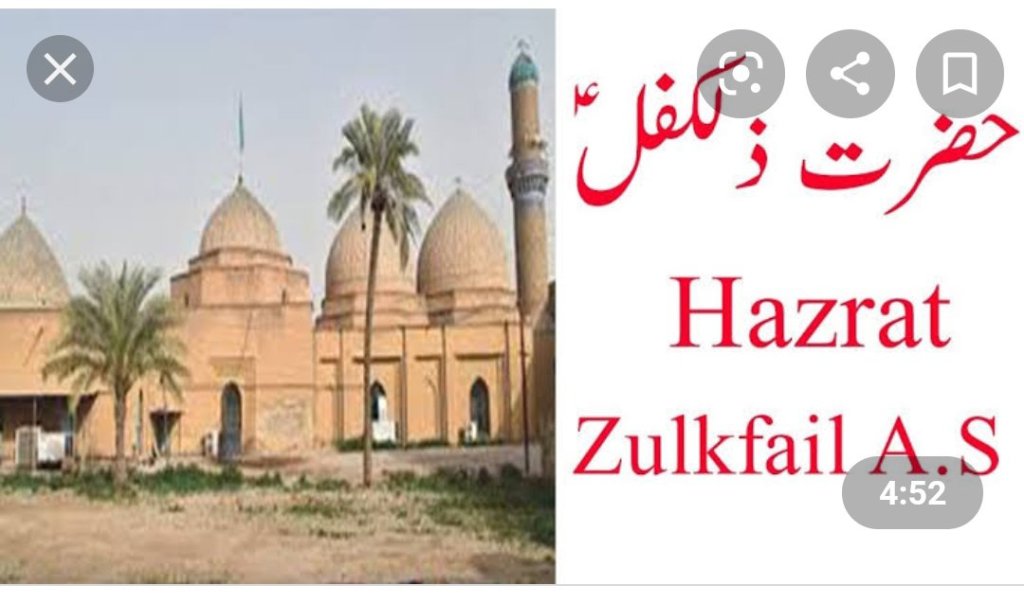
Dhu al-Kifl (Arabic: ذُو ٱلْكِفْل, lit.‘Possessor of the Fold’; c. 600 BCE), also spelled Zu al-Kifl, pronounced Zu l-Kifl, is an Islamic prophet who has been identified with various Hebrew Bible prophets, most commonly Ezekiel. It is believed that he lived for roughly 75 years and that he preached in what is modern day Iraq. Dhu al-Kifl is believed to have been exalted by Allah to a high station in life and is chronicled in the Quran as a man of the “Company of the Good”. Although not much is known of Dhul-Kifl from other historical sources, all the writings from classical commentators, such as Ibn Ishaq and Ibn Kathir, speak of Dhu al-Kifl as a prophetic, saintly man who remained faithful in daily prayer and worship.
According to reliable sources ‘Abd al-‘Alim has said that he sent a letter to Imam Muhammad al-Taqi AlahisSalam to ask him the name of Dhulkifl and whether he was a Prophet? In reply the Imam stated that Allah has sent One lakh and twenty four thousand Prophets in the world. Among them three hundred and thirteen were apostles. Dhulkifl was one of them and he was appointed after Sulayman. He was very quiet and calm-natured person. Allah, the great stated in the Qur’an,
Hazrat zulkifl alaihis salaam kaa wakiya
Quraane Majeed mai RABB TA’ALA irsaad Fharmataa hai“Aur Yaad karoo Ismaail Aur Yasa’a Aur Zul-kifl ko Aur Sab Acche hai”(Surah Saad, Aayat-48)
Aapkaa Naam ‘Bashar’ hai yah ‘Sharf’ hai, Aap Hazrat Ayyub Alayhis Salaam ke Beite hai, (Aapke Muta’alaq Aur vi Mukhtelaf Aqwaal hai),ALLAH TA’ALA ne inko inke Baap Hazrat Ayuub Alayhis Salaam ke Baad Nabi Banaa kar Bheija Aur Hukm diya kee Aap Logo koo Meri Wahdaaniyat par Imaan Laane kee Taraf Bulaaye, kee Meire Bageir Koi Ma’abud nahi,Aap Umar bhar Saam ke Ilaaqe mai hi rahe, ALLAH TA’ALA ke Ahkaam Logo tak Pahonchate rahe, 75 Saal kee Umar mai Duniya se Rukhsat huye,Hazrat Zul-kifl Alayhis Salaam ne Apne Beite Ebraan koo Wasiyat kee thi kee Meri Wafaat ke Baad Neiki ke Amal par Qaayam rehna, Lougo koo vi Imaan Aur Neik Aamaal kee Targib deina,Hazrat Zulfikal Alayhis Salaam Yatimo, Mohtaajo, Garibo, Beiwa Aurato par Reham Fharmaate, Unki Zaruriyaat kaa Khyaal rakhte, Unhi Mohtaaj Lougo kee Kefaalat kee Wajah se hi Aapka Naam ‘Zul-kifl’ (Kefaalat Karne wala) Padh gaya tha.(Roohul Ma’ani, Jild-9, Hissa-2, Safa-82)
Allah has said in the Qur’an
And as to Isma’il and Idris and Zul Kifl, each was of the persevering one; and We admitted them to Our mercy; surely they were of the righteous. 85-86)
(Al-Anbiya 21
ones. And remember Our servants Ibrahim and Ishaq and Ya’qub, men of might and vision. Surely We purified them with a quality most pure, the remembrance of the Abode. And surely they are with Us of the chosen, the excellent ones. And remember Isma’il and Al-Yas’a and Zul Kifl, and they were all of the excellent (Sad, 38:45-48)
The consensus of opinion also holds him as a Prophet From the context of the Qur’an, it seems obvious that Zul-Kifl AlahisSalam was Prophet.
He had taken it upon himself to preach and guide his people and to judge between them with fairness, and that is why he was called Zul-Kifl.
Ibn Jarir and Ibn Abu Hatim have cited Mujahid as saying that when Al-Yasa’ grew old, he wished to choose someone to guide men during his lifetime, so that he could see how he carried on. He, therefore, assembled the people and expressed his desire to appoint someone who fulfilled three conditions. He wanted a man who fasted during the day, kept vigil in the night praying to Allah, and who never lost his temper. One of the men with defective eyes, stood up, and said, “l”. Do you observe fast in the day, keep awake at night and never get angry?” “Yes”, said the man in the crowd. That day, he did not select him.
The same thing happened the next day. None of the people spoke at all but the same man arose again and claimed to fulfil the conditions, and was selected.
Iblis, the devil, set his team of devils against this man, but they could not succeed against him. So he decided to deal with him himself and misguided him.
Iblis came to him in the afternoon when he used to have a short nap. This man did not sleep in the night or at any other time during the day, but for this short nap. Iblis knocked at the door and he was in the guise of an old man, “Who is there?” asked Zul-Kifl. “An old Shaikh, destitute” came the reply. He hurried to the door and opened it. Iblis narrated a long grievance, “I have a dispute with my people who oppress me…” and he carried on and on until the time of Zul-Kifl’s nap was over. He assured him that if he came to his courts, he would look into the matter. But, he did not find him there that evening or the next morning.
Again, as he prepared for the nap, there was a rap at the door, “Who is that?” he asked, “An old, helpless Shaikh.” Came the answer. “Did I not ask you to see me in court?” “My people are wicked. At the court, they told me that they would give me my rights but then denied it as we were out of it.” Zul-Kifl asked him to come to the courts for redressal. His time for the afternoon siesta was again over.
At the courts, he did not find the old man. The next morning he looked for him again but the old Shaikh was not there. The previous evening and the morning he was feeling drowsy from lack of sleep; so, that afternoon he gave instructions that no one should be allowed to disturb him while he had his short sleep.
At the particular time, the old Shaikh kept his appointment as he had been doing the previous two afternoons but there was a man, at the door this time who asked him to go away. He protested that he had come the previous day and submitted his supplication, but the gate keeper did not allow him in, “We are commanded not to let anyone in.”
The old man climbed in the house and knocked the door from inside. Zul-Kifl woke up and asked the gatekeeper if he had given him any instructions. He explained that he had not allowed him in and he could see that the door was shut as before.
Zul-Kifl now recognised who the old man was and asked him point blank, “Are you not the enemy of Allah?” He answered, “Yes, You did not let me succeed in my strategies so I hoped to anger you.”
Thus, Allah called him Zul-Kifl, for he fulfilled the responsibility that he had taken over himself.
Ibn ‘Abbas Radiallahu anhoo, Abdullah bin Al-Harith, Muhammad bin Qays and Ibn rah Al-Akbar and others have narrated about the same thing.
Dhu al-Kifl would literally mean “possessor of, or giving, a double requital or portion”; or else, “one who used a cloak of double thickness,” that being one of the meanings of Kifl. The commentators differ in opinion as to who is meant, why the title is applied to him. I think the best suggestion is that afforded by Karsten Niebuhr in his Reisebeschreibung nach Arabien, Copenhagen, 1778, ii. 264–266, as quoted in the Encyclopaedia of Islam under Dhul-Kifl. He visited Meshad ‘All in ‘Iraq, and also the little town called Kifl, midway between Najaf and Hilla (Babylon). Kefil, he says, is the Arabic form of Ezekiel. The shrine of Ezekiel was there, and the Jews came to it on pilgrimage. If we accept “Dhul al Kifl” to be not an epithet, but an Arabicised form of “Ezekiel”, it fits the context, Ezekiel was a prophet in Israel who was carried away to Babylon by Nebuchadnezzar after his second attack on Jerusalem (about B.C. 599). His Book is included in the English Bible (Old Testament). He was chained and bound, and put into prison, and for a time he was dumb. He bore all with patience and constancy, and continued to reprove boldly the evils in Israel. In a burning passage he denounces false leaders in words which are eternally true: “Woe be to the shepherds of Israel that do feed themselves! Should not the shepherds feed the flocks? Ye eat the fat, and ye clothe you with the wool, ye kill them that are fed: but ye feed not the flock. The diseased have ye not strengthened, neither have ye healed that which was sick, neither have ye bound up that which was broken..
THE PEOPLE WHO WERE ANNIHILATED BY PUNISHMENT
It was only before the revelation of Torah, that people were destroyed by heavenly punishment. This is very clear from the verse 43 of Surah Al-Qasas
And certainly We gave Musa the Book after We had destroyed the former generations. (Al-Qasas 28:43)
 Aal-e-Qutub Aal-e-Syed Abdullah Shah Ghazi