


Praise be to Allaah.
Khula’ means the separation of the wife in return for a payment; the husband takes the payment and lets his wife go, whether this payment is the mahr which he gave to her, or more or less than that.
The basic principle concerning this is the verse in which Allaah says (interpretation of the meaning):
“And it is not lawful for you (men) to take back (from your wives) any of your Mahr (bridal-money given by the husband to his wife at the time of marriage) which you have given them, except when both parties fear that they would be unable to keep the limits ordained by Allaah (e.g. to deal with each other on a fair basis). Then if you fear that they would not be able to keep the limits ordained by Allaah, then there is no sin on either of them if she gives back (the Mahr or a part of it) for her Al-Khul‘ (divorce)”
[al-Baqarah 2:229]
The evidence for that from the Sunnah is that the wife of Thaabit ibn Qays ibn Shammaas (may Allaah be pleased with him) came to the Prophet (peace and blessings of Allaah be upon him) and said, “O Messenger of Allaah, I do not find any fault with Thaabit ibn Qays in his character or his religious commitment, but I do not want to commit any act of kufr after becoming a Muslim.” The Prophet (peace and blessings of Allaah be upon him) said to her, “Will you give back his garden?” Because he had given her a garden as her mahr. She said, “Yes.” The Prophet (peace and blessings of Allaah be upon him) said to Thaabit: “Take back your garden, and divorce her.”
(Narrated by al-Bukhaari, 5273).
From this case the scholars understood that if a woman cannot stay with her husband, then the judge should ask him to divorce her by khula’; indeed he should order him to do so.
With regard to the way in which it is done, the husband should take his payment or they should agree upon it, then he should say to her “faaraqtuki” (I separate from you) or “khaala’tuki (I let you go), or other such words.
Talaaq (i.e., divorce) is the right of the husband, and does not take place unless it is done by him, because the Prophet (peace and blessings of Allaah be upon him) said: “Talaaq is the right of the one who seizes the leg (i.e., consummates the marriage)” i.e., the husband. (Narrated by Ibn Maajah, 2081; classed as hasan by al-Albaani in Irwa’ al-Ghaleel, 2041).
Hence the scholars said that whoever is forced to divorce his wife by talaaq wrongfully, and divorces her under pressure, then his divorce is not valid. See al-Mughni, 10/352.
With regard to what you mention, that a woman in your country might arrange her own divorce through the man-made laws, if this is for a reason for which it is permissible to seek a divorce, such as disliking her husband, not being able to stay with him or disliking him because of his immoral ways and indulgence in haraam actions, etc., there is nothing wrong with her seeking divorce, but in this case she should divorce him by khula’ and return to him the mahr that he gave to her.
But if she is seeking divorce for no reason, then that is not permissible and the court ruling on divorce in this case does not count for anything in terms of sharee’ah. The woman still remains the wife of the man. This gives rise to a new problem, which is that this woman is regarded as a divorcee in the eyes of the (man-made) law, and can re-marry after her ‘iddah ends, but in fact she is still a wife and not a divorcee.
Shaykh Muhammad ibn Saalih al-‘Uthaymeen (may Allaah have mercy on him) was asked about a similar matter and said:
Now we have a problem. The fact that she is still married to him means that she cannot marry anyone else, but according to the court ruling she is apparently divorced from him, and when her ‘iddah ends she can re-marry. I think that the only way out of this problem is that good and righteous people should get involved in this matter, to bring about reconciliation between the man and his wife. Otherwise she has to give him some payment, so that it will be a proper shar’i khula’.
Liqa’ al-baab al-Maftooh by Shaykh Muhammad ibn ‘Uthaymeen, no. 54; 3/174.
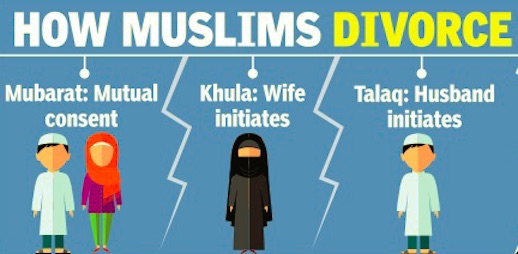
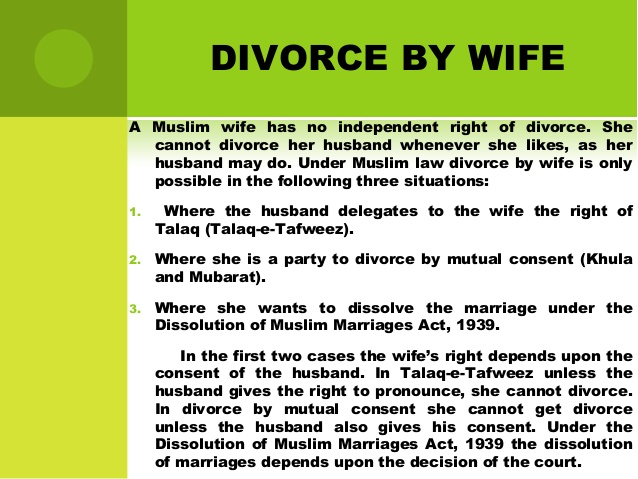
Under Islamic law, divorce can take place in three forms, namely by talaq (repudiation of wife by husband), by khula (by mutual consent) or by faskh (decree of the court dissolving the marriage). It can be said that If Talaq is defined as the right specifically granted to men to divorce their wifes , khula can be said to be its equal for women as it gives them the right to raise it when seeking for a divorce, and even if the men do not accept it, they can refer to the Qadi for help to enforce it.
Khula operates the same way as marriage is concluded in Islam, being by way of offer and acceptance, except this time it is usually the wife that makes the offer of divorce and the husband has a choice of whether to accept it or not. Like how a dowry must be gifted to the bride upon marriage, the wife has to offer some kind of compensation to the husband, as consideration for the husband releasing her from the marriage. Similarly, as in contract law, the wife has the right to revoke this offer as long as before acceptance is made. However this is not the case for a husband relying on this form of divorce, his offer will be to repudiate the wife in return for a certain amount of compensation and this offer of his is not revocable and remains effective until rejected.
The four schools of Sunni Law though divided as to how the Khula doctrine may be performed all agrees that generally under the doctrince of Khula, that in order for the wife to release herself from the marriage, she has to give up some property in return as consideration of the husband granting her a khula, the only exception being that she was subjected to abuse and threats. The value of the compensation is not to exceed the amount of dower that was given to her initially. This is reflected in a hadith where a woman approach the Prophet and told him in return for divorce, she was willing to return more than what was given to her, but the prophet replied, ‘You should not return more than that.’’ The compensation can be anything that is of value but Shafi law holds that is has to be monetary. Nonetheless, once accepted by the husband, the marriage itself is dissolved and operates as a single talaq but it is immediately irrevocable. The only way of reconciling would be to remarry.
As to when Khul can be given, it would be fair to say that the same conditions for talaq are to apply in that the wife has to be in the state of purity. The Hanafis holds to this but the Malikis say this is not necessary as the woman has willingly obtained Khul in consideration of payment, therefore her right to do so even when menstruating. Similarly the Hanbalis is of the same view that since Khula comes about by mutual agreement of the two married partners, there is no harm even if it is given during menstruation.
The very first form of Khula was narrated in the hadith by Imam Bukhari whereby a woman approached the Holy prophet and said that though she shared not animosity with her husband, she wish to separate from him because she feared she could not perform her functions as a wife. The prophet asked if she was willing to give her husband the garden he gave to her as dower and when she agreed, the prophet asked the husband to take back his garden and divorced her at once. From this hadith, we can infer that Khula need not only take in the form of mutual consent but can also be granted by third parties like the Qadi through decree of court, thereby amounting to judicial Khula. If the husband refuses to accept the wife’s offer, she can go to the Qadi and demand a formal separation and the Qadi upon satisfaction of her reasoning for wanting the divorce, may call upon the husband to repudiate her. But where the husband still refuses to do so, the Qadi can himself pronounce a divorce which will operate as valid repudiation and the husband will be liable for the whole amount of the deferred Mahr.
However the granting of Khula by the Qadi is only granted in extreme circumstances, the Prophet warned the women who asked for Khula without any reasonable ground with:
‘’If any woman asks for divorce from her husband without any specific reason, the fragrance of paradise will be unlawful to her’’
The following are the grounds where divorce may be granted by the Qadi:
- Habitual ill-treatment of the wife
- Non-fufillment of the terms of the marriage contract
- Insanity
- Incurable incompetency
- Abandoning the marital home without making provision for the wife
- Any other similar causes which in the Qadi’s opinion justifies a divorce
As can be seen, where Khula is not consented by the husband, the wife has an alternative route to the court. When the matter is brought to court, if it falls under Faskh, she will not owe the husband any compensation but otherwise if she has to do it by way of Judicial Khula, the court will require her to return the compensation to the husband. Even so, Khula or Faskh was never easily applied previously as in the traditional Hanafi law. The Hanafi law has the most restrictive view towards women seeking for dissolution; the only ground acknowledged was if the husband proves unable to consummate. Thus once consummated, she loses her request for dissolution even where the husband fails to support her, abuses her, or is imprisoned for life. The rest of the schools are more open in the sense that they recognized that a divorce may be granted upon other grounds such as those stated above. The Maliki law is the most liberal in that it gives the women the right to obtain a divorce on the ground of dhahar, being harm or prejudice. If she is unable to prove that continuing to be with her husband is causing her harm but insist that a discord existed between her and her husband, the Maliki court will reconstruct itself into an arbitration tribunal. Two arbitrators will be appointed, one being a representative from the wife’s family and the other from the husband’s. Their mission together with the Qadi would be to reconcile the spouses but if unsuccessful, they will hear evidences from both side and determine who is primarily responsible. If it is the husband, they will pronounce an irrevocable talaq on his behalf and if it the wife, they will pronounce a repudiation in return for the giving of compensation by the wife to the husband.
Over the then years reforms have been introduced to extend the rights of wife to divorce through the inspiration of the Maliki law. In India, the Dissolution of Muslim Marriage Act 1939 extended the earlier mentioned grounds for divorce to include other grounds such as where the husband has been missing for four years, the husband having been imprisoned of seven years or more, the husband was impotent at the time of marriage and repudiation by wife who married before she was 15 before attaining the age of 18 and provided the marriage had not been consummated. In Pakistan, The Muslim Family Law Ordinance 1961 added on to the extended list with a further ground being when a husband takes a second wife without complying with the provision of the Ordinance. Soon later, in the case of Khurshid Bibi v Mohammed Amen, the Supreme Court of Pakistan recognized another form of dissolution by recognising the role of Judicial Khula that now allows wives in Pakistan to petition for it on the grounds that the marriage had broken down irretrievably but provided the court was satisfied that the parties could no longer cohabit together within the limits prescribed by Allah. However, more recently in the case of Naseem Aktar V Mohammad Rafiq, where the argument was that the wife failed to prove the alleged hatred was dismissed by the Apex court and held that the fact she applied for dissolution was sufficient evidence of hatred and aversion, thereby not requiring to prove that it was impossible to cohabit with her husband and the court must grant a Khula. In addition, in a more liberal approach in Aurangzeb v Gulnaz (actually goes against the whole concept of Khula), the court held that even if the wife refused to return the dower, the marriage would be dissolved once the Family Court decided that the parties could not remain together.
Similarly the law of divorce in Egypt had been reformed to recognize Judicial Khula in the event where mutual consent cannot be obtain, the wife can bring the matter to court and the wedding will be dissolved upon her returning her dower to the husband. However before the divorce is granted, the court must attempt to bring about a reconciliation within the next three months but after which the wife still formally declares that she cannot live with her husband within the bounds prescribed by Allah, the marriage will be dissolved and the judge will have no discretion to refuse the divorce.



 Aal-e-Qutub Aal-e-Syed Abdullah Shah Ghazi