


The famed Muslim scholar Al-Kwarazmi has long been known as the father of Algebra. In this article, Aydin Sayili presents an alternative view of the inception and development of Algebra in the works of of ‘Abd al-Hamid Ibn Turk, a well known mathematician of the early 9th century, probably contemporary to al-Khwarizmi. The author raises an outstanding hypothesis according to which Ibn Turk may have written the first Arabic book on algebra in Islam, and not Muhammad ibn Mûsâ al-Khwârazmi.
1. The Text and its Manuscripts
The Arabic text presented further below in this volume together with its Turkish and English translations, i.e., Logical Necessities in Mixed Equations by ‘Abd al-Hamîd ibn Wâsi’ ibn Turk, is based on two manuscripts, both preserved in Istanbul libraries. One of these, referred to by the letter A in the edition given below, is in the Millet Library: section Carullah, No. 1505; It forms part of a collection of short treatises bound together and occupies pages 2a to 5a in the volume. Brockelmann mentions this manuscript [1]. The second copy, referred to by the letter B in the critical text given below, is in the Suleymaniye Library: section Husrev Pasa, No. 257. This manuscript too forms part of a collection and occupies pages 5b to 8a in the volume.
None of these manuscripts or collections bears any dates of transcription. Manuscript A is quite old and may be guessed to be from the twelfth century. Manuscript B is relatively recent. It must be several centuries later than A. The manuscript texts themselves have no title. I have added the title on the basis of the copyist’s note seen at the end of the text given below.
 |
|
|
Figure 1: A line sketch depicting |
A comparison of the two manuscripts shows them to agree on many points of detail. Notes 3, 8, n, 15, 23, 35, 36, 37, 45, 48, 51, 62, and 63 in the Arabic text indicate grammatical errors which are common to both. Moreover, at two common points they are both of doubtful reading, as indicated by notes 4 and 66. And as seen from note 33-34, in one point of the text they contain an almost identical small lacuna that had to be reconstructed and filled in with the help of the context, while note 41 indicates a common numerical error identical or closely similar in both manuscripts.
From these details one gains the impression that B was copied from A, or, at least, that they are very closely related. The alternative that B may not be a mere copy of A is supported especially by their difference from the standpoint of diacritical marks and the slightly different manner in which their figures are lettered.
Manuscript A contains but few dots, while in B the letters are dotted in an almost complete manner. In a few cases the dotting of verbs as found in B are clearly incorrect, as may be seen in footnotes 39 and 42, e. g. At points where I have not followed the manner in which B is dotted, I have indicated the differences in the footnotes though the disagreement may at times be of little significance. The word mas’ala is written in varying orthography in both manuscripts. I have adopted a unified spelling for this word in the text given below.
Some doubt exists concerning two words of the text. One is the word muzâd wherein the z is undotted, i. e., written as r even in B [2]. Most dictionaries do not have the fourth form of zâda, but as Dozy has it [3], I “have decided to read the word in question as the past participle of the fourth form of the verb zâda which fits well into the context.
The word darûrât, the plural of darûra, is of crucial importance to this text. A perusal of the text will show that at the beginning of most paragraphs the word sayrûra occurs. In one paragraph the word darûra is seen, and at the end of the text the statement supplying us with the title of the text contains the word darûrât. The words darûra and sayrûra could easily be confused with one another, especially in a manuscript like A where letters are rarely dotted. The possibility comes therefore to mind that all these may be the same word and its plural, i. e., either sayrûra or darûra. But manuscript B that is clearly dotted gives them as seen in the edited text below, and in manuscript A too they would seem to agree with the forms given in B. Moreover, the adopted forms seem to represent the most reasonable possibility, as will be further explained below.
The word darûra is obviously not used here in its usual and well-known meaning of social and economic need and necessity. In the Muhît the following meaning is found for this word: “With the logicians it consists of the impossibility of the separation of the predicate from the subject [4].” Several other dictionaries, which I have consulted, do not give such a meaning. In this somewhat unusual meaning, therefore, the word darûra refers to a fixed and necessary relation expressed by certain propositions, or to apodeictic or assertorical necessity.
I have looked into several Arabic texts of algebra with the hope of finding the word darûra in a clearer context, but I have not seen it elsewhere. Al-Khwârazmî’s Algebra, which is of greatest significance to this matter because of its chronological proximity to our text, has the word idtirâr that is from the same root but in the eighth form [5]. Gandz quotes the statement of Al-Khwârazmî wherein this word occurs, and he translates it as “logical or algebraic necessity” and takes it to mean “algebraic analysis” in the sense of algebraic reasoning [6]. These passages seem quite clear. The translation “logical necessity” fits the context, and this meaning goes well with the word idtirâr. Al-Khwârazmî’s usage of this word too is helpful therefore in the interpretation of the word darûra in our present text.
The word darûra apparently refers in our text to each one of such equations as x2 + bx = c or x2=bx + c and such cases as when the discriminant is equal to zero or x < b/2, x > b/2 in the equation x2 + c = bx. But it may possibly refer only to these three types of equation.
‘Umar Khayyâm, in his book on algebra makes such statements as ‘unknown quantities related to known ones in a manner such that they can be determined’ and ‘the relations which connect the data of the problems to the unknown [7].’ This could be a kind of fixed and necessary relation to which reference could be made in medieval algebra in connection with its equations. In this alternative meaning the word darûrât could be translated as determinate equations.
The name muqtarinât was given to second-degree equations with more than one term on one side of the equality, the other side never being zero. Thus, in contrast to the mufradât, i.e., “simple equations” such as ax2= b, such an equation as x2 + bx – c is an example of the muqtarinât, i.e., “mixed equations.” The title would thus refer, with this alternative meaning of the word darîrât to the determinate types of “mixed equations.”
The translation of darûrât as determinate equations could imply a knowledge of indeterminate equations in Islam before the translation of Diophantos into Arabic. Such a possibility should not be ruled out altogether especially as evidence has been brought to light that examples of such equations are found in the cuneiform tablets [8].
The adoption of this meaning for the word darûra does not seem to be entirely satisfactory, however, for several reasons. Firstly, the idea of fixed relation is emphasized and the idea of logical necessity is pushed to the background. But this latter idea is prominent both in the dictionary meaning of this word and in the closely related term as used by Al-Khwârazmî. Secondly, when the word darûra is translated as determinate equation in the ordinary sense of the term one is tempted to change the words sayrûa into darûra in the text given below [9]; and this would run contrary to manuscript B and would not be the preferred reading in manuscript A. Finally, the title would have to be translated, as stated above, as “the determinate types of mixed equations,” and the preposition fî in the Arabic title would not seem to constitute the best choice for conveying such a meaning.
I have therefore preferred the first alternative and taken the word darûra to mean logical necessity without however excluding the meaning ‘fixed or uniquely determined relation.’ It seems to me that this word is used by ‘Abd al-Hamîd ibn Turk in a slightly different sense as compared with Al-Khwârazmî’s usage of the word idtirâr, a difference which is consonant with their dictionary meanings. Al-Khwârazmî’s usage of this latter word refers to obvious steps of analytical procedure such as those involved in the operations of “completion” and “reduction.” It would therefore seem to approach the idea of analytical treatment, though perhaps not of proof, whereas ‘Abd al-Hamîd appears to use the word darûra in reference to special cases, i.e., all the distinct types of relationships between the unknowns and the coefficients. Thus the equation x2 + c = bx is split up into several special cases, whereas no special cases are given for the other two types of “mixed” equations; this is obviously because no subclasses of the other two types of equation present themselves by logical or algebraic necessity. It would seem that darûra does not refer here to geometrical solutions of equations just as Al-Khwârazmî does not use idtirâr in such a sense.
It will be seen from footnote 40 of the Arabic text that although I have adopted the form qawl, manuscript B has the form qawluhu, and this is perhaps true for manuscript A also. One reason for my preference of qawl is that otherwise the third word following it, i.e., ‘Isrîn, would have to be corrected in both manuscripts and made ‘Isrîn. Moreover, the pronoun at the end of qawluhu stands, so to say, in the air, the text containing nothing to which this pronoun can refer. It could be conjectured, however, that the missing earlier parts of the text might possibly be of such a nature as to make this usage meaningful. In that case, ‘Abd al-Hamîd may have referred previously to a certain author or authority and done so several times, but such a speculation is of course meaningless in the absence of the needed text.
The word murabba’ seems to be used in slightly varying senses in the text. At times it is used in the meaning of quadrilateral. For when speaking of the geometrical square, murabba’ often occurs together with the adjectives equilateral and rectangular. On the other hand, however, murabba’ is also used without further specification when referring to rectangles, and at times to squares [10]. I have translated this word as quadrilateral and have generally given a literal rendering of the text although this has made the translation somewhat clumsy at points. I have thereby aimed to give a translation that, in technical points, resembles the original text. The need is felt, e.g., to distinguish between the geometrical square and the algebraic term standing for the square of the unknown quantity.
The term mâl, standing for x2, used in Arabic books of algebra, does not, as a word, contain the idea of square. In its ordinary dictionary meaning it is merely a quantity, money, capital, possession, and the like. In the present text the word mâl is used throughout for expressing x2, and jadhr, to express x; jadhr means root, or “a quantity which is multiplied by itself,” as it is sometimes defined. There are other Arabic terms also for these quantities, but the consistent use of this pair of terms should by no means be unusual.
In our present text x2 is seen to come to the foreground, as an unknown, almost as prominently as x, and this observation may be said to be applicable to Al-Khwârazmî as well. It almost seems as if ‘Abd al-Hamîd thinks in terms of an equation of the form X +b ÖX= c, rather than x2 + b x = c, X being the real unknown and ÖX the square root of the unknown.
It is of interest in this connection that Al-Khwârazmî occasionally uses the term mâl also for the unknown in the first power [11], and that in his geometrical demonstrations, or solutions of equations, Al-Karkhî (Al-Karajî? [12]) lets line segments represent x2 as well as x [13].
Apparently, the question of the Arabic terminology of algebra has interested not only recent historians of mathematics [14] but also the mathematicians of Islam. Thus, there is a marginal note in an Istanbul manuscript of Al-Karkhî’s, or Al-Karajî’s, algebra called Al-Fakhrî [15]. The writer of this note refers to the three terms shay, i.e., thing, meaning also the unknown x, jadhr, and mâl. He points to slightly varying usages of these terms and to different shades of meaning between them, quoting certain authors as authorities for his statements.
One distinction between shay and jadhr mentioned in this marginal note is that shay refers to the unknown, while the same thing is called jadhr when its value is determined. And another distinction made between them is contained in a statement concerning the terms shay and mâl. It is said that shay and mâl are not used together; implying that if a term in x2 exists then the name, jadhr and not shay is given to x.
It is also asserted in this marginal note that shay stands for “the unknown” whether the unknown be in the form of x or x2. This is reminiscent of ‘Abd al-Hamîd ibn Turk’s text, and the following statement in the same marginal note is likewise of interest in this connection. It is said, namely, that the word shay stands both for the “absolute unknown, i.e., the thing whose solution is required, and the unknown which is multiplied by itself; thus, in the second case it is a name given to the root and in the first case a name given to the unknown.
It will be noted that, in the text of ‘Abd al-Hamîd ibn Turk, the letters of one of their diagonals generally indicates rectangles. This is quite usual, but the expression “the murabba‘” of AB, e.g., is also frequently found used in the same sense, AB referring to the diagonal of a rectangle. I have translated these as “the quadrilateral drawn on” AB, or an equivalent expression. Such examples too make the translation of murabba’ as quadrilateral preferable to its translation as square.
It would have been desirable to translate the word mâl without using the word square. But as such a term which would correspond roughly to mâl is not in use at present in algebra; I have chosen the expression “square quantity,” which may be said to be in harmony with the terminology employed by ‘Umar Khayyâm who is preoccupied with making similar distinctions [16].
Notes 6, 24, 38, 52, 60, and 75 of the Arabic text indicate differences in letters used in the corresponding figures found in manuscript B. There is disagreement in one letter only in the figures indicated by the notes 6, 52, and 60, while the other figures referred to show a difference of two letters. Note 61 also indicate a certain correction that had to be made in the corresponding figure of both A and B, namely the interchange of the positions of the letters H and K. The sign x in the footnotes of the Arabic text is used to show damaged spots, which exist only in manuscript A.
2. The Author, ‘Abd Al Hamîd Ibn Wâsî’ Ibn Turk
This text gives, as far as our present information goes, the only work of the author that has come down to us, and very little is known concerning the author himself. Certain sources refer to him as the grandson of “the Turk from Jîl.” Jîl, Jîlan, or Gîlan, is a district to the south of the Caspian Sea. Others have the word Khuttalî, i.e., “from Khuttal,” a region around the sources of the Oxus River, to the south of Farghana and west of Chinese Turkistan. Still another formal possibility is from Jabalî [17]. Jabalî could refer to several places, most of them being in Syria. In the Arabic script these three words could be easily mistaken for one another through the omission or addition of dots. As manuscript A that is quite old has the form Jîlî, this may be said to constitute rather strong evidence in favour of this version, but the possibility of the form Khuttalî cannot be ruled out [18].
The titles Ibn Turk and Ibn Turk al-Jîlî (or Khuttalî) indicate that ‘Abd al-Hamîd’s grandfather was called “the Turk from Jîl (or Khuttal)” and therefore that ‘Abd al-Hamîd was Turkish or of Turkish descent. ‘Abd al-Hamîd’s grandson or great grandson Abû Barza [19] too kept the title Ibn Turk, indicating that the family remained to be Turkish. It is of interest in this connection that Al-Khwârazmî too was from the district of Turkistan.
Among the earlier scientists of medieval Islam a large number are seen to have originated from districts to the northeast of Persia. As Turks formed a part of the population of these districts [20], it is reasonable to think that a considerable number among this group of scientists were Turkish or of Turkish ancestry, although it is generally difficult to speak of the nationality of such scientists individually with any degree of certainty. But a few of them are seen to have been given the title “The Turk” or “Turkish,” just as a few scientists bore the title “Al-Farsi,” i.e., Persian, or from the region of Fars. For example, the two or three scientists of the Amajur Family (fl. 885-933) [21], distinguished philosopher Abû Nasr al-Fârâbî (d. 950-951) [22] and the famous lexicographer Abû Nasr Isma’il al-Jawharî from Fârâb (d. 1002) [23] had the title Al-Turkî. ‘Abd al-Hamîd ibn Wâsi’ ibn Turk is apparently one of the earliest among this category of Turkish scientists.
Information concerning ‘Abd al-Hamîd ibn Turk is given by Ibn al-Nadîm, Ibn al-Qiftî, and Hajji Khalîfa. As this information is completed and partly given also in connection with ‘Abd al-Hamîd’s grandson or great grandson Abû Barza, who was also a mathematician, there is some necessity of taking up these two scientists together.
 |
|
Figure 2: Al-Fārābi depicted on a postage stamp of Kazakhstan. |
Ibn al-Nadîm says concerning ‘Abd al-Hamîd, “He is Abu ‘l-Fadl ‘Abd al-Hamîd ibn Wâsi’ ibn Turk al-Khuttalî (or, al-Jîlî), the calculator, and it is said that he is surnamed Abû Muhammad, and of his books are The Comprehensive Book in Arithmetic which contains six books (chapters) and The Book of Commercial Transactions.”
This item occurs under the general heading “The Calculators and the Arithmeticians.” ‘Abd al-Hamîd ibn Turk is the first item and the second item concerns Abû Barza, and information on Abû Kâmil Shujâ’ ibn Aslam follows it immediately. On Abû Barza, Ibn al-Nadîm writes, “Abu Barza Al-Fadl ibn Muhammad ibn ‘Abd al-Hamîd ibn Turk ibn Wâsî’ al-Khuttalî (or Jîlî), and of his books are The Book of Commercial Transactions and the Book of Mensuration [24].”
Ibn al-Qiftî gives the following information concerning ‘Abd al-Hamîd ibn Turk:
“‘Abd al-Hamîd Ibn Wâsi’ Abu ‘l-Fadl. He is a calculator learned in the art of calculation (hisâb) having antecedence in the field, and the people of that profession mention him. He is known as Ibn Turk al-Jîlî, and he is surnamed also as Abû Muhammad. In the field of arithmetic he has well known and much used publications. Among them is the Comprehensive Book in Arithmetic which comprises six books, and The Book of Little-Known Things in Arithmetic and the Qualities of Numbers [25].”
The same author has the following item on Abû Barza:
“Abû Barza, the calculator in Baghdad and busied himself with the science of arithmetic, its subtleties, its fine points, and with the discovery of its peculiarities and rare qualities. He is the author of books in that field and has made original contributions to the subject. He died in Baghdad on the twenty seventh of the month of Safar in the year two hundred and ninety eight (November, 910 A.D.) [26].”
The following passage in Hajji Khalîfa’s Kashf al-Zunûn is of great interest although its reference to ‘Abd al-Hamîd is quite incidental.
Hajji Khalîfa writes, “Abu Kâmil Shujâ’ ibn Aslam says in his Kitâb al-Wasâyâ bi’l-Jabr we’l-Muqâbala: ‘I have written a book known as Kamâl al-Jabr wa-Tamâmuhu wa’z-Ziyâdatu fî Usûlihi and in its second book I have proved the priority and antecedence of Muhammad ibn Mûsâ. [Al-Khwârazmî] in algebra and have refuted the assertion of the professional (?) [Mathematician] known as Abû Barza in what he makes go back to ‘Abd al-Hamîd, who, he claims, is his ancestor (or grandfather). And when I made clear his shortcoming and his deficiency in what he traces back and attributes to his ancestor, I decided to write a book in the subject of legacies treated by the way of algebra (al-wasâyâ bi’l-jabr wa’l-muqâbala)..” [27].
Most likely, the Kamal al-Jabr wa-Tamâmuhu … contains further information of interest, but this book is probably lost. Apparently a copy of Abû Kâmil’s Kitâb al-Wâsâyâ exists in Musul [28]; I have not been able to consult it. Of course Abû Barza’s book too, in which he presumably set forth his claim, if found, would shed much needed light on this controversial question.
 |
|
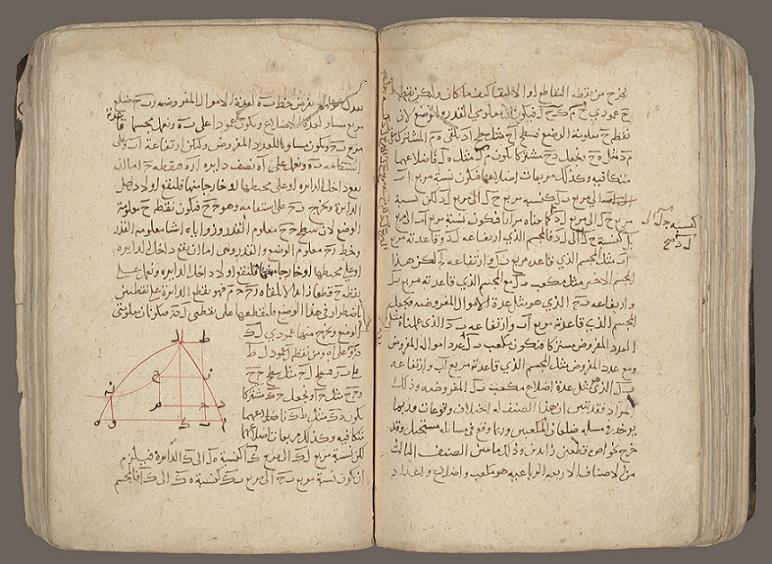
Figure 3: Manuscript of Maqalah fi al-jabr wa-al-muqabalah by ‘Umar al-Khayyam, hand written manuscript on paper, 56 leaves, copied in Lahore in the 13th century. Property of Columbia University Library, RBML, Smith Oriental, MS 45. (Source). |
It is seen clearly from the passage quoted by Hajji Khalîfa that there was rivalry between ‘Abd al-Hamîd ibn Turk and Al-Khwârazmî in the matter of antecedence and priority in the publication of books on algebra, or, at least, that such an issue was raised by Abû Barza and that the question was taken very seriously by Abû Kâmil Shuja’.
Salih Zeki considers Abû Kâmil Shujâ’ to be a contemporary of Al-Khwârazmî and concludes from the passage in the Kashf al-Zunûn that Abû Barza himself claimed priority over Al-Khwârazmî in the writing of a book on algebra. Under these circumstances, our author ‘Abd al-Hamîd would be two or three generations before Al-Khwârazmî, and his priority in the matter would be securely established [29].
According to Aldo Mieli, however, Abû Kâmil Shujâ’ flourished toward the year 900 [30], while Sarton places him between the years 850 and 955 [31], These latter dates are based on the fact that in his Algebra Abû Kâmilspeaks of Al-Khwârazmî as a mathematician of the past, while a commentary to Abû Kâmil’s Algebra was written by ‘Ali ibn Muhammad al-‘Imrânî al-Mawsilî who died in the lunar year 955-956 A.D [32].
From the phraseology and tone of Abû Kâmil’s statement quoted above from the Kashf al-Zunûn it may be concluded that he lived at a somewhat later date than Abû Barza [33]; and at the most, he could be a contemporary of Abû Barza. We have seen, on the other hand, that Ibn al-Qiftî gives the exact date of Abû Barza’s death as 910 A.D. It seems quite clear therefore that Abû Kâmil’s lifetime must correspond approximately to the first half of the tenth century, extending, very likely, back to the end of the ninth century.
Now, ‘Abd al-Hamîd was two or three generations before Abû Barza, and Al-Khwârazmî is said to have been among the group of astrologers who had gathered at the death-bed of the caliph Al-Wathiq, who died in 847. Al-Khwârazmî must therefore have lived beyond this date, but there is some doubt on this point [34]. There can be no certainty therefore that ‘Abd al-Hamîd’s lifetime was before that of Al-Khwârazmî. It is much more reasonable to assume that they were, roughly speaking, contemporaries. And this should be a safe assumption, as it may be concluded, on the basis of Ibn al-Qiftî’s statement quoted above, that ‘Abd al-Hamîd wrote his book on arithmetic and the art of calculation before Al-Khwârazmî’s book on the same general subject.
Moreover, the passage quoted by Hajji Khalîfa is quite clear in that Abû Barza made the claim of priority of publication in the field of algebra over Al-Khwârazmî not for himself but in behalf of his grandfather or ancestor ‘Abd al-Hamîd. As we have seen, however, Abû Kâmil Shujâ’ rejects this claim rather violently; and he asserts the priority of Al-Khwârazmî once more in his Algebra [35].
Ibn Khaldun says: “The first to write on this discipline (algebra) was Abû ‘Abdullah al-Khwârazmî. After him, there was Abû Kâmil Shujâ’ ibn Aslam [36].” According to Salih Zeki, Shihâb al-Din ibn Bahâim too, who was a contemporary of Ibn Khaldun, says, in the commentary he wrote to the book called Yâsamînîya, the same thing about Al-Khwârazmî [37]. Finally, Hajji Khalîfa also states, just prior to the words of Abû Kâmil quoted from him above, that Al-Khwârazmî was the first to write a book in the subject of algebra [38].
There should be little doubt that Hajji Khalîfa’s authority for this statement is Abû Kâmil Shujâ’, and the phraseology of Ibn Khaldun too suggests such a possibility. It thus seems that it was through Abû Kâmil that this assertion gained its circulation in certain sources. But Abû Kâmil was certainly far from being impartial toward Abû Barza and his family. He speaks in somewhat derogatory terms about Abû Barza and his knowledge of mathematics, and he is clearly contradicted in this by Ibn al-Qiftî; he expresses doubt concerning Abû Barza’s relation to ‘Abd al-Hamîd, and such a relationship is confirmed by the texts of both Ibn al-Nadîm and Ibn al-Qiftî.
It appears quite possible therefore that Abû Barza’s claim on behalf of ‘Abd al-Hamîd is not without foundation. The following items of circumstantial evidence may in fact be brought to support it.
It seems likely that the lifetime of ‘Abd al-Hamîd was somewhat earlier than that of Al-Khwârazmî, for, as mentioned before, it appears from the statement of Ibn al-Qiftî quoted above that ‘Abd al-Hamîd preceded Al-Khwârazmî in writing a book on arithmetic [39]. It is even possible to interpret Ibn al-Qiftî’s words to mean that ‘Abd al-Hamîd wrote his Algebra before that of Al-Khwârazmî. For the “art” in which, according to Ibn al-Qiftî, ‘Abd al-Hamîd was a pioneer, is the field of “calculation” or “arithmetic” in a general sense, i.e., hisâb. Algebra too is a type of hisâb, and, in fact, the expression “the hisâb of jabr and muqâbala” occurs in the title of Al-Khwârazmî’s Algebra [40]. It should perhaps be considered permissible, therefore, to see in Ibn al-Qiftî’s statement a partial evidence in favour of ‘Abd al-Hamîd’s priority over Al-Khwârazmî in the field of algebra.
‘Umar Khayyâm speaks merely of the existence of special cases of the equation x2 + c = bx, but he does not feel the need of dwelling upon them or even of enumerating them, saying that they are evident [41]. Apparently he considers them to be sufficiently well-known. Al-Khwârazmî too perhaps did not feel the need of going into details for explaining these special cases because they were available in an earlier text. For he is seen, to touch most of these cases; but he does not do so in a systematic manner, and his reference to some of the cases is only implicit [42].
 |
|
Figure 4: A scene from the city of Gilan. |
It may be added also that Abû Kâmil Shujâ’, in his words quoted above, seems to treat our author somewhat lightly and that our present text does not support his attitude but shows Ibn al-Qiftî’s statement concerning ‘Abd al-Hamîd to be much more accurate. The fact that apparently Abû Kâmil Shujâ’ did not attempt to refute Abû Barza’s claim on the basis of any considerations pertaining to chronological impossibility or anachronism should likewise constitute a point in favour of an earlier date for ‘Abd al-Hamîd ibn Turk’s lifetime as compared to that of Al-Khwârazmî.
It may be conjectured, moreover, that were Al-Khwârazmî’s Algebra the first written in Arabic this would have been somehow revealed in the text. Al-Khwârazmî seems to have written his book without any claims of originality of any kind.
In the introductory-section of his Algebra Al-Khwârazmî writes as follows:
“The learned in times which have passed away, and among nations which have ceased to exist, were constantly employed in writing books on the several departments of science and on the various branches of knowledge, bearing in mind those that were to come after them, and hoping for a reward proportionate to their ability, and trusting that their endeavours would meet with acknowledgment, attention, and remembrance- content as they were even with a small degree of praise; small, if compared with the pains which they had undergone, and the difficulties which they had encountered in revealing the secrets and obscurities of science.
“Some applied themselves to obtain information which was not known before them, and left it to posterity; others commented upon the difficulties in the works left by their predecessors, and defined the best method (of study), or rendered the access (to science) easier or placed it more within reach; others again discovered mistakes in preceding works, and arranged that which was confused, or adjusted what was irregular, and corrected the faults of their fellow-labourers, without arrogance towards them, or taking pride in what they did themselves.
“That fondness for science, by which God has distinguished the Imam Al-Mamun, the Commander of the Faithful (besides the caliphate which He has vouchsafed unto him by lawful succession, in the robe of which He has invested him, and with the honours of which He has adorned him), that affability and condescension which he shows to the learned, that promptitude with which he protects and supports them in the elucidation of obscurities and in the removal of difficulties,- has encouraged me to compose a short work on calculating by (the rules of) Completion and Reduction, confining it to what is easiest and most useful in arithmetic, such as men constantly require in cases of inheritance, legacies, 1 partition, law-suits, and trade, and in all their dealings with one another, or where the measuring of lands, the digging of canals, geometrical computation, and other objects of various sorts and kinds are concerned – relying on the goodness of my intention therein, and hoping that the learned will reward it, by obtaining (for me) through their prayer the excellence of the Divine mercy: in requital of which may the choicest blessings and the abundant bounty of God be theirs! My confidence rests with God, in this and in every thing, and in Him I put my trust. He is the Lord of the Sublime Throne. May His blessing descend upon all the prophets and heavenly messengers!” [43].
These details given by Al-Khwârazmî indicate that his Algebra was written during the reign of Al-Mamun, i.e., between the years 813 and 833. From the words of its author the main purpose for its composition was to make available a book which could serve practical needs and one that would be easy to follow. Such reasons for writing a book are frequently encountered in Islam. There is no suggestion that this was the first book on algebra in Arabic.
Al-Khwârazmî states his book to be a short work, and the exact title of Al-Khwârazmî’s Algebra too, as it has come down to us in its printed edition, contains the word mukhtasar, i.e., abridged [44]. It may be contended that, considering the conditions prevalent at the time, such a word would not be very likely to be applied to the first book written in Arabic on algebra.
 |
|
Figure 5: The planetarium of al-Khawarizmi Astronomy Complex in Melaka, Malaysia (Source), and in the left top corner the depiction of al-Khawarizmi on a Soviet stamp. |
From the considerations dwelled upon above it seems quite likely that Abû Barza’s claim was not without foundation and that ‘Abd al-Hamîd ibn Wasi’ ibn Turk, and not Muhammad ibn Mûsâ al-Khwârazmî, was the first to write an Arabic book on algebra in Islam.
Al-Khwârazmî’s Algebra contains a very short section on commercial transactions [45]. It may be noted that according to Ibn al-Nadîm, ‘Abd al-Hamîd ibn Turk wrote an independent book devoted to this subject [46]. It seems quite certain that in the field of algebra itself too, just as in the field of commercial transactions, it was ‘Abd al-Hamîd ibn Turk who wrote the longer and more detailed treatise.
3. ‘Abd Al Hamîd Ibn Turk’s Logical Necessities in Mixed Equations
The knowledge of the history of algebra underwent a great transformation when it was shown, by O. Neugebauer, about thirty years ago, that the Mesopotamian cuneiform tablets gave proof of the existence of a rich knowledge of algebra as far back as two thousand years before our era [47], This was bound not only to change the perspective of Greek mathematics in general and of Greek algebra in particular but also to show Al-Khwârazmî’s place in the history of algebra in a different new light.
The importance of Al-Khwârazmî’s place in the history of algebra may be said to rest upon two considerations, although his algebra is more primitive in some respects than certain earlier phases of “algebra and even though no originality can be claimed for him in this branch of mathematics. He is, or was, thought to have written the first treatise or systematic manual on algebra, or, at least, to have been the first to do so in Islam; his book on algebra played a great part in the transmission of the knowledge of algebra to Europe, being also instrumental in giving this discipline its European name [48].
‘Abd al-Hamîd ibn Turk’s Algebra constitutes a serious challenge to the first of these two items in Al-Khwârazmî’s title to fame, still leaving him as an influential figure in the history of algebra.
It may be surmised from the statements of Abû Kâmil Shujâ’ that there possibly was some kind of rivalry between Al-Khwârazmî and ‘Abd al-Hamîd himself in the field of algebra. Indeed, Abû Barza may not have been the originator of the controversy but someone who renewed it in an intensified form. It is likewise possible that this rivalry did not consist merely of a question of priority but that also certain differences of approach existed between them. ‘For Abû Kâmil Shujâ’, in the beginning of his Algebra too, praises Al-Khwârazmî for the solidity and superiority of his knowledge of the subject [49].
Gandz sees in a certain statement of Al-Khwârazmî “a sharp point of polemics.” He refers here first to the old Babylonian tendency to reduce problems to certain types of equations and to avoid the types found in Al-Khwârazmî. He then explains that Al-Khwârazmî represents the complete reversal of this tendency. The “point of polemics” in question refers to Al-Khwârazmî’s instruction and recommendation to reduce all problems to one of the “mixed” equations. Gandz sometimes speaks of Al-Khwârazmî merely as a representative of this new school in algebra, but apparently he considers him as one who at least played an important part in making the ideas or practices of this school predominant [50].
The question comes to mind therefore whether any divergences having to do with such matters may have existed between Al-Khwârazmî and ‘Abd al-Hamîd ibn Turk. A brief perusal of ‘Abd al-Hamîd’s text shows clearly that there were no major divergences of such nature between the two authors. It is possible that the slight difference seen in their terminologies already referred to may be of interest in this respect. Differences of pedagogical presentation too should be likely. At any rate, it seems quite reasonable to think that any differences which may have existed between them were of such a nature as not to seem of any considerable magnitude from our distance.
As the text of ‘Abd al-Hamîd that is available at present is only a part, and probably a relatively small part, of his book, the information available to us is insufficient to answer such questions. In summarizing and analyzing this text, therefore, I shall keep this problem in the background and shall prefer to utilize this text, as much as possible, to the end of increasing our knowledge of the algebra of the time of Al-Khwârazmî and ‘Abd al-Hamîd.
The present text of ‘Abd al-Hamîd ibn Turk which is of about fourteen hundred words is probably a chapter of ‘Abd al-Hamîd’s Algebra. It may possibly consist of only a part of one chapter, but in that case it forms a well-rounded section, complete in itself with its beginning and end.
Our text begins with the equation x2 = bx. This is apparently placed at the beginning of the section as an introductory passage. For this equation is not a “mixed” equation, i.e., of the type called muqtarinât unless the definition of this type of equation may be extended to include equations in x2 and x. His explanation of the solution suggests that, just like Al-Khwârazmî [51], he does not think of dividing such an equation as x2 = bx through by x. This is a clear sign of the predominance of the geometrical way of thinking, as contrasted to the analytical, in this algebra.
In Nesselmann’s classification, the present text represents the rhetorical stage of algebra. The equations dealt with, besides the above-mentioned x2 = bx, are x2 + bx = c, x2 + c = bx, and x2 = bx + c. Their solutions are based on geometrical reasoning. The idea of negative quantity does not exist, and in the representative types of equation none of the terms is subtracted. These three types of second degree equation, therefore, taken together, do not add up quite to the general case ax2 + bx +c = 0. As would be expected, in all these general characteristics ‘Abd al-Hamîd ibn Wâsî’s text shows no differences with that of Al-Khwârazmî.
The numerical example ‘Abd al-Hamîd ibn Turk gives for the equation x2 + bx = c is x2 + 10x = 24. He is thus seen not to use here the famous equation x2 + 10x = 39 found in Al-Khwârazmî, Al-Karkhî, or Al-Karajî, ‘Umar Khayyâm, Fibonacci, and others. The geometrical figure used for this equation is formed by adding two rectangles of sides x and b/2 to the adjacent sides of a square representing x2 and then completing the larger square of side x + b/2 by the addition of the square (b/2) 2. He thus has x+ bx + (b/2) 2 = c + (b/2) 2, and this gives the solution x = √((b/2)2+c–b/2). This familiar figure is found, e.g., in Al-Khwârazmî but not in ‘Umar Khayyâm. This is the only figure used by ‘Abd al-Hamîd. Al-Khwârazmî has a second figure which is also found in ‘Umar Khayyâm’s Algebra [52].
For equation x = bx + c ‘Abd al-Hamîd ibn Turk gives the example x2 = 4x + 5. On the same occasion Al-Khwârazmî uses the equation x2 = 3x + 4 and ‘Umar Khayyâm x2 = 5x + 6 [53]. In his geometrical figure, ‘Abd al-Hamîd starts with the square x2 and subtracts from it a rectangle equal to c. The remaining rectangle equals bx. One side of this rectangle being equal to b, the square figure (b/2) 2 is drawn on its side adjacent to the rectangle c. Two sides of this square are then lengthened by the amount x – b, thus forming the square [b/2+(x-b)]2=x2–bx+(b/2)2. This square is equal to c+(b/2)2. Each of its sides therefore is equal to √((b/2)2+c), and to obtain x we have to add b/2 to this quantity.
The treatment of the type x2 + c = bx constitutes the most interesting part of ‘Abd al-Hamîd’s text. The examples he gives for this equation are x2 + 21 = 10x with its double solution, x2 + 25 = 10x and x2 + 9 = 6x for the case x = b/2, and x2 + 30 = 10x for the case with no solution. The equation x2 + 21 = 10x is also found in Al-Khwârazmî [54] and Al-Karkhî, or Al-Karajî [55]. ‘Umar Khayyâm mentions the terms x2 and 10x but leaves the constant term undetermined, saying that it can be varied for the different cases that occur [56]. There is thus a parallelism also between ‘Umar Khayyâm and ‘Abd al-Hamîd in this respect.
 |
|
Figure 6: A stamp issued by Iran in 1980, depicting al-Farabi, al-Biruni, and Avicenna. (Source). |
The geometrical scheme followed in the solution of this type of equation is to represent c by a rectangle one side of which is equal to x and to juxtapose x2 and c in such a manner that their equal sides are superposed. They thus form one single rectangle together. Then the square (b/2) 2 is drawn in such a manner that one of its angles coincides with one of the angles of the rectangle c which are not adjacent to x2.
In the general case where b/2≠x and (b/2)2 > c, there are two possibilities. The case x < b/2 in which one has to find the value of the geometrical square (b/2-x)2, and the alternative x > b/2 in which case one has to find the value of the geometrical square (x–b/2)2. The procedure followed is to find geometrically the value of the square √((b/2)2+c) which is equal to (b/2)2–bx+x2, i.e., equal to (b/2-x)2 for x < b/2 and to (x–b/2)2 for x > b/2. Thus for x < b/2, b/2-x=√((b/2)2–c), and x = b/2 – √((b/2)2–c); and for x > b/2, x – b/2 = √((b/2)2–c) and x = b/2 + √((b/2)2–c). Hence, two values are found for x, and this demonstration of two solutions for x2 + c = bx is based on a purely geometrical reasoning.
The case x = b/2 is also considered, and it is shown geometrically that in this case c must be equal to (b/2)2 in order to obtain a solution for the unknown x.
Thinking in terms of our general equation and formula ax2 + bx + c = o and x = [-b±√(b2-4ac)]/2a, the equation of the type x2 + c = bx represents the case of positive c and positive a. This is therefore the type in which imaginary, roots may occur. ‘Abd al-Hamîd discusses this also, and shows with the help of two geometrical figures that in case c > (b/2)2 the equation has no solution regardless of whether we imagine x < b/2 or x > b/2.
The geometrical scheme of demonstration adopted by ‘Umar Khayyâm for the type x2 + c = bx is seen to be different from that of ‘Abd al-Hamîd [57]. Al-Khwârazmî uses a figure which is identical with that of ‘Abd al-Hamîd for the case c < (b/2)2 and x < b/2. For the case c < (b/2)2 and x > (b/2)2 the extant Arabic text of Al-Khwârazmî, as it has come down to us in Rosen’s edition, contains no figure and no special treatment, but its Latin translation by Robert of Chester has a figure that is different from that given by ‘Abd al-Hamîd, in that it is of a composite nature [58].
The general solution for the second degree equation x = [-b± √(b2-4ac)]/2a becomes x = -b/2± √((b/2)2–c) for the case a = 1. Since in the times of ‘Abd al-Hamîd ibn Turk and Al-Khwârazmî the negative root was excluded, only a positive root could be conceived as added or subtracted. Now, in Al-Khwârazmî, there is only one solution for each one of the equations x2 + bx = c and x2 — bx + c, namely, x = √((b/2)2+c) – b/2 and x = √((b/2)2+c)+b/2 respectively, but two solutions for the equation x2 + c = bx, viz., x = b/2±√((b/2)2–c).
In the equation x2 + c = bx therefore the positive square root is added to b/2 to obtain one solution and subtracted from the same quantity to obtain the other solution. Gandz has explained this peculiarity by tracing these three equations back to their Babylonian origin.
The types of equations found in the cuneiform tablets are, according to the list given by Gandz [59], the following:
I. x + y = b; xy = c
II. x — y = b; xy = c
III. x + y = b; x2 + y2 = c
IV. x — y = b; x2 + y2 = c
V. x + y = b; x2 — y2 = c
VI. x — y = b; x2 — y2 = c
VII. x2 + bx = c
VIII. x2 — bx = c
IX. x2 + c = bx
Types I and II lead directly, III and IV with change in the constant term, to the types VII, VIII, and IX; types V and VI become transformed into first degree equations when reduced to one unknown. Types VII, VIII, and IX are of course those found in ‘Abd al-Hamîd and Al-Khwârazmî.
 |
|
Figure 7 |
When the pair of equations of type I is reduced to one unknown one obtains two equations of the type x2 + c – bx, one in x and the other in y. Hence, the two solutions for the unknown, adding up to b. That is, the two solutions for x in this equation stand for the two solutions, one for x and the other for y, in the original pair x + y = b; xy = c. When, on the other hand, the second Babylonian type is similarly transformed, one of the two equations obtained is in the form x2 + bx = c and the other in the form x2 = bx + c. Hence, the two single solutions for these two equations correspond to the two solutions, one for x and the other for y, in the original pair x – y = b; xy = c. Thus, the four solutions for the three “mixed” equations are accounted for without having to think in terms of a negative square root [60].
Such therefore is the historical background of the algebra of ‘Abd al-Hamîd ibn Turk also. In fact, the two cases of the equation x2 + c = bx which are clearly distinguished in ‘Abd al-Hamîd’s text may be said to represent a distinction between the two original solutions x and y. This clear twofold classification may therefore be looked upon as a vestige of past his¬tory and may be said to corroborate the explanation given by Gandz.
It may be said, on the other hand, that to distinguish between the cases x < b/2 and x > b/2 is merely tantamount to saying that x has two solutions, and it may be added that the text of ‘Abd al-Hamîd ibn Turk seems to be self-sufficient with respect to the explanation of the occurrence of the double solution so as not to leave much need for referring back to the original forms of the “mixed” equations. ‘Abd al-Hamîd ibn Turk’s Logical Necessities in the Mixed Equations is thus seen to have the strange quality of suggesting a need for giving further thought to this matter.
4. The Algebra of ‘Abd Al-Hamîd Ibn Turk and Al-Khwârazmî
The explanation of the double root of x2+ c = bx as given by Gandz is undoubtedly very satisfactory as far as the question of the ultimate sources of Al-Khwârazmî’s algebra is concerned. But it cannot be claimed to stand for the answer Al-Khwârazmî himself would have given if the same question were asked from him, and Gandz too, perhaps, does not mean to offer this solution of the problem as necessarily valid in the latter sense.
According to the conclusions reached by Gandz, in a first stage i.e., in the “old Babylonian school,” the first six types of equations in two unknowns seen in the list given above were the types in use [61]. Later on the remaining three types of equation with one unknown also came into use, but the type x2 + c = bx was avoided [62]. Gandz considers a new school to have developed directly out of this second stage found in Babylonian algebra. The place and time of its appearance is not known, and its earliest representative known was Al-Khwârazmî. The outstanding characteristic of this new school of algebra is its practice of excluding the six old Babylonian types and of using the three “mixed” equations in one unknown. The old Babylonian attitude is thus seen to have been completely reversed [63].
The reasons for the disappearance of the avoidance of, or the hesitation felt toward, the type x2 + c = bx are not accounted for in these views advanced by Gandz. Moreover, the fact that the acceptance and free usage of the type x2 + c = bx was accompanied by an aloofness toward the old types and methods suggests that the interpretation of the double root exclusively with the help of the pair of equations x+ y = b and xy = c should not constitute an explanation that could be prevalent and current in the time of Al-Khwârazmî but only an elucidation valid in terms of what may be called a long term history and distant origins.
This is not to say, of course, that Al-Khwârazmî was not familiar with the old types of equations and that he did not know that the two roots of the equation x2 + c = bx correspond to the two unknowns in a pair of equations such as x + y = b and xy = c which leads to the equation x2 + c = bx. The question here concerns the prevalent methods of algebraic reasoning, solution, and explanation, i.e., if the course of development in algebra as traced by Gandz is true, it could be said that Al-Khwârazmî’s explanation of the double root of the equation x2 + c = bx and the acceptance of only one solution for each of the other two “mixed” equations, would, most likely, not be in terms of an abandoned type of algebra.
It is of course possible to think that Al-Khwârazmî himself would have given such an explanation for the occurrence of two solutions for the equation in question and only one for the other equations. But the adoption of such a view would imply that Al-Khwârazmî was either the founder of the new school or that in his time the school was relatively new and that its ideas were not as yet entirely formed or sufficiently wide-spread. As we have seen, Gandz is inclined toward such a view [64].
‘Abd al-Hamîd ibn Turk’s text can be of help in elucidating this point. For it seems quite reasonable to think that the answer Al-Khwârazmî himself would have given in connection with the two solutions of the equation x2+. c = bx would have been quite similar to that given by ‘Abd al-Hamîd, in its general lines, if not identical to it.
Gandz says: ”Al-Khwârazmî tries hard to break away from algebraic analysis and to give to his geometric demonstrations the appearance of a geometric independence and self-sufficiency. They are presented in such a way as to make the impression that they are arrived at independently without the help of algebraic analysis. It seems as if geometric demonstrations are the only form of reasoning and explanation which is admitted. The algebraic explanation is, as a rule, never given [65].” It may be added here that Al-Khwârazmî closely associates the “cause” of an equation and its geometrical figure [66].
These observations of Gandz find full confirmation in ‘Abd al-Hamîd’s text. It may also be said that this tendency probably constitutes an even more important characteristic of the new school than its practice of avoiding the old types and transforming them into the three “mixed” equations of the second degree.
In answering our question therefore Al-Khwârazmî would be expected to present us with certain figures serving to illustrate the different cases which occur for the equation x2 + c = bx. For these cases represent, in the terminology of ‘Abd al-Hamîd, the logical necessities and the fixed relations connected with this type of equation, and the figures serve to give the “causes” for each type, according to Al-Khwârazmî himself. Indeed, for each one of the equations x2 + bx = c and x2= bx + c one figure is all that is needed for an unequivocal representation of the solution, whereas for x2 + c = bx it is impossible to represent the solution with a single figure drawn on the same principle. This point is set forth very clearly in ‘Abd al-Hamîd’s text.
The Arabic text of Al-Khwârazmî’s Algebra, as it has come down to us in F. Rosen’s edition, contains only one figure which concerns the solution obtained by the subtraction of the square root of the discriminant, and this figure is exactly the same as the figure given by ‘Abd al-Hamîd ibn Turk for this solution. The Latin translation of Al-Khwârazmî’s Algebra by Robert of Chester contains the figure reproduced here which is obtained by the superposition of the two figures for each one of the solutions [67]. The sides of the square AD represent the value of x obtained by subtracting the square root of the discriminant, and the sides of the square OD represent the other solution for x.
 |
|
Figure 8 |
This figure corresponds to the superposition of the two separate figures given by ‘Abd al-Hamîd for the two cases in question. It probably is a later addition. For Al-Khwârazmî’s text does not take up the second case in detail arid in a systematic manner, and none of the figures seen in Al-Khwârazmî and ‘Abd al-Hamîd are of such a composite nature.
In conformity with his treatment of the double solution of the equation x2 + c = bx, Gandz feels the need of explaining Al-Khwârazmî’s references to the cases of x = b/2 and (b/2)2 < c in a non-geometrical form by tracing them back to old Babylonian analytical methods [68]. But again, these explanations are not in harmony with his observations just quoted to the effect that geometrical demonstrations are the only form of algebraic reasoning and explanation admitted by Al-Khwârazmî. Their clear explanation based on the principle of geometrical demonstration is found in cAbd al-Hamîd ibn Turk’s text, and this should correspond pretty nearly, or exactly, to the way Al-Khwârazmî himself would have accounted for them.
In explaining the solution of equations of the type x2 + c = bx Al-Khwârazmî takes the example x2 + 21 = 10x and first gives the solution x = 5 – √(52-21) =3. Then he remarks that the root may also be added if desired, thus giving the solution x = 5 + 2 = 7. This special example is followed by the general instruction to try the solution obtained by addition first and if this is found unsatisfactory to resort to the method of subtraction [69]. There is thus a reversal of order, in which the two alternative solutions are recommended to be found, between the example of solution presented and the general instruction given.
Gandz sees a contradiction in this and decides that the general instruction must be a gloss by a later commentator [70]. For he observes that in nine out of a total of ten examples of the solution of equations of this type given by Al-Khwârazmî the solution obtained by subtracting the square root of the discriminant is preferred [71]. Gandz uses the word preference here in a composite sense. At times he refers by it to the rejection or omission of the other root, and at times he means by this word merely a preference in the order of calculation.
Gandz considers this “preference” for the method of subtraction to find confirmation also by the facts that Al-Khwârazmî’s geometrical demonstration for the solution of this type of equation concerns the alternative of the method of subtraction [72] and that Weinberg’s translation, from the Hebrew, of Abû Kâmil Shujâ’s Algebra, where the author quotes this part of Al-Khwârazmî’s text, does not contain the recommendation of first trying, the method of addition [73].
Gandz says on this occasion, “It is therefore a well established rule with Al-Khwârazmî to prefer the negative root. He teaches this rule expressly in his exposition of the types, on p. 7, and he adheres to it also in his geometric demonstration of the type. There must have been a special reason for this preference and partiality exercised in favour of the negative root. Now if we were to consider the type in its later Arabic form, x2 + b = ax, there would be, to the writer’s knowledge, no plausible explanation for this preference. But if we trace the type back to its historical old-Babylonian origin, there appears to be a very good and plausible reason for this strange procedure. The original form was: x + y = a; xy = b. The first part of it is still preserved in Al-Khwârazmî’s examples, which have the condition x + y = 10. But we have seen that in five examples the positive root would lead for x to a value x > 10 [74].”
These five examples, as they are numbered by Gandz, are:
5) x + y= 10; xy/(y-x)=21/4
6) x + y= 10; 5x/2y+ 5x = 50,
7) x + y = 10; y2 = 81x,
8) x + y = 10; 10x = y2,
9) x2 + 20 = 12x.
The solutions for example No. 6 are x1 = 8, x2 = 50/4, and for No. 7 they are x1 = 1 and x2 = 100. Al-Khwârazmî takes only the smaller values in both cases, obviously because both solutions x2 exceed 10.
Al-Khwârazmî himself gives no solutions for examples No, 5 and 8 above [75], but Gandz includes them in his list. The conclusion properly to be drawn here is that, at times, Al-Khwârazmî leaves the final calculation of the answers to his reader. The solutions here are x1 = 3 and x2 = 70/4 for No. 5, and x1 = 15 – √125 and x2 = 15 + √125 for No. 8. Gandz says that Al-Khwârazmî would have been obliged to choose the smaller values in both cases, had he given the solutions [76], and this seems quite acceptable.
These four examples hardly reveal anything beyond the simple fact that of the solutions x1 and x2 those which fit the initial conditions such as x + y = b were naturally preferred. In the examples considered here the acceptable solutions have to satisfy the condition x < 10. That is why in two out of the four examples the smaller values were chosen by Al-Khwârazmî, and in the remaining two also the smaller roots should have been chosen as asserted by Gandz. I shall take up example No. 9 later on.
We may now consider example No. 10 which appears on Gandz’ list. It is (x – (x–x/3-x/4-4)2 = x + 12. This leads to the equation x2 + 576/25=624x/25. Its two solutions are x1 = 312/25-288/25=24/25 and x2 = 312/25-288/25=24. Al-Khwârazmî gives only the value 24, and Grandz remarks that he is compelled to do so because if the value 24/25 is substituted in the equation (x–x/3-x4-4)2 = x + 12, the value obtained inside the parenthesis would be 10/25 – 4, i.e., a negative quantity [77].
It is thus seen that the solution of smaller value was rejected and the larger one accepted without any hesitation when the nature of the problem required-such a choice. There should therefore be no bias in Al-Khwârazmî against the solution obtained by the method of addition.
We have so far looked into five out of the ten examples mentioned by Gandz. I shall now take up examples 1 and 2. In these two examples Al-Khwârazmî is seen to mention both solutions.
Example No. 1 is x + y = 10; x2 + y2 = 58. It gives the equation x2 + 21 = 10x. Its two solutions are x1 = 3 and x2= 7, and Al-Khwârazmî gives both solutions [78], apparently because x1 and x2 both are quite admissible, i.e., they are not only the roots of the equation x2 + 21 =10x but they also give satisfactory values for x and y in the original system x+y = 10, x2 + y2 = 58.
Example No. 2 is x + y = 10; xy = 21. This too leads to the equation x2 + 21 = 10x. Again Al-Khwârazmî gives both solutions. He first mentions 3, and then he says, “and this is one of the parts, and if you wish you may add the root of four to half the coefficient of the unknown (i.e., to 5) and you will obtain seven, and this also is one of the parts.” By the word “parts” he refers to x and y, or to x and 10 – x, i.e., to the two parts into which 10 is divided. Then he adds, “And this is a problem, in which one operates both by addition and by subtraction” [79].
In these two examples there are no conditions which would necessitate the rejection of one of the two solutions x1 = 3 and x2 = 7. And, indeed, Al-Khwârazmî is seen not to make any such choice. The conclusion that the solution which fits the conditions presented by, the problem is selected is therefore seen to be applicable to all cases and to both solutions. The rule, then, is that the choice of x1 or x2, or both, is governed by whether xl, x2, or both x1 and x2, happen to satisfy the problem.
It may be noted that the statements of Al-Khwârazmî quoted above in connection with example No. 2 are quite similar to those wherein Gandz has detected a contradiction. Here too, at the beginning, Al-Khwârazmî mentions and finds the smaller value first and then he gives the second solution, but then, at the end, he mentions addition first and subtraction afterward.
Al-Khwârazmî says, “And this is a problem, in which one operates both by addition and by subtraction,” and, “and if you wish you may add the root of four . . . and you will obtain seven.” The same peculiarity of expression is partly found also in the passage where Gandz has found a contradiction. This phraseology suggests, firstly, that it could be known before the actual derivation of the values of x1 and x2 whether both solutions would be acceptable or not, and secondly, that when both solutions were acceptable it was considered just as natural to derive both x1 and x2 from the equation x2 + c = bx or to derive only one of them from that equation; the second root could then be derived from one of the equations leading to x2 + c = bx. This second point may be -said to be a direct consequence of the symbolism implicit in Al-Khwârazmî’s formulation of equations. For it may be said that in Al-Khwârazmî equations in two unknowns are a bit in the background. From an initial and ephemeral x and y he passes immediately to x and 10 – x or b – x. I shall dwell on the first point in greater detail a little further below [80].
The expression “if you wish you may. . .” which we have just met and certain other peculiarities encountered here and there in. this algebra make it seem probable that there was in Al-Khwârazmî’s algebra a tendency of being satisfied with a single solution of the equation x2 + c = bx even when both solutions were acceptable. That such was not the case is indicated, however, by certain examples of solutions given, as well as by Al-Khwârazmî’s clear reference to the type of problems in which one operates both by addition and by subtractionas seen in the quotation made from him above to which footnote 78 has been attached. Hence, our interpretation in the preceding paragraph.
Example No. 4 in Gandz is x + y = 10; x/y+y/x=13/6. It gives the equation x2 + 24 = 10x, and its two solutions are x1 = 4, x2 = 6. Al-Khwârazmî mentions only x1 = 4 [81]. It is obvious that he accepts x2 = 6 also. We must conclude therefore that, at times, he mentions one of the solutions only, when both are acceptable. As we have just seen, his phraseology too shows this to be quite permissible. He leaves it to the reader to find the other answer either directly from the equation x2 + 24 = 10x or, by subtraction, from x + y = 10, i.e., from the relation 10 – x = y.
We now come to example No. 3 in Gandz’ list. It is x + y = 10; x2 + y2 + (y – x) = 54. Or we may write it directly as (10 – x) 2 + x2 + [(10 – x) -x] = 54. It is seen that in this equation the relation y > x or 10 – x > x is assumed to hold by the very formulation of the problem. The equation leads to x2 + 28 =11x, and the solutions are x1 = 4, x2= 7. Al-Khwârazmî gives only x1 = 4 [82]. The reason for his not accepting both values is obviously that 4 + 7 ≠ 10. But 7 too is less than 10. Why then did he not choose x2 = 7? The reason for this must simply have been that only x1 satisfies the relation 10 – x > x which was assumed in the formulation of the problem.
Gandz asks the following additional question: Why is it that Al-Khwârazmî did not formulate the equation in the form x2 + (10 – x) 2 + [x – (10 – x)] = 54, assuming that x- (10 – x) > 0? His answer is that in that case the equation x2 + 18 = 9x would have been obtained, and as the two solutions of this equation are x1 = 3 and x2 = 6, Al-Khwârazmî would have been compelled to choose x2 = 6 because x1 = 3 would not satisfy the relation x- (10 – x) > 0. But Al-Khwârazmî according to Gandz feels inertia for accepting the larger answer; therefore he chose to formulate his problem as he did [83].
But how can we be sure that Al-Khwârazmî chose to formulate his problem, as he did because he had a feeling against the acceptable solution resulting from the alternative formulation? He has the problem (10 – x) 2 – x2 = 40, e.g., in his book, just before our present example No. 3. It implies the relation 10 – x > x, and leads directly to the simple equation x = 3. He could have formulated it as x2 – (10 – x) 2 = 40 leading to the equation x2 + 10x = 70. Could we conclude from here that Al-Khwârazmî avoids equations of the type x2 + bx = c? It is much more reasonable to answer Gandz’ additional question by saying that, had Al-Khwârazmî chosen the second formulation, he would have accepted x2 = 6, because this is the answer which satisfies the condition x > (10 – x).
We now come to example No. 9, the only one remaining from Gandz’ list. This is the equation x2 + 20 = 12x. It is directly given, i.e., it is not derived from other relations imposing such conditions as x + y = 10. Here the solutions are x1 = 2, x2 = 10, and Al-Khwârazmî gives only x1 = 2 [84].
Why does he not mention x2 = 10? To answer this question Gandz assumes that Al-Khwârazmî associated this example in his mind with a system in the form of x + y = 10; x2 = 4xy occurring in another part of Al-Khwârazmî’s text [85]. He changes the second member of this pair into y2 = 4xy and says that the equation x2 + 20 = 10x must in reality be the second degree equation derived from x + y = 10; y2 = 4xy. For one thus obtains (10 – x) 2 = 4x (10 – x), or x2 + 20 = 12x. The condition x + y = 10 being thus introduced into the equation x2 + 20 = 12x, the solution x2 = 10 can be said to be undesirable because it leads to the value zero for y. This, according to Gandz, is the reason why Al-Khwârazmî passes over x2 = 10 with silence [86].
The equations x2 + 20 = 12x and x + y = 10; x2 = 4xy are separated in Al-Khwârazmî’s book by twenty five intervening isolated examples, and Al-Khwârazmî gives no inkling of the connection suggested by Gandz. Moreover, the equations x + y = 10; x2 = 4xy, as treated by Al-Khwârazmî, become transformed into x2 = 8x. This is an example of “simple” equations (mufradât), and not-of the “mixed” equations where the example x2 + 20 = 12x occurs. Al-Khwârazmî is thus seen to deal with these two examples in two different parts of the section on problems, in his book, treating two different categories of equations. What conceivable reason could there possibly be under these circumstances for seeing the system x + y = 10x; x2 = 4xy, and in its version proposed by Gandz, loom suddenly behind the equation x2 + 20 = 12x?
As we have seen it was Al-Khwârazmî’s intention to write a book that could easily be understood [87]. And Gandz himself claims that Al-Khwârazmî represented the tendency of the simplification and standardization of algebraically procedures and that his school did away with all solutions and transformations depending upon subtly concocted relations and ingenious devices [88]. How then could Al-Khwârazmî expect his readers to jump back twenty five examples in his book to make such a circuitous interpretation of his mere silence?
Moreover, this kind of explanation by Gandz is, if not contradictory to his general theory concerning this type of equation, at least not in harmony with it. For Gandz’ own general theory directs us, in the present example, e. g., to see the system x + y = 12 and xy = 20 behind the equation x2 + 20 = 12x, and not the system x + y = 10; y2 = 4xy, in order to render the occurrence of two solutions intelligible. But the reasoning that x = 10 gives y = 0 and is therefore undesirable as a solution would not work in that case.
As we have seen, Al-Khwârazmî occasionally leaves the calculation of the result, whether it is the larger or the smaller root, to his readers [89] and his phraseology suggests that he should not necessarily be expected to mention two solutions when they are both acceptable [90]. It should therefore be quite possible that Al-Khwârazmî left it to the reader to figure out the value of x2 in the present example also. It may be supposed too, although such a supposition would represent an extreme attitude and is really unnecessary, that the solution x2= 10 is missing due to some kind of an oversight on the part of some copyist or of Al-Khwârazmî himself. At any rate, a single exceptional case, even if it were in existence here, should not justify such an attempt to establish a complicated rule.
It does also seem a bit exaggerated to see in the occurrence of the equation x + y = 10 in any specific and isolated problem a meaningful survival of one half of the standard Babylonian equation type I even if the second member of the pair bore no resemblance to that type. It is hardly necessary to invoke the old Babylonian practices for the clarification of the individual solutions of the equation x2 + c = bx found in Al-Khwârazmî. It can be said with little hesitation that these examples contain no puzzles and that they require no complex explanations.
Three cases occur with regard to the acceptance or rejection of the two solutions of the equation x2 + c = bx. The solution obtained by the method of subtraction may be accepted; the solution obtained by the method of addition may be accepted; both solutions may be accepted. The special conditions contained in the problem solved dictate the choice between these three cases.
These general conclusions may be said not to be in any essential disagreement with those of Gandz. Gandz claims, however, that the procedures followed in the choice and preference of these roots cannot be made intelligible unless we consider them in the light of their distant Babylonian origins. This certainly does not seem to be true. The treatment of these examples rather indicates that the algebra of Al-Khwârazmî was quite self-sufficient in explaining its methods and the procedures it employed. Moreover, strict dependence upon geometrical reasoning was a prominent feature of this algebra, and it will have to be brought well into the foreground.
We come now to the question of preference, if any, in the order in which the two solutions were derived even if both solutions were to be accepted, as in the case when the equation x2 + c = fax was directly given or when both solutions were expected or foreseen to be acceptable.
It will be observed from the foregoing details that Al-Khwârazmî’s text contains five examples which may serve the elucidation of this question in an unequivocal manner. Once he proceeds to teach the solution of x2 + c = bx and uses the method of subtraction first, then he adds the second solution. Immediately after, he gives a general instruction in which he speaks of the method of addition first [91]. There are, in addition to these, two problems which could be expressed in a pair of equations in two unknowns and leading both to the equation x2+ 21 = 10x. These are examples No. 1 and 2 in the list mentioned above. In one of these he derives first the smaller answer obtained by subtraction and then finds the other solution [92]. In the other example too first the method of subtraction is used and then the method of addition, but immediately after he adds that the equation “should be solved both by addition and by subtraction [93],” thus once more mentioning the method of addition first.
In these five cases therefore Al-Khwârazmî is seen to mention three times the method of subtraction first and twice the method of addition first. These examples are too few to constitute a basis for a general conclusion. It should be safe to decide, however, that Al-Khwârazmî exercises no preference or partiality in the matter of the order of derivation of the two solutions of the equation x2 + c = bx.
It is true nevertheless that the smaller solution is seen to occur more frequently in the list made by Gandz and that the smaller root of the equation is observed to constitute the satisfactory solution in the majority of the examples where only one solution is acceptable.
If we add to Gandz’ list the two general statements by Al-Khwârazmî concerning the double roots and the example connected with his teaching how to solve x2 + c = bx we will have thirteen cases. Six or seven of these concern or exemplify cases where both roots are acceptable. In five of them Al-Khwârazmî speaks of both roots. Twice he speaks of the larger root first and three times of the smaller root first. In the remaining two examples he mentions only the smaller root of the equation. There are in addition six examples wherein only one solution is acceptable. In one of these the acceptable solution is the larger one and in the remaining five the smaller one. Al-Khwârazmî mentions the former one and three out of the latter five.
In Al-Khwârazmî’s examples therefore the smaller root of this type of equation is encountered, in one way or another, more frequently than the larger solution. Is there a reason, for this? It is possible that Al-Khwârazmî has a tendency or an inclination to set the unknown he is going to eliminate as greater than the unknown he lets remain in his equations, i.e., to set y > x, or, for x + y = 10, e.g., to suppose x < 10 – x. For the examples found in his text suggest such likelihood. This may partly explain why the smaller solution is more prominently represented in his examples. But the relation x < 10-x cannot be said to constitute an established rule with Al-Khwârazmî. The first example in the group of problems found in his book is x2 = 4x (10 – x), and here x > 10 – x [94].
Our foregoing conclusions may be summarized or formulated as follows. When a system of two equations in two unknowns F(x, y) = 0 and f(x, y) = 0 leads to an equation of the type x2 + c = bx, the two roots x1 and x2 of the latter equation will in general result in two new values y1 and y2 for y. It is only in the special case wherein both F(x, y) = 0 and f(x, y) = 0 are symmetrical with respect to x and y that x1 = y2 and y1 = x2. The solutions x1and x2 will therefore stand in such a case for the solutions of x and y in the system F(x, y) = 0 and f(x, y) = 0.
Now, as in Al-Khwârazmî’s algebra the solutions of x2 + c = bx were in principle conceived to stand not only for the solutions of this equation itself but also for the solutions of x and y in F(x, y) = 0 and f(x, y) = 0 when the equation x2 + c = bx was derived from such a system of simultaneous equations, and as the examples of simultaneous equations used were not always both symmetrical with respect to x and y, it was natural that, occasionally at least, the two solutions x2 and x2 should be found not to be both satisfactory. One of them had to be accepted and the other rejected. Special conditions contained in F(x, y) = 0 and f(x, y) =0, depending also upon certain algebraic conceptions of the time, governed the choice between x1 and x2 in such cases.
In short, Al-Khwârazmî is seen not to contradict himself, and his general instruction need not be discarded. There is no conclusive evidence indicating that he exhibited any partiality in the order of derivation of the two roots. He may be said, however, not to treat this question in a well ordered fashion. ‘Abd al-Hamîd ibn Turk’s text, on the other hand presents the matter in a more orderly and complete fashion, and as it was, likely, written before Al-Khwârazmî’s Algebra, the latter may not have felt the need of clearer explanation because he did not consider the subject, in its details, as one that was unknown or obscure.
The additional light shed on the subject by the text of ‘Abd al-Hamîd ibn Turk was of some help in arriving at the conclusions presented above concerning Al-Khwârazmî’s algebra. There should not be much need therefore to insist on their applicability to ‘Abd al-Hamîd’s text also.
‘Abd al-Hamîd ibn Turk applies the rules of subtraction and addition both to the same example, namely to the familiar equation x2 + 21 = 10x, and this implies the permissibility of accepting both roots. He, moreover, clearly distinguishes between the cases b/2 > x and b/2 < x, with positive discriminant. In the first case the square root of the discriminant has to be subtracted from half of b and in the second case it has to be added to the same quantity.
This mode of expression seems a bit awkward from the standpoint of the solution of the equation though not from the viewpoint of geometrical representation. For, from the standpoint of the solution of the equation, this phraseology amounts merely to saying that if x is smaller than half of b then subtract the square root of the discriminant from half of b and in the opposite case add that amount to half of b. One is tempted to interpret this to mean that first both values of x are found, and if it is seen that the problem requires a solution which satisfies the condition x < b/2 the solution which fulfils this condition is chosen, and in the opposite case the alternative solution is accepted.
‘Abd al-Hamîd ibn Turk leaves the impression of having been a person who attached some importance to formal and logical order of presentation and exposition, however, and he would be expected to avoid such a circular manner of expression. There is evidence that Al-Khwârazmî too knew and used some, at least, of these rules and ways of classification [95]. It may be said therefore that these rules and modes of expression had been developed apparently by the school of algebra of which ‘Abd al-Hamîd ibn Turk and Al-Khwârazmî are the earliest representatives known to us, and that these rules and expressions had probably received the approval of several other mathematicians.
Moreover, ‘Abd al-Hamîd is seen to use an identical expression when speaking of the case of negative discriminant, and it could not be, said that in this case too he means to refer to the actual comparison of x and b/2. He could only be interpreted in this case to mean that c > (b/2)2 leads to the impossibility of solution whether we imagine the relation b/2 > x or b/2 < x to hold. It is thus seen that the same mode of expression has to be interpreted in a certain manner for the case of positive discriminant and in another manner for that of negative discriminant.
All these considerations suggest that we possibly lack the knowledge of certain details needed here and that if the true elements of the particular reasoning involved were known to us the strangeness of this mode of expression would disappear. It may be wondered therefore whether this algebra may have possessed a method for deciding beforehand on the following questions: will both solutions of x2 + c = bx be acceptable; and if not, should the acceptable solution be greater or smaller than b/2, in case x ≠ b/2, the case x = b/2 being detectable through a comparison made between c and b.
As we have seen before, certain statements of Al-Khwârazmî too suggest that he considered it predictable before the solutions were actually derived, whether both roots of the equation would be acceptable or only one of them [96]. Al-Khwârazmî’s general instruction, however, is to the effect that one may first try the method of addition and if the result is not satisfactory then subtraction will be sure to give the satisfactory result [97], and this renders predictions unnecessary. But Al-Khwârazmî may be supposed to give here a short-cut and simplified rule which he considered more practical and preferable from a pedagogical standpoint.
The missing parts of ‘Abd al-Hamîd ibn Turk’s Algebra did probably contain information serving to shed light on this question. In the absence of such information, only tentative guesses could be advanced.
It may be conjectured that very frequently one of the equations F(x, y) = 0 and f(x, y) = 0 used, leading to an equation of the type x2 + c = bx, say, F(x, y) = 0, was, e. g., in the form x + y = B. If B was seen to be equal to b, it was decided that both roots of x2 + c = bx would be acceptable. In case b ≠ B, they may have looked at f(x, y) = 0 to see whether it bore more strongly upon x or upon y, and in some such a way it may have been decided whether the acceptable solution of x2 + c = bx should be greater or less than b/2.
This assumption or guess has seemed sensible to me because such a procedure should be traceable to the much used Babylonian and Diophantine methods of transformation of equations by the introduction of new unknown quantities. Thus if F(x, y) = 0 is in the form x + y = B and f(x, y) = 0 is seen to be transformable into the form zy = c or z2 + y2 = c, then the way z is related to x could supply the needed relation between, x and b/2.
It may seem reasonable to think that in his treatment of the solution of x2 + c = bx when (b/2)2 > c, ‘Abd al-Hamîd ibn Turk takes into consideration, although he does not state it explicitly, the possibility of the operations needed for the solution, i.e., in our terminology, both the constant term and the coefficient of x2 being positive, in this case, in the equation of the type x2 + c = bx the square root of the discriminant (b/2)2 – c is smaller than b/2, and the possibility of a negative solution, which was not acceptable, is thus excluded. For this may be said to be implied by his detailed treatment, on this occasion, of the case of negative discriminant.
Such a consideration would constitute and supply an additional arithmetical or operational elucidation of the reason why x2 + c = bx has two solutions while each of the other “mixed” equations has only one. It would serve to supplement the geometrical demonstrations by an additional comparison between the three “mixed” equations. Indeed, the solutions x= Ö((b/2)2+c) ± b/2 of the other two “mixed” equations would both become transformed into negative quantities if one thought of the alternative of subtracting the square root of the discriminant. In other words, both cases would lead to operations impossible to perform. For these two “mixed” equations, therefore, such alternatives had no meaning in the geometrically conceived algebra of the time.
The meaning of the word darûra becomes clearer in the light of ‘Abd al-Hamîd’s treatment of these special cases and after the details considered above. The meaning of fixed or uniquely determined relation seems superimposed on the meaning of logical necessity and a meaning close to that of “determinate equation” ensues perhaps because the cases are envisaged, when necessary, as a pair of simultaneous equations. Thus the equation x3 + c = bx may be said not to represent a uniquely determined relation because it admits, in general, two distinct solutions. When one of the additional conditions x < b/2, x > b/2 is also imposed, however, one equation and one inequality together constitute a uniquely determined relation.
This explains why ‘Abd al-Hamîd’s reference to the case wherein both solutions may be admitted is indirect and implicit. For in this part of his book his main purpose is to make an exposition of the darûrât. The case x = b/2 ay be looked upon in a like manner when this relation is translated into the condition c= (b/2)2 “Logical necessity” seems essential as a component in the meaning of darûra because it accounts better for the case of negative discriminant for which case too both’ alternatives x < b/2, x > b/2 are taken into consideration. Moreover, this meaning of the word possibly may, by extension, refer also to the method of geometrical demonstration or “proof.”
We cannot be entirely certain that ‘Abd al-Hamîd ibn Turk wrote his book before Al-Khwârazmî’s Algebra, but there seems to be no reason for doubt that the part of his text that has come down to us constitutes the first extant systematic and well-rounded treatment and exposition of the topic it deals with.
We have seen that Gandz is inclined to believe that Al-Khwârazmî was, if not the founder of the school of algebra which he represents, at least one of its earlier representatives who played a part in the dissemination of its views and its manners of approach. The text of ‘Abd al-Hamîd, however, may be said to corroborate the opposite thesis. The algebra of ‘Abd al-Hamîd and Al, Khwârazmî does not at all seem close to its stage of genesis. It does not have the earmarks of an algebra which had not still finished going through its initial processes of development but of one with well-established rules, traditions, and points of view.
5. The Origins And Sources Of The Algebra Of Cabd Al Hamîd Ibn Turk And Al Khwârazmî
One of the most important and influential books in the history of algebra is Diophantos’ Arithmetica. Apparently, the algebra of Diophantos is directly related to and derived from the old Babylonian school. But Diophantos did not influence the algebra of Al-Khwârazmî and ‘Abd al-Hamîd ibn Turk. His influence was felt in Islam after his book was translated by Qustâ ibn Lûqâ (d. ca. 912), but this was after the times of ‘Abd al-Hamîd and Al-Khwârazmî.
I have outlined above the development of algebra, or the transformations it underwent, from its old Babylonian origins up to the time of Al-Khwârazmî, as conceived and brought to light by Gandz. The first stage was characterized by the usage of certain types of equations. At an intermediary stage the three “mixed” equations also came to be used, but the type x2 + c = bx was avoided. At the stage represented by Al-Khwârazmî the old Babylonian types became excluded and the “mixed” equations began to be used.
A question that naturally comes to the mind is the reason for this reversal of attitude. Let us hear its answer from Gandz.
He says, “In Al-Khwârazmî’s algebra we may easily discern the reverse of the Babylonian attitude. Here we find that the three Arabic types are used, regularly and exclusively. The old Babylonian types and methods are entirely rejected and repudiated. They never occur; they are thoroughly discarded, while the three Arabic types, formerly the struggling and tolerated methods, are now the dominating ones to the complete exclusion of the old Babylonian methods. In Al-Khwârazmî’s Algebra we, very frequently, find the same problems as in the Babylonian texts. But the Babylonian methods of solution though near at hand and though very convenient, are systematically avoided. Herein lays the great merit of Al-Khwârazmî, his great contribution to the progress of algebra. He does away with all those brilliant ideas, ingenious devices, and clever tricks adopted by the Babylonians for the solution of their individual problems. He entirely spurns this romanticism and individualismin the algebra, and instead, he introduces and originates what we may call the classic period in algebra. The methods of solution are, so to say, standardized. There are only, three types and all the quadratic equations and all the problems may be reduced to these standard types and solved according to their rules. ‘And we found,’ so he says at the outset of his book, on p. 15, after the six types (bx2 = ax, bx2 = a, bx = a, x2 + ax = b, x2 + b = ax, x2 = b + ax) have been described and explained by him, ‘that all the problems handled by algebra will necessarily be reduced to one of these six types just described and commented upon. So bear them in mind.’ There is a sharp point of polemics in these words. He means to say: You must not waste your time with the study and practice of all those antiquated Babylonian types and of all the innumerable devices and tricks to be employed in order to reduce the problems to these types, of equations. It is enough to study these three types that I have just expounded, and you will be in a position to solve all the problems. And the rest of his algebra is planned to bear out this statement. The problems are selected from the great storehouse of Babylonian mathematics and are all reduced to the three Arabic types. Thus the uselessness of the Babylonian methods and the usefulness of the Arabic methods are fully demonstrated [98].”
As to the relation between the algebra of the time of Al-Khwârazmî and Greek geometric algebra as developed by the Pythagoreans and found in Euclid, Gandz is of the belief that although this algebra too is based’ upon and derived from the Babylonians no direct relations or connections exist between it and the algebra of Al-Khwârazmî.
Speaking of geometrical demonstrations and comparing Euclid and Al-Khwârazmî, Gandz says, “Euclid demonstrates the antiquated old Babylonian algebra by a highly advanced geometry; Al-Khwârazmî demonstrates types of an advanced algebra by the antiquated geometry of the ancient Babylonians.
“The older historians of mathematics believed to find in the geometric demonstrations of Al-Khwârazmî the evidence of Greek influence. In reality, however, these geometric demonstrations are the strongest evidence against the theory of Greek influence. They clearly show the deep chasm between the two systems of mathematical thought, in algebra as well as in geometry [99].”
And concerning Diophantos he says, “Both, Al-Khwârazmî and Diophantos, drew from Babylonian sources, but whereas Diophantos still adheres to old Babylonian methods of solution, Al-Khwârazmî rejects those old methods and introduces the more modern methods of solution [100].”
The first algebra which made its appearance in Islam becomes, therefore, according to this theory, a direct-line descendent of Babylonian algebra without any intervening or interfering side-influences. A crucial test and one of the most weighty arguments Gandz offers for this thesis rests on his ability to account for the occurrence of the double root of the equation x2 + c = bx. Let us examine then this thesis of Gandz a little more closely.
As we have seen, there is ample evidence that Al-Khwârazmî, and therefore also ‘Abd Al-Hamîd ibn Turk, knew that the two solutions x1 and x2 of an equation x2 + c = bx often did not correspond to the solutions x and y of a set of equations F(x, y) = 0 and f(x, y) = 0 which leads to the equation x2 + c = bx. It does not seem very satisfactory to think therefore that their explanation of the double root was made through reference to the system x+y = b; xy = c.
In fact, had such been the case, Al-Khwârazmî’s text would very likely have revealed it unambiguously. For, in connection with the double root, clear though implicit reference is made, as we have seen, to the sets of equations F(x, y) = 0 and f(x, y)> =0, when the equation x2 + c = bx is derived from such a set. This reference is made, however, not in order to explain the occurrence of two solutions for a single equation but in order to make a choice, if necessary, between the two solutions. Moreover, references of such a nature are necessary to a set of equations in its more general form which would not serve to explain the occurrence of two solutions, and not to the special case x + y = b; xy = c.
The explanation offered by Gandz could therefore be completely valid only in an indirect manner, when the matter is traced back to its origins in the past. The answer that Al-Khwârazmî would have given for the occurrence of the double root would, furthermore, have to be also and especially in terms of the equation x2+ c = bx itself and not merely in terms of a set of equations F(x, y) = 0 and f(x, y) = 0 leading to it.
That answer is ready at hand in ‘Abd al-Hamîd’s text, as we have seen, and it concerns the equation x2+ c = bx itself, as it, at least partly, should, and not a set of simultaneous equations from which x2 + c = bx may be considered derived. This manner of accounting for the double root constitutes therefore the valid answer to our version of the question, i.e., the answer not pertaining to distant origins but the one Al-Khwârazmî himself would have supplied, and it serves, appropriately, to bring the method of geometrical demonstration well into the foreground, as it has been pointed out before.
We are, moreover, here in the presence of an algebra which accepted the double root of x2 + c = bx without any hesitation. Would not its explanation by referring it directly to an algebra which felt uneasy toward the double root somewhat miss the point? The required explanation should also elucidate the passage and transition between the two types of algebra. There is obviously an important missing link in Gandz’ explanation, arid it is essential, or highly desirable at least, not to bypass it.
What, then, was the nature of the hesitation felt toward the equation x2 + c = bx and why and how did that hesitation disappear? Speaking of the Babylonian algebra and the equation x2 + c = bx to which he refers by the symbol A II, Gandz writes as follows.
“With regard to type A II, however, the writer’s theory is that it was never made use, of. It must have been well known to the Babylonian mathematicians, but all kinds of ingenious devices were used to avoid this type of equations. So far, no Babylonian text came to my knowledge which would plainly, expressly and unequivocally exhibit this type of equation and the instruction for its solution, as was the case with the two Arabic types in BM 13901. Indeed, the most remarkable thing of this old document, seems to me to be that in its first part, dealing with equations of one unknown, it has no example of the type x2 + b = ax, whereas the other two types are distinctly taught in several instances. The lesson it teaches us is plainly that in the mathematical school from which this text comes such a type of equation was not recognized at all.
“This lesson is repeated and further corroborated by several other texts. The problems treated in those texts could be very simply and easily solved, if they were reduced to the equa¬tion x2 + b = ax. Instead of that, however, all kinds of tricks and ingenious devices are employed in order to reduce them to the type of an equation with two unknowns x+ y = a; xy = b. Our modern students of Babylonian mathematics explained these equations of type B I by reducing them to the form x2 + b = ax. The Babylonian mathematicians, however, proceeded quite in the opposite way. They made all efforts to transform the equations of the type x2 + b = ax into the type x + y = a; xy = b. The reason for it is clear and was already mentioned in this paper (§ 3, p. 415). The type was well known to them and it was also known to them that it leads to two solutions and two values. This idea of two values for one and the same quantity seems to have been very embarrassing. It was re¬garded as an ambiguity, as an illogical absurdity and as nonsense. Hence all the ingenious devices were invented in order to circumvent, dodge and forestall the use of this embarrassing type [101].”
Again, Gandz says, “In the selection and arrangement of these 8 problems there is plan and method and no mere chance and accident. Evidently the formulation and the plan-full arrangement of these examples have the aim of furnishing instances for the two fundamental Babylonian types and the three Arabic types. Most characteristic are especially the two last examples which demonstrate the two possible solutions of type A H, or else, let us say, the confusion arising out of the use of this type. We have here before us a regular and systematically lesson in the five fundamental types of the quadratic equations. The lesson gradually progresses from the plain and simple to the more difficult and more complicated tasks. The probability is that the Babylonian teacher chose these examples and this arrangement in order to demonstrate through them the great practicability and the usefulness of the old, traditional Babylonian methods. He most probably wanted to show that all these new fangled Arabic types may be reduced to the old Babylonian types, thus saving us from the confusion and duplicity involved in the use of types all [102].” The term “Arabic types” refers here to the “mixed” equations x2+ bx = c, x2 + c = bx, and x2 = bx + c.
On still another occasion Gandz expresses his ideas on this matter in the following manner: “But a dualism of value and of solution for one and the same quantity must have appeared to the Babylonian mathematician as a strange thing. That one and the same quantity should be the length and breadth of a rectangle, should amount to 3 and to 7 at the same time, must have been regarded by him as an illogical nonsense; he must have shunned it with abhorrence as an absurdity and monstrosity, belonging into the art of magic rather than into the science of mathematics [103].”
We have seen that according to Gandz the reasons leading to the exclusive adoption of the “mixed” equations by the school represented by AI Khwârazmî were akin to a principle of economy; these mathematicians wished to standardize the solutions and to make algebra less dependent upon ingenious devices and clever tricks. As to why such an attitude was not adopted by the Babylonians, we now see him give the reason that they did not feel quite at home with the idea of two solutions for one and the same quantity. Presumably therefore what prevented an earlier adoption of the principle of economy in algebra was the hesitation felt toward the double solution of the equation x2 + c = bx.
At least from the standpoint of the algebra of Al-Khwârazmî it seems proper to distinguish between two cases in connection with the hesitation felt for this double root. The case where the equation was directly given; and the case of its derivation from a pair of simultaneous equations in two unknowns. It could be conjectured that for the Babylonian mathematician there should have been less room for hesitation when x1 and x2 corresponded to the solutions sought for x and y. On the other hand, the derivation of two distinct values for one and the same quantity, both satisfying the equation and not traceable to two unknowns entering the problem to be solved, may have produced some kind of a psychological difficulty.
In the algebra of Al-Khwârazmî the double solution seems to have been looked upon as something quite normal when the equation was directly given. But when the equation was derived from a pair of simultaneous equations, there was the possibility that both solutions of x2 + c = bx would not correspond to the two unknowns of the simultaneous equations, and additional considerations had to come into play.
This being the situation, the turning point and the major characteristic of the algebra of the school to which Al-Khwârazmî belonged must have been closely related with the disappearance of the hesitation felt for the double solution of the equation x8 + c = bx when this equation was directly given. As we have seen, it was the method of geometrical demonstration that made this double solution seems quite natural and understandable. It is to be concluded therefore that it was through the superposition of this method of geometrical demonstration on the Babylonian algebra that the new algebra came into being. It was not a direct-line descendent of the Babylonian algebra as found in the cuneiform tablets; but a side influence responsible for the adoption of the geometrical method of demonstration was indispensable for its coming into being.
As we have seen, Gandz finds in this method of geometrical demonstration “the strongest evidence against the theory of Greek influence [104].” What is it that makes Gandz think so? He mentions two reasons. He believes the geometrical figures of Al-Khwârazmî’s algebra to be essentially different from the corresponding figures found in Euclid; he sees a great difference between the geometries underlying these two types of demonstration.
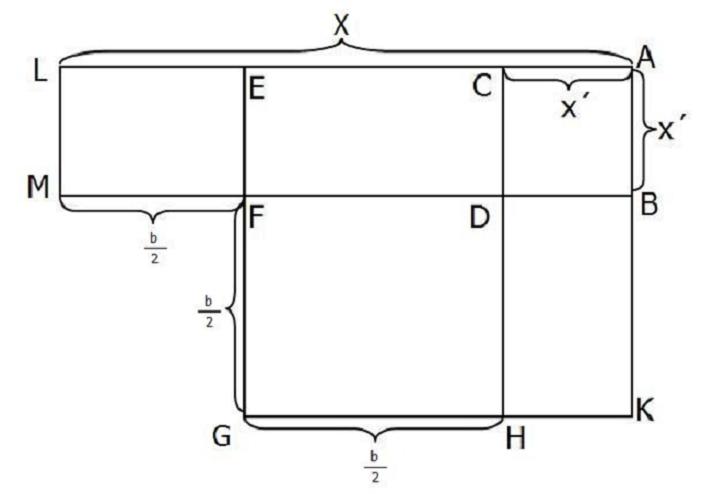 |
|
Figure 9 |
Now, are the figures of Al-Khwârazmî’s algebra essentially different from the corresponding figures found in Euclid? Corresponding to x-x’ = b; xx’ = c Euclid has the figure presented here (Figure 9) [105]. The successive steps of solution may be represented as follows:
EFDHKA+FD2=AE2 (1)
EFDHKA = LMBA=xx’=c (2)
c+FD2=AE2 (3)
EA= √((b/2)2+c (4))
x= EA – b/2 = √((b/2)2+c) – b/2 (5)
x= EA + b/2 = √((b/2)2+c)+b/2 (5)
In Al-Khwârazmî and ‘Abd al-Hamîd ibn Turk the equation x’2 + bx’ = c does not contain x. The rectangle LMEF is therefore not needed. In fact such is exactly the figure found both in Al-Khwârazmî and ‘Abd al-Hamîd. In solving the equation x’2 + bx’ = c, for similar reasons equality (2) above will naturally not occur. Instead, one will have EFDHKA = x’2 + (b/2)x’ + (b/2), x’ = x’2 + bx’ = c, and the remaining relations (3), (4), and (5), will be identical. This is actually seen to be the case in Al-Khwârazmî and ‘Abd al-Hamîd ibn Turk.
That the solution and figure given here by ‘Abd al-Hamîd ibn Turk and Al-Khwârazmî are in harmony with Euclid’s way of thinking, as far as the difference of the algebraic background implied by the distinction between the “mixed” equations and the old Babylonian types is concerned, may be considered further corroborated by the fact that theorem 4, e.g., of book II in the Elements can easily be brought into direct correspondence with equation x’2 + bx’ = c in one unknown considered here. Its figure is quite similar to the corresponding figure of ‘Abd al-Hamîd and Al-Khwârazmî, and the proof of this theorem, likewise, is essentially the same as the solution for this equation found in ‘Abd al-Hamîd ibn Turk and Al-Khwârazmî.
For the geometrical figure illustrating the solution of x2 = bx + c, the longer straight line x in fig. 2 has to be preserved.
The rectangle xx’ is also preserved. The side x’ therefore remains in the new figure automatically although it does not appear in the equation. The modifications seen in the figure of Al-Khwârazmî and ‘Abd al-Hamîd ibn Turk, as compared to Euclid’s figure, are, firstly, that the square of x is drawn, and secondly, that the rectangle ACHK appears attached to the left side of the square drawn on b/2 instead of being on its right side.
 |
|
Figure 10 |
None of these two modifications introduce anything essentially new as compared to the figure found in Euclid. To compare the figure of Al-Khwârazmî and ‘Abd al-Hamîd (Figure 10) with that of Euclid (Figure 10), we may show the first modification, as well as a missing x’ of Euclid’s figure, in dotted lines. The main difference between the two figures, then, is that in the new figure the square of the unknown is shown. This is natural, as here x is the only unknown and is derived independently.
These trivial alterations in Euclid’s figure do not result, moreover, in any change in the manner of geometrical reasoning. The solution of the unknown is based on exactly the same kind of geometrical demonstration. Here too the main relation utilized is c + (b/2)2=(x–b/2)2.
 |
|
Figure 11 |
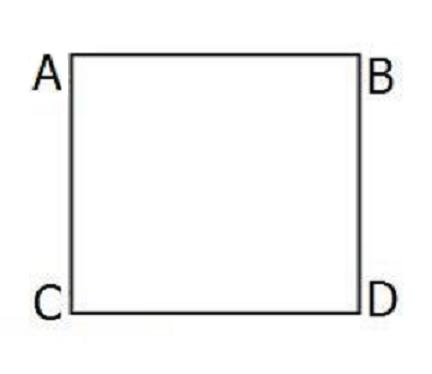 |
|
Figure 12 |
Euclid’s figure for x + x’ = b; xx’ = c (Figure 12) [106] is, as will readily be seen, very similar to the figure (Figure 11) given for x’2 + c = bx’; x’ < b/2 in the algebra of ‘Abd al-Hamîd and Al-Khwârazmî. And the principle of geometrical proof of the solution is likewise identical. The main relation utilized is
(b/2)2 = xx’+(b/2-x’)2, or (b/2)2=c+(b/2-x’)2.
The first form of this relation containing the term xx’ of course does not appear in the solution of the equation x’2+ c = bx.’
For x2 + c = bx; x > b/2, it may be guessed from the previous example concerning the equation x2= bx + c that a larger square, i.e., the square of x will appear in the figure. Again, here too, the part of Euclid’s figure (Figure 11) representing x’2 and (b/2)x’ jointly should naturally play a secondary part. This portion of the figure is seen to be transposed in a manner corresponding exactly to the transposition found in the figure for x2 = bx + c. The resulting figure (Figure 13) is that found in ‘Abd al-Hamîd ibn Turk’s text. For facilitating comparison the new parts and a missing x’ are shown in dotted lines in this figure (Figure 13).
 |
|
Figure 13 |
The alterations in the figure are thus trivial. The principle of geometrical demonstration of the solution remains, moreover, exactly the same. For the main relation utilized is (b/2)2=c+(x–b/2)2.
It is therefore quite clear that the geometrical figures of Al-Khwârazmî’s algebra, far from being totally different from the corresponding figures found in Euclid’s Elements, are essentially the same as the latter, and the nature of the geometrical demonstrations in the two cases arc, for all intents and purposes, and as geometrical demonstrations, identical. Why, then, does Gandz believe the two geometries underlying these two types of demonstration to be very different from one another?
Gandz says, “His (Euclid’s) figure has nothing in common with the two, respectively three, figures of Al-Khwârazmî. The latter one proves two Arabic types independent of each other.-Euclid prove the ancient Babylonian type B II. Algebraically, AI Khwârazmî is ahead of Euclid with 1000 years, geometrically, he is behind of Euclid with 1000 years. His demonstrations are based entirely upon intuition. He has nothing else to base them upon. In his geometry the Euclidean axioms, definitions, theorems, and propositions are entirely ignored [107].”
On another occasion Gandz reaches the conclusion that Al-Khwârazmî knows nothing of the special importance of the problem of cutting a given straight line in extreme and mean ratio [108].
Speaking of the equation x2 + c = bx, in a passage partly quoted before, Gandz writes, “In. spite of their apparent similarity, the two figures of Euclid and Al-Khwârazmî are basically and intrinsically different. They are proving different cases by different methods. Euclid proves and demonstrates a case of ancient Babylonian algebra; Al-Khwârazmî demonstrates a case of modern Babylonian school whose algebra came to be regarded as Arabic algebra. Euclid demonstrates the antiquated old Babylonian algebra by a highly advanced geometry; Al-Khwârazmî demonstrates types of an advanced algebra by the antiquated geometry of the ancient Babylonians.
“The older historians of mathematics believed to find in the geometric demonstrations of Al-Khwârazmî the evidence for Greek influence. In reality, however, these geometric demonstrations are the strongest evidence against the theory of Greek influence. They clearly show the chasm between the two systems of mathematical thought, in algebra as well as in geometry [109].”
Speaking of the part of Al-Khwârazmî’s Algebra dealing with menstruation, Gandz says, “Now, if Al-Khwârazmî had really studied Greek mathematics, we were certainly justified in the expectation to find some traces of the content or terminology of Euclid’s Elements in his geometry. The fact, however, is that there are no such traces of Euclid in Al-Khwârazmî’s geometry. Euclid’s Elements in their spirit and letter are entirely unknown to him. Al-Khwârazmî has neither definitions, nor axioms, nor postulates, nor any demonstration of the Euclidean kind. He has just a plain treatise on menstruation, a compilation of popular rules for the practical purpose of land surveyors [110].”
Each of Euclid’s figures concern two unknowns and are thus equivalent to two figures in Al-Khwârazmî’s or ‘Abd al-Hamîd ibn Turk’s algebra. Thus Euclid’s figures correspond to the Babylonian equations with two unknowns while those of Al-Khwârazmî and ‘Abd al-Hamîd correspond to the “mixed” equations and their special cases. But these do not constitute basic and essential differences as far as the type of geometry going into the demonstrations is concerned.
It should not be safe, furthermore, to conclude that Al-Khwârazmî was not familiar with the Euclidean geometry just because the part of his Algebra dealing with menstruation is not based on Euclidean methods of treatment. Menstruation was apparently a subject conceived as serving the need of surveyors in a practical manner by supplying them with ready formulas and instructions. Al-Khwârazmî must have written this part of his book in conformity to a set prototype. Abû Barza ibn Turk wrote an independent book on this subject [111].
Euclid’s Elements is said to have been made available in Islam already during the reign of the Abbasid caliph Al-Mansur (754-775). This item of information which is accepted by Kapp [112] is derived apparently from Ibn Khaldun. According to Ibn Khaldun, upon Al-Mansur’s request the Byzantine emperor sent him a number of books among which was that of Euclid [113]. This seems reasonable. For there is information that a translation of Euclid into Arabic was made by Hajjaj ibn Yusuf ibn Matar around the year 790 for Harun al-Rashid (786-809) [114]. This was probably its first translation made in Islam. Hajjaj ibn Yusuf made a second translation of this book for Al-Mamun (813-833). This translation has come down to us partly, and, moreover, Sanad ibn ‘Alî, one of Al-Mamun’s astronomers, is said to have written a commentary on it [115].
Euclid’s Arabic translation was later improved especially by Hunayn ibn Ishaq, Ishaq ibn Hunayn, and Thabit ibn Qurra. But the details presented above indicate that Euclid’s Geometry became, known to the mathematicians of Islam during the reign of Harun al-Rashid. Al-Khwârazmî, on the other hand, was attached especially to the Bayt al-Hikma whose most prominent function was its being the centre of translation activity [116]. It seems unlikely therefore that Al-Khwârazmî should not have been familiar with the Euclidean geometry.
But it is not really relevant to our subject whether Al-Khwârazmî knew Euclidean geometry or not, and this is apparently the point on which we must dwell for a moment. For the difference between the conclusions we have reached and that of Gandz has its roots in this point.
From the quotations just given, it is seen that Gandz looks upon the Euclidean geometrical demonstrations of the algebraic equations in question as forming an inseparable part of the Euclidean geometry with its definitions, axioms, postulates, and proofs. It is true of course that the material in question appears in Euclid in the form of theorems. But these Euclidean theorems could, together with their proofs, be very well taken out of their Euclidean context and placed within a less advanced type of geometry. And they could likewise be presented in the form of problems, as they were in their Pythagorean origin, without altering their contents or details of procedure in any essential manner.
These geometrical demonstrations of Al-Khwârazmî and ‘Abd al-Hamîd ibn Turk, as well as the corresponding Euclidean propositions considered in their historical background, resemble the solutions of the second degree equation by the analytical method of completing squares as seen in modern textbooks of algebra. They are proofs in the sense that they prove the correctness of the solutions of these types of problems treated with a geometric scheme of approach. These proofs are based upon the knowledge of certain geometrical relations, but they do not necessarily presuppose a logical system of geometrical reasoning based on definitions, axioms, postulates, and theorems. The nature of these geometrical demonstrations, even in their Euclidean form, is such that, in a sense, they need not be considered as necessarily partaking of the logical and systematic perfection of the Euclidean geometry. For they are based on very simple geometrical knowledge.
As they occur in Euclid’s text, the underlying geometrical relations are of course based on axioms, postulates, and theorems. But, on the other hand, there is nothing forbidding us from assuming that the situation is the same in the case of Al-Khwârazmî. The point, however, is that this particular question is not very relevant here.
The geometrical demonstrations of Euclid as well as those of Al-Khwârazmî and ‘Abd al-Hamîd ibn Turk stand indispensably in need only of the type of geometry which was developed, or, at any rate, represented, by the Pythagoreans. Whether, as Gandz says, this also corresponds to Babylonian geometry, or whether it was derived from it or was similar to it, is still another question.
It would seem quite safe to say that the geometrical knowledge necessary for the geometrical demonstrations found in, Al-Khwârazmî and ‘Abd al-Hamîd ibn Turk was not beyond the reach of the Babylonian mathematicians. But there apparently is no documentary evidence indicating that such geometrical demonstrations were used by the Babylonians in their algebra.
As we have seen, Al-Khwârazmî speaks, in his Algebra, of the learned men “in times which have passed away and among nations which have ceased to exist” who “were constantly employed in writing books on several departments of science and various branches of knowledge [117],” Looking at the first part of this quotation, it seems probable that Al-Khwârazmî himself associated his algebra with the Babylonians. But it is also possible to see here an allusion to the Greeks. Moreover, the second part of the quotation refers to books written on various scientific subjects, and this applies more readily to the Greeks. This seems especially likely when we take into consideration the fact that the Arabic text contains reference also to books written on philosophy, or wisdom, (Hikma) [118], a word which does not appear very clearly in Rosen’s translation quoted above.
The interpretation of these statements of Al-Khwârazmî cannot be made with certainty, and, moreover, he may not have been well-informed on the history of his subject. His statement seems, nevertheless, to support the theory of Greek influence.
In short, it seems quite reasonable to see in the geometrical demonstrations of the algebra of Al-Khwârazmî and ‘Abd al-Hamîd ibn Turk a clear sign of Greek influence. Thus, the Greek influence in question could have acted on the Babylonian algebra of the later school to produce the algebra of ‘Abd al-Hamîd and Al-Khwârazmî, if we think [119] in terms of the course of development sketched by Gandz. But it is also probable that the algebra of Al-Khwârazmî and ‘Abd al-Hamîd was a direct outgrowth of the Greek geometric algebra, possibly with the superposition of a supplementary influence from the later Babylonian school.
Another evidence in favour of Greek influence may be found in the fact that, as Gandz points out, Al-Khwârazmî does not reject irrational numbers as solutions. This may be said to apply to ‘Abd al-Hamîd also. For, had he rejected irrational solutions, the extant part of his book would have been the very place to speak of it. Alongside of the special case and logical necessity represented by the imaginaries, he would have to have another special case of impossibility of solution corresponding to results involving irrational quantities. Diophantos did not admit irrational solutions [120].
The acceptance of irrational quantities in the algebra of Al-Khwârazmî and ‘Abd al-Hamîd ibn Turk is very likely a result of Greek influence. For, as we have seen, complete reliance on reasoning in terms of geometrical demonstrations was apparently a very prominent and characteristic feature of this algebra, and this points to an awareness of the difficulties presented by analytical methods of treatment based purely on number and discrete quantity.
It would seem therefore that the algebra of Al-Khwârazmî was the outcome of a tendency of simplification and economy in procedure and method coupled with the disappearance of the hesitation felt toward the double root of the equation x2 + c = bx. The ambiguity surrounding this question of the double root was apparently dissipated through the adoption of the method of geometrical demonstration, this method being a modification of the method of geometrical demonstration of the Pythagoreans and Euclid. The nature of the modification was determined by the need for its adaptation to the tendency for the exclusive use of the “mixed” equations. The geometrical method of demonstration may also have commended itself because of the need of avoiding difficulties arising from the irrationals. The tendency for the exclusive use of the “mixed” equations at the stage of solution was probably a Babylonian development, and the adoption of the new method of geometrical demonstration was apparently a result of influence deriving from the Greek geometric algebra.
This seems to be the most reasonable picture of the course of the developments leading to the algebra of ‘Abd al-Hamîd ibn Turk and Al-Khwârazmî. Chronological and geographical details of a substantial nature are entirely lacking. Moreover, this picture is only partly based on direct and conclusive evidence. For the relevant documents available at present leave serious lacunas, and these have to be filled by carefully thought out guesses. Greater certainty on these points of detail will have to await future research based on fresh documentary evidence.
6. Original text: English translation
Logical Necessities in Mixed Equations: From The Kitâb Al Jabr Wa’l Muqâbala of Abû ‘l-Fadl ‘Abd Al-Hamîd Ibn Wâsi’ Ibn Turk Al-Jîlî
With the name of God the merciful and compassionate. Blessing and peace be upon Muhammad, the master of the prophets, and on all his descendents.
The case of the equality of [a certain number of] square quantities to a number of roots (i.e., root of the square quantity). When we say, e.g., that one square quantity equals three roots; we represent the square quantity by the area of a plane quadrilateral figure with equal sides and right angles. Let ABCD be this figure. Each one of its sides is the root of the square quantity. The line AB is therefore the root of the square quantity. But the quadrilateral ABCD equals three roots, and AB is the root of the square quantity. The line BD is therefore numerically equal to three. For when we multiply it by AB, which is the root of the square quantity, it gives us the quadrilateral ABCD which is equal to three roots. But BD is the root of the square-quantity. The root of the square quantity is therefore three. And the square quantity is nine. And this is the shape of the figure.
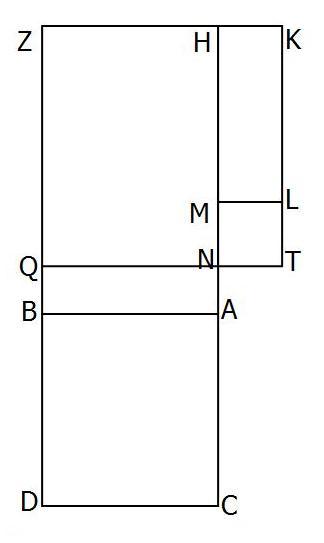 |
|
Figure 14 |
The case of equality of one square quantity and a number of roots to a certain number. Thus, when we say that one square quantity and ten roots equal twenty four, we represent the square quantity by a plane quadrilateral figure with equal sides and right angles. Let this be the surface AD. Each one of its sides is the root of the square quantity. We add to this figure the rectangular surfaces QD and DH, and we set the length of each numerically equal to five and their breadth equal to that of the surface AD, i.e., equal to the root of the square quantity. Each one of these two rectangular surfaces is therefore equal to five roots. The three surfaces AD, QD, and DH are thus equal to ten roots and one square quantity, i.e., twenty four. In order to complete the larger figure AK the product of ZD with DT is needed. Each one of these lines is equal numerically to five, and the quadrilateral formed by them, i.e., the surface DK, is equal to twenty five. This twenty five becomes juxtaposed upon the twenty four consisting of the surfaces DH, DQ, and DA, and the whole thing thus adds up to forty nine. This is the greater surface AK. We take its root, which is seven, and this is the value of each one of its sides. When we subtract from this seven, which is the line AH, the extended line CH which is equal to five, the line AC, which is the root of the square quantity, remains, and it, is found to be equal to two. The root, of the square quantity is therefore two and the square quantity itself four. And when ten roots are added to it the quantity twenty four is obtained. And this is the shape (of the figure).
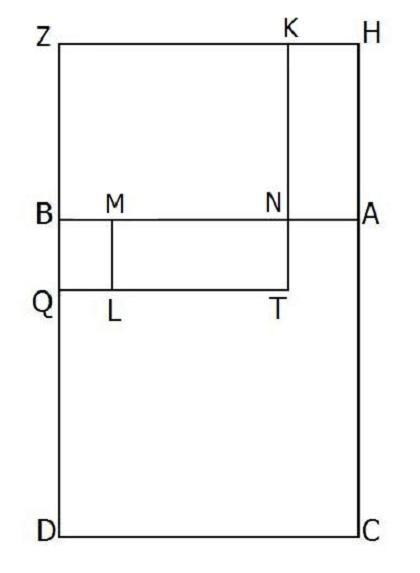 |
|
Figure 15 |
The case of equality of a square quantity and a given number to a number of roots. Thus, when we say that one square quantity and twenty one equal ten roots, we represent the square quantity by a plane quadrilateral figure of equal sides and right angles, and this is the surface AD. Each one of its sides is the root of the square quantity. We add to it the rectangular area HB and set it equal to twenty one. Each one of the lines HC and DZ is therefore equal to ten. For the line CD is the root of the square quantity, and the areas ZA and AD are equal to ten roots. At the point Q, we divide the line ZD into two equal parts, and we draw at right angles to it the line QT equal in length to both ZQ, and QD. The point Q, which is the midpoint, will either fall on the line ZB or on the line BD. This point of equal division cannot in this example be the point B. For if B were located at the middle of the line ZD, BD would be equal to the line BZ. And as the line BD is of the same length as AB, the line AB would equal BZ, and the quadrilateral built on HB would thus equal twenty five. But we know this not to be so. For its value was supposed to be twenty one. And in case the point Q, which is the midpoint of ZD, is located on the line ZB, then the line QT must surely cut the quadrilateral HB. For QT is of the same length as QD and QP is longer than BD, while BD is equal to AB. The line QT is therefore longer than the line AB.
Let us first suppose Q to be on BZ. We draw QT and complete the quadrilateral KQ. This quadrilateral is then equal to twenty five. The line QT is equal to QD, and BD is equal to NQ. The line TN is therefore equal to each of the lines BQ and NA. We mark off from the line KT, which is equal to QT, a section equal to NQ, i.e., the line KL, and we draw LM. The remaining section LT is thus equal to TN and the quadrilateral on KM equal to the quadrilateral on NB, and the quadrilateral LN is equilateral. But the quadrilaterals HQ and QA together are twenty one, and the quadrilateral NB is equal to the quadrilateral KM, while the quadrilateral HQ is common between them. The quadrilaterals KM and HQ equal therefore twenty one. But the quadrilateral KQ was equal to twenty five. The quadrilateral LN which is their difference is thus equal to four. Each one of its sides is its root. The line TN is therefore equal to two. But TN was equal to QB. The line QB is thus equal to two. When we subtract two, which is the value of QB, from five, which is the length of QP, we obtain the value of the line BD, which is the root of the square quantity, as equal to three. And this is the shape of the figure.
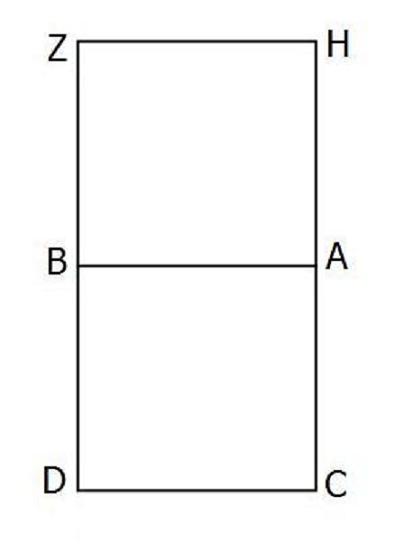 |
|
Figure 16 |
If, on the other hand, the midpoint of ZD falls within the section BD, then the line QT is shorter than the line AB, and it does not cut the quadrilateral AD. For the line TQ is equal to the line QD, and the line AB is equal to the line BD, while the line BD is greater than the line QD. The line AB is thus lengthier than the line TQ. Let then the point Q be on the line BD. We draw the line QT and complete the quadrilateral KQ, and it is equal to twenty five. Now, the line NB is equal to the line QD. The line AN is therefore equal to the line BQ. But the line BQ is equal to NT. The line NT is thus equal to the line AN, and the line KT is equal to the line TQ. We mark off from the line TQ a section equal to the line KN, i.e., the section TL, and we draw the line LM. There thus remains the line LQ, which is equal to the line TN, and the line LM is equal to the line TN. The quadrilateral on the line MT is therefore equal to the quadrilateral on the line HN, and the quadrilateral on the line MQ is equilateral. But the two quadrilaterals HN and NZ are equal to the quadrilaterals NZ and MT. The quadrilaterals NZ and MT together are therefore equal to twenty one. Now, the quadrilateral KQ was equal to twenty five. When we subtract from it the quadrilaterals NZ and MT, which are equal to twenty one, the remaining quadrilateral MQ is seen to equal therefore four. This latter being equilateral, each one of its sides is its root. The line BQ is then equal to two. When we add the line BQ to the line QD, which is equal to five, we obtain seven, and this is the root of the square quantity. The square quantity is therefore forty nine, and when twenty one is added to it becomes seventy.
 |
|
Figure 17 |
As to the intermediate case of equality, this obtains when the root of the square quantity is equal to half the number of the roots. This will not occur except in an example wherein half of the number of the roots is multiplied by its equal, this product being the numerical quantity which is with (on the same side of the equality as) the square quantity. Such is the case when it is said that one square quantity and twenty five equal ten roots, or one square quantity and nine equal six roots, and similar examples. These conditions being satisfied, we represent the square quantity by a plane quadrilateral figure of equal sides and right angles. Let this be the surface AD. We add to it the surface HB which we set equal to twenty five. The surface HD thus becomes one square quantity and twenty five, and this is equal to ten roots. Each one of the lines HC and DZ is therefore equal to ten. When we divide the line ZD into two equal parts at B and draw from this midpoint a perpendicular line the length of which is five, i.e., equal to each one of the halves, and square it, we obtain twenty five. AB is this line and it is equal to the line HZ. Its square is the surface HB. For it is equal to twenty five. Half the number of the roots is therefore the root of the square quantity. And this is the shape of the figure.
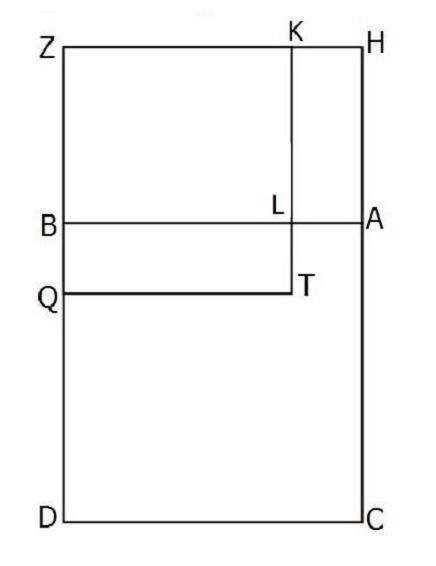 |
|
Figure 18 |
There is the logical necessity of impossibility in this type of equation when the numerical quantity which is with (on the same side of the equality as) the square quantity is greater than half the number of the roots multiplied by its equal. Thus, when we say that one square quantity and thirty dirhams equal ten roots, we represent the square quantity by an equilateral plane quadrilateral figure. Let this be the surface AD. We add to it the rectangular figure HB, and we set it equal to thirty. The surface HD is thus equal to ten roots and each one of the lines HC and ZD have the value ten. We divide the line ZD into two equal parts at the point Q.
Let us first consider the case wherein the point Q is located on the line ZB, as was done before. We draw the line QT at right angles to ZD and of the same length as each one of the lines ZQ and QD, i.e., equal to five, and we complete the quadrilateral KQ, which is thus equal to twenty five. The line TQ is equal to the line DQ. Therefore the line TL is equal to the line LA. As the line LQ is equal to the line AC and the line KT is equal to the line TQ, the quadrilateral KL is greater than the quadrilateral LB; and we add the quadrilateral HQ to both these quadrilaterals. The quadrilaterals KL and HQ together are therefore greater than the quadrilaterals HQ and QA taken together. Now, the quadrilaterals HQ, and QA together were equal to thirty, and the quadrilaterals KL and HQ together were equal to twenty five. Twenty five becomes therefore greater than thirty. But this is absurd and impossible. The logical necessity of impossibility in this type of equation has thus come into appearance. And this is the shape of the figure.
 |
|
Figure 19 |
Likewise, let the point Q fall within the section BD. We draw the line QT at right angles to ZD and of the same length as each one of the lines ZQ and QD, and we complete the quadrilateral KQ, which thus has the value twenty five. Conditions such as those satisfied here indicate that the quadrilateral LQ is greater than the quadrilateral HL. We consider the quadrilateral KB as added to both these quadrilaterals. The quadrilaterals KB and BT together are thus greater than the quadrilaterals KB and KA taken together, now, the quadrilaterals KB and KA together had the value thirty and the quadrilaterals KB and BT together twenty five. Twenty five therefore becomes greater than thirty. But this is absurd and impossible. And this is the shape of the figure.
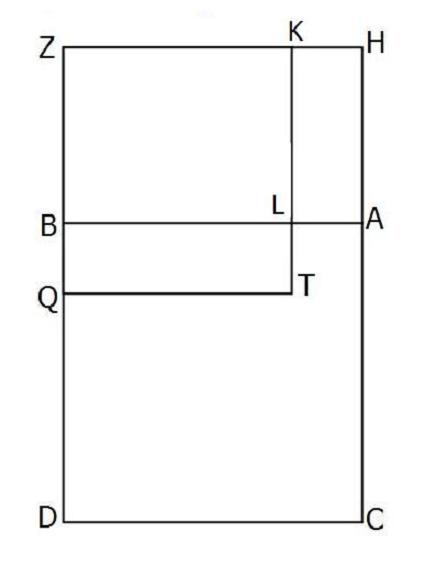 |
|
Figure 20 |
The case of equality of a numerical quantity and a certain number of roots to one square quantity. Thus, when we say that four roots and five dirhams are equal to one square quantity, we set the square quantity equal to a plane quadrilateral figure of equal sides and right angles. Let this be the surface AD. Each of its sides is the root of the square quantity. Within it we draw the line HZ parallel to the lines AB and CD both, and we set the surface AZ equal to five. The remaining surface HD is thus equal to four roots. As the line CD is the root of the square quantity and the surface HD is equal to four roots, the line HC becomes equal to four. At the point Q we divide the line HC into two equal parts, and we draw the line QT at right angles to it and equal to each one of the two lines HQ and QC. Its length is thus equal to two. We complete the quadrilateral KQ, which is equal to four. We then extend the line QT to the point L, and we set the line TL equal to each one of the lines AH and BZ. We draw the line LM at right angles to the line QL. The line AQ is thus equal to the line MA. The line QC is therefore equal to MB. But the line QC is also equal to the line LN. The line LN is thus equal to MB. And each one of KN and TL is equal to each one of MN and BZ. The quadrilateral MZ is therefore equal to the quadrilateral KL. In our construction the quadrilateral AN is contiguous to both these quadrilaterals. The quadrilaterals AN and BN together therefore equal the quadrilaterals AN and NT. But the quadrilaterals AN and JMB together are equal to five. The quadrilaterals AN and NT together are thus equal to five. But the quadrilateral KQ is equal to four. The quadrilateral AL has therefore the value nine. Each one of its sides is its root. Thus, the line AQ is equal to three. Now, the line QC was equal to two. The whole line AC is therefore equal to five, and this is the root of the square quantity. And this is the shape of the figure.
 |
|
Figure 21 |
Here ends “Logical Necessities in Mixed Equations” taken from the book of Al-Jabr wa’l Muqâbala by ‘Abd al Hamîd ibn Wâsî’ al Jîlî, may God’s blessing be upon him.


 Aal-e-Qutub Aal-e-Syed Abdullah Shah Ghazi