


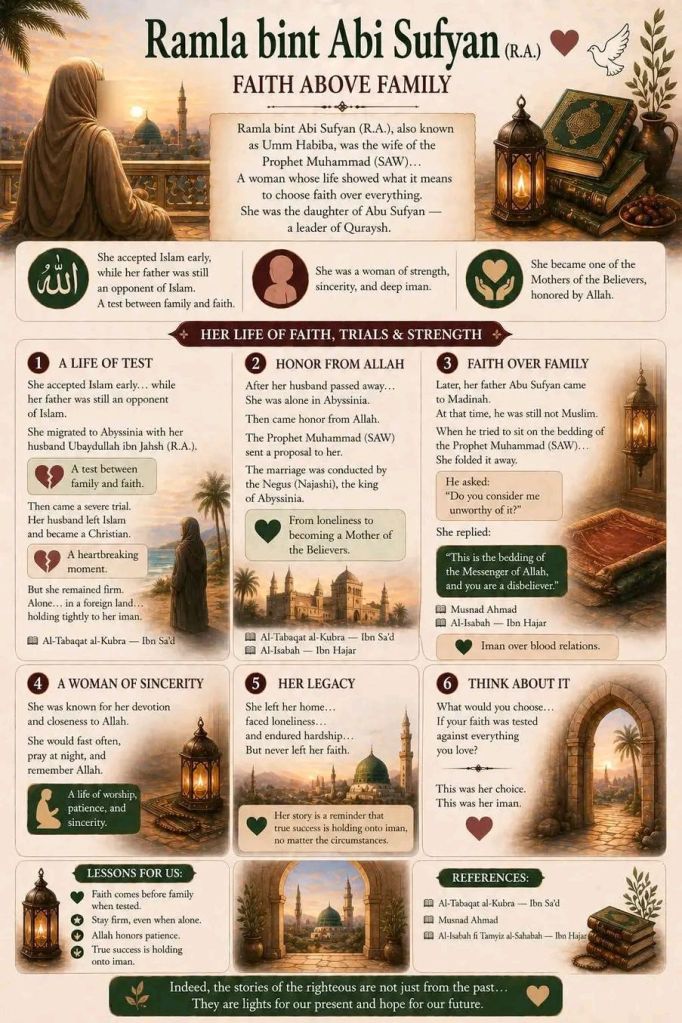
🌿 Ramla bint Abi Sufyan (R.A.) — Faith Above Family 🤍🕊️
Ramla bint Abi Sufyan (R.A.), also known as Umm Habiba, was the wife of the Prophet Muhammad (SAW)…
A woman whose life showed what it means to choose faith over everything.
She was the daughter of Abu Sufyan — a leader of Quraysh.
—
🌿 A Life of Test
She accepted Islam early… while her father was still an opponent of Islam.
💔 A test between family and faith.
She migrated to Abyssinia with her husband Ubaydullah ibn Jahsh (R.A.).
📖 Al-Tabaqat al-Kubra — Ibn Sa’d
Then came a severe trial.
Her husband left Islam and became a Christian.
💔 A heartbreaking moment.
But she remained firm.
Alone… in a foreign land… holding tightly to her iman.
—
🌿 Honor from Allah
After her husband passed away…
She was alone in Abyssinia.
Then came honor from Allah.
The Prophet Muhammad (SAW) sent a proposal to her.
The marriage was conducted by the Negus (Najashi), the king of Abyssinia.
📖 Al-Tabaqat al-Kubra — Ibn Sa’d
📖 Al-Isabah — Ibn Hajar
🤍 From loneliness to becoming a Mother of the Believers.
—
🌿 Faith Over Family
Later, her father Abu Sufyan came to Madinah.
At that time, he was still not Muslim.
When he tried to sit on the bedding of the Prophet Muhammad (SAW)…
She folded it away.
He asked:
“Do you consider me unworthy of it?”
She replied:
“This is the bedding of the Messenger of Allah, and you are a disbeliever.”
📖 Musnad Ahmad
📖 Al-Isabah — Ibn Hajar
💛 Iman over blood relations.
—
🌿 Her Legacy
She was a woman of strength and sincerity.
She left her home… faced loneliness… and endured hardship…
But never left her faith.
—
🌿 Think about it:
What would you choose…
If your faith was tested against everything you love?
This was her choice.
This was her iman.
—
🌿 Lessons for Us:
💛 Faith comes before family when tested
💛 Stay firm, even when alone
💛 Allah honors patience
💛 True success is holding onto iman
📚 References:
Al-Tabaqat al-Kubra — Ibn Sa’d
Musnad Ahmad
Al-Isabah fi Tamyiz al-Sahabah — Ibn Hajar


