

Many centuries before there was a well‐known theory of atomism
advanced by the Greek philosopher, Democritus. He and
the people who came after him assumed that matter
consists of tiny, indestructible, indivisible particles called
atoms. The Arabs too, used to deal in the same concept; in
fact, the Arabic word dharrah commonly referred to the
smallest particle known to man. Now, modern science has
discovered that this smallest unit of matter (i.e., the atom,
which has all of the same properties as its element) can be
split into its component parts. This is a new idea, a
development of the last century; yet; interestingly enough,
this information had already been documented in the
Quran (Surah Saba’, 34:3) which states:
“He [i.e., Allah] is aware of an atom’s weight in the
heavens and on the earth and even anything smaller
than that…”
Undoubtedly, fourteen centuries ago that statement would
have looked unusual, even to an Arab. For him, the
dharrah was the smallest thing there was. Indeed, this is
proof, that the Quran is not outdated.
Year: 2019

Brotherhood
The Messenger of Allah ﷺ said:
“There are certain people amongst the servants of Allah, who are not prophets, nor are they martyrs, yet on the Day of Judgement they will have attained to such a position that even the prophets and the martyrs will look at them in admiration”.
The Companions, may Allah be pleased with them all, asked:
“Who are these people and what sort of good deeds will they have done? Let us know so that we can love them and be close to them, o Messenger of Allah”. The Prophet ﷺ answered:
‘They are such people that though there are no blood relations amongst them, nor any business or trade relations, yet they love each other for the sake of Allah. By Allah their faces are radiant with light and they are upon pillars of light. When others fear, they do not fear, and when others feel sorrow, they do not feel sorrow”.
He ﷺ then recited the following verse:
‘Yes, the friends of Allah will feel no fear and will know no sorrow:
those who have faith and are conscious of Allah, there is good news for them in the life of this world and in the afterlife. There is no changing the words of Allah. That is the great victory!’ (Yunus, 10:62-64)
The Blessed Prophet ﷺ narrated the following story as an demonstration of how loving one’s fellow Muslim for Allah will allow one to attain to Allah’s love.
“One time a man set out to visit his Muslim brother who lived in another village. Allah Most High appointed an angel with the duty of watching him on his way. When the man came to the angel, the angel asked him:
‘Where are you going?’
The man replied:
‘My Muslim brother lives in that village. I am going to see him.
The angel asked him:
‘Is there something that you wish to benefit from that friend?’
The man replied:
‘No, no. It is just that I love him for the sake of Allah and I am going to visit him’.
The angel then said:
‘Just as you love him, so does Allah love you. I am a messenger sent to you by Allah in order to give you this good news’ (Muslim, Birr, 38; Ahmad, II, 292).
________________________________________________________
Abu Idris al-Hawlani (may Allah have mercy on him) narrates:
“I had gone to the mosque of Damascus, where I saw a young man there with a smiling face. A group of people had gathered around him. Whenever they fell into dispute about some matter they would immediately go to that young man and ask for and accept his opinion. I asked who this young man was. They told me it was Muadh ibn Jabal .
The next day I ran to the mosque as early as I could. When I got there I saw that that young man was there already performing his prayer. I waited until he had finished and then approached him and greeted him with the greeting of peace and then said to him”:
“By Allah! I love you”.
“Do you love me for the sake of Allah?” he asked.
“Yes for Allah” I said. Then he asked me twice:
“Do you really love me for the sake of Allah?” Both times I answered:
“Yes I truly love you for the sake of Allah”. Then he held me by my robe and pulled me towards him and said:
“I congratulate you. I heard the Messenger of Allah ﷺ say:
“Allah Most High has said: ‘Those who love each other merely for My sake, and those who gather together to please Me, and those who visit each other for My sake and who give charity and do good for My sake… They will be the ones who (will) have earned my love” (Muwatta, Sha’r, 16).

Merchant Marine
Some years ago, the story came to us in Toronto about a
man who was in the merchant marine and made his
living on the sea. A Muslim gave him a translation of the
Quran to read. The merchant marine knew nothing about
the history of Islam but was interested in reading the
Quran. When he finished reading it, he brought it back to
the Muslim and asked, “This Muhammad S.A.W, was he a
sailor?” He was impressed at how accurately the Quran
describes a storm on a sea. When he was told, “No as a
matter of fact, Muhammad S.A.W lived in the desert,” that was
enough for him. He embraced Islam on the spot.
He was so impressed with the Quran’s description because
he had been in a storm on the sea, and he knew that
whoever had written that description had also been in a
storm on the sea. The description of
“…a wave, over it a wave, over it clouds” (Surah Nur,
24:40)
…was not what someone imagining a storm on a sea to be
like would have written; rather, it was written by someone
who knew what a storm on the sea was like. This is one
example of how the Quran is not tied to certain place and
time. Certainly, the scientific ideas expressed in it also do
not seem to originate from the desert fourteen centuries
ago.

His Mercy is our only constant
Allah Guides to His Light Whom He Wills.”
Bismillah-ir-Rahman-ir Raheem.
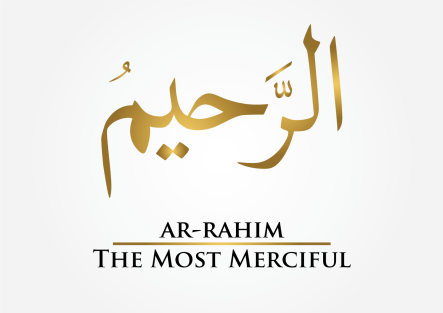
Allah’s (Most High) Rahma is infinite. In less than the blink of an eye, His Rahma (mercy) renews itself and further penetrates existence.
Take a moment.
Look at your hands – touch them. What do you feel? Smooth skin, bones, joints, and veins. Look how Allah (Most High) constructed your hands. The small veins of your hands lay on the service, while larger veins lay deeper. His Rahma is reflected in this, as if it were that your larger veins lay on the surface, you would be in grave danger of injury.
Take another moment.
Think about your sight. Allah (Most High) has limited your sight, but this limitation is His Rahma. If you were to see all that there was to see, you would not be able to even drink spring water from a store bought bottle, as all the microscopic elements of water would be transparent to you, moving around in the bottle.
Take yet another moment.
Think about your hearing. Allah (Most High), from His Rahma, has limited your hearing as well. Every process in your body makes as sound, but yet we are unable to hear the closest sounds to us! If our hearing was not limited, we would constantly imbued with sounds from within our own body.
We must think and reflect on His endless Rahma. His Rahma is our only constant, and the only constant that increases consistently; the more we think and reflect, the more we will begin to realize His all-encompassing Rahma.
May Allah (Most High) raise your maqam, and May He envelope you always in His Rahma.
 Aal-e-Qutub Aal-e-Syed Abdullah Shah Ghazi