
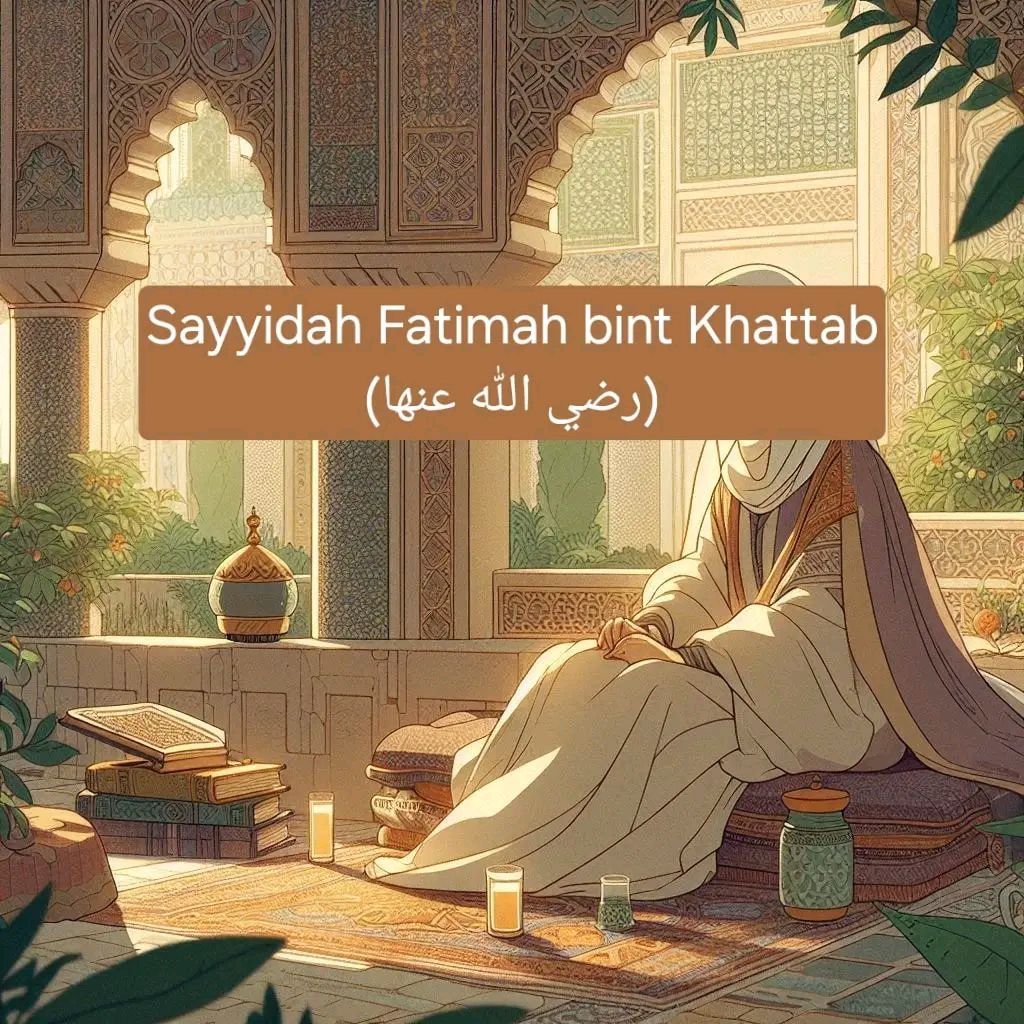
Who Was Sayyidah Fatimah bint Khattab (رضي الله عنها)?

■ Who Was Sayyidah Fatimah bint Khattab (رضي الله عنها)?

An amazing woman from the golden days of Islam — Sayyidah Fatimah bint Khattab (رضي الله عنها)!

Her real name was Fatimah, and she was lovingly known as Umm Jameel. She was the real sister of none other than Sayyiduna Umar Ibn Khattab (رضي الله عنه) — yes, the mighty Umar we all know and love!

She married Sa’eed bin Zaid (رضي الله عنه), and together, they both embraced Islam early on.
And here’s the beautiful part:

Sayyiduna Umar’s (رضي الله عنه) journey to Islam actually began because of her!

You must have heard this famous story — after Sayyiduna Hamzah (رضي الله عنه) accepted Islam, Umar (رضي الله عنه) was furious. He decided to go straight to the Prophet Muhammad ﷺ to put an end to it all (astaghfirullah)!

But on the way, someone from the Makhzoom tribe stopped him and said,

“Why are you going to the Prophet ﷺ when your own sister and brother-in-law have already accepted Islam?”

Hearing this, Umar (رضي الله عنه) stormed towards his sister’s house. As he got closer, he heard the beautiful sound of the Qur’an being recited! Curious but furious, he barged in.

Fatimah (رضي الله عنها) quickly tried to hide the pages of the Qur’an and denied reading anything.
Umar (رضي الله عنه) was so angry, he beat both his sister and her husband brutally. Blood was flowing from Fatimah’s (رضي الله عنها) face, but she stood strong and said bravely:

“Umar! Do whatever you want. Islam has entered our hearts and it will never leave!”

Her courage melted his heart.

Seeing her bleeding but fearless, Umar (رضي الله عنه) calmed down and said,

“Let me read what you were reading.”

They handed him the pages of the Qur’an, and when Umar (رضي الله عنه) read those powerful verses, his heart trembled.

Within moments, he cried out:

“I bear witness that there is no god but Allah and that Muhammad is His Messenger.”

SubhanAllah, from that moment, the future second Caliph of Islam was born!

Sayyidah Fatimah (رضي الله عنها) migrated to Madinah with her husband.

She didn’t live very long after that; the exact date of her passing isn’t recorded, but she left behind one son named Abdur Rahman.

الراجی رحمۃَ ربّہِ العلٰی
و الفقیر الٰی حضرۃ النّبی المصطفیٰ ﷺ
محمد فرحان جمیل

What Are the Manners of Reciting Salawat (Durood Sharif)?

■ What Are the Manners of Reciting Salawat (Durood Sharif)?

You see, in the world of divine love, even perfume is not pure enough. A Sufi once said,

❝If we must prepare ourselves to utter the name, then let us first wash our tongues with rosewater and musk, because to say a name without manners is itself a disrespect.❞

That name? The blessed name of Prophet Muhammad ﷺ.

When lovers of Allah ﷻ speak of the Messenger ﷺ, they tremble a little. Why? Because saying his name isn’t an ordinary act. It’s a moment of spiritual intoxication (masti) and reverence. So, when it comes to sending Salawat (Durood Sharif), we don’t just rush through it like any other task. No, no. We slow down. We prepare our hearts. Because this is no casual act — this is a royal invitation to the presence of the Beloved ﷺ.

Here are about some of the spiritual manners — the adab — that should be observed when reciting Salawat:

Read it with Passion, Presence, and Love
Don’t let your lips move while your heart is asleep. Salawat should not be just a sound from your throat — it must be a fragrance from your heart. You must recite it with passion (zauq-o-shauq), longing, and devotion. Push away every other thought. Remove the clutter from your mind. Imagine your heart as a guest knocking on the door of the Prophetic Presence ﷺ — would you let it knock distractedly? No. Be present. Feel the weight, the light, the honor of the words.

As you begin, picture in your heart that you are seated in the sacred gathering of Prophet Muhammad ﷺ. Feel his light, his grace, his mercy enveloping you. Let your soul bow in humility. Draw in your mind an image of his exalted rank. Don’t just say the Salawat — feel it. Let your heart see what your eyes cannot.

If possible, turn your face toward Madinah — the resting place of the Beloved ﷺ. Then softly close your eyes. This isn’t just reading — this is presence (muraqabah). This is reverence. It’s like closing your eyes before a delicate moment, like a bride removing her veil — quietly, with tears.

Try to remain in this state of deep inward focus for the entire time you recite Salawat. You’re not just saying something — you’re offering your heart. You’re not just speaking — you’re arriving.

Try, with love and respect, to bring his blessed name to your heart’s eye. Just like a mother thinks of her child with affection, just like a lover imagines their beloved — bring his light-filled form to your inner world. If Allah ﷻ wills, you might even be blessed with seeing him ﷺ in your dreams.

This is not a checklist. This is love. And love, dear one, has its own language, its own etiquette, its own secrets. Just like a letter to a king is never written in casual ink, Salawat is not recited with a distracted soul.

Let the fragrance of your Salawat rise beyond the skies. Let your heart say what your tongue cannot. And remember, every time you send Salawat upon him ﷺ, your name is mentioned in the gatherings of angels. What greater honor could there be?

اَللّٰهُمَّ صَلِّ عَلَىٰ مُحَمَّدٍ وَّعَلَىٰ اٰلِ مُحَمَّدٍ
May our hearts always tremble with love when we say his name ﷺ.

الراجی رحمۃَ ربّہِ العلٰی
و الفقیر الٰی حضرۃ النّبی المصطفیٰ ﷺ
محمد فرحان جمیل