

“If the stars dimmed.” (The Holy Qur’an 77:8)
Scientific Signs of The Holy Qur’an
Starlight
The statement “If the stars dimmed” (Qur’an 77:8) has been interpreted in light of modern astrophysics as a possible reference to the transient and evolving nature of stellar luminosity. In contemporary stellar astrophysics, it is well established that stars are not static objects; rather, their luminosity changes significantly throughout their life cycles depending on mass, composition, and evolutionary stage (1–5).
Luminosity and Stellar Evolution
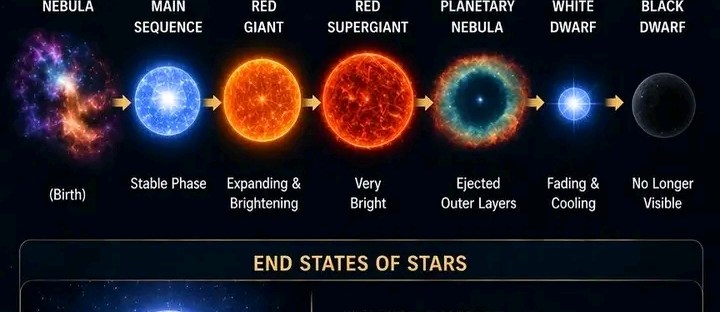
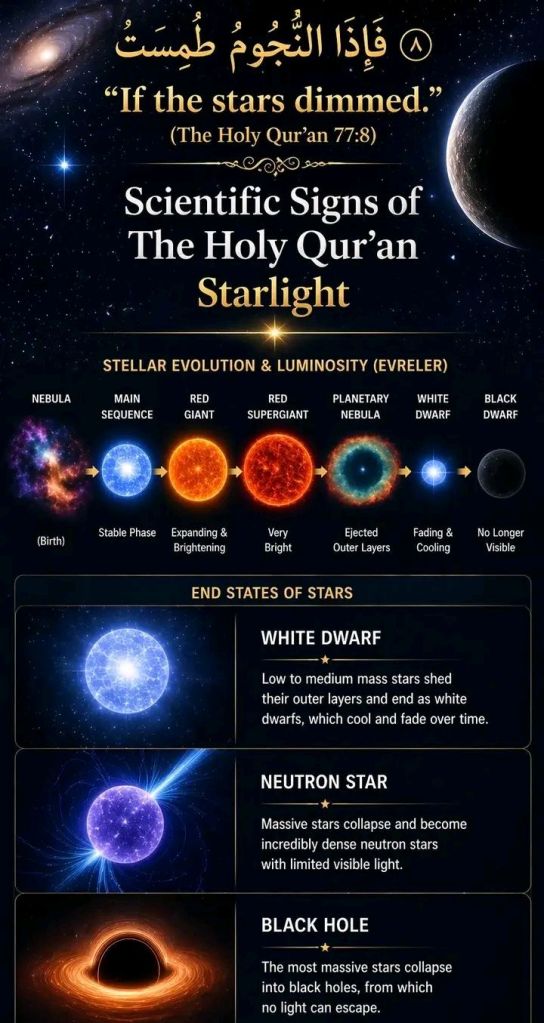
Stellar luminosity is governed primarily by nuclear fusion processes occurring in the core. During the main sequence phase, stars maintain relatively stable luminosity; however, as hydrogen fuel depletes, stars evolve into red giants or supergiants, dramatically increasing in brightness before eventually dimming (6–10). Observations confirm that luminosity is not constant but varies across different stages of stellar evolution (11–14).
Skeptical interpretations historically assumed stars were immutable and unchanging points of light. However, modern astrophysical data—especially from missions such as Hipparcos, Hubble Space Telescope, and Gaia—demonstrate variability, pulsation, and eventual fading in stellar output (15–18).
End States of Stars
After exhausting nuclear fuel, stars collapse into one of several compact remnants, depending on their initial mass:
* White dwarfs: low- to medium-mass stars shed outer layers, leaving a cooling core that gradually dims over billions of years (19–21).
* Neutron stars: massive stars collapse under gravity, forming extremely dense objects with limited electromagnetic emission (22–24).
* Black holes: the most massive stars undergo gravitational collapse into objects from which no light escapes (25–27).
These stellar remnants emit little or no visible light, rendering them effectively invisible to the naked eye over time (28–30). This aligns conceptually with the description of stars “losing their light.”
Meaning of “Tumisat”
The Arabic term “طُمِسَتْ (ṭumisat)” conveys the meaning of being effaced, obliterated, or having light extinguished. Linguistic analyses indicate that it implies not merely dimming but complete loss of visible luminosity (31–33). In astrophysical terms, this corresponds closely to stellar death and the transition into faint or non-luminous remnants.
Conclusion
Modern astrophysics confirms that:
* Stellar luminosity is not constant but evolves (34)
* Stars eventually exhaust their energy sources (35)
* Their remnants become faint or invisible
Thus, the Qur’anic expression describing stars dimming can be viewed, within a scientific framework, as consistent with the lifecycle of stars as understood today.
⸻
Kaynaklar (1–35)
1. Salaris & Cassisi, Evolution of Stars and Stellar Populations
2. Kippenhahn et al., Stellar Structure and Evolution
3. Hansen et al., Stellar Interiors
4. Carroll & Ostlie, An Introduction to Modern Astrophysics
5. Prialnik, An Introduction to the Theory of Stellar Structure
6. Iben, Stellar evolution theory (Annual Review)
7. Maeder, Physics of Rotating Stars
8. Clayton, Principles of Stellar Evolution
9. Eddington, The Internal Constitution of the Stars
10. Chandrasekhar, stellar equilibrium studies
11. Gaia Collaboration data releases
12. ESA Hipparcos mission data
13. Hubble Space Telescope observations
14. Kepler mission stellar variability data
15. Percy, Understanding Variable Stars
16. Aerts et al., Asteroseismology
17. Bedding, stellar oscillations studies
18. NASA stellar evolution archives
19. Mestel, white dwarf cooling theory
20. Fontaine et al., white dwarf physics
21. Winget & Kepler, white dwarf evolution
22. Shapiro & Teukolsky, neutron star theory
23. Baym et al., neutron star matter
24. Lattimer & Prakash, neutron star structure
25. Hawking & Ellis, black hole theory
26. Penrose, gravitational collapse
27. Thorne, black hole astrophysics
28. Rees, compact objects
29. Narayan & McClintock, black hole observations
30. Event Horizon Telescope Collaboration
31. Lane, Arabic-English Lexicon
32. Lisān al-ʿArab (classical Arabic source)
33. Qur’anic linguistic studies (Izutsu)
34. Phillips, The Physics of Stars
35. Ryden & Peterson, Foundations of Astrophysics


