Abu Hanifa Kay Bad Kya Hoa – Fiqah Hanfiya Ka Asal Bani Kon | Allama Yasin qadri


#Wilayat E #Ali AS Ka Sawal…,,
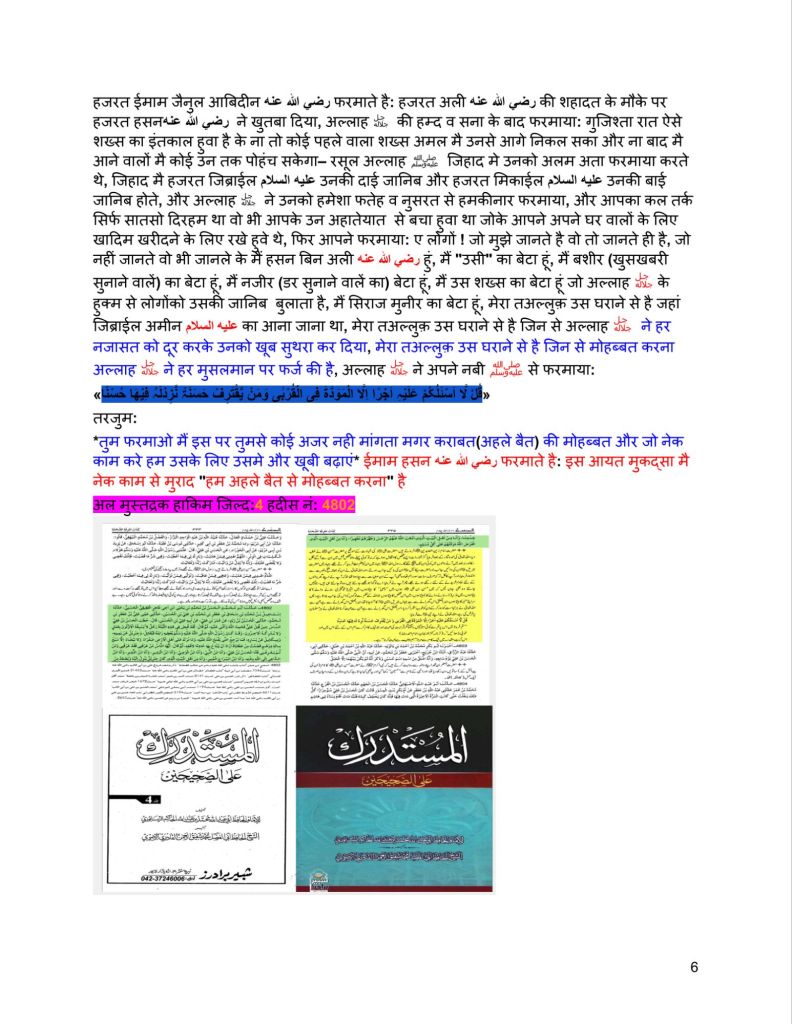
Hazrat #AbuSaeed RA Ke Is Qoul
وَقِفُوهُمْ إِنَّهُمْ مَسْعُو لُونَ (Surah Saffat : 2)
(Unko Roko, Unse Sawal Baaki hai)
Ke Muta’alik Nabi Kareem SAWS Se Riwayat ki,
Aap SAWS Ne Farmaya :-
وِلَايَةِ عَلِي بْنِ انيطالب
Ke Ye Sawal #Ali ibne #AbiTalib AS Ka Hoga..,,
Imam Vahdi RA Ne Kaha, Iske Ma’ani Ye Hai Ke Moula e Kayenaat Ki #Mohabbat Va Vila’a Ka Sawal Hoga,
Jis Tarah Uski Wasiyat #Rasulullah SAWS Ne Farmayi.
Page no:- 70
Fraid ul Simtain fi Fazayil al Murtaza wal Batool wal Sibtain by Imam ibrahim bin muhammad al jwaini r.a ( Arabi )
📚Writer :- Shaikh e Khurasan, Mohaddis e Kabeer, Ibrahim bin Muhammad bin Al Maveed Abi Bakr Jovaini 822 Hijri
Noor us Saqalain ( Urdu Translation )
Translator:- Allama Safdar Raza Qadri

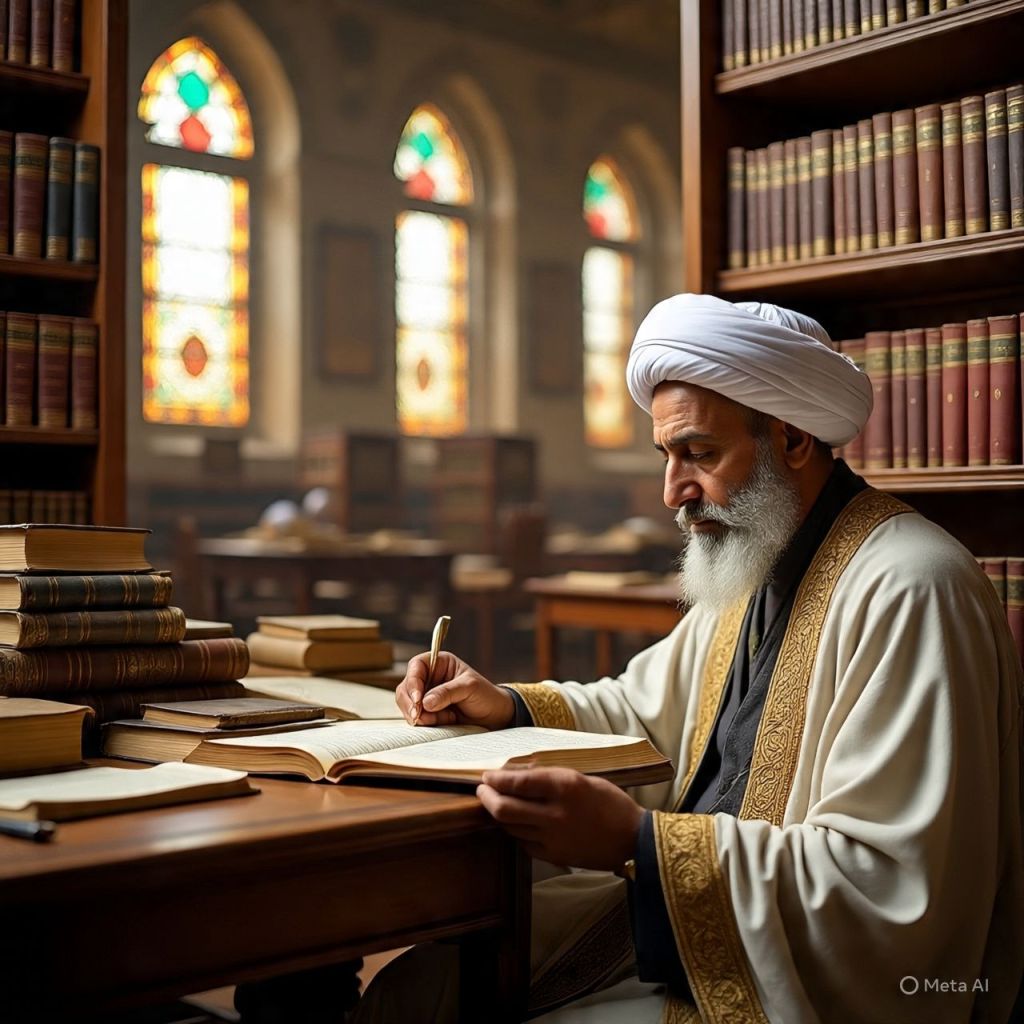
Abū al-Wafāʾ al-Būzjānī (940–998) was a Persian mathematician and astronomer who formulated the foundations of modern trigonometry in Baghdad during the Islamic Golden Age.
He simplified astronomy and navigation by introducing the tangent function and compiling precise trigonometric tables.
His contributions encompassed the general law of sines for spherical triangles, exhaustive sine and tangent tables, and the definitions of secant and cosecant functions.
As an astronomer, he enhanced observational instruments, particularly the use of a wall quadrant for precise sky measurements, and worked in conjunction with al-Biruni to ascertain precise longitude differences.
A lunar crater named in his honor and some of the earliest applications of negative numbers are among his legacy.
Reference:
Biographical Encyclopedia of Astronomers Reference work entry
Būzjānī: Abū al-Wafā’ Muḥammad ibn Muḥammad ibn Yaḥyā al-Būzjānī

Scientific Signs of the Holy Qur’an
Venus
Abraham said to his father Azar, “Do you take idols for gods? I see that you and your people are in evident error.” Thus We showed Abraham the dominion of the heavens and the earth so that he would be among those possessing certainty. When the night covered him, he saw a celestial body (kawkab). He said, “This is my lord.” But when it set, he said, “I do not love those that disappear.” Then when he saw the moon rising, he said, “This is my lord.” But when it set, he said, “Unless my Lord guides me, I shall surely be among the misguided people.” Then when he saw the sun rising, he said, “This is my lord; this is greater.” But when it set, he said, “O my people, indeed I am free from what you associate with Allah. I have turned my face toward the One who created the heavens and the earth, inclining toward truth, and I am not among the idolaters.” (1–6)
The Holy Qur’an 6:74–79
The Qur’anic passage concerning Prophet Abraham(pbuh) is frequently discussed in relation to ancient Mesopotamian astronomy, astral religion, and the linguistic meaning of the Arabic word kawkab (7–14). Ancient civilizations in Mesopotamia, including the Sumerians, Akkadians, Babylonians, and Assyrians, practiced elaborate forms of celestial worship in which the sun, moon, and Venus occupied central religious roles (15–24). Archaeological discoveries from Ur, Harran, Babylon, Nineveh, and surrounding regions demonstrate that Venus was among the most revered heavenly bodies in the ancient Near East (25–31).
Modern historians of religion note that Venus was associated with the goddess Inanna in Sumerian civilization and with Ishtar in Akkadian and Babylonian traditions (32–37). The famous eight-pointed “Star of Ishtar” symbolized the planet Venus, especially its appearance as the morning and evening star (38–42). Cuneiform tablets such as the Venus Tablets of Ammisaduqa carefully recorded the movements of Venus centuries before the Common Era, proving the importance of the planet in Mesopotamian culture (43–47). Ancient peoples visually perceived Venus as a brilliant star-like object in the sky because it is one of the brightest objects visible from Earth after the Sun and Moon (48–51). Yet astronomically Venus is not a star; it is a terrestrial planet orbiting the Sun within the inner Solar System (52–56).
Several modern Qur’anic researchers argue that the Qur’an’s use of the term kawkab is significant because it does not explicitly describe the object as a fixed star (najm) but instead uses a broader celestial designation compatible with a wandering body or planet (57–61). Classical Arabic lexicons such as Lisan al-‘Arab, Taj al-‘Arus, and Lane’s Arabic-English Lexicon note that kawkab can refer to a luminous heavenly body, including planets distinguished by motion and brightness (62–66). Medieval Muslim astronomers such as Al-Biruni, Al-Farghani, Al-Battani, and Nasir al-Din al-Tusi also differentiated between fixed stars and wandering planets in their astronomical writings (67–72).
In astronomy, the term “planet” derives from the Greek planetes, meaning “wanderer,” because planets move against the background of fixed stars (73–75). Venus is especially notable because it alternates between appearances as the Morning Star and Evening Star depending on its orbital position relative to Earth and the Sun (76–79). Ancient civilizations often misunderstood this object as a star because of its brightness, despite its planetary nature (80–82). Contemporary planetary science confirms that Venus is an inner rocky planet with a dense carbon dioxide atmosphere, volcanic plains, and retrograde rotation (83–87). Radar mapping missions such as Magellan and observations by spacecraft including Venera, Venus Express, and Akatsuki have dramatically expanded modern scientific understanding of Venus (88–92).
The Qur’anic narrative emphasizes that Prophet Abraham(pbuh) rejected the worship of transient celestial objects because they rise and set, demonstrating their dependence and impermanence (93–95). The passage ultimately directs attention away from celestial worship toward the Creator of the heavens and the earth, presenting monotheism as transcending astral religion and planetary deification (96).
The Arabic term:
“فَلَمَّا جَنَّ عَلَيْهِ اللَّيْلُ رَأَىٰ كَوْكَبًا”
contains the word kawkab (كَوْكَب), which classical and modern scholars identify as referring to a luminous celestial object or planet. In the historical context of Mesopotamian worship, many researchers associate this object with Venus because Venus occupied a uniquely important role in Near Eastern religion as the “Star of Ishtar” (15–24, 32–42).
References
1. The Holy Qur’an, Surah Al-An‘am 6:74–79.
2. Abdel Haleem, M.A.S., The Qur’an.
3. Pickthall, M., The Meaning of the Glorious Koran.
4. Yusuf Ali, A., The Holy Qur’an: Translation and Commentary.
5. Asad, Muhammad, The Message of the Qur’an.
6. Ibn Kathir, Tafsir al-Qur’an al-‘Azim.
7. Nasr, S.H., The Study Quran.
8. Al-Tabari, Jami‘ al-Bayan.
9. Al-Qurtubi, Al-Jami‘ li Ahkam al-Qur’an.
10. Fakhr al-Din al-Razi, Mafatih al-Ghayb.
11. Seyyed Hossein Nasr, Islamic Cosmological Doctrines.
12. David A. King, Astronomy in the Service of Islam.
13. George Saliba, Islamic Science and the Making of the European Renaissance.
14. E.S. Kennedy, A Survey of Islamic Astronomical Tables.
15. Samuel Noah Kramer, History Begins at Sumer.
16. Thorkild Jacobsen, The Treasures of Darkness.
17. Jeremy Black & Anthony Green, Gods, Demons and Symbols of Ancient Mesopotamia.
18. Henri Frankfort, The Intellectual Adventure of Ancient Man.
19. Georges Roux, Ancient Iraq.
20. Oppenheim, A.L., Ancient Mesopotamia.
21. Jean Bottéro, Religion in Ancient Mesopotamia.
22. Tzvi Abusch, Mesopotamian Religion.
23. Jacob Klein, Three Šulgi Hymns.
24. Piotr Michalowski, The Correspondence of the Kings of Ur.
25. Leonard Woolley, Ur of the Chaldees.
26. Harriet Crawford, Sumer and the Sumerians.
27. Marc Van De Mieroop, A History of the Ancient Near East.
28. Karen Radner, Ancient Assyria.
29. Dominique Charpin, Writing, Law, and Kingship in Old Babylonian Mesopotamia.
30. Stephanie Dalley, Myths from Mesopotamia.
31. Joan Oates, Babylon.
32. Tikva Frymer-Kensky, In the Wake of the Goddesses.
33. Rivkah Harris, Gender and Aging in Mesopotamia.
34. Dina Katz, The Image of the Netherworld in the Sumerian Sources.
35. Wolkstein & Kramer, Inanna: Queen of Heaven and Earth.
36. Jeremy Black, Reading Sumerian Poetry.
37. Beaulieu, Paul-Alain, The Pantheon of Uruk.
38. Black & Green, Gods, Demons and Symbols of Ancient Mesopotamia.
39. Wayne Horowitz, Mesopotamian Cosmic Geography.
40. Franz Cumont, Astrology and Religion Among the Greeks and Romans.
41. Otto Neugebauer, A History of Ancient Mathematical Astronomy.
42. Hunger & Pingree, Astral Sciences in Mesopotamia.
43. Hermann Hunger, The Venus Tablets of Ammisaduqa.
44. David Pingree, Astronomy Before the Telescope.
45. Neugebauer & Sachs, Mathematical Cuneiform Texts.
46. Rochberg, Francesca, The Heavenly Writing.
47. Rochberg, Francesca, Babylonian Horoscopes.
48. Carl Sagan, Cosmos.
49. Fred Whipple, Earth, Moon and Planets.
50. Pasachoff, J., The Cosmos.
51. Patrick Moore, The Observer’s Book of Astronomy.
52. NASA Planetary Science Division publications.
53. ESA Venus Express Mission Reports.
54. JAXA Akatsuki Mission papers.
55. Britannica Encyclopedia, “Venus”.
56. International Astronomical Union publications.
57. Toshihiko Izutsu, God and Man in the Qur’an.
58. Angelika Neuwirth, The Qur’an and Late Antiquity.
59. Mustansir Mir, Coherence in the Qur’an.
60. Neal Robinson, Discovering the Qur’an.
61. Fazlur Rahman, Major Themes of the Qur’an.
62. Ibn Manzur, Lisan al-‘Arab.
63. Al-Zabidi, Taj al-‘Arus.
64. Edward William Lane, Arabic-English Lexicon.
65. Hans Wehr, Dictionary of Modern Written Arabic.
66. Raghib al-Isfahani, Mufradat Alfaz al-Qur’an.
67. Al-Biruni, Al-Qanun al-Mas‘udi.
68. Al-Farghani, Elements of Astronomy.
69. Al-Battani, Kitab az-Zij.
70. Nasir al-Din al-Tusi, Tadhkira fi ‘Ilm al-Hay’a.
71. F. Jamil Ragep, studies on Islamic astronomy.
72. Aydin Sayili, The Observatory in Islam.
73. Thomas Kuhn, The Copernican Revolution.
74. Michael Hoskin, The Cambridge Concise History of Astronomy.
75. Heath, T.L., Greek Astronomy.
76. Patrick Moore, Guide to the Planets.
77. Impey & Hartmann, Astronomy: The Cosmic Journey.
78. Seeds & Backman, Foundations of Astronomy.
79. Ridpath, Ian, Stars and Planets Guide.
80. Asimov, Isaac, Asimov’s Guide to Science.
81. Stephen Hawking, A Brief History of Time.
82. Timothy Ferris, Coming of Age in the Milky Way.
83. Taylor, F.W., Planetary Atmospheres.
84. Bougher, Hunten & Phillips, Venus II.
85. Bullock & Grinspoon, Venus climatology studies.
86. Basilevsky & Head, volcanic geology of Venus.
87. McGill, Geology of Venus.
88. NASA Magellan Mission Reports.
89. Soviet Venera Mission archives.
90. ESA Venus Express scientific findings.
91. JAXA Akatsuki atmospheric studies.
92. National Geographic, “Venus Explained”.
93. Mircea Eliade, A History of Religious Ideas.
94. Karen Armstrong, A History of God.
95. William Chittick, The Self-Disclosure of God.
96. Montgomery Watt, *Bell’s Introd

■ The Miracles (Karāmāt) of Sayyidī Abū al-Hasan al-Shadhilī, may Almighty Allāh
The Pole of Poles and Refuge of Seekers
“Steadfastness is the greatest miracle.”
In Your Name, O Allāh, with Your praise, and through the outpouring of Your radiant lights.
Know that miracles, in the eyes of the Shaykh may Allāh be pleased with him, were never sought for their own sake. Rather, he used to say:
“Steadfastness upon the Path is the greatest miracle.”
Yet despite this, Allāh manifested through his hands many extraordinary events that astonished minds, serving as signs of the truthfulness of his sainthood and the firmness of his spiritual station. Among the most famous transmitted accounts are the following:
▪︎ Part One: The Miracle at the Sea of ʿAydhāb and the Story of Hizb al-Bahr
This is among his most famous miracles.
It is related that while traveling through the
Sea of ʿAydhāb, there was with them a distinguished man whose ship became stranded when the wind ceased completely. Days passed without movement, and distress overtook the travelers.
The Shaykh, may Allāh be pleased with him slept and saw the Prophet ﷺ in a dream, who taught him the litany known as Hizb al-Bahr (“The Litany of the Sea”).
The Shaykh then ordered his companions:
“Raise the sails.” They replied:
“There is no wind.” He answered:
“Do as you are commanded.”
As soon as the litany was recited, the wind arrived, Allāh opened the way for them within
a single hour, and they were saved through the blessing of that remembrance.
▪︎ Part Two: His Knowledge of the Thoughts of Disciples and Hidden Matters
Shaykh Abū al-Abbās al-Mursī, may Almighty Allāh sanctify his secret, said:
“By Allāh, I never sat with our master Abū al-Ḥasan for even a single day except that he informed me of what was within myself before I spoke of it.”
It is also narrated that a man once came to him inwardly objecting to the Shaykh’s wearing of elegant clothing.
Before the man even spoke, the Shaykh turned to him and said:
“My son, these garments of mine say:
‘I am independent of you, so give me nothing.’
While your garments say:
‘I am in need of you, so give me something.’”
The man was left speechless and repented at the Shaykh’s hands.
▪︎ Part Three: His Command Over Beasts and Protection from Enemies
It is mentioned that during one of the Shaykh’s journeys in the mountains, a great lion appeared before them. His companions became terrified.
The Shaykh stepped forward, took the lion by its ear, shook it gently, and said:
“O Maymūn, we are servants of Allāh.”
The beast immediately submitted and retreated, overcome by the awe Allāh had clothed His saint with.
It is also narrated that a group once intended harm against the Shaykh and his companions on the road to the Hijaz. The Shaykh invoked Allah through Hizb al-Nasr (“The Litany of Victory”), whereupon their enemies’ sight was veiled.
They passed directly beside the Shaykh and his companions yet could not see them, as though they were concealed within the protected veil of Allāh.
▪︎ Part Four: The Multiplication of Food and Drink Through Blessing
It is reported that a group once stayed with the Shaykh during a time of hardship, while they possessed only a small amount of provisions.
The Shaykh ordered that his hand be placed upon the food. Everyone ate until satisfied,
and much still remained afterward.
The Shaykh said:
“This is spiritual aid from the Presence of the Most Generous. The blessing lies not in the food itself, but in obedience.”
▪︎ Part Five: His Miracle at the Time of His Passing in Humaythirah
Among his greatest miracles was his foreknowledge of the place and time of his death. While traveling for pilgrimage, he told
his companions:
“At Humaythirah shall the meeting take place.”
In another narration:
“At Humaythirah you shall witness.”
He instructed them to carry axes and digging tools. When they arrived at that desolate place, where there was no water, the companions became severely thirsty.
It is narrated that the Shaykh took an arrow from his quiver and cast it into a bitter salty well. Immediately, sweet pure water burst forth from it, the famous Well of Humaythirah, known to this day.
That same night, the Shaykh, may Allāh sanctify his secret. passed away while in prayer, and it is also said while remembering Allah.
Thus ends what we intended to mention of his miracles. These accounts are but a drop from an endless ocean. The station of the Shaykh is greater than words can encompass, but these are signs for people of understanding.