


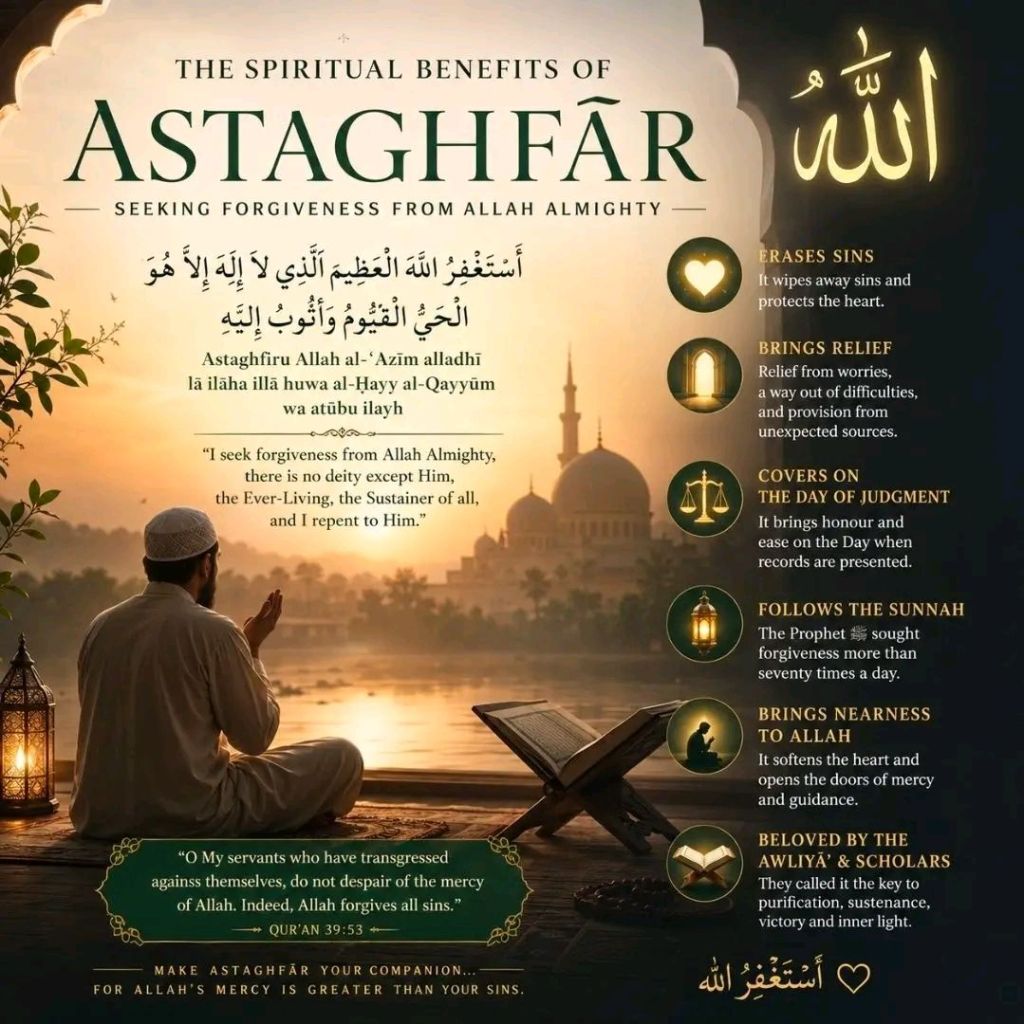
■ The Spiritual Fruits of Astaghfār:
Seeking Forgiveness from Allāh Almighty
There is a remembrance that cleanses the heart without making a sound, softens the soul without force, and opens the door of return no matter how far a servant may have wandered.
That remembrance is Astaghfār.
To say Astaghfirullāh is not merely to ask that a sin be erased. It is to acknowledge our weakness, abandon reliance upon ourselves, and turn once more toward the infinite Mercy of Allāh Almighty.
■ What Is Astaghfār?
Astaghfār means seeking forgiveness from Allāh Almighty.
The root gh-f-r carries meanings connected with covering, protecting, and forgiving. Thus, when the servant seeks maghfirah, he asks Allāh Almighty not only to pardon his sin, but to cover him with His mercy and protect him from its consequences.
▪︎ Allāh Almighty says:
“Whoever does evil or wrongs himself and then seeks forgiveness from Allāh will find Allāh Forgiving, Merciful.” (Qur’ān 4:110)
Astaghfār therefore belongs to the very essence of the believer’s journey: sin to awareness to repentance to forgiveness to nearness. The seeker does not remain imprisoned by yesterday’s failure. He returns. And every sincere return is beloved to Allāh Almighty.
■ Astaghfār and the Purification of the Heart
The heart can become clouded by heedlessness, attachment, pride, anger and sin. Astaghfār is among the greatest means by which that darkness is removed.
▪︎ The Beloved Messenger of Allāh ﷺ said:
“By Allāh, I seek forgiveness from Allāh and repent to Him more than seventy times a day.”
(Ṣaḥīḥ al-Bukhārī)
If the Messenger of Allāh ﷺ, whose past and future sins were forgiven, constantly sought forgiveness, how much more should we, who are immersed in weakness and need, make Astaghfār part of our daily lives?
Astaghfār teaches the heart humility.
It whispers:
“I cannot purify myself by myself.
I need You, O Allāh.”
■ The Qur’ānic Call to Astaghfār
The Qur’ān repeatedly connects seeking forgiveness with mercy, repentance, blessing and divine protection.
▪︎ Allāh Almighty says:
“Do they not repent to Allāh and seek His forgiveness? And Allāh is Forgiving, Merciful.”
(Qur’ān 5:74)
▪︎ And:
“Seek forgiveness of your Lord and then turn to Him in repentance. Indeed, my Lord is Merciful, Most Loving.” (Qur’ān 11:90)
▪︎ And He describes the people of taqwā:
“Those who, when they commit an immorality or wrong themselves, remember Allāh and seek forgiveness for their sins.” (Qur’ān 3:135)
The secret is not that the righteous never fall.
Rather, when they fall, they return.
■ Astaghfār and the Promise of Relief
Allāh Almighty relates the words of Prophet Nūḥ, peace be upon him:
“Ask forgiveness of your Lord. Indeed, He is ever Forgiving. He will send rain upon you in abundance, give you increase in wealth and children, and provide you with gardens and rivers.” (Qur’ān 71:10–12)
Astaghfār is therefore not merely about the Hereafter. It is a means through which the servant seeks Allāh’s mercy in every dimension of life. But its greatest gift is not wealth.
It is the return of the heart to its Lord.
■ When Should We Make Astaghfār?
▪︎ After Falling Into Sin
The moment the servant realizes that he has wronged himself, he should not allow Shayṭān to convince him that he is too sinful to return.
▪︎ Allah Almighty teaches us the prayer of Ādam and Ḥawwā’, peace be upon them:
“Our Lord, we have wronged ourselves. If You do not forgive us and have mercy upon us, we will surely be among the losers.” (Qur’ān 7:23)
The door of repentance remains open.
Do not allow shame to prevent you from returning to the One whose Mercy is greater than your sin.
▪︎ After Worship
The servant should seek forgiveness even after good deeds, because he knows that his worship is never performed with the perfection that Allāh Almighty deserves. For this reason, Astaghfār is prescribed after the prayer.
The servant finishes his ṣalāh and immediately says:
Astaghfirullāh.
Astaghfirullāh.
Astaghfirullāh.
It is as though he is saying:
“O Allāh, forgive the shortcomings in the worship I have just offered You.”
▪︎ During the Last Portion of the Night
▪︎ Allāh Almighty praises those who seek forgiveness before dawn:
“And in the hours before dawn they would seek forgiveness.” (Qur’ān 51:18)
These are precious moments for the seeker.
The world is quiet. The distractions have fallen silent. The heart becomes more receptive.
And the servant whispers: Astaghfirullāh…
Sometimes a single sincere Astaghfirullāh uttered in the darkness can carry more weight upon the heart than a thousand words spoken without presence.
■ The Beautiful Formula of Astaghfār
Among the well-known formulas of seeking forgiveness is:
Astaghfirullāha al-ʿAẓīm, alladhī lā ilāha illā Huwa, al-Ḥayy al-Qayyūm, wa atūbu ilayh.
“I seek forgiveness from Allāh Almighty, there is no deity except Him, the Ever-Living, the Sustainer of all, and I repent to Him.”
Its meaning is profound.
The servant does not merely say:
“Forgive me.” He declares:
“You alone are worthy of worship.
You alone sustain me.
I have wronged myself.
And I return to You.”
That is the essence of tawbah.
■ Astaghfār in Times of Hardship
When difficulties descend upon the servant, Astaghfār reminds him that relief ultimately comes from Allāh Almighty.
The Prophet ﷺ taught his Ummah to increase remembrance and supplication during times of great signs and difficulty. Astaghfār therefore becomes a refuge, not because every difficulty will immediately disappear, but because the heart learns where to turn when it does.
From the creation to the Creator.
From anxiety to surrender.
From heedlessness to remembrance.
■ The Final Door: Never Despair
Perhaps the greatest spiritual benefit of Astaghfār is that it teaches the servant never
to despair of Allāh Almighty.
▪︎ Allāh Almighty says:
“O My servants who have transgressed
against themselves, do not despair of the mercy of Allāh. Indeed, Allāh forgives all sins.
He is truly the Most Forgiving, Most Merciful.”
(Qur’ān 39:53)
Notice the tenderness of this verse. Allāh Almighty does not address them merely as “sinners.” He calls them:
“My servants.” Even after they have transgressed. Even after they have fallen.
The relationship has not been severed.
The door has not been closed.
The servant can still return.
■ The Way of the Awliyā’
The great people of spiritual realization understood that Astaghfār is not simply a formula upon the tongue.
It is a state of the heart. It is to recognize one’s poverty before the Rich. One’s weakness before the Powerful. One’s ignorance before the All-Knowing. And one’s need before the One who needs none.
The seeker who makes Astaghfār sincerely gradually discovers that forgiveness is not merely about removing yesterday’s darkness.
It prepares the heart for tomorrow’s light.
■ The Story of Imām al-Ḥasan al-Baṣrī, may Almighty Allāh have mercy upon him;
It is famously reported that when people came to Imām al-Ḥasan al-Baṣrī with different complaints, including poverty, drought and difficulties in life, he repeatedly directed them toward seeking forgiveness.
When questioned about this, he pointed toward the verses of Sūrah Nūḥ:
“Ask forgiveness of your Lord. Indeed,
He is ever Forgiving.” (Qur’ān 71:10)
Then Allāh Almighty mentions rain, wealth, children, gardens and rivers. The lesson is profound: When the servant repairs his relationship with Allāh, he places himself beneath the rain of Divine Mercy.
■ The Deeper Secret of Astaghfār
There are people who say Astaghfirullāh
with their tongues while their hearts remain attached to the very thing for which they seek forgiveness. But the deeper Astaghfār is different.
It is when the tongue seeks forgiveness, the heart feels remorse, the soul turns away from the sin, and the servant resolves to return to Allāh Almighty. Then Astaghfār becomes a transformation rather than merely a repetition.
The seeker begins with: “Astaghfirullāh.”
He continues with: “I have wronged myself.”
Then: “I return to You.” And eventually the heart discovers: “There is nowhere to return except to You.”
■ A Final Reflection
Do not underestimate the words: Astaghfirullāh. Say them when you have sinned. Say them when you have been heedless. Say them after your worship.
Say them when your heart feels hard.
Say them when you are confused.
Say them when you are grateful.
Say them before dawn, after prayer, while walking, while sitting, and whenever your heart remembers its Lord. For Astaghfār is the language of the servant who knows his own weakness and trusts in the Mercy of Allāh Almighty.
And perhaps one day, after thousands of whispered Astaghfirullāhs, you will discover that what you thought was merely a request
for forgiveness was actually Allāh Almighty drawing your heart back toward Him.
“Astaghfirullāha Rabbī min kulli dhanbin wa atūbu ilayh.”
“I seek forgiveness from Allāh, my Lord, from every sin, and I turn to Him in repentance.”
May Allāh Almighty cleanse our hearts,
conceal our faults, forgive our sins, accept
our repentance, illuminate our souls, and make our final return to Him one of love, mercy and acceptance.
And only with Almighty Allāh is true success.


