
Woman Who Shook an Empire


Story ⬇️

The battle of Ajnadayn was loud and frightening.
The Byzantine army was huge, thousands of soldiers moving forward like a dark flood.
Their swords shone in the sun.
The Muslims were few and getting surrounded.
Some were already captured.
From inside the enemy camp, the voices of the prisoners could be heard crying for help.
It felt as if hope was slipping away.

In the middle of this danger, a single rider suddenly came out of the dust.
The person was covered in black clothes from head to toe.
The face was hidden.
The rider held a sword and went straight toward the enemy.
He—at least everyone thought it was a man—cut through the soldiers again and again.
With every strike, more captives were saved.
The Muslims saw the enemy lines breaking.

The Muslim fighters watching shouted,
“This must be Khalid ibn al-Waleed, the great commander!
Who else can fight like this?”

But when the rider’s helmet moved and slipped, everyone was shocked.

It was Khawlah bint al-Azwar (RA).
A woman.
A believer.
The sister of the captured commander.
She came because she could not leave her brothers and sisters in the hands of the enemy.

Her arms were tired from the heavy sword.
Her body hurt under the weight of the armor.
But her heart was strong.
She thought only of the Muslims who were crying for help.
She kept fighting until the prisoners were safe and the enemy soldiers began to run away.

That day, the name Khawlah spread everywhere.
People remembered her as a woman whose courage came from her iman—her faith in Allah.
She showed that real strength is not about being a man or a woman.
It comes from a heart that trusts Allah.

Lesson of the Story ⬇️

Islam does not cage a woman’s strength.
When faith calls, gender does not limit bravery, sacrifice, or honor.
Khawlah (RA) showed that a woman who trusts Allah can rise with such courage that even empires cannot stand in her way.

Itteba Na ki

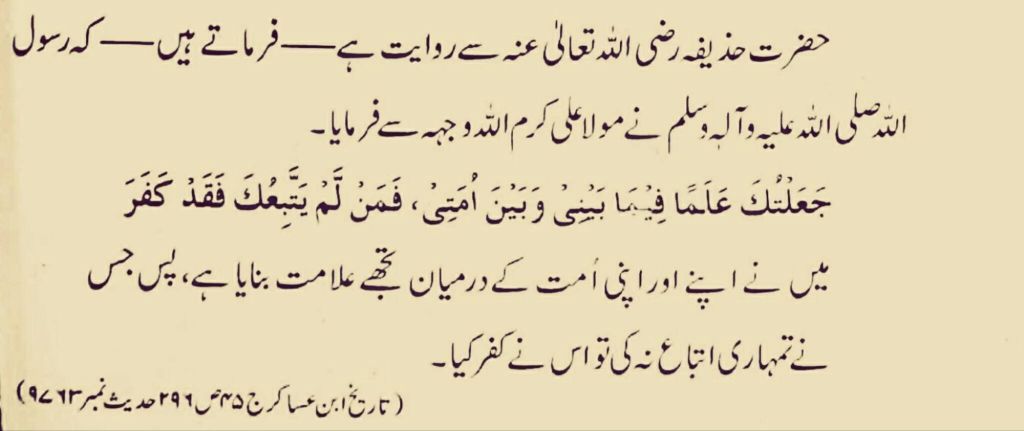
Hazrat Huzaifa رضی اللہ تعالی عنہ Se Riwayat Hai Farmate Hai ke Rasool Allah صلی اللہ علیہ و آلہ وسلم ne Maula Ali علیہ السلام se Farmaya
Maine Apne Aur Apni Ummat ke Darmiyan Tujhe Ala’mat banaya Hai,Pas Jis Ne Tumhari Itteba Na Ki us Ne Kufr Kiya..


“Tareeq Ibne Asaqir, Jild 45, Safah 296, Hadees Number, 9763”

Dozakh Ko Haram Kar Diya Hai

Hazrat Bibi Noor Sayyidah Fatimah Zahra Se Mohabbat Karne Waalo Par Allah Ne Dozakh Ko Haram Kar Diya Hai 👇🏻

Hazrat Jabir Bin Abdullah (RadiAllahu Ta’ala Anhum) Se Riwayat Hai Ki RasoolAllah (Sallallahu Alaihi Wa Aalaehi Wa Sallam) Ne Farmaya : Meri Beti Ka Naam Fatimah is Liye Rakkha Gaya Hai Ki Allah Ta’ala Ne Usay Aur Us Se Mohabbat Rakhne Waalo’n Ko Dozakh Se Alag Thalag Kar Diya Hai.

___

Hazrat Abdullah Bin Mas’ood (RadiAllahu Ta’ala Anhum) Se Riwayat Hai Ki Huzoor Nabi e Akram (Sallallahu Alaihi Wa Aalaehi Wa Sallam) Ne Farmaya : BeShak Fatimah Ne Apni ismat Wa Paak Daamani Kee Aiesi Hifaazat Kee Hai Ki Allah Ta’ala Ne Usay Aur Us Kee Aulaad Ko Aag Se Mahfooz Farma Diya Hai.

____

Subhan Allah 💚

References 📗 :

Daylami Fi Musnad-ul-Firdaws, 01/346, Raqam-1385

Hindi Ne ‘Kanz-ul-‘Ummal 12/109, Raqam-34227

Sakhawi ‘Istijlabu Irtiqa’-il-Ghurafi Bi-Hubbi Aqriba’ Ar-Rasooli SallAllahu Ta’ala Alaihi Wa Aalaehi Wa Sallam Wa Dhaw-ish-Sharaf Safah : 96

Tabarani Fi Al-Mu’jam-ul-Kabir, 22/407, Raqam-1018

Bazzar Fi Al-Musnad, 05/223, Raqam-1829,

Hakim Fi Al-Mustadrak, 03/165, Raqam-4726,

Abu Nu’aym Fi Hilyat-ul-Awliya’ Wa Tabaqat-ul-Asfiya’, 04/188

Sakhawi Fi Istijlabu Irtiqa’-il-Ghurafi Bi-Hubbi Aqriba’ Ar-Rasooli SallAllahu Ta’ala ‘ Alaihi Wa Aalaehi  Wa Sallam Wa Dhaw-ish-Sharaf, 01/115, 116

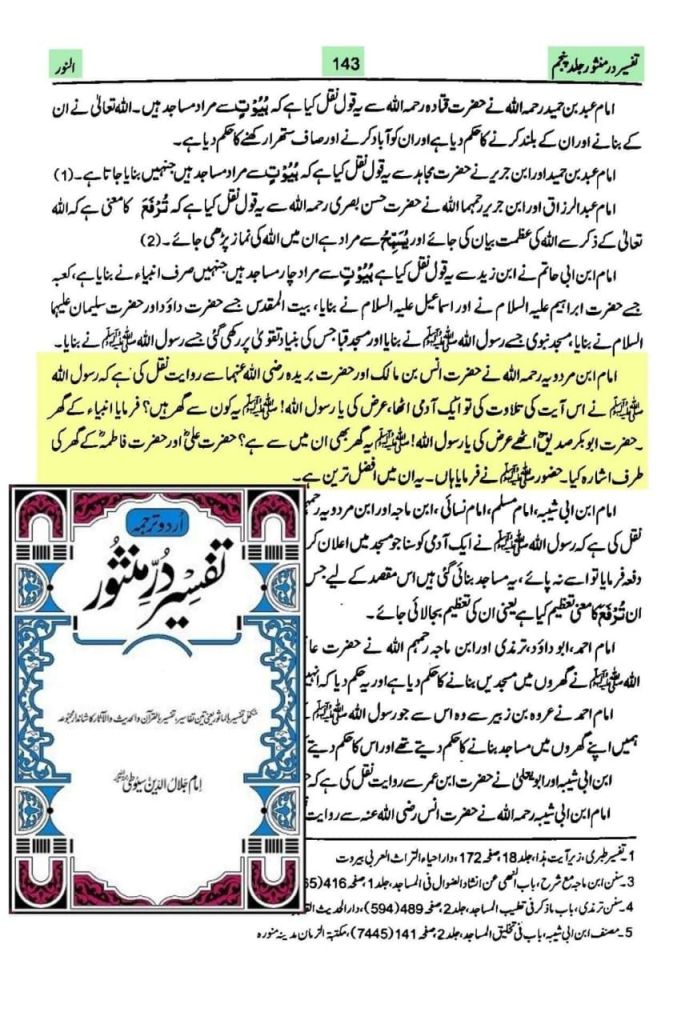
घरों से अफ़ज़ल है

*रसूल अल्लाह ﷺ ने हज़रत अबूबकर से फ़रमाया कि अली عَلَیهِ‌السَّلام और फ़ातिमा س का घर नबियों (ع) के घरों से अफ़ज़ल है।*
*رسولِ خداﷺ نے حضرت ابوبکر رضی اللہ عنہ سے فرمایا:*
*علی و فاطمہ کا گھر انبیاء کے گھروں سے افضل ہے۔*
👇


*तफ़सीर ए दुर्रे मंसूर जिल्द -5 पेज नंबर 143  (अल्लामा जलालउद्दीन सुयूति र अ)*

The Story of Safīnah and the Lion.

■ The Story of Safīnah and the Lion.

One of the remarkable narratives from the early Muslims concerns Safīnah, a mawla (freed servant) of the Prophet Muhammad ﷺ.

His mother freed him on the condition that
he would serve the Prophet ﷺ for life, and he honored that pledge with devotion and humility.

After the passing of the Prophet ﷺ, Safīnah continued to live a life of sincerity and service. On one occasion, he set out on a journey toward the sea.

During this voyage, his ship was struck by disaster, broken apart by the waves, and he was cast into the water.

Clinging to a large piece of floating wood, he drifted until he reached an uninhabited island covered with thick bushes and wild terrain.

Exhausted from the ordeal, he dismounted
and tried to find shelter and water.

As night approached, he found himself alone in the wilderness, facing uncertainty and danger. Suddenly, a lion appeared.

For any traveler, a lion would be terrifying a creature feared for its strength and ferocity.

But Safīnah remembered that he was the mawla of the Prophet ﷺ and acknowledged this truth in his heart. He softly spoke to the lion:

“O Abu al‑Harith, I am Safīnah, the servant of the Messenger of Allāh ﷺ.”

Upon hearing this, the lion did not attack him. Instead, it lowered its head and came closer without aggression.

Then, it gently nudged him with its shoulder,
as if guiding him through the difficult terrain.

The lion walked beside him, ensuring he was led out of the wilderness and onto a path that would ultimately lead him to safety.

Once Safīnah was on the right way and no longer in immediate danger, the lion stopped, gave a low growl that seemed like a farewell, and then disappeared back into the bush.

Safīnah continued his journey to safety and eventually rejoined people who could assist him.

He lived the remainder of his life known for this extraordinary incident not as a boastful tale, but as a reminder of how Allāh’s honor toward His sincere servants manifests in unexpected ways.

▪︎ Source:

1. Al‑Hakīm al‑Mustadrak
In Kitāb Ma‘rifat al‑Ṣaḥābah (vol. 3, p. 606)
2. Hilyat al‑Awliyā’ by Abu Nu‘aym al‑Aṣbahānī
(vol. 1, p. 368)
3. Dalā’il al‑Nubuwwah by Al‑Bayhaqi