SCIENTIFIC MIRACLES IN THE COLOR OF HONEY AND ITS RELATIONSHIP TO KIDNEY STONES

SCIENTIFIC MIRACLES IN THE
COLOR OF HONEY AND ITS RELATIONSHIP TO KIDNEY STONES

Ahmed bin Stal

. • Chemistry teacher at the University of Aljelfa


God says in the Qur’an:

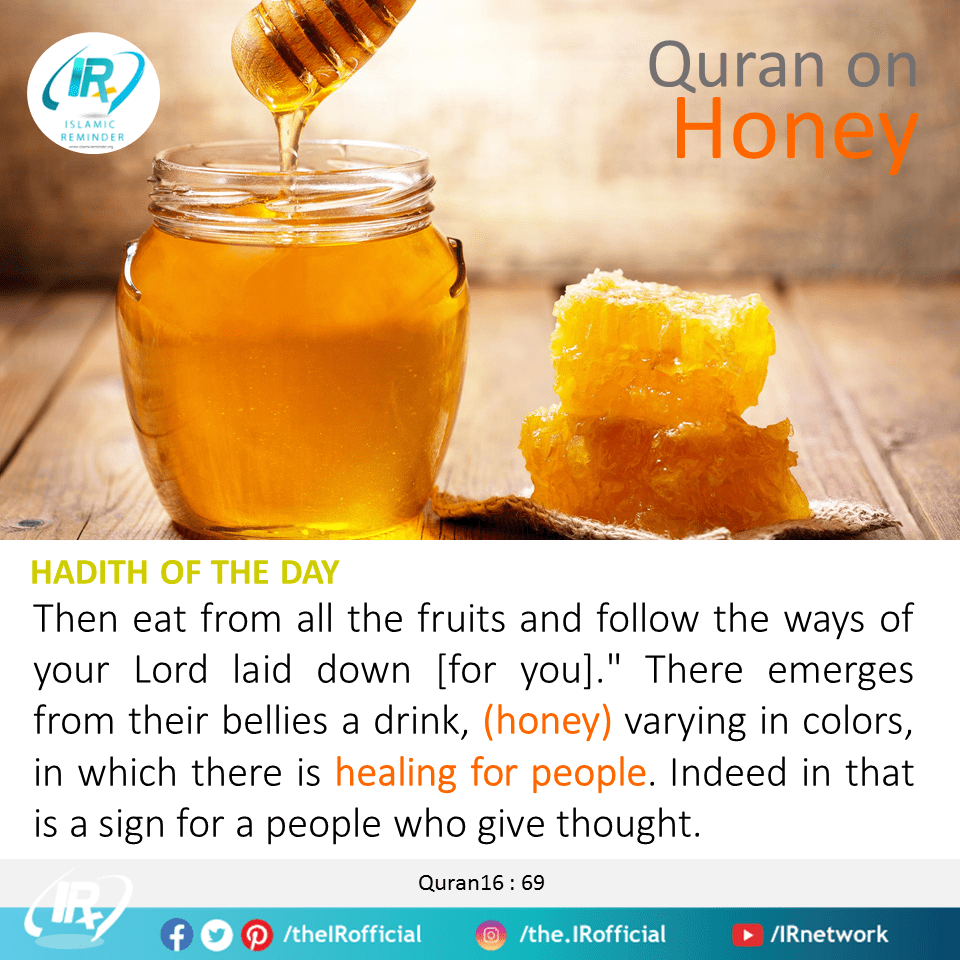
“And your Lord inspired to the bee, “Take for yourself among the mountains, houses [i.e., hives], and among the trees and [in] that which they construct. Then eat from all the fruits and follow the ways of your Lord laid down [for you].” There emerges from their bellies a drink, varying in colors, in which there is healing for people. Indeed in that is a sign for a people who give thought.” (Surah an-Nahl, 16:68-69)

(B) Scientific truth associated with the text

Honey has different colors like the transparent and the bright white, the light, the very light and the dark amber. All of these dyes are derivatives of chlorophyll and carotene and the xanthophylls and other unknown pigments. The most common factor affecting the color of honey is the amount of mineral salts which if present in excess, cause the darker coloration of the honey. The different chemical composition of the soil also affects the color of honey because the flowers’ nectar depends heavily on what minerals the plants absorb from the soil.

Kidney stones are solid masses composed of very small solid crystals. They vary in size from the very small, which could not be seen by the naked eye, to the large. These stones are formed in the pelvis of the kidney, in the ureters or can even move to the bladder. This may cause an obstruction in the urinary tract or diminish its drainage which may lead to its inflation or to severe infections.

Kidney stones are of several types, including:
1. Calcium Stones: which, in turn have many types: calcium oxalate, which constitutes 70% to 80% of the stones and calcium phosphate.

2. Mixed Infective Stones: constitute 15% of the total urinary stones and are more frequent in women.

These stones appear as a result of a defect in the metabolism of calcium and phosphorus in the body. Any rise of calcium and/or oxalates in the urine would lead to the formation of relatively insoluble calcium oxalate in the urine which represents the majority of kidney stones, especially among men.

Often, researches concerning the scientific miracles match between the scientific truth and the Qur’anic text or the Hadith. However, in our research we are trying to link between what was said in the verse about the different colors of honey drink and its various effects and impact on the different kinds of kidney stones. Relying on the method of application, we will also show how the Lord Almighty linked the cure with the different colors.

In our lab we chose two types of honey with different colors, trying on one hand to determine by experiment the effect of each type on the form of the kidney stones and on the other hand to see why the Prophet, peace be upon him, recommended to drink the solution of honey. Moreover, wewill show how using honey dissolved in water with different proportions show different results.

(C) The miracle found in the text:

The recommendation of Prophet-Pease Be upon Him-to drink the solute of hony was miraculous. This was seen by obtaining the relation between the drink of verying colors mentioned in the previous verse and the formation of the kidney stones.

Section 7b – Marriage and related issues

Section 7b – Marriage and related issues

The second praiseworthy category of necessity is that which is excellent in large quantities, and this category includes such matters as marriage and rank.

It is praiseworthy for a man to have more than one wife, referring to the Prophet, praise and peace be upon him, Abbas’ son said, “The best of this community is the one with the most wives (also reported is “the best of this community is she who gives birth).”

The Prophet, praise and peace be upon him, forbade celibacy because marriage protects appetites from straying, and said, “Whosoever is able to marry should marry, it lowers the eyes and protects the private parts.” It is for this reason that the scholars of Islam say that it is not a matter that detracts from the virtue of abstinence.

When one examines the examples of the Companions, it is found that the most abstemious among them had wives and were sexually active with them and those whom their right hand possessed. Many disliked the thought of meeting Allah unmarried.

The question has been raised, “How can marriage be so virtuous when Allah praised, Prophet John, son of Prophet Zachariah for being chaste? And how is it that Allah praised him for not doing something that is considered to be a virtue. In addition, Prophet Jesus, son of Mary also remained celibate. If it is as you say, would they have married?”

In answer to this question indeed Allah praised Prophet John for being chaste, and it was not, as someone once said, that he was weak or not masculine. This derogatory remark has been rejected by knowledgeable scholars and perceptive commentators on the grounds that it implies imperfection and fault, neither of these characteristics befit any of the prophets of Allah. What it does mean is that (in his state of celibacy) he was protected from wrong actions, it is also said that he was detached from all bodily desires and had no desire.

From this it is understood that marriage is a desirable virtue whereas there is an imperfection in those who are able to marry but do not. The inability to marry may be counteracted with the virtue of striving. Prophet Jesus was perfect and

strove. In the case of Prophet John, he was given sufficiency from Allah.

Marriage frequently distracts one from the remembrance of Allah when this is

SO a person is attached to the world. There are those who marry and fulfill the obligations of marriage without being distracted from the remembrance of Allah and these people attain a high rank before Allah. This high rank is found in Prophet Muhammad, praise and peace be upon him, who had several wives but was never distracted from his worshipping. Rather, it increased him in worship because he protected his wives, gave them their rights, provided for them and guided them to the worship of Allah.

The Prophet, praise and peace be upon him, said, “Allah caused me to love women and perfume in this world of yours, but the coolness of my eye (my delight) is in prayer.” What he implied was that whereas other people have the love of women and perfume, for them such matters belong to worldly affairs, however his involvement with them was not for this worldly life but rather for the Everlasting Life because he was anxious to be wearing perfume when he met angels.

Above these worldly affairs, his passion which was distinctly for him, was the witnessing of the angelic hosts of his Lord and the closeness of conversation with Him. It is for this reason that he made a distinction between the two loves by separating the two conditions in his saying “and the delight of my eye is in prayer.”

There is, however, an extra virtue the satisfaction of satisfying a wife’s need. The

Prophet, praise and peace be upon him, was given an abundance of this ability and would visit all of his wives in the same hour. Anas and his companions concluded that he had been given the power of thirty men. Others such as Tawas said, “In the matter of sexual intercourse, the Prophet was endowed with the power of forty men.” After having visited each wife he would take a purification bath before going to the next and said, “This is better and purer.”

Prophet Solomon and Prophet David were endowed with the same ability. Prophet Solomon said, “During the night I visited a hundred or ninety-nine women. Abbas’ son said, “In the loins of Solomon there was the semen of a hundred men, and he had three hundred wives and three hundred whom the right hand possesses.” It has also been reported that he had seven hundred wives. As for Prophet David, he had ninety-nine wives.

Prophet Muhammad, praise and peace be upon him, was sent during a time in which it was common-place to have forty wives. He reduced the number of wives


a man could have to four, and made it conditional when marrying more than one that justice must prevail and each should be evenly treated, if this cannot be established, then a man should only marry one wife.

Anas reported that the Prophet, praise and peace be upon him, said, “I have been preferred over my nation in four things – generosity, courage, abundance of

sexual intercourse and great power.”

The Prophet, praise and peace be upon him, was a modest person. Even in the hearts of those who rejected, injured him and his Companions or tried in secrecy to harm him he was well regarded. When he met them face to face they became respectful and gave him what he requested.

There are many reports of the experiences of people who met him, when Kayla saw him she began to tremble on account of timidity but he calmed her gently saying, “Poor girl, you must be calm.” The father of Masood reported that a man came before the Prophet, praise and peace be upon him, and started to tremble, but the Prophet, praise and peace be upon him, straight away put him at ease saying, “Relax, I am not a king.”

Miracles of the Saints:Muhammad Ibn  Hasan Muneer Samanoodi Misri.

Muhammad Ibn Ibn Hasan Muneer Samanoodi Misri

Shaykh Muhammad Ibn Hasan Muneer Samanoodi Misri’s villagers once dug a well. They dug deep and deep into the ground but didn’t come across any water. They became helpless and asked the Shaykh to stand at the well and with his heart to summon the water. On their request the Shaykh accompanied them,when he arrived at the designated place he read Surah Fatiha, prayed to Allah and asked the villagers to dig. As soon as they began digging water began flowing in abundance just as a river flows freely. (Jame’ Karamaatul Auliya)

The Superiority of Ali Recognised by his Contemporaries


Abu Bakr, the first Caliph of Islam, at one time said, “It would be difficult indeed for any one to pass through the bridge of “Sirat”, on the Day of Judgment without getting a permit from Ali, because this is what I have heard from the Holy Prophet.”

(Sawai’q Muhair’qa)

Umar the Great, the second Caliph of Islam, related that once the Holy Prophet said, “If the faith of the inhabitants of the seven Earths be put on one side of the scale, and that of Ali alone on the other side, verily Ali’s side will weigh heavier than the other.

According to Imam Shafi, Ali will judge mankind and allot them paradise and hell. He was the leader of men and Jinnis, a true testator of the Holy Prophet. If the followers of Ali are “Raffidhes “(the hetrogenous sect of Shias) verily I am one of that sect. Ali at the time of the breaking of idols in the Kab’ah put his feet on that shoulder where God had put His hand on the ‘Night of Miraj’ and verily Ali was that man into whose eyes was shone the light of God.”

Once, Imam Ahmad asked his father, Imam Han- bul, as to who was superior, Mu’awiya or Ali, to which query Imam Hanbul replied, “Ali had numerous enemies and all of them tried to find fault with him but they searched in vain and could not find any flaw in him. At long last they joined hands with Mu’awiya and declared war on Ali. When they failed to defeat him by fair means they took to treacherous and deceitful courses to harm him.”

Ibn Athir says, “Ali was the first Caliph both of whose parents were pure Hashmites and who was so judicial minded that he could not put up with the dishonesty of his relations or friends and was so much engrossed in piety that at the time of his marriage with Fatima, he did not possess anything save a camel skin, on which he fed his camels in the day and which he converted into a bed sheet at night. The Prophet in his table talk has not extolled any of his companions as much as he has Ali. Surely Ali never spoke a lie in his life-time.”. Some one asked the Ummayyad Caliph, Umar bin Abdul Aziz (717-20 A.D.) as to whom he considered the most pious man in the world, to which query he replied, “Ali excelled mankind in piety. Not only did he practise its virtues but he tried zealously to reform his friends, associates, acquaintances and all those who came in contact with him.”

Ibn Masud used to say that throughout Arabia there was no more impartial judge than Ali. Abu Saeed Khudiri held that he could casily detect a hypocrite by his enmity towards Ali.

Abdullah ibn Abbas used to say that should schism. seep into Islam, it would be bounden duty of the Be- livers to take firm hold of Ali (i.c. his teachings) and the Qur’an for I have heard the Prophet say, “Ali was the first to believe in me, he will be the first to meet me in Paradise and will be the greatest discriminator of truth from falsehood, he is the leader of all the Believers, he is the ‘Sadiq-i-Akbar’ (The great truthful one) and is that door (of faith) the entry into which will lead to Paradise.” ibn

(Munaqib Murwaiyia)