Al-Baghdadi’s Method for Finding Equivalent Numbers
Al-Baghdadi gives a very elegant method for finding Equivalent numbers. The method is best illustrated with an example. Suppose one is attempting to find equivalent numbers n and m such that their proper divisors add up to, say, 23. In mathematical terms, given a positive integer k, we attempt to find n and m such that σo(n) = oo(m) = k. Below is the algorithm for finding equivalent numbers:
1. Subtract 23 from 1. Next, find two distinct prime numbers such that, when summed, they equal 22.
5 2. These two pairs are (3, 19) and (5, 17).
3. Next, multiply out each set separately. So, 3 19 = 57 and 5.17 = 85
4. The resulting numbers, 85 and 57, are then equivalent numbers.
One can follow this method for any positive integer k. Al-Baghdadi, however, stipulates two contingencies to this method: “But, whenever one subtracts from the [given] number 1 and the remainder is in no way divisible into two unidentical primes, or is so only one way, the said rule will fail” [21].
Discoveries in Number Theory
The discipline of Number Theory relies heavily on advancements in calculus, abstract algebra, and formal logic. Thus, number theory was weakly studied during the time of the Islamic civilizations. Only historically recently has number theory burgeoned due to advancements in calculus and abstract algebra, yet it is quite astonishing to learn that, even before such highly advanced discoveries and methods, two significant results in number theory were discovered, only using premodern algebra
Covering this aspect of the character of the grandson of the Prophet [s] by no means signifies a difference among the guiding Imams [a] in this respect, or in any other ingredient of the ideal Islamic character. They are equal in this. We will confine ourselves to presenting some narratives of the Imam’s behaviour with the people. We hope that his morals are the ones which we adopt and follow.
His Modesty
It is reported that he once chanced upon some poor men who put a few crumbs of bread on ground in front of them which they had earlier picked up from the road. They were eating them. They invited him to eat with them. He accepted the invitation and said:
“Certainly Allah does not like the proud.”
Having finished eating with them he invited them to his house. He showered them with money, fed and clothed them.
1. Imam Hasan [a] reportedly passed by some boys who were eating. They invited him to share their food with them. He accepted their invitation, then called them to his house and generously rewarded them.
2. It is reported that he was sitting in some place. When the Imam [a] rose to go, a poor man came in. The Imam [a] greeted him, and spoke kindly to him. “You have come at the time when I was taking leave,” he said to the man. “Do you permit me to go?”
“Yes, O son of the Messenger of Allah,” replied the man.
“The Prophet (s.a.) entered the grave prior to Interment of Hazrat Khadija. Till that time, there Was no order for offering Salat al Janaza. n Ansaab al Sharaf, Vol 1, Page 406 “9
This is the list of baseless doubts that people have concocted to prove the infidelity of Abu Talib. The faith of Abu Talib is supported with the sayings of the Prophet (s.a.) and the Ijma of the Infallible Imams (a.s.). Every right thinking person can read through the bias of the critics of Abu Talib and see through the thin veneer of doubts they try to create in the minds of people.
Hazrat Abu Talib was the protector of the Creed and the supporter of the Faith of Islam. He was like a protective rampart for the Prophet (s.a.) and an invincible fort. He confronted severe difficulties with courage and at no moment he raised the slightest objection for coming to the help of Mohammed (s.a.) and his Divine Mission. He acted with the same zeal, during his long association with the Prophet, when he was young and also when he was a grand old man! Even on his death bed his mind was occupied with the thoughts of protecting Islam and its founder! Therefore, facing the difficulties at Shaab e Abu Talib, his health deteriorated beyond repair. He called up the Sheiks and elite of Qureish and advised them to be trustworthy, truthful, generous, charitable to the poor, to respect the Kaaba and to protect and help the Prophet (s.a.).He said:
“I make a will that you do good to Mohammed (s.a.). He is a custodian (Ameen) in the Tribe of Qureish and a Siddeeq (truthful person) for the Arabs. He has all the qualities which I have willed you to cultivate. He has brought a Thing about which the hearts are convinced and the tongues are silent because of fear of enmity. By Allah! I am visualizing the scene when the poor of Arabia and the Bedouin of the neighborhood and the weak saying “Labbaek” to his call! Mohammed (s.a.) has entered the whirlpool with them and The elite of Qureish have been belittled, the chiefs ridiculed and their homes rendered desolate. The poor and the weak have come to the positions of power and the elite are subjugated to Those who are far away are drawing benefits. Arabs have turned his sincere friends and with purity Of hearts have become his well-wishers. They have entrusted to him their leadership. group of Qureish: O You should also become The friends and supporters of Mohammed (s.a.). By Allah! Whoever treads the path shown by him, he will get the Guidance and
them.
whoever follows his ways, will be felicitous. If I had some more life in me and there was
Some delay inmy inevitable death, I would shield him from
The attacks of his enemies and protect him against difficulties!”
–Samarat al Awraq, Vol 2, Page 13
After this general advice, he turned to the Progeny of Abd al Mutallib and said:
“As long as you keep paying heed To Mohammed (s.a.)’s words, and follow his precepts, Felicity and benefit will come to you. Follow him and give him a helping hand, you will remain On the path of guidance!”
Eulogising about the truthfulness and the trustworthiness of the Prophet (s.a.), during his last moments, Abu Talib advised his family to seek knowledge and guidance following him. If a person doesn’t acknowledge and bear witness to the Prophethood of Mohammed (s.a.), then there is no use of his existence. Are these words of wisdom and enlightenment not the proof of his Faith in Islam?
When he was through with his will to all concerned, the signs of impending death emerged on his face. The color of his face changed and his forehead developed the pearls of sweat. The biggest supporter and protector of the Prophet (s.a.) breathed his last. His passing away cascaded an avalance of sorrow on the Prophet (s.a.). Tears welled in his eyes and in a hoarse voice he told to Ali (a.s.):
“Go, give him Ghusl-e-janaza, wrap him in the shroud
And make arrangements for his interment. May Allah
Give him maghfirat (absolution) and keep him in His Blessing.”
Ref: Tabaqaat Ibne Saad, Vol 1, Page 105
The Prophet (s.a.) nominated Hazrat Ali (a.s) to the task of preparing his father for the last rites, although he was the youngest of his brothers. The only reason for this change from the normal social custom of assigning such duties to the eldest brother was that Aqeel and Talib had’nt embraced Islam till their father had passed away and Jafar, although in the fold of Islam, was away in Abyssinia. This act too throws light on the Faith of Abu Talib. If he was an infidel, there would be justification for entrusting this duty to one of his sons who was still living in infidelity. Thus, after all the preparations, the Prophet (s.a.) looked at his beloved uncle in his shroud, cried and said:
“O uncle! You have brought me up in my childhood,
You gave me, an orphan, your profound love and maintained me. On my growing up you gave me support. May Allah give you Good Reward
On my behalf!”
Ref: Tareeq e Yaqoobi, Vol 2, Page 26
When people started carrying the bier, the Prophet (s.a.) supported it with his shoulder from start of the journey till it reached the graveside. He participated in the interment of the mountain of patience and courage at the foot of the Mount Hajoon.
For the Prophet (s.a.) the passing away of Abu Talib was a big calamity. He was his biggest supporter and promoter. The Prophet (s.a.) was now left in the midst of sworn enemies to contend with them. Although statistically Muslims were a sizeable group now, there was none of the caliber and
position of Abu Talib who could confront the tyranny of the Qureish with some degree of success. It was logical that the nefarious activities of the Qureishincreased with the death of Abu Talib. Ibne Hisham writes:
“When Abu Talib died, the Qureish gave so much trouble to the Prophet (s.a.) that during the living days of his uncle, they couldn’t have had desire of putting him through such hardship.” Ref: Serat Ibne Hisham, Vol 2, Page 58
The sadness of Abu Talib’s death was still fresh when, after a month and five days of his demise, Janab Khadija passed away. This tragedy too had a profound saddening effect on the Prophet. He was so much affected with these two deaths that he named that year as Aam al Huzn – the Year of Sorrow! He said:
“Those days two calamities struck the Umma.
I cannot say which one is the greater cause of
Sorrow for me!
-Tareeq e Yaqoobi, Vol 2, Page 26
The Prophet (s.a.) termed the passing away of Hazrat Abu Talib and Hazrat Khadija as great calamities for the Umma. The reason was that in the early days of his ordainment as the Prophet (s.a.) the two stood with him as strong pillars of support. Hazrat Khadija sacrificed her entire wealth for the Mission of the Prophet (s.a.) and Hazrat Abu Talib stood like a rock between him and the forces of tyranny. These two deaths, which were a calamity for the person of the Prophet (s.a.), were certainly calamitous for the Umma as well!
The people of Makka mourned the passing away of the chief of the Qureish, the scion of Abd al Mutallib, the Raees e Batha, Abu Talib. Hazrat Ali (a.s.) penned elegies on the death of his beloved father..A few couplets of one of the elegies are given here:
“Aba Talib asmat al mustajir Wa ghais al mahol wa noor al zulm O Abu Talib! You are the Place of Peace for those seeking refuge Rain bearing cloud in drought and a light in the darkness! Laqad had faqadak ahl al hafaz Fasali alaika wali al naym On your death the people with modesty are saddened. May Allah shower His Bounties on you. Wa laqak Rabbak Rizwana Faqad kunta liltahr man khair am May Allah’s Beneficence be on you. You were the best (beloved) Uncle of the Prophet (s.a.)” Ref: Tadkira Sibt ibne Jauzi, Page 6.
Nara-e-Hayder Nawai Buzor Ast, Gar Che Az Halqi Bilalo Qamber Ast
In this couplet Iqbal says that Islam had unified the Muslims in their thought and words. Abu Zar a companion of the Prophet (s.a.w.) and Bilal and Qamber who were only slaves always utter in one and the same sentence from lips. Thus their thought and speech did not differ from one another. Iqbhl by saying this, wishes that all Muslims of today should follow this track and should not make difference between themselves.
COUPLET 2
Chonn Ali Dar Saz Ba Nan-e-Shaeer, Gardane Marhab Shikan Khyber Be Geer
Hazrat Ali (a.s.) used to lead a very simple life. His meal contained bread of barley flour. Sometimes he would eat stale loaf of bread with water and despite this dry and ordinary food, God granted him victory in the battle of Khayber. When even Abu Bakar and Umar failed to conquer the fort of Kamoos, the Holy Prophet (s.a.w.) said “Tomorrow I will give the flag of Islam to the bravest man, whose power is unparallel, and, God would grant victory
through him. He is true lover of God and the Apostle of God, and God and his Apostle love him deeply.” So next morning the flag of Islam was given by the Holy Prophet (s.a.w.) to Hazrat Ali (a.s.) and when Hazrat Ali (a.s.) advanced with his renowred Sword Zulfiqar and carrying the flag of Islam towards the fort, the veteran warrior of the forces of enemy, whose name was Marhab, came forward and stood before Hazrat Ali (a.s.) reciting loudly the songs in self praise to frighten Hazrat Ali (a.s.). Marhab was verily a famous warrior and brave soilder well-skilled in the art of fighting. “Khayber knows that I am that Marhab who is the adorner of the arms. I am the bravest of the brave. I show my valour and skill?” Hazrat Ali (a.s.) in response spoke aloud: “Beware! I am not unknown to the world. I am the man who was named Hayder (the killer of the lion) by my mother. I am a fierce lion for my enemies and I am here to entertain the bravest combatant with the sharpness of sword just as a lion meets its pray”. With this exchange of words they fought fieriously and Hazrat Ali (a.s.) in one stroke of his sword beheaded Marhab and thus the pillar of the pride of didbelievers fell down.
Hazrat Ali (a.s.) after killing him broke open the weighty iron door of the fort and conquered it. This was a glorious victory for the Muslims and proved long stride in the glory of Islam.
Allama Iqbal by referring to this historical miracle of the valour and strength of Hazrat Ali urges the Muslims of today to follow Hazrat Ali who despite a simple life possessed matchless strength. Hazar Khayber o Sad goona Azdarast eenja, Na har ke Nane Javeen Khurd Hayder donad
Iqbal says that there are thousands of Khaybers (forts) and serpents around us, but it is not possible for us to subdue these formidable enemies. Hazrat Ali (a.s.) had renounced all worldly comforts. He contented himself with bread of barley throughout his life but God Almighty had endowed him with such strength that he conquered the famous fort of Khayber single-handed and tore off the jaws of a serpent while still a child. But according to Iqbal every one who eats bread of barley or renounces worldly pleasures cannot claim to possess the qualities of Hazrat Ali (a.s.). In fact it was God given strength which Hazrat Ali (a.s.) possessed and which no one on earth could match.
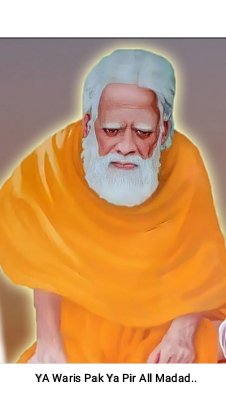
Our Saint for our correct guidance repeatedly mentioned those things which are forbidden and cause injury to our way of life. He taught affectionately to avoid them, which is obligatory for one who aspires to reach the Divine proximity. It is positive proof that it fosters a noble heart and a special system of knowing God. By his instructions one group of his devotees became patched mendicants and their way of life was similar to ascetics and free from worldly burden.
The other group though engaged in worldly occupation are full of love and have a leaning towards mysticism. Among this group he advised Mustaqeem Shah not to open his eye, Hafiz Gulab Shah Saheb to me awake day and night, Abdul Razaak Shah Saheb not to speak and to Qadar Bakhsh Saheb to abstain eating vegetables, beef meat or birds.
His instructions to mendicants were general, to avoid mean matters; it was unlawful to hoard worldly. It is necessary for a Pir to sacrifice his life in the cause of God and not to amass any worldly wealth. He also stressed that a Pir is one who owns nothing, never to rely on anyone except God, he should not hoard for the morrow, should not seek help from anyone other God. A Pir is imperfect if he calls anything his property. One who makes profession a means of subsistence is not a mendicant.
It is the dignity of a Pir to be free, independent and self-less should never fear adversity, never complain if any trouble occurs because hardship and comfort are God given and if so to who should he complain? A Pir is one who for love of God should obliterate himself. A Faker is one who has no capital in this world and after life. A Pir is one who maintains his behaviour and manners. One who relies on God succeeds and one who trusts humanity he loses. A Pir is on who should not think of other except God. A Pir is one who is always contented with God and is absolutely aloof from this world. A Pir should not pray for a friend or curse an enemy. A Pir should never indulge in making amulets or knotted strings.
Our Saint often advised mendicants not to sit on a stool or sleep on a cot. The leaven of man is mud and he should merge himself in mud. It is obligatory for a mendicant to make the hard floor his bed. To sit on stool or couch causes pride, to sit on the floor is a proof of his humility.
What Sarkar Waris preached he practised, he never made use of a stool or couch for his comforts and always slept on the bare ground. Sarkar Waris refrained from leading the prayer as it suggests his superiority and he disliked this temporary honour.
He advised his disciples never to wreak vengeance even on an enemy. Thus precepts and practices were the unique way of his advice and instructions. He instructed his disciples to carry out the practice in full. Breaking promise is a sin, greed is a prelude to dishonour. When common sense is subdued the symptom of greed raises its head. Envy is an ignoble quality and it spoils one’s faith. One should adopt the distinctive quality of the earth it bears the burden of all and never shift its load on others, one should hide one’s good deeds and never discern evil in anybody.
A patched clothed dervish said that according to instruction he was invoking the name of god during the last hours of the night but lacked concentration and sought remedy. The Saint advised that he should not at all think about others. It is the courtesy of love that to a lover everything belonging to the Beloved appears good to him. Just as the legendary lover Majnu appreciated the dog of his beloved Laila. For if one views God’s creatures with good intention the heart’s condition will become proper. Sarkar Waris also said never to speak ill of anybody’s religion.
For example it is narrated that Maulana Rumi during his last days never differed with precepts and practices of different sects of Islam. A high ranked Muslim jurist to corroborate this, sent two of his students of Maulana instructing them to abuse him and find out this truth. Accordingly they met Maulana and abused him to which he meekly replied ‘I respect the feelings or others about their beliefs”.
Sarkar Waris further stressed on his disciples that to contract dept is a reprehensible act and is a slur on their dignity. If one forwards a loan should not expect its return. If credit is given with the object of getting it back, it is against love. In Divine love as well as mystic law they will reach divine vicinity if they avoid mutual bickering. Whatever they do they should do it relying on God. Selflessness increases modesty. Ego separates a disciple from his guide. Obscurity should be regarded as a friend and publicity should be avoided. The yearnings of one’s base self keeps one away from God. But to act against one’s appetite is prayer. To be friendly with the heart’s urgings corrupts one.
The steps to a disciple’s success are good manners. The love of this world would deprive one of the advantages of the Hereafter world. The root of all evil is this mundane world. One who fears t.r,uth is not afraid of humanity and one who fears God is afraid to commit sins. If one is struck with adversity one must be patient and offer thanks when in comfort.







 Aal-e-Qutub Aal-e-Syed Abdullah Shah Ghazi