Volume 1, Parts 1.62.1 Muhammed Ibn Umar al-Aslami informed us; he said: Mamar Ibn Rashid related to me on the authority of al-Zuhri, he on the authority of Abu Umamah Ibn Sahl Ibn Hunayf and ‘Urwah, (the latter) on the authority of Ayishah; they (AbuUmamah and ‘Urwah) said: When the party of seventy persons returned, the Apostle of Allah, may Allah bless him, was much pleased that Alláh had provided him with supporters and had helped him through men of martial spirit and valour. In the meantime the unbelievers had intensified their tyranny on Muslims since they had learnt of their migration. Consequently they had rendered their life miserable. They committed cruelties and showered abuses which they had not yet used. The Companions of the Apostle of Allah, may Allah bless him, complained to him and asked him to permit
them to migrate. He said: I have been shown the place of your migration I have been shown a tract of moorland full of date-palms between two stony places. Had al-Sarát been the place of date-palms and moorland, I would have said it was this. He waited for a few days and looked happy when he came to his Campanions and said: I have been informed of the place of your migration; it is Yathrib; he who likes may go to it. The people began preparations helping and supporting each other and keeping it a secret. The first person from among the Companions of the Apostle of Allah, may Allah bless him, to arrive at al-Madinah was Abu Salamah Ibn Abd al-Asad. After him came 'Amir Ibn Rabi'ah with his wife Layla Bint Abi Hathmah. She was the first woman to arrive at alMadinah. Then the Companions of the Apostle of Allah, may Allah bless him, came in a group. They stayed in the houses of Ansàrs who provided them with shelter and supported and helped them. Salim the mawla of Abu Hudhayfah used to lead the Muhàjirs in prayer at Quba before the arrival of the Apostle of Allah, may Allah bless him. When the Muslims came out to migrate to al-Madinah, the Quraysh behaved rabidly towards them, fought them and became angry with those of their young men who had left. The Ansàrs after having offered hay'ah to the Apostle of Allah, may Allah bless him, at al-Aqabah on the second occasion, had retired to alMadinah. After the first batch of immigrants had reached Quba, some of them (Ansárs) came to Makkah and then migrated with the companions; they are known as Immigrant Ansárs. (Muhajrun Ansariyun, they had come to Makkah to return to al-Madinah as muhajirs, so that they might get the reward of hijrah.) Their names are Dhakwán Ibn Abd Qays, 'Uqbah Ibn Wahb Ibn Kaldah, al-'Abbas IbnUbadah Ibn Nadlah and Ziyàd Ibn Labid. (Subsequently) all the Muslims migrated to al-Madinah and none remained at Makkah, except the Apostle of Allah, may Allah bless him, Abu Baker and `Ali, besides those who were imprisoned or were ill or too weak to migrate
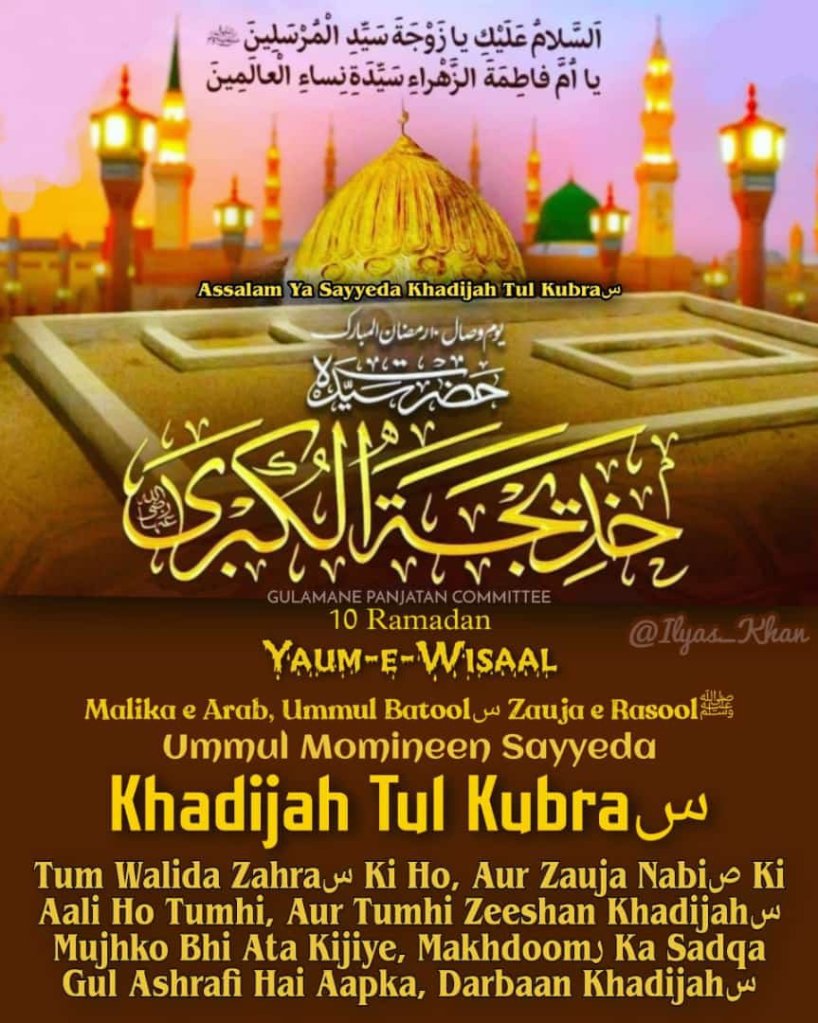
Hazrat Abu Huraira Razi Allahu Tala Anhu Bayan Karte Hain:- Ke Sayyedna Jibraeel Alahis Salam Rasool Allah ﷺ Ki Khidmat Me Hazir Hue Aur Arz Kiya Ya Rasool Allah! Ye Khadija Salamullah Alaiha Aapki Khidmat Me Hazir Hain Inke Paas Ek Bartan Hain Jisme Salan Hai Ya Farmaya Khana Ya Koi Mashrub Hai, Jab Ye Aapke Pas Aaye To Unko Allah Tala Ki Taraf Se Aur Meri Taraf Se Salam Kahen Aur Unhe Jannat Me Ek Mahal Ki Basharat De Dijiyega Jahan Na Shor Hoga Na Takleef…
📚 *Reference* 📚
Sahih Muslim, Kitab ul Fazail, Jild 3, Safa 634.
Ameer ul Momineen Mola Imaam Ali Alahis Salam Farmate Hain :- Rasool Allah ﷺ Ne Farmaya Apne Zamane Me Maryam Sabse Afzal Aurat Thin Aur Is Ummat Me Khadija Sabse Afzal Hain…
📚 *Reference* 📚
Sahih Bukhari, Kitab ul Manaqib, Jild 2, Safa 482.
Hazrat Sayyeda Ayesha Siddeeqa Salamullah Alaiha Farmati Hain :- Mene Rasool Allah ﷺ Ki Kisi Zauja Par Itna Rashk Nahi Kiya Jitna Sayyeda Khadija Salamullah Alaiha Par Kiya, Halake Mene Unko Dekha Tak Nahi Magar Wajah Ye Thi Ke Rasool Allah ﷺ Unka Zikr Bhut Kiya Karte The Aur Jab Kabhi Bakri Zibah Karte To Uske Paarche Bana Kar Sayyeda Khadija Salamullah Alaiha Ki Dost Auraton Ko Bhej Dete Me Kabhi Aapse Yu Kehti Shayad Khadija Ke Siwa Aur Duniya Me Koi Aurat Thodi Thi To Aap ﷺ Farmate Khadija Me Ye Sifatein Thi Aur Meri Aulad Unhi Ke Shikam Se Hui…
📚 *Reference* 📚 Sahih Bukhari, Kitab ul Manaqib, Jild 2, Safa 483.
Rasoolullah(ﷺ) Ne Farmaya Allah Ta’ala Ne Mujhe Khadijahس Se Behtar Badal Ata Nahi Farmaya Woh Toh Aisi Khatun Thi’n Jo Mujh Par Us Waqt Iman Layin Jab Log Mera Inkar Kar Rahe The Aur Meri Us Waqt Tasdiq Ki Jab Log Mujhe Jhutla Rahe The Aur Apne Maal Se Us Waqt Meri Dharas Bandhai Jab Log Mujhe Mahrum Kar Rahe The Aur Allah Ne Mujhe Usse Aulad Ata Farmayi. 📖(Mujam al-Kabir, Tabarani, Hadees-22)
रसूलल्लाह ﷺ ने फरमाया खुदाﷻ की कसम खुदाﷻ नेमुझे ख़दीजा सलामुल्लाह अलैहिया से बेहतरीन कोई ओरत अदा नही की वो मुझ पर उस वक़्त ईमान लाई जब सब लोग कुफ्र इख़्तियार किए हुवे थे उसने मेरी उस वक़्त तस्दीक़ की जब लोग मुझे झुठलाते थे
Reference :- 📚 Book Al Bidayah Wan Nihayah Jild 3 Safa 📖 144
His real name was Zaid. His kunyat was Abu Mughaira. His mother was Fatima binte Saad. She married Rubiah ibne Haram Azri after the death of Kalab. She moved to the habitation of Bani Azra with her new husband. The little Qasi moved to the new place with his mother. Kalab’s other son, Zahra, was a grown youth and stayed back at Macca. The appellation of Qasi got stuck to Qasi because the word means ‘one who is away’. Qasi received his upbringing with Bani Azra and he was considered a member of the tribe. Once it chanced that he had an altercation with an Azari. The person sarcastically said that Qasi was an outsider who had imposed himself on the tribe. Qasi asked him to what tribe he originally belonged. The man said he must go to his mother and ask her. Qasi went to his mother and made inquiries. She replied:
“Myson! In the matter of personal pedigree and your male parentage you are far superior to the Azri. You are the son of Kalab ibne Marra and your people live in Makka near the Kaaba.”
Ref: Tareeq e Kaamil, Vol 2, Page 11.
When Qasi knew that his origin was Makka, he decided to go there. Fatima binte Saad said that she didn’t want to prevent him from going and, to the contrary, her wish was that he went to his ancestral home. But she wanted him to wait for some time. She said that Bani Qazaa would shortly leave for Haj when he could accompany them to Makka. When Haj drew near, Qasi along with step-brother, Zaraj Ibne Rabiah joined the caravan of Bani Qazaa and reached Makka. He stayed with his brother Zahra Bin Kalab. At that time Makka was under the control of Bani Qazaa and Haleel Ibne Habea was at the helm of affairs. Qasi asked for the hand of Haleel’s daughter, Habbi, in marriage. Haleel was aware of Qasi’s ancestral superiority and he readily agreed to the proposal. Habbi gave Qasi four sons who are known by the names of Abd Manaf, Abd al Uzza, Abd al Qasi and Abd al Dar. When these children grew into youths, Haleel said that Qasi’s children are his own children and in the future they would be the keepers of
the Kaaba and the rulers of Makka. Thus Qasi was nominated Haleel’s successor. Ibne Saad writes:
Haleel made a will that the upkeep of the Kaaba and the emirate of Makka must vest in Qasi. He also told to Qasi that it was his rightful inheritance.
Ref: Tabqat, Vol 1, Page 68
In the books of history it is also mentioned that when Haleel was breathing his last, he willed that his daughter Habbi would be the keeper of the Kaaba and Abu Ghabshan al Malkani to assist her in the discharge of this duty. Therefore, Abu Ghafshan used to open the gate of the Kaaba one day and on behalf of Habbi this duty was performed by Qasi the next day. When this practice continued for some time, Qasi told to Habbi that the rightful keepers of the Kaaba were the progeny of Ismail and, hence, this task must be entrusted to Abd al Dar. Habbi said that Abd al Dar was her son and she would have no objection entrusting the task to him. But she also insisted that, according to the will of her father, Abu Ghafshan had an equal right on the matter as she had. She also doubted if he would concede to the new arrangement. Qasi asked her to leave to him the matter of convincing Abu Ghafshan. When Habbi agreed to concede the keeping of the Kaaba in favor of her son, Abd al Dar, Qasi proceeded to Taef where Abu Ghafshan was residing. One evening Qasi went to the place of Abu Ghafshan where a carousel of music, dance and drinking was in full swing. Abu Ghafshan was high with intoxication. He shook Abu Ghafshan and struck a bargain for the Kaaba in return for a she camel and one container of liquor. When Abu Ghafshan regained his senses, he was very sorry for the deal. Qasi returned to Makka having achieved success in his task. In front of a large gathering the key of the precincts of Kaaba were handed over to Abd al Dar. When Bani Qaza-aa and Bani Bakr realized that Abu Ghafshan had deprived their tribes of the position of the keepers of the Kaaba because of his intoxicated and inebriated state of mind, they started to fight to get back their authority. Qasi too was prepared for such an eventuality. The Qureish and Bani Kanana were already with him and Zaraj ibne Rabia, along with his brothers and a strong contingent of Bani Qaza-aa came in support of Qasi. When many men from both the warring groups died, some well meaning persons arbitrated. Therefore Yaamar bin Auf was appointed the referee. He ruled that Qasi had a right to be the keeper of the Kaaba. The families of the persons from his side who died in the fight must be compensated with blood money. The men who lost their lives from the ranks of Bani Qaza-aa and Bani Bakr need not be compensated. This verdict was accepted as final and Qasi was now the sole keeper of the Kaaba and the ruler of Makka. Ibn e Ishaq writes:
Qasi was appointed the keeper of the Kaaba and the ruler of Makka. He gathered together people of his tribe from many places and consolidated his power. All people in Makka submitted to him. Among th progeny of Kaab, Qasi is the first ruler to whom the entire tribe owed allegiance. The keeping of the keys of Kaaba, feeding and provision of water to the Hajis, presiding over the Majlis ( the Council) and bearing the standard of the troops were
the duties entrusted to him. Thus all the prestigious responsibilities were vested in him.
Ref: Tareeq e Khamis, Vol 1, Page 155
The keeping of Kaaba always rested with Ismail and his progeny. After Ismail, his son Thabit performed this duty. But after Thabit this privilege slipped away from the hands of Bani Ismail and shifted to Bani Jarham, the maternal family of Thabit. Bani Jarham turned towards tyranny and as their power grew stronger they became more tyrannous. In the second century A.D when Yemen was struck with a deluge, a person, of name Qaza-aa moved from there to Makka. He assumed control of Makka and thus commenced the two hundred years’ rule of Bani Qaza-aa. When the authority shifted from Bani Qaza-aa to Qasi he gathered in Makka the Bani Fahr who were scattered in the nearby hills and the wilderness as nomads. Because of this act of consolidation he was remembered with the title of Majma or the one who gathered together the people! Therefore Hazafa ibne Ghanam says thus in his poem:
“Your father, Qasi, is one who is known with the title of Majma and it was through him that Allah brought together all the branches of Fahr in one place!”
Because of this gathering together of people Qasi is remembered with the title of Qureish. The word qureish is derived from taqreesh that means consolidating or clubbing together. There is, however, a difference of opinion as to who was the first to get the title of Qureish. Some say that the progeny of Ilyas were the first to be remembered with this title. Another opinion is that the progeny of Mudar are the Qureish. Some others say that the first to get this title were the progeny of Nazar ibne Kanana. One group feels that Fahr ibne Malik was the first to be known with this title. But the researchers do believe that Qasi got the title of Qureish and his progeny are known as such. Allama Tabari writes:
When Qasi came to the precincts of the Kaaba, and assumed control, he performed deeds of virtue; thus he is remembered as Qarshi. He was the first who was known as Qarshi.
Ref: Tareeq e Tabari, Vol 2, Page 23
Abdul Malik ibne Marwan enquired of Muhammed ibne Jubair as to when Qureish came to be called thus. He said ever since they came to the Haram of Kaaba, they are called the Qureish. They are called thus because the word is derived from Taqarrush which means gathering or assembling together. Abdul Malik said,
“I have not heard anything like this. My information is that Qasi was known as Qarshi and before him none was addressed with this title. Ref: Tabaqaat Ibne Saad, Vol 1, Page 71
Ibne Saad too was of the same opinion. He writes:
“It is because of Qasi that the Qureish are called as Qureish. Prior to him they were known as Banu Nazar.”
Ref: Tabaqaat Vol 1, Page 71
By facilitating the settlement of the progeny of Fahr in the environs of the Kaaba, Qasi revived their past greatness. He helped them achieve high state of civilization. On account of this the progeny of Fahr held him in great esteem and bowed their heads in acceptance to all his commands as
people would do for the Commandments of their Faith! Balazari writes: “For the Qureish, every word of Qasi was like a religious Commandment. They followed his commands and never diviated an iota from what he desired them to do. 33
Ref: Ansaab al Ashraaf, Vol 1, Page 52
In addition to bringing together the progeny of Fahr and settling them, Qasi started the departments of Saqaya (Water Supply) and Rafada (The Public Mess) for the water and feeding needs of the Hajis. With the cooperation of the inhabitants of Makka he used to feed the pilgrims coming from far away places and take care of their comforts. He encouraged the people of Makka to take interest in this activity. He used to say during his sermons:
“You are the neighbors of Allah and the inhabitants of these Holy Precincts. These Hajis are the guests of Allah and the pilgrims of this Holy House. They are more esteemed than any other guests. Therefore, you must look after their comforts during the period of the Haj!”
Ref: Tareeq al Kaamil, Vol 2, Page 14
With his practical and active living Qasi performed highly commendable tasks for the society. He renovated the Kaaba and thatched its roof with date palm leaves. Between Arafat and Muna he constructed a building that he named Mashar al Haram. During the period of the Haj lamps used to be lighted in this building to facilitate the pilgrims reaching there without difficulty. Ibne Abdarba writes:
“Qasi built Mashar al Haram where lamps were lighted during the nights as beacons to guide the pilgrims.”
Ref: Aqd al Fareed, Vol 2, Page 209
He arranged lighting of pyres at Muzdalifa to guide the pilgrims coming from Arafat. Ibne Athir writes:
“Qasi was the first to get a pyre lighted at Muzdalifa. Then this practice was revived during the time of the Prophet (s.a.).” Ref: Tareeq e Kaamil, Vol 2, Page 18
Before the period of Qasi houses were not constructed in the area of Makka and people used to live in temporary shacks. He was the first to build a house near the Kaaba. The door of this house opened towards Kaaba. This house became known as Dar al Nadwa. Yaqoobi writes:
“Qasi built his house in Makka. This was the first house that was constructed in Makka and was called Dar al Nadwa.” “” Ref: Tareeq e Yaqoobi, Vol 1, Page 239
The Qureish used to view this house with great respect and veneration. They considered it very felicitous to celebrate their weddings in these precincts. They used to assemble there to settle their societal disputes and when going out to battle they used to raise their standards from there only. Before Qasi arrived at Makka the people used to draw water from the well of Lavi ibne Ghalib known as Aisara and the well of Marra ibne Kaab, known as Al Rawa. They also drew water from the stagnated pits near Makka. Qasi got a well excavated near Makka to facilitate the people there. This well was called Ajool. This well was situated at the place where the house of Umme Hani binte Abu Talib was located. The reforms achieved by Qasi were the renovation of the Kaaba, constructing other buildings, relocating the progeny of Fahr in Makka and other programmes of popular welfare.
Besides his reforms, Qasi is remembered for his words of wisdom. Here we quote a few of his wise sayings:
“One who agreed with the mean thoughts and words of a person, he will himself be a party to the meanness.
One who views evil with approbation, will himself be an evil person. One who cannot be reformed with respect, he can be reformed only with insults and harsh treatment.
One who expects more than his worth, he will be deserving of disappointment.
A jealous person is a hidden enemy.
Ref: Seerat e Halabia, Vol 1, page 13
During his last moments, Qasi advised his children in the following words:
“Abstain from intoxicating drinks. Though they might help improve your bodies, they will destroy your senses and wisdom!” Ref: Seerat e Halabia, Vol 1, Page 13
He died in 480 A.D. at Makka and is buried at the foot of the Mount Hajoon. The Arabs mourned their great leader and and reformer. People used to visit his graveside with much veneration. Balazari writes:
“When he died, he was interred at the Mount Hajoon. People visited his grave to pay respects to him and acknowledge his greatness.” Ref: Ansaab al Ashraaf, Vol 1, Page 152
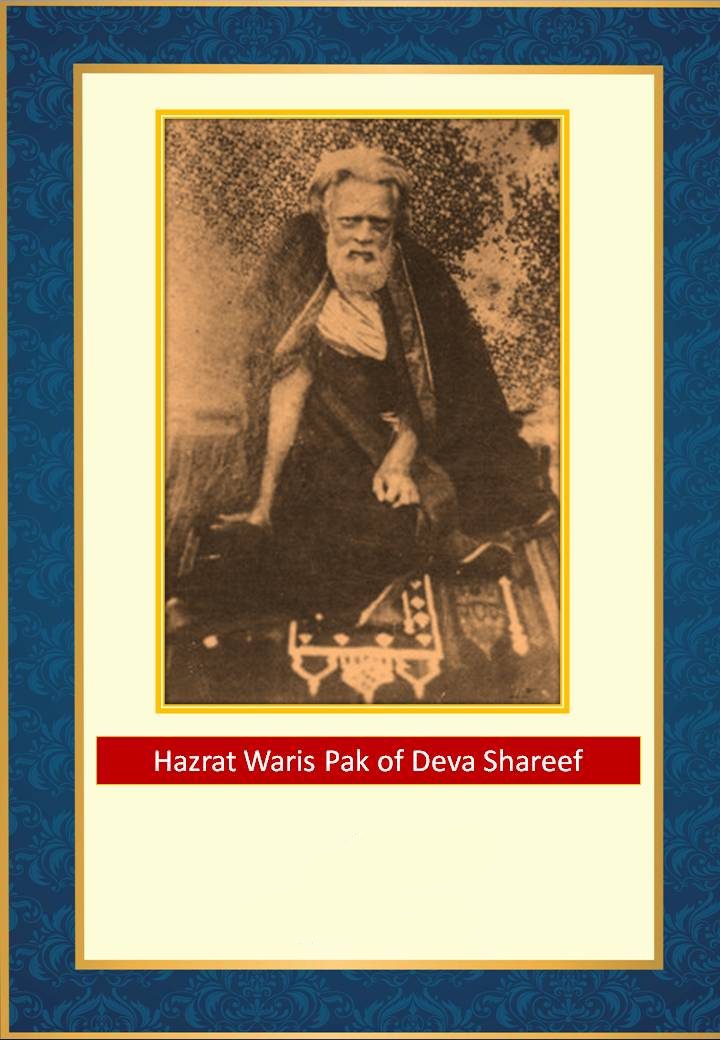
A brief statement is necessary to describe that instructions were given by Our Saint concerning all out endeavour by his devotees and how they could discard the worldly comforts and wealth to attain their heart’s desire to win the affection of their Beloved entirely.
A few examples of his devotees will bring out the miracles of revolution in their life due to effects of love and to gain it. In spite of the sacrifices they had to endure they were always absorbed in the thought of their Beloved, all their mundane leanings and cravings were effaced from their heart. This eternal hardship is an extraordinary effort and truly it is an attribute bestowed by Divine favour.
Thakur Panjim Singh Saheb Warisi a resident of Mallevall, Manipur district was wallowing in wealth and comfort, spending his leisure in shooting and indulging in recreations and amazing activities. Due to the tormenting affects of love within a wink of a moment his life was thoroughly changed. He discarded his dignified life of pomp and glory and descended to the level of a common man, wearing the common garb of a mendicant and spent his life in the name of Vaqas Shah. Thus he discarded the evanescent riches for eternal honour.
Similarly Syed Muhammad Waseem Shah sahib Warisi residing in Maulanagar, Manghyr district whose income from his lands was annually twenty thousand rupees, due to the blessings of Our saint gained honour and disgusted with the worldly authority, tore as under the worldly shackles and in a zeal of love garbed himself in mendicant’s clothes and spent his life in a garden like a recluse.
Thus due to the affects of love many devotees of Our Saint became uneasy and perturbed, so that there was a remarkable change in their ordered life and they lost themselves in contemplation of their Beloved, losing completetouchwiththe mundaneworld.
Hindu Pandits who were proficient in Vedic knowledge and spiritual leaders of their belief and creed, due to the heart rending affects of love, found a sudden and revolutionary change in their lives. Pandit fazul Shah Warisi, whose former name was Ramavtar Shastri, was a Sanskrit Spiritualist and was far superior in meditation. When he became a disciple of Our Saint and practised uttering prayer of love, he attained highest degree of knowledge because of absorbing himself in Divine love and submission. He discarded the outward forms of worship till his death and remained in Radhawalli Shereef.
Similarly Pandit Sita ram a well to do priest, came to pay respects to Our Saint. During their mutual conversation Our Saint advised him to know and find out God. He replied that he had just found God in whose quest he was wandering from door to door. He further, asked, “when I have found Him, where should I go?” smiling our Saint gave him a mendicant’s garb advised him not to go home and to embark on with travels and never to stretch hand even if he were to starve for a week.
A similar incident happened about Pandit Keshawa Rao of Malabar. Although he was a deep scholar of learning he was in search of Divine truth. He joined the fold of our Saint and learned the lessons of love. The result was that he became a mendicant wearing a patched dress and spent his life in Deva Sheriff lost in prayer.
Hundreds of our Saint’s devotees who were educated men of intellect and wisdom after undergoing training in the school of Warisi love became self forgetful and discarded their previous mode of life, native place and spent their life in wandering without means and stayed away in travelling. They had no comfort during day and rest during night. Every moment they were lost in thought of their beloved, ceaseless in their efforts to reach their goal. In fact love is an extraordinary endeavour to reach their goal. Our Saint instructed his devotees to engage themselves in different kinds of efforts.
To some our Saint instructed to be spare in their food and others to abstain from relishing food and to be satisfied with simple fare, to others to be vegetarians, ordered some to fast continually. Hence Faizu Shah Saheb fasted twenty six years Abul Hassan Sahib Warisi resident of Etawah for twelve years and Babu Kanyalal Saheb Warisi vakil of Aligarh for fourteen years, Haji Makki Shah Saheb Warisi resident of district of Barabanki. Miskeen Shah Saheb Warisi. Bibi Sakina Sahiba Warisia, daughter of Gulab Sahib of Agra and Haji Ramzan Shah Saheb, resident of Fatehpur for life.
Rumi Shah Saheb Turk, Miskeen Shah Saheb Warisi, resident of suburb of Allahabad were ordered to fast for life and so also Bibi Naseeban Shah Sahiba Warisia abided by our Saints, command breaking her fast with water for two days and on the third day by food, Ahmed Shah Sahib Warisi of Akbarabad for twelve years spent his life in nocturnal prayer and Maulvi Barkatullah Saheb Warisi to recite everyday twenty four thousand four hundred times Darood Sheriff (i.e. to recite blessings for our Prophet). In Lucknow Syedani Bibi Warisia was instructed to recite Kalam-aytaiyaba and also to implement it. She was so absorbed in reciting that she left off speaking with yone and was taking food once a time and that too by pressure lest she might commit a mistake in recitation. So, different sets of efforts were prescribed to various disciples.
There were disciples of Our Saint beyond India who carried out his commands wholeheartedly, For example Mohabbat Shah Warisi a resident of Punjab states that during his tour of Iraq was going towards Beirut accompanied by Karam Ali Shah Sahib from Baghdad. They lost their way and reached a place where there was a solitary mosque facing the pole star a portion of which was in ruins. There was a water reservoir in the courtyard and they sat beside it to rest. After sometime Mohabbat Shah wanted to answer the call of nature and felt a fragrant smell emanating from the ruined portion of the mosque. So he and his companions searched the place and discovered the fragrance emanating from a cave. When they entered they found an elderly person seated. Whom, they mistook to be Sarkar Waris. They wished him and were directed by a gesture to sit down. During the course of the conversation the name of Sarkar Waris was mentioned and the venerable old man enquired about Our Saint, when asked how he knew him he replied with a deep sigh “I became his disciple when he was hardly fifteen years old. I accompanied him from Shahjahanpur till this place where he ordered me to sit here saying “We will come again.” From that time I am awaiting the arrival of my guide. “









 Aal-e-Qutub Aal-e-Syed Abdullah Shah Ghazi