


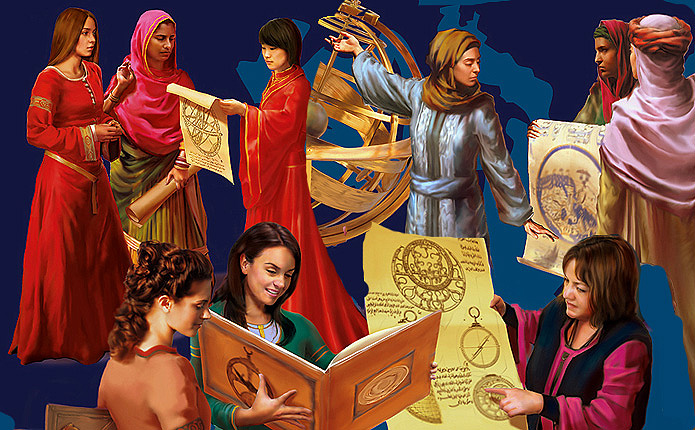
To celebrate Women’s Day on 8th March, no way is better than reproducing a collection of articles written by FSTC scholars and associates on the achievements of women in Muslim Heritage in various fields. We focused in our work on this topic of contributions made by women in science, technology, medicine, social care, management and patronage.
***
In view of the growing importance of the subject of gender and women in society, this collection of articles we present below represents some of what we currently know about some famous Muslim women. We hope that this will initiate debate and start the process of unearthing what could be a most significant find:
Despite the scarcity of references to the historical role women played in these fields, we endeavoured to unearth significant pieces from various literary genres to build the first synthesis on this important subject. Among the examples we present there are famous ones, such as those of Zubayda who pioneered a most ambitious project of digging wells and building service stations all along the pilgrimage route from Baghdad to Makkah; and also constructing a complex water system to bring water from aquifers to Makkah using underwater canals and aqueducts. Additional examples being that of Dhayfa Khatun who excelled in management and statesmanship alongside Fatima al-Fehri who founded the Qarawiyin mosque – school complex that became the oldest extant university in the world.
There are other women of science who are much less known, such as Sutayta who was a mathematician and an expert witness in courts, Lubana of Cordoba whose expertise in mathematics was quoted in numerous historical sources, and the astrolabe maker Al-‘Ijliya (Al-Astrulabi).

From Bangladesh to Pakistan, Kyrgyzstan to Nigeria, Senegal to Turkey, it is not particularly rare in our own times for women in Muslim-majority countries to be appointed and elected to high offices—including heads of state. Nor has it ever been.
Stretching back more than 14 centuries to the advent of Islam, women have held positions among many ruling elites, from malikas, or queens, to powerful advisors. Some ascended to rule in their own right; others rose as regents for incapacitated husbands or male successors yet too young for a throne. Some proved insightful administrators, courageous military commanders or both; others differed little from equally flawed male potentates who sowed the seeds of their own downfalls.
This six-part series presents some of the most notable historical female leaders of Muslim dynasties, empires and caliphates:

Professor Salim Al-Hassani published in the issue 369 (Spring 2012, p. 10) of Runnymede Bulletin (Spring 2012 Runnymede Bulletin – Sport) a short article on “Sports in Muslim Heritage”. He argues, notably, that while Europe was in the “Dark Ages”, the Islamic world enjoyed a period of high art, science, and sport. During this long period, various forms of Riyadha (sport in Arabic) was widely practiced in the classical Islamic world, and this practice continues intensively in the present.
http://www.muslimheritage.com/node/704

Fatima al-Fihri, a Muslim woman activist from the annals of history has been reintroduced to inspire future generations.
“Last week I mentioned the one-day conference at the University of Derby on Muslim women activists and suggested that Muslim women activists were not a new phenomenon, that indeed Muslim women have been activists since the advent of Islam. At this same conference, a presentation on historical Muslim women activists was given by the Muslim Women’s Historical Heritage (Müslüman Kadının Tarihi Mirası) who are working in conjunction with the Foundation for Science, Technology and Civilization (FSTC) from Britain and the Turkish NGO, IGETEV.
FSTC, an NGO which supports activities like the 1001 Muslim Inventions books and exhibitions, Muslim Heritage and Curriculum Enrichment for the Future (CE4tF), has been keen to bring these historical personages, who are missing from the typical curriculum, back into the history classroom and people’s consciousness. In Turkey the MWHH group is concentrating on women with Muslim heritage, they are bringing to light women from the distant past about whom little is known, in the hopes that people will be inspired to find out more. A further aim of this project is to give young people role models from their own culture to whom they can turn.” Zeynep Jane Louise Kandur

In the history of Islamic civilization, many hospitals were founded by women, either as wives, daughters or mothers of sultans. All health personnel were male at these hospitals. In the Ottoman period, the female patients were treated either at their homes or at the residences of the medical practitioners until the 19th century. This feature somewhat explains the rich varieties of females practicing medicine both in and outside the Ottoman palace. In this article, Professor Nil Sari, provides information on the various medical practices dedicated to female patients under the Ottomans.
http://www.muslimheritage.com/node/952

The Foundation for Science Technology and Civilisation (FSTC), launched a new course in Istanbul, Turkey. Entitled “Women of Science Medicine and Management in Muslim Heritage”, the course was in collaboration with Insan Gelisimi Ve Toplumsal Egitim Vakfi (iGETEV). The course aimed to focus attention on women who excelled in science, medicine and management within the Muslim Heritage.
http://www.muslimheritage.com/node/2046

This is a review of the book prepared by Hilal Kazan for the Istanbul Greater City Council Cultural Foundation in order to provide a useful and important bio-bibliographic resource on the history of calligraphy of the Muslim Civilization. Written in Turkish and English, the book consists of notices of past and present Muslim female calligraphers, with many priceless examples of masterpieces of calligraphy. It emphasises also the importance of the activities of female calligraphers in the Muslim civilization at various places. The book reviewed in the following article is a unique work on the subject.

The English aristocrat and writer Lady Mary Wortley Montagu (1689-1762) is today remembered particularly for her letters from Turkey, an early example of a secular work by a Western woman about the Muslim Orient. When Lady Mary was in the Ottoman Empire, she discovered the local practice of variolation, the inoculation against smallpox. Unlike Jenner’s later vaccination, which used cowpox, variolation used a small measure of smallpox itself. Lady Mary, who had suffered from the disease, encouraged her own children to be inoculated while in Turkey. On her return to London, she enthusiastically promoted the procedure, but encountered a great deal of resistance. However, her example certainly popularized the practice of inoculation with smallpox in British high society. The numbers inoculated remained small, and medical effort throughout the 18th century was concentrated on reducing the risks and side-effects of the inoculation process.

Aise Asli Sancar, a renowned writer and lecturer on women’s issues has said when she began investigating the subject of Ottoman women, she realized that they were much more complex and multifaceted than they are usually portrayed to be. Noting that Ottoman women were described as submissive and suppressed women entrapped in the harem, Sancar says the imperial harem was a more diverse and complex institution than she had formerly thought it to be. This is the main theme of her book: Ottoman Women: Myth and Reality reviewed in this article by Qaisra Shahraz, the well known writer and novelist. Suitable for all publics, the book, a well written and enjoyable to read piece, presents an engaging and appealing image of Ottoman women, far away from the clichés widely spread in the contemporary literature.

Professor Nil Sari Akdeniz, the head of the History of Medicine and Ethics Department of Istanbul University at the Cerrahpasha Medical School since 1983, is a world famous historian of Islamic medicine in general and of medical knowledge and practices in the Ottoman Empire and in modern Turkey in particular. In the following unpublished interview, carried on by Dr Mehrunisha Suleman in Istanbul in 2004 on behalf of FSTC and updated in February 2009 by Professor Sari, she expounds her opinion on some issues relating to Muslim Heritage, science and Islam, and her passion as a historian of medicine.

In the following interview, Dr Zohor Idrisi sheds light on Islamic agriculture and the culinary art in Muslim heritage. She mentions the various factors that favorised the development of agriculture in the Islamic civilisation, such the use of astronomical knowledge, the availability of an efficient water management system, the introduction of new techniques in irrigation, the use of new varieties of crops and plants. The result was a real agricultural revolution marked by a high productivity, never reached before in history. The last part of the interview hits upon contemporary issues, like environment strategies and consumption habits that we have to learn from the standpoint of Islamic practices based on respect of nature, human wisdom and common sense.

The tradition of Islamic astronomy is the main topic of the following interview, in which Dr Rim Turkmani, an astrophysicist scholar, draws on her passion for Islamic science to present a survey on salient aspects of Islamic classical astronomy. At the end, she shows how this scientific tradition is still inspiring today. On that point, the attitude of openness, diversity and tolerance is highlighted.
http://www.muslimheritage.com/node/598

 We are delighted to bring you the most recent YouTube clip uploaded by Her Majesty Queen Rania of Jordan. This clip highlights just some of the everyday items in our homes that came to us through a shared heritage with Muslim Civilisation. (Image Source)

Bettany Hughes is an advisor to the Foundation for Science, Technology and Civilisation (FSTC) and member of its consultant network Muslim Heritage Awareness Group (MHAG)
Professor Emilie Savage-Smith expands in this remarkable interview on Islamic medicine of which she draws a lively picture. Beginning with a general survey of the conditions of its inception and development in an intercultural context, she mentions representative names and treatises, then the various fields of expertise are scrutinized and the different innovations this tradition brought are highlighted, from the classification of diseases, their treatment, the use of surgery, the improvement of medical instruments, the foundation of hospitals. The answers of the expert are informative on specific areas of medical care such as ophthalmology, mental illness, the development of a real industry of drugs, the various ways of healing, including the use of music in the treatment of emotional and mental stress. The exploitation of this treasure of medical knowledge in Europe until the 17th century is also reminded.

In June 2014, The Foundation for Science, Technology and Civilisation (FSTC) played host to a delegation from Turkey and held a workshop on Women of Science and Management in History attended by 27 participants. The delegation from the Human Development and Social Education Foundation (iGETEV) was led by Zeynep Jane Louise Kandur and has been working closely with FSTC since June 2013, on highlighting the roles played by a number of remarkable women from the Muslim civilisation. The two day workshop, which took place on the 24th and 25th June 2014, followed on from sessions held in Istanbul in October 2013, and is part of a collaborative project between FSTC and iGETEV.
http://www.muslimheritage.com/node/2306

Zaynab was a famous female calligrapher who was renowned for her work in fiqh (Islamic law) and hadiths, in addition to her husn-I khatt. She was highly praised and positioned, and was appointed as teacher of Yaqut, the last Abbasid Caliph. She was also the calligrapher in the Musa Palace. She was a brilliant, well-established teacher and many people had the opportunity to study with her and to receive their ijaza from her. The fame of Zaynab was well established when she was named Siqat al-Dawla because of her association with al-Muktafibillah, the Abbasid Caliph. She spent her time studying science and literature.

Image by artist Ali Amro created for 1001 Inventions.
 Over thousands of years, many women have left a mark on their societies, changing the course of history at times and influencing small but significant spheres of life at others. Since ancient times, women have excelled in the areas of poetry, literature, medicine, philosophy and mathematics. A famous example is Hypatia (ca. 370-415), a philosopher, mathematician, astronomer, and teacher who lived in Alexandria, in Hellenistic Egypt, and who participated in that city’s educational community
In the same vein, it is interesting to note the Islamic view of Cleopatra of Egypt (b. 69 BCE). Arabic sources referred to her as a strong and able monarch who was very protective of Egypt. These sources focused on her talents but made no reference to her morals or seductive power. They focused instead on her learning and talents in management. This Arabic image of Cleopatra is in direct contrast to that presented by the Greco-Roman sources which presented her as a hedonist and seductive woman.
From the early years of Islam, women had crucial roles in their society. They contributed substantially to the prominence of Islamic civilization. For example, Aisha bint Abu Bakr, wife of the Prophet Muhammad, had special skills in administration. She became a scholar in hadith, jurisprudence, an educator, and an orator. There are also many references which point to Muslim women who excelled in areas such as medicine, literature, and jurisprudence. This long tradition found its counterpart in modern times. For example, in a more recent and unusual role, Sabiha Gökçen (1913-2001) was the first female combat pilot in the world. She was appointed as chief trainer at the Turkish Aviation Institution.

A Turkish banknote dated 30 August 1995 to celebrate Sabiha Gökçen (1913-2001), the first female combat pilot in the world and the first Turkish aviatrix.

In contrast, we find little information on Muslim women’s contributions in the classical books of history. New light might arise from the study of not yet edited manuscripts. There are many manuscripts in archives around the world. Only few of them are edited and most of these are not about science. This points to the challenging task lying ahead for researchers into the subject.
Fatima al-Fihri played a great role in the civilisation and culture in her community. She migrated with her father Mohamed al-Fihri from Qayrawan in Tunisia to Fez. She grew up with her sister in an educated family and learnt Fiqh (Islamic jurisprudence) and Hadith. Fatima inherited a considerable amount of money from her father which she used to build a mosque for her community. Established in the year 859, the Qarawiyin mosque had the oldest, and possibly the first university in the world. Students travelled there from all over the world to study Islamic studies, astronomy, languages, and sciences. Arabic numbers became known and used in Europe through this university. This is just one important example of the role of women in the advancement of education and civilisation.
 Razia (or Raziyya) Sultana of Delhi who took power in Delhi for four years (1236-1240 CE). She was the only woman ever to sit on the throne of Delhi. Razia’s ancestors were Muslims of Turkish descent who came to India in the 11th century. Contrary to custom, her father selected her, over her brothers, to be his successor. After her father’s death, she was persuaded to step down from the throne in favour of her stepbrother Ruknuddin, but, opposed to his rule, the people demanded that she become Sultana in 1236. She established peace and order, encouraged trade, built roads, planted trees, dug wells, supported poets, painters, and musicians, constructed schools and libraries, appeared in public without the veil, wore tunic and headdress of a man. State meetings were often open to the people. Yet, she made enemies when she tried to eliminate some of the discriminations against her Hindu subjects. (Image Source)
 During Muslim civilisation, numerous women excelled in various fields in Subsaharan Africa. Among them was Queen Amina of Zaria (1588-1589). She was the eldest daughter of Bakwa Turunku, who founded the Zazzau Kingdom in 1536. Amina came to power between 1588 and 1589. Amina is generally remembered for her fierce military exploits. Of special quality is her brilliant military strategy and in particular engineering skills in erecting great walled camps during her various campaigns. She is generally credited with the building of the famous Zaria wall.
Labana of Cordoba (Spain, ca. 10th century) was thoroughly versed in the exact sciences; her talents were equal to the solution of the most complex geometrical and algebraic problems, and her vast acquaintance with general literature obtained her the important employment of private secretary to the Caliph Al-Hakam II.
Sutayta al-Mahmali. Sutayta was taught and guided by several scholars including her father. Other scholars who taught her were Abu Hamza b. Qasim, Omar b. Abdul-‘Aziz al-Hashimi, Ismail b. Al-Abbas al-Warraq and Abdul-Alghafir b. Salamah al-Homsi. She was praised by historians such as Ibn al-Jawzi, Ibn al-Khatib Baghdadi and Ibn Kathīr. She died in the year 377H/987CE. Sutayta did not specialise in just one subject but excelled in many fields such as Arabic literature, hadith, and jurisprudence as well as mathematics. It is said that she was an expert in hisab (arithmetics) and fara’idh (successoral calculations), both being practical branches of mathematics which were well developed in her time. It is said also that she invented solutions to equations which have been cited by other mathematicians, which denote aptitude in algebra. Although these equations were few, they demonstrated that her skills in mathematics went beyond a simple aptitude to perform calculations.
 Gevher Nesibe Sultan “was an early 13th century princess of the Sultanate of Rum, the daughter of Kilij Arslan II and sister of Kaykhusraw I, and the namesake of a magnificent complex comprising a hospital, an adjoining medrese devoted primarily to medical studies, and a mosque in Kayseri, Turkey. The complex (külliye in Turkish) that she endowed, is considered one of the preeminent monuments of Seljuk architecture. The hospital was built between 1204 and 1206, and the medrese, whose construction started immediately after Gevher Nesibe’s death in 1206, was finished in 1210. The complex takes its name from the princess. The medrese within is known under a variety of names: the Gevher Nesibe Medrese; the Çifte Medrese (Twin Medrese); or as the Gıyasiye Medrese, after Ghiyath al-Din Kaykhusraw I, who was responsible for its construction. The tomb within the medrese is said to belong to Gevher Nesibe.”(Source)
“Melike Mama Hatun, or simply Mama Hatun, was a female ruler of the Saltukid dynasty, with its capital in Erzurum, for an estimated nine years between 1191 to 1200. During her reign she had a caravanserai, a mosque, a bridge, and a hammam built in the town of Tercan, located midway between Erzincan and Erzurum, which are still standing and are named after her. Her tomb is also in Tercan. The town itself was called Mamahatun until recently, and is still referred to as such locally. Mama Hatun also remains a vivacious figure in Turkish folk literature to this day.” (Source) Mama Hatun Kulliyesi (Kulliye means complex of buildings adjacent to a mosque, “Collage” in modern English).


This article presents Abu’l-Qasim Khalaf ibn ‘Abbas al-Zaharawi, Arabic أبو القاسم خلف بن عباس الزهراوي, Latin Albucasis (936-1013 A.D.), one on the most outstanding Arabic physicians and the most remarkable Arabic surgeon. His work had a strong impact in middle ages. Greek-Roman surgery had almost ceased to be practiced, in the Western world, after Paul of Aegina (625-690 A.D.), the last Byzantine compiler. Albucasis took for himself the task of making of surgery an honorable art. He recovered ancient surgical texts from damaged scrolls, developed, expanded and refined Greek-Roman operations, adding his own pioneer techniques, procedures, and devising his own instruments. His clear and insightful teachings laid the foundations of accurate and safer surgical procedures that were adopted in the following centuries.

 Frontispiece of the Latin translation of Al-Zahrawi’s (Albucasis’) Kitab al-tasrif (Source) |
During Galen´s life (129-217 A.D.), magic and supernatural thinking was already replacing the brilliant Greek rational medical thought of Hippocratic times and from Herophilus and Erasistratus’ Alexandrian Medical School. Galen’s studies on anatomy and physiology, performed on animals, were the last achievement of Greek-Roman medicine. Later Byzantine authors were mainly compilers who added to previous works their personal and sometimes very important contributes.
After the fall of the Western Roman Empire, in 476 A.D., the Western populations were invaded by hordes of barbarians, and deprived of their books. Medicine and health care were in charge of monks and nuns in monasteries in which theurgic and demonic mysticism prevailed. Surgery was increasingly depreciated and became a despicable art, practiced by barbers, midwives or butchers. Arabic sciences, including medicine, were led by Arabic authors until the sixteenth century. Arabic physicians took care of the Greek-Roman legacy, translating into Arabic the Greek authors who otherwise would have been lost. Their most importance contribution was in the development of pharmacy. Arabic medicine reigned largely in Europe throughout the middle ages. (Velensky, 1908, 20-27). However, Arabs did not accept the Greek authors blindly. They analyzed their writings, often cumbersome and obscure, abstracted the essentials, and discarded the details (Ricci, 1949, p. 61).
The portrait of the physician by the poet Geoffrey Chaucer (1340-1400) in the Prologue to “The Canterbury Tales” depicts the European importation of Arabic medicine, surgery and pharmacy in his time. Chaucer cited Arabic authors side by side with Greek-Roman authorities and imminent contemporary European doctors:
 |
With us was a Doctor, a Physician; for skill in medicine and in surgery there was no peer in this entire world. He watched sharply for favorable hours and an auspicious ascendant for his patients treatment, for he was well grounded in astrology. He knew the cause of each malady, if it was hot, cold, dry or moist, from where it had sprung and of what humor. He was a thorough and a perfect practitioner. Having found the cause and source of his trouble, quickly he had ready the sick man’s cure. He had his apothecaries all prepared to send him electuaries and drugs, for each helped the other’s gain; their friendship was not formed of late! He knew well the old Aesculapius, Dioscorides and Rufus, Hippocrates, Haly and Galen, Serapion, Rhasis and Avicenna, Averroes, Damascene and Constantine, Bernard, Gatisden and Gilbertine. His own diet was moderate, with no excess, but nourishing and simple to digest. His study was only a little on Scripture. He was clad in red and blue-gray cloth, lined with taffeta and sandal silk. Yet he was but moderate in spending, and kept what he gained during the pestilence. Gold is a medicine from the heart in physicians’ terms; doubtless that was why he loved gold above all else.”
(Chaucer, Canterbury Tales, vv. 409-444) |
Surgery was a difficult matter. It was the last available resort, when medicinal therapeutics failed. However, “something like 120 operations were performed, at least in some places at some times, over the course of the Roman Empire” (Bliquez, 2006, p. 1). In Greek-Roman times, medicine and surgery were regarded as complementary tasks, performed with equal care and pride. Funerary monuments of doctors depict them with their scrolls and surgical instruments, as we can see on the sarcophagus with a Greek physician from Ostia, Italy, dating from early 300s A.D., housed in the Metropolitan Museum of Art, New York (Figure 1).

Figure 1. Sarcophagus with a Greek Physician. Courtesy of the Metropolitan Museum of Art, New York, Nº 48.76.1.
Roman doctors were buried with their instruments. Roman working people used to be buried with their professional tools and with the symbols of their arts (Kenrick, 1858, p.p. 29-30). Tombs of doctors buried with their instruments are the numerous. Publications reporting One hundred seven publications report tombs of doctors buried with heir tools, dating from the first century B.C. until the third century A.D. The tombs were found all over the Roman Empire (Künzl, 2002, pp. 32-33).
Greek and Roman doctors also prepared their medicines, as the great Roman encyclopedist, Pliny the Elder (23-79 A. D.), stated. Pliny complained about patients who relied on drug dealers that spoiling everything with fraudulent alterations (Pliny, Book XXXIX, Chapter XXV, in Rackam, 1952, p. 209).
The Arabs continued and improved the Greek-Roman medicine, pharmacy and surgery.
Albucasis was not the only Arabic doctor who wrote on surgery. Two of the most outstanding Arabic doctors also wrote on surgery. Rhazes, Abū Bakr Muhammad ibn Zakariyyā al-Rāzī (865-925 A.D.), a physician, alchemist and philosopher, born in Iran, also wrote on surgery in his book Al–Manṣūrī fī ‘ṭ–ṭibb (chapter VII). The work was translated into Latin as Liber medicinalis Almansoris by Gerard of Cremona (c.1114-1187), an Italian scholar who worked in Toledo and translated scientific books from Arabic into Latin. Rhazes took advantage on his expertise on alchemy, and used alcohol, which he distilled for the first time, as an antiseptic, in his unguents for surgical wounds. He also used opium as an anesthetic and analgesic (Rhazes, 1497, pp. 30-35).
Avicenna, Abu ‘Ali al-Husayn ibn-Sīnā (980-1037 A.D.), born in Persia, was a philosopher, a doctor, a poet, and the leading figure the Islamic Golden Age. In his medical treatise, Canon of Medicine, he included surgery amongst diet and use of simple and compound medicines (Avicenna, 1507). He presented minor and major surgery which he drew from Greek-Roman authors, adding his own experience and insights. He used sedatives, anesthetics and paid special attention to ophthalmology. However, surgery occupies a small place in his treatises (Sanagustin, 1986, pp. 84-112).
Abu’l-Qasim Khalaf ibn ‘Abbas al-Zaharawi, Arabic أبو القاسم خلف بن عباس الزهراوي, known in Latin Europe as Albucasis, Bucasis and Alzaharavius (936-1013 A.D.), was born of Spanish parents at El-Zahra, near Cordova, in Spain. There is little material on his biography. His most outstanding work was Altasrif, an encyclopedia of medicine and surgery, consisting of two parts, and each of fifteen sections. He borrowed from Rhazes parts dealing on anatomy, physiology and dietetics, with little original material (Campbell, 2006, pp. 85-86). Galen was the main source on these matters for these authors. His books were translated into Arabic. A manuscript from the ninth century, translated into German by Max Simon (Simon, 1906).
Albucasis’ treatise, Altasrif, is divided in three books. His main sources are Hippocrates (460-370 B.C.) and Paul of Aegina (625-690 A.D.). Albucasis also gave valuable contributions to medicine. He described accurately hemophilia, for the first time, as well as hydatid cyst, lacrimal fistula and ear polyps and explained a case of hydrocephalus by birth defect, caused by obstruction to drainage of the cerebrospinal fluid (Cambra, 2003, 13). Chapter XVIII, on pharmacy and pharmacology, was also translated into Latin, and known as Liber Servitoris. It was a leading manual on collecting, preparation and administration of simple mineral, vegetable and animal medicinal products (Engeser, 1986, IX). It represents an early example of chemistry applied to the practice of medicine (Campbell, 2006, 90).
Albucasis’ ‘Surgery’ was published separately. It is his most original and valuable work. It was a major contribution to the development of surgery in Western Christian nations (Leclerc, 1861, p. vvii). In the twelfth century, it was translated into Latin by Gerard de Cremona (c. 1114.1187), born in Cremona, northern Italy who later moved to Toledo, and was the most outstanding translator from Arabic to Latin born in Cremona, northern Italy, who moved to Toledo and is the most outstanding translator of the Toledo translation school. Albucasis´ work is at the basis of surgical treatises of earlier medieval authors. His contributions to ophthalmology, and dentistry and stomatology are remarkable (Cambra, 2003, 11).
The ‘Surgery’ was the most accomplished attempt to recover and apply the ancient Greek-Roman technique that almost ceased to be practiced, in Western Europe. After Paul of Aegina, the knowledge of surgery had been slotted out and its remains were lost. Albucasis wrote for the skilled practitioner of operative surgery that was totally lacking in his land and time. There was nothing left except a few traces of the books of the Ancient, which have come to him corrupted by the hands of scribes, subjected to error and confusion, what made their meaning obscure and their value diminished. For that reason no skilled surgeon was to be found in his days. As he stated: Though many are doctors in name, few are in reality, particularly on the surgical side. For that reason he: “decided to revive this art by expounding, elucidating, and epitomizing it” in his treatise (Spink & Lewis, 1973, p. 2 (Albucasis, Altasrif, Book I, Intr.).
It is divided in three books. The first deals with cauterization which he widely used, possibly influenced by Indian medicine in which cauterization was also widely used (Jin & Gondal 1896, p. 184). The second book, based Paul of Aegina, deals with general surgery. The third is dedicated to bone injuries (Campbell, 2006, 85-88).
Physiology and surgery had few competent researchers, both is Islam as in Christianity during middle ages, due to the taboo of human dissection. In this period, less books were written on surgery than in any other field on medicine. In the ninth century, Hunayn b. Ishaq started to translate into Arabic the ancient Greek texts on anatomy and surgery. Hindu surgical tradition also had influence on Arabic surgery (Cambra, 2003, 13-14).
Albucasis advised the study of anatomy. The knowledge of anatomical structures was absolutely necessary because only anatomy could guide the surgeons’ hand, and he gave examples of disastrous results when doctors acted, having no knowledge of what they were incising. He gave other sound advices to those who wished to practice surgery: to assess the condition of the patient, to act only when they are experienced, and not to act for greed (Leclerc, 1861, pp. 5-6 (Albucasis, Altasrif, Book I, Intr.).
He also advised surgical experience and practice. Very threatening illnesses or difficult to cure should be left alone (Spink & Louis, 1971, p. 6 (Albucasis, Altasrif, Book I, Intr.). Some surgeries should only performed by skilled and experienced surgeons. His description of the drainage of a liver abscess by the cautery that “should not be employed except by one who has a long experience of the medical art and who has frequent practice at dealing with this kind of disease” (Spink & Louis, 1971, p. 88 (Albucasis, Altasrif, Book II, Chapter XXXI) is particularly stunning. Albucasis marks the place of the swelling with ink before the operation, a quite modern procedure of which he is also a pioneer. His procedures are correct, accurate and adequate.
Albucasis performed and described almost all surgeries, carried out by Greek-Roman authors. He does not refer to just a few operations like amputation of a gangrenous uterus by vaginal approach, described by Soranus of Ephesus, not described by Paul of Egina, certainly because he had no access to the ancient texts.
He often provided a much better description of Greek-Roman surgical procedures, and largely improved ancient operations with a better technique. He evaluated carefully the preoperative risks for surgeries, a procedure that we sometimes find in Greek-Roman authors, launched by Albucasis as a systematic procedure.
Let us take the example of embriotomy, an operation of which we know almost nothing except for the surviving texts. We have no idea what the survival rate might have been. We just know that the operation was performed because the successive descriptions present improvements.
In a text cited by Aetios of Amida (505-575 A.D.), Philumenus, probably a younger contemporary of Galen (130-210 A.D.) (Ricci, 1950, p.6), advises the examination of the woman, as a preoperative assessment. He describes signs that indicated that a woman in poor health condition would not survive (Ricci, 1950, pp.32-33 (Aetius, Gynaecolgy, Chapter XXIII).
Previous descriptions of embriotomy do not mention preoperative clinical assessment. Neither the treatise that usually comes along with the Hippocratic Corpus (5th– 4th century B.C.): “On extraction of the dead foetus” (Coxe. 1846, pp. 321-323), nor the writings by Celsus (c.25-c.50 A.D.) (Celsus, De Medicina VII, 29 in Hendersen, 1938, II vol, pp. 455-61).
Soranus of Ephesus (c. 98-323 A.D.) advises against underlying dangers that may supervene after embryotomy (Temkin, 1956, p. 190 (Soranus, Book IV, III, p. 9). Paul of Egina summarizes the texts by Soranus and Philumenus (Adams, 1846, Vol. II, pp. 387-389 (Paulus Ægineta,Book VI, Chapter 74).
From these authors, only Aetius provides some insights on preoperative assessment. That may help to understand how some women survived. Aetius, in a text by Aspasia, a woman doctor of whom nothing is known, except for the texts that Aetius copied, provides the management of the patient after embryotomy (Ricci, 1950, pp. 35-36 (Aetius, Gynecoligy, Chapter XXV). But this is a rare follow-up procedure. Albucasis is much more complete, providing preoperative assessment, clear description of the operations, describing surgical instruments, and post operative follow-up especially in Book III, when dealing with bone injury.
It is well known that Albucasis performed new surgeries and devised new instruments. Spink and Lewis have summarized his main feats:
|
Like Paulus Aegineta, his principal source, he draws both on the writing on his predecessors and on his own experience. He describes many operative procedures and instruments which do not appear in extant classical writings which may therefore be regarded as his own, or at least as being part of distinctly Arab practice. The following instances merit special attention in this respect.
The tonsil guillotine and its use (II, 36); the concealed knife and its case for opening abscesses (II, 46 and fig. 12); the trocar for paracentesis (II 54); the possibility that Albucasis or his contemporaries invented true scissors (II, 57 and several figures); the syringe (II, 59); the lithotrite (II, 60); and his design of vaginal speculum (II, 77). This chapter on gynaecological instruments gives reason to for thinking that Albucasis anticipated Chamberlain’s obstetric forceps, though not for a live delivery. Then there is the use of animal gut as suture material (II, 85); the description of, possibly, thrombophlebites migrans (II, 93); the well-illustrated account of the reducing table for extending limbs in order to reduce dislocations or displaced fracture ends (III, 31); and the formula for a kind of plaster casing anticipating the modern plaster cast (III, 27)” (Spink & Lewis, 1973, ix) |
Surgical instruments were devised by doctors. Galen told about instruments of all kinds: tools well adapted to medicine, and tools that he had invented for which he made wax models that he regularly gave blacksmiths to forge (Boudon-Millot (translation), 2010, pp. 102-103). Albucasis also told us that doctors would devise their instruments according to their need and purpose, when referring to the numerous existing dental instruments:
|
You should know that dental instruments are very numerous, as are the other instruments, almost beyond reckoning. And the experienced worker with a knowledge of his craft may devise fresh instruments according as his work on actual cases suggests them to him.”
(Spink & Louis, 1971, 284) |
 Figure 2. Indian Surgical instruments (Jee, S.B.S., A short history of Aryan medical science, 1896, Plate IX). |
When dealing with treatment of entropion, he also called for the doctor’s creativity: “The experienced practitioner will make use of his skill in many ways he can re-establish the natural form or approximate to it.” (Spink & Louis, 1971, p. 226 (Albucasis, Altasrif, Book II, Chapter 14).
Writing for his fellow doctors, Albucassis was aware of the importance of conveying images of the instruments for the teaching of surgery. Greek-Roman and Byzantine authors left no drawings. No ancient catalogue has come to us. But ancient doctors seem to have known the instruments very well, since there are quite similar whatever their provenance in the Roman Empire. As the Scottish doctor and surgeon, John Stuart Milne (1806-1873), noted, they had always some kind of air de famille (Milne, 1907, p. 18).
Albucasis operated according to Greek-Roman and Byzantine descriptions of the procedures. He cites their instruments in his descriptions. But other instruments have been adapted, as the French doctor and medicine historian Lucien Leclerc (1816-1893) noted (Leclerc, 1861, p. XII).
The tools that Albucasis portrayed share vague resemblances with Greek-Roman tools. Some similarity with Indian instruments is apparent. Albucasis mentions copper or iron from India or even China for their manufacture. Chinese copper, for example, is one of the materials indicated for explorers; bronze or Chinese alloy for cupping glasses (Spink & Louis, 1971, p. 348 and p. 360 (Albucasis, Altasrif, Book II, Chapter 46).
This faraway provenance should not surprise us, since “Islamic civilization was a lake into which flowed streams from many civilizations: Greek, Roman, Egyptian, Mesopotamian, Byzantine, Persian, Indian and even Chinese “ (Nasr, 1999, Foreword).
If we take a look at some Indian scalpels, cauteries and probes (Figure 2) and to a set of Roman tools (Figure 3, Figure 4), and some scalpels, cauteries and probes from an Albucasis’ manuscript (Figure 5), a striking difference comes out immediately. Most Indian and Albucasis’ tools are provided by mandrels to which handles were attached, what made more them more effective and easier to use. Just a few are double instruments, while almost all Greek-Roman tools were of double use, with exception for specula, forceps and tweezers.
 |
 |
 |
|||
|
Figure 3. Set of Roman instruments from the ‘Case of the surgeon”, Torre D’Ares, Portugal, 2nd/3rd centuries A.D. (Vasconcellos, 2008, pp. 73-74). |
Figure 4. Set of Roman instruments from the ‘Case of the surgeon”, Torre D’Ares, Portugal, 2nd/3rd centuries A.D. (Vasconcellos, 2008, pp. 73-74). |
Figure 5. Albucasis, Chirurgia Albucasum,Illumination 14th century, Folio 34 recto, Collection: Wellcome Images, British Museum Add. Ms. 36617; Wellcome M0004103). |
 Fig 6. Roman bronze scalpel |
Roman scalpels usually present a leaf-shaped plain leaf-shaped spatula, used as a blunt dissector (Figure 6 – Provenance: unknown. Copper alloy, Length: 84mm, Bus 54. Courtesy 0f the Lisbon National Museum of Archaeology.). Greek-Roman instruments were not provided with mandrels.
Albucasis’ scalpels display a different shape and have no spatula as a handle (see on Figure 4, the third instrument, counting from the top). Albucasis devised numerous scalpels accurately shaped for their purposes. Most Albucasis’ instruments like bone levers, gynecological specula and dilators, among many others, look quite different, although they are devised for the same purpose.
Albucassis’ tools for dentistry and stomatology surgery, in which Albucasis introduced remarkable advances, also look quite different from Greek-Roman tools. If we put side by side tw samples: a Roman dentistry case (Figure 7) and Albucasis’ dentistry tools (Figure 8), we will note that Albucasis’ set displays more typologies, and that new tools have been added to the Roman dentistry instrumentarium.
Albucasis’ tooth forceps (Nº 19 and 20 on Walsh Plate) do not resemble the Roman forceps, although both have straight jaws and are indicated for extraction of anterior teeth. There are Roman forceps for extraction dental roots, although their shape is also different from Albucasis Nº 20. There are different typologies of Roman dental forceps. Some seem to have been multifunctional, being also used in bone surgery and in the extraction of arrows. Two typologies for the extraction of anterior and posterior teeth are clearly dental (Dude, 2006, pp. 101-108).
 |
 |
|
|
Figure 7. ‘Dentistry Case’, Bustorff da Silva Collection, 2nd/3th century A.D. From left to right: rectangular box to store medicines and lid; spoon-probe; spatula-probe; triangular spoon-probe; periosteal elevator; tweezers; small tweezers with sliding ring; scalpel handle; dental forceps (Alves et alli, 1995, p. 114, Figura 201). |
Figure 8. Albucasis dentistry instruments: 6 to 20- Instruments for the treatment of the teeth. |
Figure 8. Albucasis dentistry instruments: 6 to 20- Instruments for the treatment of the teeth. 19 and 20- Forceps. 21 to 23 – Levers and hooks for the removal of roots. 26. Strong pinchers for the same. 27. A tooth saw. 28 and 29. Files for the teeth (Walsh, 1920, Plate unnumbered, after plates selected from Gurlt, 1898, Tafel IV, Vol. 1, Tafel IV, p. 648).
 Figure 9. A decorated Roman tool |
The forceps for extraction of posterior teeth had down curved jaws, like the forceps from Wederath, Gallia Belgica from the 2nd century A.D. (Kunzl, 1982, p. 71, Abb. 45). No instrument with this function figures in the Albucasis’ sample. But it is possible that Albucasis had more than the two forceps for teeth extraction. He referred that there were too many instruments in this area, and that we could not copy them all.
Some Roman tools were richly decorated (Figure 9). Some Albucasis’ cauteries, knifes and needles also display decorations on the manuscript drawings (See Figure 5). Ancient surgeons did not know that microorganism attach to decorations and provoke postperative infections. But Albucasis was surely aware of the risk of infection related to surgery. He used chemicals which have proved anti-bacterial properties. He also introduced important organic materials like catgut in intestinal stitches, for the first time. He used henbane for anesthesia (Arslan et al., 2014, pp. 103-104). Cotton was also widely used to apply medicines and for other purposes, for the first time, in this book.
When dealing with treatment of bone injury, Albucasis refers to stiff plasters. In the repair of a broken jaw: a plaster of mill-dust and egg-white, or white flour, after removing wax, and applying soft tow over the plaster (Spink & Louis, 1971, p. 716 (Albucasis, Altasrif, Book III, Chapter 4). This was a valuable contribution to immobilize fractures, beside splinters and bandages attached by sewing needles, in Greek-Roman surgery (Figure 10).

Figure 10. Greek-Roman sewing needle
The set of Torre d’Ares displays a slate to prepare medicines (Figure 11). The ‘Dentistry Case’ displays a box for storing of medicines. These items do not figure amongst Albucasis’ tools. The Roman sets included instruments like spatula, spoons, slates and boxes to store medicines because doctors prepared their medicines.

Figure 11 The set of Torre d’Ares displays a slate to prepare medicines
By the beginning of the ninth century, pharmacy was separated from medicine. Arabic pharmacy had emerged from alchemy. It began by focusing in the interest on poisons and antidotes, and extended to other areas outside toxicology. Bagdad was its first center where its school of thought was established. The Saydanah was the pharmacist (the word is derived from sandalwood). Private owned pharmacy shops rapidly extended to the suburbs and to other Muslim cities (Tschanz, 2003, pp. 11-17).
Albucasis’ contribution to pharmacy is also remarkable in this book. His teachings were followed by Arabic and European surgeons. Some instruments, concerning areas in which Albucasis’ tools had great impact, were copied in the following centuries. Caratact needles, dental instruments or gynecological and obstetric tools, portrayed in Albucasis’ drawings, have no similarity with surviving Greek-Roman instruments to which we have access from archaeological excavations. Albucasis’ instruments provided the model for the following centuries. Guy de Chauliac (c.1300-1368), the father of French Surgery cited Albucass frequently in his work. Most of instruments that figure in the treatise by Guy de Chauliac are copied from Albucasis’ ‘Surgery’ (See Chauliac, 1980, p.691). Most Arabic and Greek-Roman surgical procedures only started to be corrected from the sixteenth century onwards.
Recasting the splendor of Greek-Roman medicine, Albucasis conveyed knowledge from Eastern medical traditions. He provided his clinical experience and pharmacological knowledge to a reborn surgery, establishing new procedures and instruments that made operations more accurate and safe. Albucasis´ pioneer thought and practice became a landmark for Arabic and European surgery.
I would like to thank the Metropolitan Museum of Art of New York, the Wellcome Trust, and Dr. António Carvalho, Director of the Lisbon National Museum of Archaeology for the kind permission to reproduce the images. I would also like to thank Professor. Lino Cerejeira from the Dentistry Medical Faculty, Lisbon University, for the kind help in identifying instruments.

Dedicated to My Bhabi Syeda Naseem Fatima got shahdat on 19 feb 2019
Praise be to Allaah.
If a woman dies with a child in her womb, or she dies during childbirth or after childbirth but within the period of nifaas (post-partum bleeding), she is considered to be a shaheedah in sha Allaah. Raashid ibn Hubaysh narrated that the Messenger of Allaah (peace and blessings of Allaah be upon him) entered upon ‘Ubaadah ibn al-Saamit when he was sick and said, “Do you know who is a shaheed (martyr) in my ummah?”The people remained silent, then ‘Ubaadah said, “Help me to sit up.” They helped him to sit up, then he said, “O Messenger of Allaah, (is it) the patient one who seeks reward from Allaah for his patience?” The Messenger of Allaah (peace and blessings of Allaah be upon him) said, “Then the martyrs among my ummah would be very few. Being killed for the sake of Allaah is martyrdom, the plague is martyrdom, drowning is martyrdom, stomach disease is martyrdom, and if a woman dies during the post-partum period, her child will drag her to Paradise by his umbilical cord.” The umbilical cord is that which is cut by the midwife when the child is born. The hadeeth was narrated by Imaam Ahmad in his Musnad with a saheeh isnaad. (al-Musnad, 3/489). There is a corroborating report narrated by Maalik (1/233) and Abu Dawood, 3/482).
‘Ubaadah ibn al-Saamit also narrated that the Messenger of Allaah (peace and blessings of Allaah be upon him) said, “Who is counted as a shaheed among you?” They said, “The one who fights and is killed for the sake of Allaah.” The Messenger (peace and blessings of Allaah be upon him) said: “Then the shaheeds among my ummah would be few. The one who is killed for the sake of Allaah is a shaheed; the one who dies of plague is a shaheed; the one who dies of a stomach disease is a shaheed; the woman who dies with a child in her womb is a shaheed.” This was narrated by Imaam Ahmad, 5/315, and by Ibn Maajah, and by Ibn Hibbaan in his Saheeh, who said its isnaad is saheeh. A report with a similar meaning was narrated by Muslim, as referred to above.
A shahid is considered one whose place in Paradise is promised according to these verses in the Quran:
The Quran, chapter 3 (Al Imran), verse169–170:
Think not of those who are slain in Allah’s way as dead. Nay, they live, finding their sustenance in the presence of their Lord; They rejoice in the bounty provided by Allah. And with regard to those left behind, who have not yet joined them (in their bliss), the (Martyrs) glory in the fact that on them is no fear, nor have they (cause to) grieve. — translated by Abdullah Yusuf Ali
The Quran, chapter 9 (At-Tawba), verse111:
Allah hath purchased of the believers their persons and their goods; for theirs (in return) is the garden (of Paradise): they fight in His cause, and slay and are slain: a promise binding on Him in truth, through the Law, the Gospel, and the Qur´an: and who is more faithful to his covenant than Allah? then rejoice in the bargain which ye have concluded: that is the achievement supreme. — translated by Abdullah Yusuf Ali
The Quranic passage that follows is the source of the concept of Muslim martyrs being promised Paradise:
The Quran, chapter 22 (Al-Hajj), verse58–59:
Those who leave their homes in the cause of Allah, and are then slain or die,- On them will Allah bestow verily a goodly Provision: Truly Allah is He Who bestows the best provision. Verily He will admit them to a place with which they shall be well pleased: for Allah is All-Knowing, Most Forbearing. — translated by Abdullah Yusuf Ali

 Aal-e-Qutub Aal-e-Syed Abdullah Shah Ghazi