

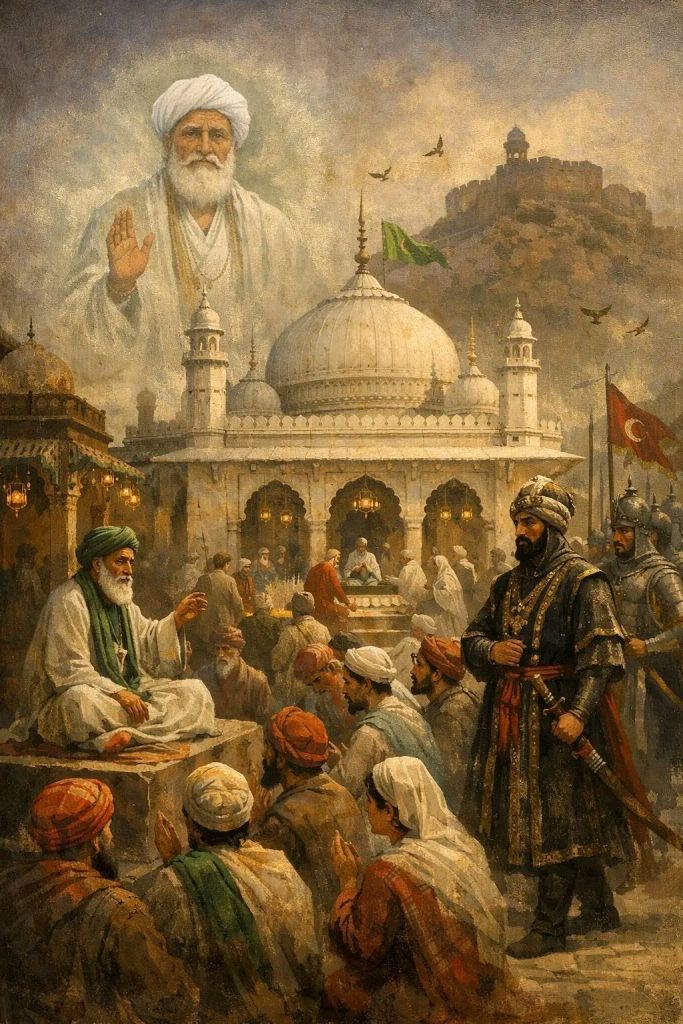
Early in 1346, Sultan Muhammad bin Tughlaq swept down upon the Deccan, crushed the recalcitrant Ismail Mukh, and stamped out the smouldering rebellion. Daulatabad held its breath. In the streets and courtyards, there was only one question that was whispered: how would the Sultan punish this hostile city?
In their distress, the people streamed to the dargah of Burhan al-Din Gharib. The great saint had been dead for years, yet his devotees believed he still moved events from behind the veil.
Their faith was not disappointed. Majd al-Din Kashani of the Chishti brotherhood dreamed that Burhan al-Din Gharib appeared to him, promising protection for Daulatabad from the Sultan’s wrath and instructing him to recite a particular verse from the Quran.
The dream proved no fevered fancy. Instead of unleashing slaughter, the Sultan showed clemency. In any case, he could not linger in the Deccan: a fresh revolt in Gujarat demanded his presence. With his departure, Daulatabad slipped once more from Tughlaq control and soon became the nucleus of the nascent Bahmani power.
News of Majd al-Din Kashani’s vision — and its happy fulfilment — must have spread swiftly through the Deccan, lending the dargah of Burhan al-Din Gharib an aura of sacred inviolability.
Thus, a few decades later, when Zain al-Din Shirazi fell out with a Bahmani Sultan and was ordered to quit the Deccan at once, he walked straight to the saint’s shrine and issued a stark challenge: “Who is the man that will take me from this place?” In the end, it was the Sultan who relented and sought reconciliation.
(References: Eternal Garden, Carl Ernst; Bahmanis of the Deccan, Haroon Khan Sherwani

 Aal-e-Qutub Aal-e-Syed Abdullah Shah Ghazi