अल्लाह के रसूल सल्लल्लाहु अलैहि व सल्लम ने मदीना तशरीफ़ लाने के बाद यहूदियों के साथ जो समझौता किया था, उसकी धाराओं का उल्लेख पिछले पृष्ठों में हो चुका है। अल्लाह के रसूल सल्लल्लाहु अलैहि व सल्लम की पूरी कोशिश और ख्वाहिश थी कि इस समझौते में जो कुछ तै पा गया है, वह लागू रहे। चुनांचे मुसलमानों की ओर से कोई ऐसा क़दम उठाया नहीं गया जो उस
इब्ने हिशाम 1/661, 662,663
समझौते की किसी एक धारा के खिलाफ़ हो ।
लेकिन यहूदी जिनकी तारीख धोखा, खियानत और वायदा खिलाफी से भरी हुई है, वे बहुत जल्द अपने पुराने स्वभाव की ओर पलट गए और मुसलमानों के अन्दर लगाई बुझाई, षड्यंत्र, लड़ाने-भिड़ाने और हंगामा और बेचैनी पैदा करने की कोशिशें शुरू कर दीं। लगे हाथों एक मिसाल भी सुनते चलिए।
यहूदियों की मक्कारी का एक नमूना
इब्ने इस्हाक़ का बयान है कि बूढ़ा यहूदी शाश बिन कैस, जो क़ब्र में पांव लटकाए हुए था, बड़ा ज़बरदस्त काफ़िर था और मुसलमानों से ज़बरदस्त दुश्मनी और जलन रखता था, एक बार सहाबा किराम की एक मज्लिस के पास से गुज़रा, जिसमें औस व खज़रज दोनों ही क़बीले के लोग बैठे आपस में बातें कर रहे थे। उसे यह देखकर कि अब उनके अन्दर अज्ञानता-युग की आपसी दुश्मनी की जगह इस्लाम की मुहब्बत और भाईचारा ने ले लिया है और उनकी पुरानी रंजिशों का खात्मा हो गया है, बड़ा रंज हुआ, कहने लगा-
‘ओह ! इस इलाक़े में बनूक़ैला के लोग एक हो गए हैं, ख़ुदा की क़सम ! इनके मिलन के बाद तो हमारा यहां गुज़र नहीं।’
चुनांचे उसने एक नवजवान यहूदी को, जो उसके साथ था, हुक्म दिया कि उनकी सभाओं में जाए और उनके साथ बैठ कर फिर बुआस की लड़ाई और उससे पहले के हालात का वर्णन करे और इस सिलसिले में दोनों ओर से जो काव्य कहा गया है, कुछ पद उनमें से पढ़कर सुनाए। उस यहूदी ने ऐसा ही किया ।
उसके नतीजे में औस व खज़रज में तू-तू मैं-मैं शुरू हो गई। लोग झगड़ने लगे और अपने को बड़ा बताने लगे, यहां तक कि दोनों क़बीलों के एक-एक आदमी ने घुटनों के बल बैठकर रद्द व कद्द शुरू कर दी, फिर एक ने अपने सामने के व्यक्ति से कहा, अगर चाहो, तो हम इस लड़ाई को फिर जवान करके पलटा दें। मक़सद यह था कि हम इस आपसी लड़ाई के लिए फिर तैयार हैं, जो इससे पहले लड़ी जा चुकी है।
इस पर दोनों फ़रीक़ को ताव आ गया और बोले, चलो हम तैयार हैं। हर्रा में मुक़ाबला होगा। हथियार हथियार !
और लोग हथियार लेकर हर्रा की ओर निकल पड़े। क़रीब था कि खूनी लड़ाई हो जाती, लेकिन अल्लाह के रसूल सल्लल्लाहु अलैहि व सल्लम को इसकी खबर हो गई। आप अपने मुहाजिर सहाबा को साथ लेकर झट उनके पास पहुंचे और फ़रमाया-
‘ऐ मुसलमानों की जमाअत ! अल्लाह ! अल्लाह ! क्या मेरे रहते हुए जाहिलियत की पुकार, और वह भी इसके बाद कि अल्लाह तुम्हें इस्लाम की हिदायत दे चुका है और इसके ज़रिए से तुमसे जाहिलियत का मामला काट कर और तुम्हें कुन से निजात दिलाकर तुम्हारे दिलों को आपस में जोड़ चुका है।’
आपकी नसीहत सुनकर सहाबा को एहसास हुआ कि उनकी हरकत शैतान का एक झटका और दुश्मन की एक चाल थी। चुनांचे वे रोने लगे और औस व खज़रज के लोग एक दूसरे से गले मिले, फिर अल्लाह के रसूल सल्लल्लाहु अलैहि व सल्लम के साथ फ़रमांबरदार बनकर इस हालत में वापस आए कि अल्लाह ने उनके दुश्मन शास बिन क़ैस की मक्कारी की आग बुझा दी थी।
यह है एक नमूना उन हंगामों और बेचैनियों का, जिन्हें यहूदी मुसलमानों के अन्दर पैदा करने की कोशिश करते थे और यह है एक मिसाल उस रोड़े की, जिसे ये यहूदी इस्लामी दावत के रास्ते में अटकाते रहते थे। इस काम के लिए उन्होंने विभिन्न योजनाएं बना रखी थीं। वे झूठे प्रोपगंडे करते थे, सुबह मुसलमान होकर शाम को फिर काफ़िर हो जाते थे, ताकि कमज़ोर और सादा दिल क़िस्म के लोगों के दिलों में शक व शुबहे के बीज बो सकें ।
किसी के साथ माली ताल्लुक़ होता और वह मुसलमान हो जाता तो उस पर खाने-कमाने की राहें तंग कर देते। चुनांचे अगर उसके ज़िम्मे कुछ बक़ाया होता, तो सुबह व शाम तक़ाज़े करते, और अगर खुद उस मुसलमान का कुछ बक़ाया उन पर होता, तो उसे अदा न करते, बल्कि ग़लत तरीक़े पर खा जाते और कहते कि तुम्हारा क़र्ज़ तो हमारे ऊपर उस वक़्त था, जब तुम अपने बाप-दादा के दीन पर थे, लेकिन अब जबकि तुमने अपना दीन बदल दिया है, तो अब हमारे और तुम्हारे लिए कोई राह नहीं 12
स्पष्ट रहे कि यहूदियों ने ये सारी हरकतें बद्र से पहले ही शुरू कर दी थीं और इस समझौते के होते हुए शुरू कर दी थीं जो उन्होंने अल्लाह के रसूल सल्लल्लाहु अलैहि व सल्लम से कर रखा था, मगर अल्लाह के रसूल सल्लल्लाहु अलैहि व सल्लम और सहाबा किराम रज़ि० का यह हाल था कि वे इन यहूदियों की हिदायत पाने की उम्मीद में इन सारी बातों पर सब करते जा रहे
इब्ने हिशाम 1/555-556
2. टीकाकारों ने नमूने दिए हैं। सूरः आले इम्रान आदि की व्याख्या में उनकी इस क़िस्म की हरकतों के
थे। इसके अलावा यह भी अभिप्रेत था कि इलाक़े में सुख-शान्ति का वातावरण बना रहे।
बनू क़ैनुलाअ का वचन भंग
जब यहूदियों ने देखा कि अल्लाह ने बद्र के मैदान में मुसलमानों की ज़बरदस्त मदद फ़रमाकर उन्हें इज़्ज़त और दबदबा दिया है और उनका रौब व दबदबा दूर व नज़दीक हर जगह रहने वालों के दिलों में बैठ गया है, तो उनकी दुश्मनी और जलन की हांडी फूट पड़ी। उन्होंने खुल्लम खुल्ला दुश्मनी दिखाई और एलानिया बग़ावत और पीड़ा पहुंचाने पर उतर आए।
इनमें सबसे ज़्यादा दुश्मनी दिखाने वाला और सबसे बड़ा दुष्ट काब बिन अशरफ़ था, जिसका ज़िक्र आगे आ रहा है। इसी तरह तीनों यहूदी क़बीलों में सबसे ज़्यादा बदमाश बनू क़ैनुकाअ का क़बीला था। ये लोग मदीना के अन्दर ही रहते थे और उनका मुहल्ला इन्हीं के नाम से जाना जाता था। ये लोग पेशे के लिहाज़ से सोनार, लोहार और बरतन बनाने वाले थे। इन पेशों की वजह से इनके हर आदमी के पास भारी मात्रा में लड़ाई का सामान मौजूद था। इनके लड़ने वाले मर्दों की तायदाद सात सौ थी और ये मदीने के सबसे बहादुर यहूदी थे। इन्हीं ने सबसे पहले समझौता भंग किया। इसका विवरण इस तरह है-
जब अल्लाह ने बद्र के मैदान में मुसलमानों को विजय दिलाई, तो उनकी सरकशी और बढ़ गई। उन्होंने अपनी शरारतों, हरकतों और लड़ाने-भिड़ाने की कोशिशों में तेज़ी पैदा कर ली और हंगामा मचाना शुरू कर दिया।
चुनांचे जो मुसलमान उनके बाज़ार में जाता, उसकी वे खिल्ली उड़ाते और उसे कष्ट पहुंचाते, यहां तक कि मुसलमान औरतों से भी छेड़छाड़ शुरू कर दी।
इसी तरह जब स्थिति अधिक संगीन हो गई और उनकी सरकशी बहुत ज़्यादा बढ़ गई, तो अल्लाह के रसूल सल्लल्लाहु अलैहि व सल्लम ने उन्हें जमा फ़रमाकर वाज़ व नसीहत की, और सही रास्ते की दावत देते हुए जुल्म व बग़ावत के अंजाम से डराया, लेकिन इससे उनकी बदमाशी और अहं में कुछ और बढ़ोत्तरी ही हो गई ।
चुनांचे इमाम अबू दाऊद वग़ैरह ने हज़रत इब्ने अब्बास रज़ि० से रिवायत की है कि जब अल्लाह के रसूल सल्लल्लाहु अलैहि व सल्लम ने कुरैश को बद्र के दिन परास्त किया और आप मदीना तशरीफ़ लाए तो क़ैनुकाअ के बाज़ार में यहूदियों को जमा किया और फ़रमाया-
‘ऐ यहूदियो ! इससे पहले इस्लाम कुबूल कर लो कि तुम पर भी वैसी ही
मार पड़े जैसी कुरैश पर पड़ चुकी है।’
उन्होंने कहा, ऐ मुहम्मद ! तुम्हें इस कारण भ्रम में नहीं पड़ना चाहिए कि तुम्हारा टकराव कुरैश के अनाड़ी और नातजुर्बेकार लोगों से हुआ था और तुमने उन्हें मार लिया। अगर तुम्हारी लड़ाई हमसे हो गई तो पता चल जाएगा कि हम मर्द हैं और हमारे जैसे लोगों से तुम्हें पाला न पड़ा था। इसके जवाब में अल्लाह ने यह आयत उतारी-
‘इन काफ़िरों से कह दो कि बहुत जल्द मलूब किए जाओगे और जहन्नम की ओर हांके जाओगे और वह बुरा ठिकाना है। जिन दो गिरोहों में टक्कर हुई, उनमें तुम्हारे लिए निशानी है। एक गिरोह अल्लाह की राह में लड़ रहा था और दूसरा काफ़िर था। ये उनको अपनी आंखों देखने में दोगुना देख रहे थे और अल्लाह अपनी मदद के ज़रिए, जिसकी ताईद चाहता है, करता है। इसके अन्दर यक़ीनन नज़र वालों के लिए सबक़ है।’ (3/12-13) 1
बहरहाल बनू कैनुकाअ ने जो जवाब दिया था, उसका मलतब लड़ाई का साफ़-साफ़ एलान था, लेकिन नबी सल्लल्लाहु अलैहि व सल्लम ने अपना गुस्सा पी लिया और सब किया। मुसलमानों ने भी सब किया और आने वाले हालात का इन्तिज़ार करने लगे ।
इधर इस नसीहत के बाद बनू क़ैनुलाअ के यहूदियों की जुर्रत और बढ़ गई। चुनांचे थोड़े ही दिन गुज़रे थे कि उन्होंने मदीने में बलवा और हंगामा खड़ा का दिया, जिसके नतीजे में उन्होंने अपने ही हाथों अपनी क़ब्र खोद ली और अपने ऊपर जीने का रास्ता बन्द कर लिया ।
इब्ने हिशाम ने अबू औन से रिवायत की है कि एक अरब औरत बनू क़ैनुलाअ के बाज़ार में दूध लेकर आई और बेचकर (किसी ज़रूरत के लिए) एक सोनार के पास, जो यहूदी था, बैठ गई। यहूदियों ने उसका चेहरा खोलवाना चाहा, मगर उसने इंकार कर दिया।
इस पर उस सोनार ने चुपके से उसके कपड़े का किनारा उसकी पीठ पर गांठ दिया और उसे कुछ ख़बर न हुई। जब वह उठी, तो उसकी शर्मगाह खुल गई और यहूदियों ने ज़ोर का ठहाका लगाया ।
इस पर उस औरत ने चीख-पुकारं मचाई, जिसे सुनकर एक मुसलमान ने उस सोनार पर हमला किया और उसे मार डाला। जवाब में यहूदियों ने उस मुसलमान पर हमला करके उसे मार डाला।
1. सुनने अबी दाऊद मय औनुल माबूद 3/115, इब्ने हिशाम 1/552 इसके बाद मक्तूल (क़त्ल किए गए) मुसलमान के घरवालों ने शोर मचाया और यहूदियों के खिलाफ मुसलमानों से फ़रियाद की। नतीजा यह हुआ कि मुसलमान और बनू क्रैनुकाअ के यहूदियों में बलवा हो गया। 1
घेराव, समर्पण और देश निकाला
इस घटना के बाद अल्लाह के रसूल सल्लल्लाहु अलैहि व सल्लम के सब का पैमाना लबालब भर गया। आपने मदीने का इन्तिज़ाम अबू लुबाबा बिन अब्दुल मंज़िर को सौंपा और खुद हज़रत हमज़ा बिन अब्दुल मुत्तलिब के हाथ में मुसलमानों का झंडा देकर अल्लाह की फ़ौज के साथ बनू क़ैनुकाअ का रुख किया।
उन्होंने आपको देखा तो गढ़ियों में क़िलाबन्द हो गए। आपने उनका ज़ोरदार घेराव कर लिया। यह जुमा का दिन था और शव्वाल 03 हिजरी की 15 तारीख । पन्द्रह दिन तक यानी जीक़ादा चांद के निकलने तक, घेराव जारी रहा। फिर अल्लाह ने उनके दिलों में रौब डाल दिया।
चुनांचे बनू क़ैनुलाअ ने इस शर्त पर हथियार डाल दिए कि अल्लाह के रसूल सल्लल्लाहु अलैहि व सल्लम इनकी जान व माल, आल-औलाद और औरतों के बारे में जो फ़ैसला करेंगे, उन्हें मंजूर होगा। इसके बाद आपके हुक्म से इन सबको बांध लिया गया।
लेकिन यही मौका था जब अब्दुल्लाह बिन उबई ने अपना मुनाफ़िक़ाना पार्ट अदा किया। उसने अल्लाह के रसूल सल्लल्लाहु अलैहि व सल्लम से पूरा ज़ोर देकर और बार-बार कहा कि आप इनके बारे में माफ़ी का हुक्म करें। चुनांचे उसने कहा, ऐ मुहम्मद ! मेरे दोस्तों के बारे में एहसान कीजिए। स्पष्ट रहे कि बनू कैनुकाअ खज़रज के मित्र थे। लेकिन अल्लाह के रसूल सल्लल्लाहु अलैहि व सल्लम ने देर की। इस पर उसने अपनी बात दोहराई।
मगर इस बार आपने उससे अपना रुख फेर लिया। लेकिन उस व्यक्ति ने आपके कुरते के गरेबान में हाथ डाल दिया।
आपने फ़रमाया, मुझे छोड़ दो और ऐसे ग़ज़बनाक हुए कि लोगों ने गुस्से की परछाइयां आपके चेहरे पर देखीं।
फिर आपने फ़रमाया, तुझ पर अफ़सोस, मुझे छोड़ ।
लेकिन यह मुनाफ़िक़ अपना आग्रह करता रहा और बोला, नहीं, खुदा की क़सम ! मैं आपको नहीं छोडूंगा, यहां तक कि आप मेरे मित्रों के बारे में एहसान
इब्ने हिशाम, 2/47-48
फ़रमा दें। चार सौ खुले जिस्म के जवान और तीन सौ कवचधारी, जिन्होंने मुझे लाल व काले से बचाया था, आप उन्हें एक ही सुबह में काट कर रख देंगे ? अल्लाह की क़सम ! मैं ज़माने की चाल का ख़तरा महसूस कर रहा हूं।
आखिरकार अल्लाह के रसूल सल्लल्लाहु अलैहि व सल्लम ने उस मुनाफिक के साथ (जिसके इस्लाम ज़ाहिर करने पर अभी कोई एक ही महीना गुज़रा था) रियायत का मामला किया और उसके लिए इन सबकी जान बख्शी कर दी। अलबत्ता उन्हें हुक्म दिया कि वे मदीने से निकल जाएं और आपके पड़ोस में न रहें।
चुनांचे ये सब अज़रआत शाम की ओर चले गए और थोड़े ही दिनों बाद वहां अक्सर की मौत वाक़े हो गई।
अल्लाह के रसूल सल्लल्लाहु अलैहि व सल्लम ने उनके माल ज़ब्त कर लिए, जिनमें से तीन कमानें, दो कवच, तीन तलवारें और तीन नेज़े अपने लिए चुन लिए और ग़नीमत के माल में से पांचवां हिस्सा निकाला। ग़नीमत का माल जमा करने का काम मुहम्मद बिन मुस्लिमा ने अंजाम दिया।
Before Hazrath Ali took charge of the state the condition of the country was in a hopeless turmoil. All the most important people and the companions of the Holy prophet (A.S.) had lost sympathy with the government and were openly hostile to it. Rank, favouritism and short-sighted greed of Marwan and his clan were responsible for this chaos. People were embolden to rise in arms against the mis-managed and malevolent rule. Their uprising had succeeded. They had lost every respect of the authority, and had no desire to see the ruling junta back into power again. On the other hand the members of the overthrown regime had sinister designs to gain back the control which had benefited them for so long, while some influential persons were hoping to gain caliphate for themselves.
For three days after the murder of the caliph there was anarchy in the capital and on the fifth day Hazrath Ali was unanimously elected. He neither claimed nor contested for the temporal kingdom. It was forced upon him. But when he accepted it he openly declared his policy in his very first speech. And that was to the effect that they had elected him as their temporal ruler and so he would remain as long as they kept on obeying him. But he had grave doubts about the sincerity of their desire, therefore, he had originally twice refused to accept their request to act as their ruler; but their hopeless plight and
their repeated solicitations moved him to assent to their entreaties; yet he was under no obligation to them for their election, on the contrary he had done them a service by agreeing to rule over them. He knew fully well the reasons of their persistent supplications for his rulership, they had been very badly treated by the malevolent, cruel and oppressive regime, the ruling class had insulted them and had always refused to listen to their grievances and to come to their relief. The masses had been kept under complete ignorance of the true teaching of Islam and were made to feel that such ignorance was the best thing for them, they had been made to concentrate on wordly benefits at the cost of religion and piety, the result was a rule of brutal force of which they were tired and wanted the kind of benign government which had been introduced by the Holy prophet (A.S.). That desire had made them look for somebody who could reintroduce that type of government; and they realized that he was the man in whom the Holy prophet (A.S.) had confided and intrusted more than in anybody else, and that he had been the Trustee to everyone of Holy prophet (A.S.) secrets, therefore they unanimously elected him as their ruler.
But they had not realized the responsibilites and obligations under which they had brought themselves by making him their Amir (ruler). He knew their weaknesses and also knew that they would lose their confidence in him when they would find that he attached more importance to general welfare than to personal good, when he would make them follow the path laid down by the Holy prophet (A.S.), when with the introduction of equality and equity he would make them accept the principles of brotherhood of man and general amity towards their fellow-beings, and when he would iry to lead them to ward selfless discharge of duties as laid down by God and the Holy prophet(A.S.), and thus would make them a model subject of the kingdom of God, a model to be adopted by those who desire peace and prosperity under a benign rule. He was afraid that with introduction of such system of the government and the society they would revolt against him, they would clamour for personal benefits, and would crave for vicious pleasure, but which would be made impossible in his government. They did not realize that by allowing them cheap and simple pleasure, by granting them limited power and by keeping them in darkness of ignorance the rulers had actually turned them into automata to work for them, kind of slaves without vision, fore-sight and prospect of future life. He would try to make them follow the true path of religion of their own free will, to develop the habit of simple living and high thinking and to give up the desire of seeking undue favours and unjustifiable pleasures. That was the kind of men that God wanted them to be and the Holy prophet (A.S.) had tried to model them to. The task had not been easy then, the lapse of a quarter century had made it even more difficult, but he would try to achieve it. (Alkurrar of Maulana Riaz Ali).
Whatever shadow of hope was lurking in the minds of persons expecting wealth, prosperity and governorship disappeared by this very first speech of Hazrath Ali. They knew that they cannot expect unholy and ungodly concession from Ali-ibne-Abu Talib. Theur unreasonable claims on public wealth, their fiefs and their unjustifiable holdings of public property will not remain with them. The result was three rebellions against Ali ibne-Abu Talib and a restless period of rulership for about four year.
His Reforms: But Ali with the sincerity of purpose tried to do what he had promised, that is to raise the mental uplift of the masses: the first thing was the consolidation of the state. This be successfully carried out against very heavy odds. The second thing was to create a Central Bureau where he distributed the work of training the crude Arabs into educated and civilised being. To ‘Abul-Asswad-Velli, he dictated basic principles and rules of grammar for the Arabic language with special instruction to concentrate on the syntax of that language. Abdul Rehman Sulmee was made to look after the art of reading the Quran correctly. Kumai-ibne-Ziyad was made responsible for the Mathe. matics, Engineering and Astronomy. Omer-Ibne-Sulma for Arabic language and litera ture (prose). Abadaa-ibne Samith for poetry and logic. Abdullah-ibne-Abbas for prin ciples of Administration and. Rhetorics, and he himself for philosophy of religion, ethics, commentary of the Holy Quran and the traditions of the Holy prophet (A.S.), But actually he was hub of the whole activity. Though every hour of his glorious life was crowded yet he found time to teach his assistants, what to say, when and how to say it. what to teach, and when and how to teach it. Long after his death every one of his above pupils proved a shining.star in the sky of Muslim civilization, they have been considered as Imams.
Introduction of New System of Government:
The next subject which engaged his immediate attention was the improvement of administration. To make due arrangements for security of the state from external attacks, to preserve law and order, to control corruption and bribery, to provide equality of opportunities and equal distribution of public wealth among his subjects, to appoint honest and pious officers, to chastise and remove from service dishonest ones, to main. tain a powerful army, to avoid enrollment of mere mercenaries in it, to take care of trades and traders and treat non-Muslims with deserving leniency and respect, were apparently the items of his programme which he successfully carried out.
Division of Public Service Departments: He divided the state service into following sections:
1. Public Finance, 2. Army, 3. Central Secretariat, 4. Judiciary, 5. Provincial offices Finance Department: The department of the Public Finance was divided into two section:-
a. Collection. section and b. Distribution sections.
Collection Section was sub divided into three heads and only three kinds of taxes were allowed to be collected by Hazrath Ali:-
(i) Land Revenue: It was usually collected in coins of silver and gold or in bullion. Officers to collect this revenue were some times appointed by the centre, but Hazrath had also authorised the governors to appoint such officers themselves.
(ii) Zakath (poor rate) and Sadaquath (poor fund); it was usually collected in kind or in live-stock. Officers to collect this revenue were always appointed directly by Haz- rath and he took great care to appoint honest and pious persons on these posts and to keep a sharp look out on their activities and behaviour.
(iii) Jaziyah: a tax from non-Muslims in lieu of Zakath etc. and in return for the security and amenities provided to them. Collection of no other kind of tax, from non Muslims, was allowed by him.
Land survey was carried on by him wherever necessary. Every tax-payer had the right to appeal and an appellate jurisdiction was brought into force. Officers for this court of appeal were directly appointed by Hazrath.
He was the first man to introduce the Budgetary system for collection of Revenues and for its Expenditure. Every province had to present its budget direct to him for approval. The incomes were divided into two heads; provincial and central. Zakath and Sadaquath were items of the Central Revenues, Land Revenue and Jaziya were Provin. cial Incomes.
The schedule of rate for Land Revenue was fixed by him as under
:-
1. 1st class (most fertile) land 2. 2nd class fertile land 3. 3rd Grade land 4. Vine yards, and Orchards and date palm groves 1 1/2 Dirham per Jareeb 1 Dirham per 1/2 Dirham per 10 Dirhams per Jareeb
Jareeb Jareeb
(Note 1 Jareeb=2268 3/4 sq. yd.)
Sadaquath and Zakath were the taxes which only Muslims had to pay. It was a tax levied on personal income, landed property, hoarded bullion and currency and on livestock, its rate was that which was fixed by tenets of the Muslim Law.
Jaziya was a personal tax, collected per head of a person irrespective of his income or property. But such persons were divided into classes. It was an annual tax. The division of classes was as under:-
1st class: Very rich persons and land-lords 2nd class: Middle class people 3rd class: Businessmen 4th class: General public
48 Dirhams per head 42 Dirhams per head 42 Dirhams per head 12 Dirhams per head
There were positive orders that no Jaziya was to be collected from beggars, and persons falling in following categories.
1. Those who were above 50 years of age 2. Those who were below 20 years of age 3. All women-folks 4. All paralysed persons 5. All disabled persons 6. All blind persons 7. All mad persons
heads:
Income from the source of Zakath and Sadaquath was reserved for the following
A. Administration of the Departments of Collection and Distribution. B. Grants, Donations and aids to poor, have-nots, orphans, aged widows and disabled persons. C. Honorarium to volunteers who fought for the state D. Pensions to widows and orphans of soldiers and officers of the army E. To acquire and to set free slaves from the bondage of slavery. F. Reparation of government loans G. To help Hajis whenever and wherever they were found stranded.
Items C to F were for the first time introduced by Hazrath Ali and so far as F was concerned previously no king ever thought his kindom to be morally obliged to pay back a loan taken from somebody.
Hazrath Ali was the first man who declared that a ruler’s share of income from the state was equal to that of any commoner.
Income from Jaziya was car-marked for the following items of expenditure:-
) Maintenance of army. ) Construction and maintenance of Forts ) Construction and maintenance of Roads and Bridges ) Well sinking ) Construction of Sarais (Rest houses)
(i
(ii
(iii
(iv
(v
Land Revenue was the provincial income to be spent on maintenance of courts, offices, and other necessary items as per orders of the Centre. Before I bring to an end the narration of his system of revenue collection I must mention a remark passed by him in this respect to one of his governors. He said “So far as collection of land revenue is concerned you must always keep in view the welfare of the tax-payer, which is of primary importance than the taxes themselves, and as actual taxable capacity of people rests on fertility of land therefore more attention should be paid to fertility of land and prosperity of the subjects than to the collection of revenues.
Distribution of Public wealth was a subject on which Hazrath Ali spent much time and thought and which in return caused him to lose many adherents and followers.
The first reform that Hazrath Ali (A.S.) introduced was to reorganize the Treasury and the Accounts department. Dishonest officers were removed from the service. A system of accounting was introduced. Oosman-ibne-Haneef was appointed as the Chief Treasury Officer The principle of equal distribution of public money was introduced. The system of weakly distribution was for the first time adopted. Every Thursday was the distribution day or pay day so that Muslims could spend their National Holiday of Friday happily. Every Thursday accounts were closed and every Saturday started with fresh books of accounts.
Impartiality and equity were the key-notes of his policy of distribution of wealth. At the Centre (Koofa) he often supervised the distribution himself and after the work was over and accounts cleared he would say prayers in the Treasury and thank his Lord that he had performed his duty faithfully.
Imam Shoobee says that as a young boy once he passed the Treasury at the time when Hazrath Ali was supervising the distribution, he saw negro-slaves standing in fine with the Arab Shaikhs and getting equal shares, and within a short time the heaps of silver and gold coins disappeard, the Treasury was cleared, Hazrath Ali said the prayers and left the officie empty handed. That day he had given his share to an old woman who complained that her, share was not sufficing her (Kitab-e-Gharath).
Once one of his favourite and trusty companion, Oosman-ibne-Haneef, told him that by introduction of the principle of Equal Distribution of wealth and bringing im portant persons down to the level of commoners, by raising the status of Negroes, and Persian to that of Arabs, by allotting shares to slaves equal to their masters, by depriving the rich persons of their jagirs and by stopping special grants apportioned to them according to their status, he had done more harm to himself and his cause than good. Continuing he said “Look my Lord, these are the reasons why influential and rich Arabs are deserting you and are gathering around Moavia. Of what use these poor persons, disabled people, aged widows and Negro slaves are to you. How can they help and serve you?” He replied “I cannot allow rich and influential persons to exploit the society of this Muslim state and to run an inequitable and unjust system of distribution of wealth and opportunities. I cannot for a moment tolerate this. This is public wealth, it comes from the masses it must go back to them. The rich and powerful persons have not created any wealth, they have merely sucked it from the masses and after paying the taxes, etc., what is left to them is many times more than what they pay to the state and they are welcome to retain it. Had all this been private property I would have gladly distributed it in the same manner. So far as their desertion is concerned I am glad they have deserted me. So far as the usefulness or services of these disabled persons and have-nots is concerned, remember that I am not helping them to secure their services, I fully well know they are unable to serve me. I help them because they cannot help themselves and they are as much human-beings as you and 1. May God help me to do my duty as He wishes me to do”. (Kitab-e-Gharath).
Army: Hazrath Ali was a born soldier and had started his Military career at the age of fourteen, when he acted as a bodyguard to the Holy prophet (A.S.). Thence onward he was the only Military talent on whom the Holy prophet (A.S.) would rely and all arrangements for organization of defences and maintenance of an army of volunteers or soldiers were totally entrusted to him by the Holy prophet (A.S.). It was his ability and valour which brought such succes to Islam in its early stage against such enormous odds. Even Hazrath Omer was taking his advice on Military problems (Sirajul Mobeen, Al- murtaza and Kitab-e-Gharath).
Time had not dimmed his valour or his ability to organize such an important section of the state. At the age of sixty in the battle-fields of Jamal, Siffeen and Nahrwan, he was as brave soldier, as good leader and as keen Marshal as he was in the prime of his life, in the battlefields of Bader, Ohad, Khundaq, Khaiber and Hunain.
During his short period of rulership of about four years he organized this department very carefully.
The first liability on the state exchequer was the army department. Every governor
of the province besides being chief finance officer of the province was the commander of the army placed under him. When officers could not be found to look after the military as well as civil administration then the functions were divided.
Hazrath Ali did not tolerate mere mercenaries but did not let services of volunteers go unpaid. He hated murder and blood-shed and desired his soldiers to be soldiers in the service of God and religion. His strict orders to the army were, “always keep fear of God in your mind, remember that you cannot afford to do without His Grace. Remember that Islam is a mission of peace and love. Keep the Holy prophet (A.S.) before you as a model of bravery, valour and piety. Do not kill anybody unless in self defence. Take care of your mounts and your arms, they are your best guards. Work hard while you are at it and then devote some time to rest and relaxation. Rest and relaxion are as much necessary for you as hard work. Do not let one overstep the time limit of the other. Do not pursue those who run away from an encounter and do not kill fleeing persons. Do not kill those who beg for life and mercy. Do not kill civilians. Do not pursue those who run away from an encounter and do not kill fleeing persons. Do not kill those who beg for life and mercy. Do not kill civilians. Do not outrage modesty of women. Do not harm old people and children. Do not accept any gifts from the civil population of any place. Do not billet your soldiers or officers in the houses of civilians. Do not forget to say your daily prayer. Fear God. Remember that death will inevitably come to every one of you some time or other, even if you are thousand of miles away from a battle-field; therefore be always ready to face death.” He did not appreciate heavily armed and clad soldiers. He liked lighter swords, lighter bows and arrow, lighter coat of arms and lighter chain of armours. He preferred to have an agile and a mobile army. I wish I had space at my disposal to translate parts from the books Alhgarath, Siraj-ul-Mobeen, Al- Murtaza and Kitab-e-Siffeen (as quoted by Ibne Abil Hadeed). They have discussed and narrated at some lenght his system of reorganizing the army, his principles of strategy and his tactics of war: how he divided the army into six units, beginning from van guard (Muquadamath-ul-Jaish) and ending it at the rear guards (Radah and Saqquah); how he arranged to cover every possibility of a retreat with the help of these units; how he subdivided the cavalry into horse and camel units; and infantry into archers, swords’men and ‘Mata’een’ (soldiers armed with short lances which they threw with precision, skill and force); how he made the van guard responsible for scouting, pioneering and performing duties of sapper and Miners; how he used to arrange the army in a battle-field; how he never suffered a defeat in his life; how bold he was; how he used to fight without protecting his body with armour or shield; how he never delivered more than one blow (mostly his one blow was sufficient to kill his opponent, if not he would give the opponent chance to get up and run away) and how nobody ever dared stand before him for his second blow. To him war was a pious duty to be performed only for the pourpose of defence. He often declared “A Muslim’s life is a battle-field, where he is seldom required to defend his self or his cause and country at the point of sword, which is Jehad-e- Asghar (Holy war on a minor scale), however formidable be the forces he is to face. while in every day of his life he is to fight against evil desires, vicious cravings and inordinate wishes, which is Jehad-e-Akber (A holy war on a major scale), take care and do not suffer a defeat in this battle; remember it is life long struggle; a success here will be honoured with martyrdom, even if one dies in his bed surrounded by his relatives”. harm old people and children. Do not accept any gifts from the civil population of any place. Do not billet your soldiers or officers in the houses of civilians. Do not forget to say your daily prayer. Fear God. Remember that death will inevitably come to every one of you some time or other, even if you are thousand of miles away from a battle-field; therefore be always ready to face death.” He did not appreciate heavily armed and clad soldiers. He liked lighter swords, lighter bows and arrow, lighter coat of arms and ligh. ter chain of armours. He preferred to have an agile and a mobile army. I wish I had space at my disposal to translate parts from the books Alhgarath, Siraj-ul-Mobeen. Al- Murtaza and Kitab-e-Siffeen (as quoted by Ibne Abil Hadeed). They have discussed and narrated at some lenght his system of reorganizing the army, his principles of strategy and his tactics of war: how he divided the army into six units, beginning from van guard (Muquadamath-ul-Jaish) and er ding it at the rear guards (Radah and Saqquah); how he arranged to cover every possibility of a retreat with the help of these units: how he subdivided the cavalry into horse and camel units; and infantry into archers, swords’men and ‘Mata’een’ (soldiers armed with short lances which they threw with precision, skill and force); how he made the van guard responsible for scouting, pioneering and performing duties of sapper and Miners; how he used to arrange the army in a battle-field; how he never suffered a defeat in his life; how bold he was; how he used to fight withou protecting his body with armour or shield; how he never delivered more than one blow (mostly his one blow was sufficient to kill his opponent, if not he would give the opponent chance to get up and run away) and how nobody ever dared stand before him for his second blow. To him war was a pious duty to be performed only for the pourpose of defence. He often declared “A Muslim’s life is a battle-field, where he is seldom requi. red to defend his self or his cause and country at the point of sword, which is Jehad-e- Asghar (Holy war on a minor scale), however formidable be the forces he is to face, while in every day of his life he is to fight against evil desires, vicious cravings and inor. dinate wishes, which is Jehad-e-Akber (A holy war on a major scale), take care and do not suffer a defeat in this battle: remember it is life long struggle; a success here will be honoured with martyrdom, even if one dies in his bed surrounded by his relatives”.
Judicature: The principle of keeping independent of, and over and above the executive, administrative and military sections of the state was the main factor of the reforms introduced by him. He was very particular about this. So much so that historians narrate that he appeard before his Chief Justice (Quazi Sharaih) as a complainant and the Chief Justice wanted to give him a place of honour in the court and to treat him like a king or caliph. He reproached the judge for such a behaviour, saying that he was there as a plaintif and not as a king or a caliph, and then he cheerfully accepted the decision of the court against him. The effect of upholding the prestige of the court of justice, and his adherance to the principles of equality and equity were so impressive that the person, against whom he had filed the case and had lost it, ran after him kissed the hem of his garment and said “My Lord, teach me Islam, I am a Christian and I want to be converted”. “Why”, enquired Hazrath Ali… “Did any body forced you to do that?” “No My Lord” he said, But your behaviour of treating even a non-Muslim subject as your equal. the prestige you have granted to justice and fair play and your abstination from use of power and authority made me feel that Islam is a great religion. You are a ruler and a caliph, you could have easily ordered me to be killed and my property looted, and nobody dared ask reasons of your actions, but you took the case against me to the court and cheerfully accepted the decision against you; I have never heard of such a ruler be fore you. What is more the thing that you claimed as yours is actually yours and not mine, but I know the persons who could provide proof of this are out of Koofa, there fore, I boldly said that it was mine and not yours. That was a lie, and now I am ashamed to feel that I lied against such an honourable person. You have heard me. Will you not allow me to enter the fold of Islam”? Hazrath enquired, “Are you of your free-will entering our fold”? “Yes”, he replied “Under your regime I have nothing to lose by remaining in my religion and no wordly benefit to gain by embracing Islam and by confessing my guilty and sin”.
The code which be laid down for selection and enrolment of judges shows he took care of even minute requirements of the post and position, it says:-
1. Only such persons should be selected who are well versed in Muslim Law and know enough of the Holy Book and traditions of the Holy prophet (A.S.) to decide ac cording to the principles laid down therein, besides they must knowledge of personal Laws of other religions followed in their provinces.
2. They must be men of some standing and status.
3. They must not lose temper or patience and treat litigants harshly and insul- ungly. The litigants must feel that their interests are well guarded and well looked after, and the doors of justice are always open for them.
4. If they feel that they have made a mistake they should not obstinately stick to it, but try to undo the injustice done by them.
5. They should be able to probe deeply before them and to reach the truth.
6. They must be able to reach decisions quickly and must not unnecessarily prolong & case.
7. They must not accept recommendations and must not be influenced.
Their salaries should be so fixed that they are not temped by bribes and gifts. 9. In audiences and levees of the governors they should be given seats of honour.
8.
10. Greedy and avarious persons, and those who are open to flattery and cajolery should also be avoided.
11. The door of appeal to the public should not be closed. The caliph should always hear appeals against the decisions of the courts and should decide as per orders of God and the Holy prophet (A.S.).
Central and Provincial Secretarial and Subordinate Offices:
Hazrath has laid down a code for the officers of the State which covers every aspect of their duties and obligations. It is embodied in the form of a letter (Letter No. 53, Nahjul Balagha) written to one of his governors. Abdul Masech-e-Antaki, the famous Christian Jurist, poet and Philosopher of Bairuth, who died in the beginning of the 20th Century says that “it is by far a superior and better code than the ones handed down by Mosses and Hamurabi. It explains what a humane administration should be like and how it is to be carried on and it justifies the claims of Muslims that Islam wants to introduce a Godly administration of the people, by the people and for the people and it decrees that a ruler should not rule to please himself but to bring happiness to the ruled, no religion before Islam tried to achieve this end. Ali must be congratulated for having introduced these principles in his government and for having written them down for po sterity
I quote here just a few points to illustrate what Abdul Masech meant by saying that it was a better code than the codes handed down by Mosses or Hamurabi.
(J) You must create in your mind kindness and love for your subjects. Do not behave with them as if you are voracious and ravenous beast and your success lies in tearing them up and devouring them.
(2) Muslims and Non-muslims should be treated alike. Muslims are your brothers and Non-muslims are human beings just like you.
(3) Do not feel ashamed to forgive. Do not hurry over punishments. Do not quickly lose your temper over mistakes and failures of those over whom you rule. Angy and desire of vengeance are not going to be of much use to you in your administration.
(4) Do not allow favouritism and nepotism force you to violate your duties to God and to man, and drive you towards tyranny and oppression.
(5) While selecung officers take care that you do not select such people who have served tyrannous and oppressive rulers and have been responsible for atrocities and savage cruelties committed by the state.
(6) Select honest and kind persons and from amongst them prefer those who speak out bitter truth to you unreservedly without fear or favour.
(7) Appointments in the first place must be on probation.
(8) Keep your officers well paid so that they may not be tempted to corruption or mis-appropriation.
(9) Appoint confidential officers to secretly watch the activities of your officers and staff and report to you about their behaviours.
(10) Your secretaries should be cream of your civil, judicial or military service. Choose the best amongst them irrespective of age or period of service.
(11) All letters or applications should be dealt with by the officers and replies or orders about them should be drafted by them only, no subordinate must be allowed to work as the eyes and minds of these officers.
(12) Take your subjects into your confidence and make them feel that you are their well-wisher and friend.
(13) Never break a promise or go agair st the terms of a treaty. It is a sin against God.
(14) You must take care of your traders but should never allow them to resort to hoarding, black-marketing and profiteering.
(15) Help handicraft, it reduces poverty and raises the standard of life.
(16) Agriculturists are assets to the state and should be protected as an asset.
(17) Remember that your sacred duty is to look after the poor, disabled and or. phans. Let not your officers humiliate them, ill-treat thern or oppress them. Help them, protect them and let them approach you whenever they are in need of your help.
(18) Avoid blood-shed, do not kill anybody unless he deserves to be killed according to the canons of Islam.
Christian missionary and Shah Abd al Aziz of Delhi:
Delhi, like any other capital always played a significant role in exchange of ideas. The city was open for dialogue, attracted many Christian missionaries during the last days of Mughal Empire. Mr. Metcalfe was appointed as a resident of Delhi by East India Company to look after economical and political affairs of Delhi. He knew Delhi well and intellectuals of the city. One very interesting interaction between a Christian missionary and Shah Abd al Aziz (son of Shah Waliullah) has been recorded in ‘Kalam at-i-Aziz’.
“Once a missionary came to Delhi to Metcalfe, the English Resident at Delhi, and wished to have a debate with some prominent Alim (Islamic Scholar). Metcalfe brought him to Shah Abd al Aziz on the condition that if the missionary would be talked down by Shah Abd al Aziz, then the missionary would pay two thousand rupees to Metcalfe. Otherwise Metcalfe would pay to the missionary the same amount on behalf of Shah Abd al Aziz. Both agreed and went to Shah Abd al Aziz. Shah Abd al Aziz was asked to answer the question on the ground of reason and logic without quoting the Quran or the Hadith. The missionary asked if the Prophet Muhammad was the beloved prophet of God why did he not ask God to save his grandson Husayn and his children. The assassination of Husayn, he said it proved that the Prophet Muhammad was not beloved of God. Shah Abd al Aziz replied that the Prophet did go to God for help, but God said that He could not help his grandson because he could not save HIS OWN SON from crucifixion. This reply silenced the missionary, and he paid the promised amount to Metcalfe.”
From the book: ‘Muslims & Missionaries in Pre-Mutiny India by Avril Ann Powell pp. 104. (Quoted, Kalam at-i-Azizi, pp.225-6, quoted in ‘Indian Muslim attitude’ pp.118-19.)
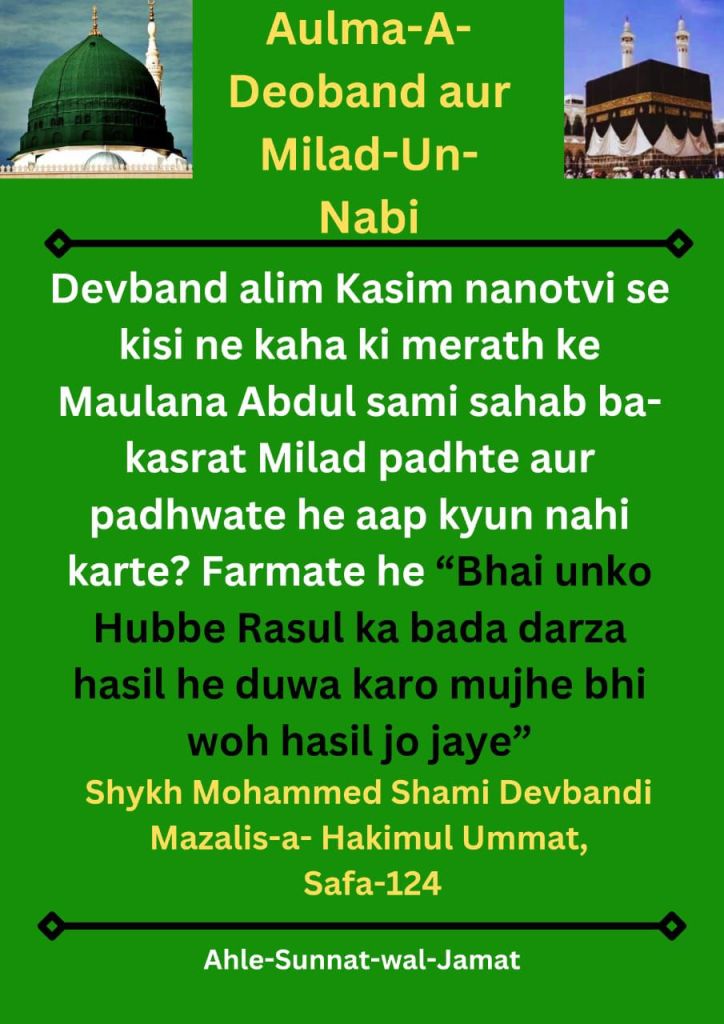
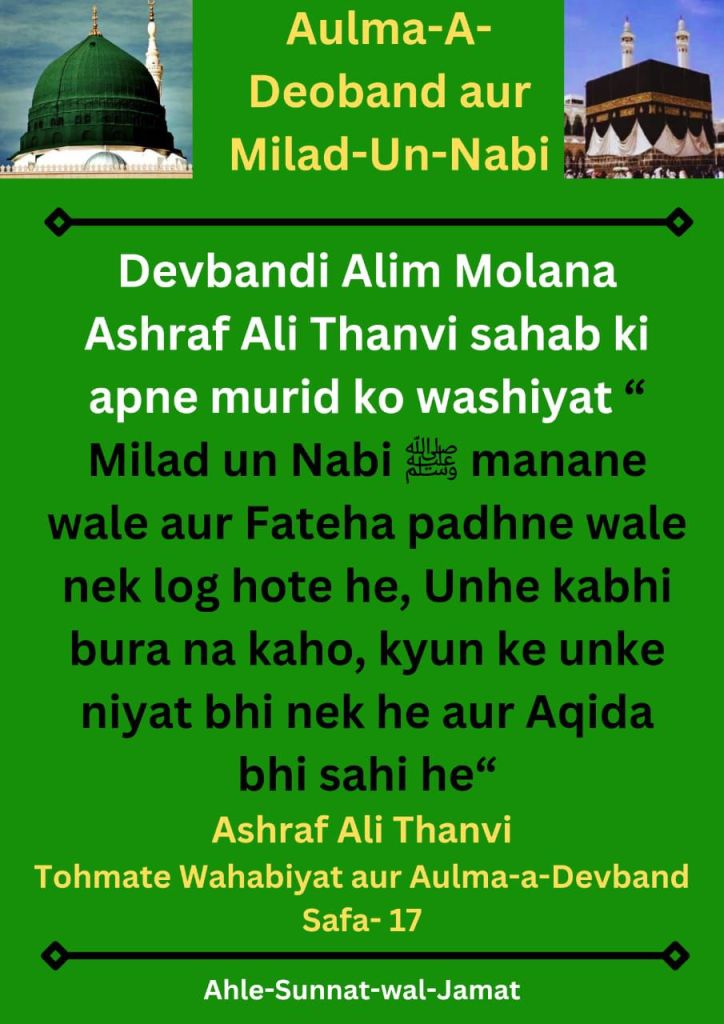
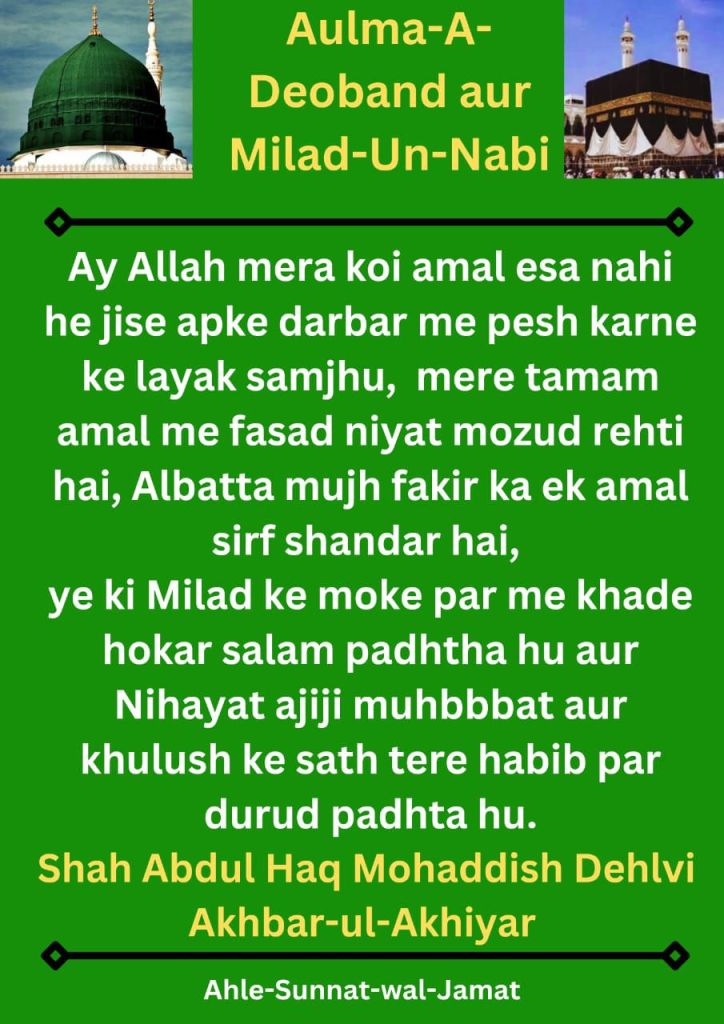
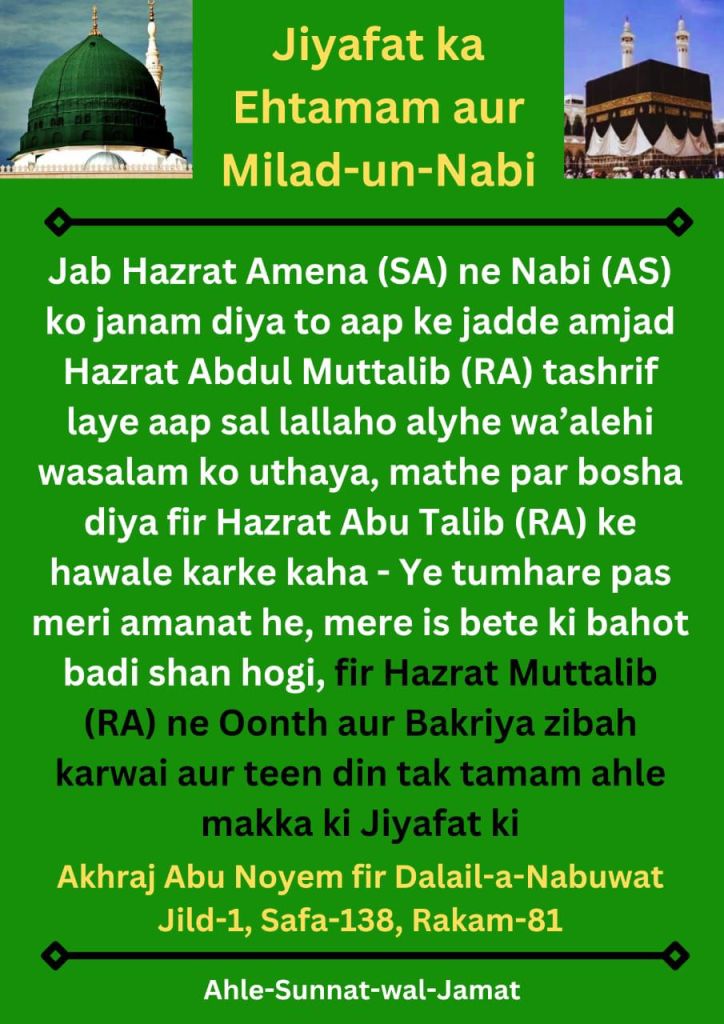
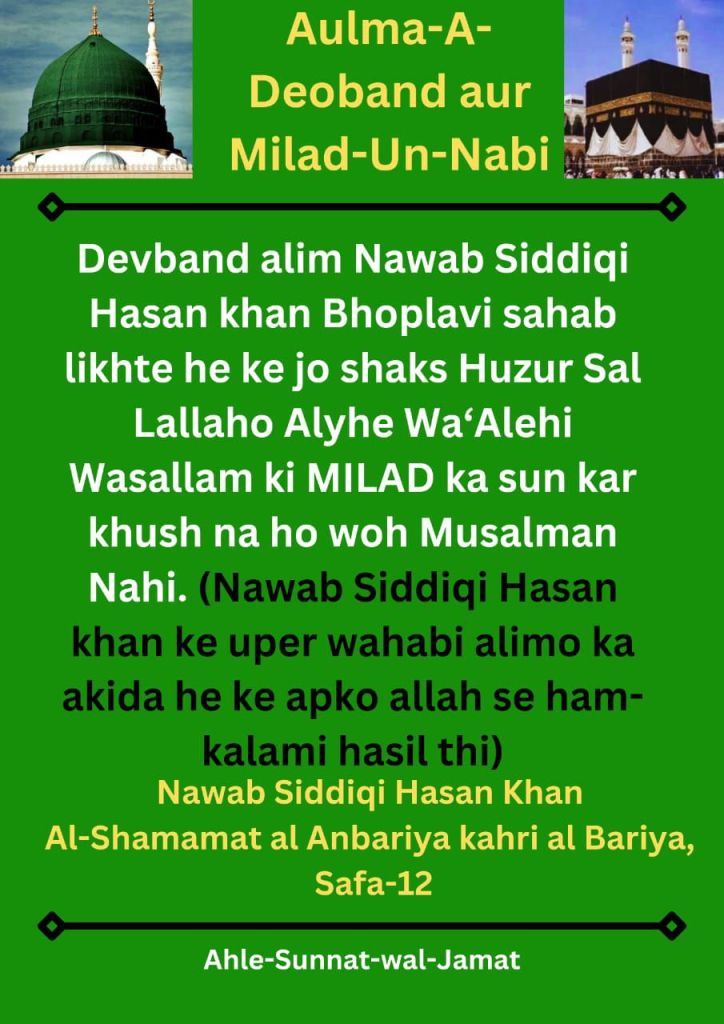
(हुजुर सल्लल्लाहु अलैह व सल्लम का खुद मिलाद कि खुशी मे जानवर ज़िब्हा करके खाना खिलाना )
तिबरानी अल मजुअल ओसत कि जिल्द नम्बर एक हदीस नम्बर 994 हजरत अनस रज़ियल्लाहु अन्हु से रिवायत है कि नबी ए करीम सल्लल्लाहु अलैह व सल्लम ने एलाने नबुवत के बाद खुद अपना अकिका किया
हदीस मे ये अलफ़ाज़ अक्का अन नफसेही इसलिये आया कि रावी को गलत फहमी हो गयी कि ये अकिका था
ईमाम जलालुद्दीन सुयुती रहमतुल्लाह अलैह ने अपने फतावा अल हावी कि जिल्द एक सफा 196 पर इस हदीस के तहत लिखा है कि
आपका अकिका आपकी विलादत के सातवे दिन आपके दादा हजरत अब्दुल मुत्तलिब ने कर दिया था और अकिका दौबारा नही किया जाता ये आपकी विलादत के शुक्र गुज़ारी और इज़हारे मसर्रत यानी खुशी मे आपने जानवर जिब्हा करके अपने अकारिब व अज़िज़ो को बुलाकर खिलाया था















6215826709411920905.jpg)


 Aal-e-Qutub Aal-e-Syed Abdullah Shah Ghazi