Jibreel in the presence of the Holy Prophet Hadhrat Muhammad (Sallallahu alaihi wa sallam) part 3

Jibreel (May peace be upon him) came to the Holy Prophet (Sallallahu alaihi wa sallam) 420000 times

Imam Muhammad Fasi (May Allah shower His Mercy on him) writes in his Matali’ul Massarraat, Pg. No. 322 on the authority of the book of Shaikh Abu Abdullah, Lafzud Durri Bi Anamlil Kaff:

Translation: Which means that Hadhrat Jibreel (May peace be upon him) had the honor of coming to the Holy Prophet (Sallallahu alaihi wa sallam) 420,000 times. Each time he came and waited upon Him with proper respect.

Jibreel (May peace be upon him) requests permission to enter the presence of the Holy Prophet (Sallallahu alaihi wa sallam)

Whenever Jibreel (May peace be upon him) came to the presence of the Holy Prophet (Sallallahu alaihi wa sallam), he would become the very personification of respect and would request permission. Out of respect, he would not come closer to the Holy Prophet (Sallallahu alaihi wa sallam) suddenly, but he would be constantly requesting the Holy Prophet (Sallallahu alaihi wa sallam) for permission. When the Holy Prophet (Sallallahu alaihi wa sallam) would grant him permission, then he would come close to the Holy Prophet (Sallallahu alaihi wa sallam) and sit parallel-legged.

Thus, in many different types of books of Hadith like the Sihah, Sunan, etc., there are many Hadith of this kind. As an example, the following Hadith is being reproduced here:

Translation of Hadith: It has been narrated on the authority of Hadhrat Abdullah bin Umar (May Allah be well pleased with him), he says: We were present before the Holy Prophet (Sallallahu alaihi wa sallam). Suddenly a person with a beautiful face, fragrant odor and in a clean dress came to His presence and said:

Assalamulaikum, O Prophet of Allah (Sallallahu alaihi wa sallam). May I come closer to you? Then He (Sallallahu alaihi wa sallam) said: Come closer. He came a little closer. In the same way, he kept requesting for permission many times and kept coming closer to the Holy Prophet (Sallallahu alaihi wa sallam).

In Musnad Imam Ahmad Bin Hambal, the Hadith is with a slight change:

Jibreel said: Assalamulaikum, O Prophet of Allah (Sallallahu alaihi wa sallam). The Holy Prophet (Sallallahu alaihi wa sallam) said: Walaikum Assalam. Then he said: O Prophet of Allah (Sallallahu alaihi wa sallam) may I come closer? He (Sallallahu alaihi wa sallam) said: Come closer.

In Kanz Ul Ummal, the words are like this:

Jibreel (May peace be upon him) said: May I come closer to You, O Prophet of Allah (Sallallahu alaihi wa sallam)! The Holy Prophet (Sallallahu alaihi wa sallam) said: Come closer to me.

In Sunan Nasai, the following words have been recorded:

Jibreel (May peace be upon him) came to the edge of the floor coverlet and said: O Personification of Praise and Worthy of all extolment (i.e. even His name was used as a form of praise) Assalaamulaikum! Then the Holy Prophet (Sallallahu alaihi wa sallam) replied to his salaam. Jibreel (May peace be upon him) said: O Muhammad (Sallallahu alaihi wa sallam)! May I come closer to you? The Holy Prophet (Sallallahu alaihi wa sallam) said: Come closer. Jibreel (May peace be upon him) kept requesting permission and the Holy Prophet (Sallallahu alaihi wa sallam)_continued granting it.

Musnad Imam Ahmad Bin Hambal and Sunan-e-Baihaqui have these words: O Prophet of Allah (Sallallahu alaihi wa sallam)! May I enter your presence?

The commentator of Musnad Imam A’adham has interpreted this line thus:

Jibreel (May peace be upon him) requested permission in this manner to come closer to the Holy Prophet (Sallallahu alaihi wa sallam) because of the fear that coming closer suddenly would come under disrespect of the Prophet of Allah Ta’ala (Sallallahu alaihi wa sallam). This shows us the respect and reverence with which Jibreel (May peace be upon him) would come to the Holy Prophet. In the same way, Allah Ta’ala used to command Jibreel (May peace be upon him) that he should not leave the Holy Prophet (Sallallahu alaihi wa sallam) without asking His permission and will.

Do not return until the Beloved (Sallallahu alaihi wa sallam) permits you to

Hadhrat Qazi Sanaullah Panipati Naqshbandi (May Allah shower His mercy on him) narrates a Hadith in his Tafseer-e-Mazhari on the authority of Ibn e Sa’ad and Abu Shaikh:

Translation of Hadith: When the Holy Prophet (Sallallahu alaihi wa sallam) finished with the Battle of Badr, Jibreel (May peace be upon him) came to His presence on a red horse wearing armor, holding a spear in his hand and entreated: O personification of praise and O Muhammad (Sallallahu alaihi wa sallam), Allah Ta’ala has sent me to Your presence and has commanded me not to return until You are pleased with me. Is the Holy Prophet (Sallallahu alaihi wa sallam) pleased with me? The Holy Prophet (Sallallahu alaihi wa sallam) said: Yes, I am pleased with you. Then Jibreel (May peace be upon him) returned.

ALI, THE MAGNIFICENT part 15

The Holy Prophet’s Pilgrimage to Mecca in 6 A. H. (628 A. D.) and The Treaty of Hudaibiya.

The Holy Prophet desired to make a pilgrimage to the Kaaba. Ever since he migrated to Medina six years ago re had always been a longing on his part to do so.

Hasty preparations were made, and the Prophet informed the people of Medina that this trip was meant only as a pilgrimage. Arrangements for the journey having been
completed, the Prophet led fourteen hundred men to Zul Hulefa on the road to Mecca. All swords were to be sheathed and the wearing of armour of any kind was forbidden.

Before approaching Mecca, the Prophet was informed that the Meccans hearing about his journey had despatched a cavalry of two hundred to prevent him from proceeding further. To advance was out of the question as the Prophet had not come to give them battle; so he diverted to the right towards Al Hudaibiya. Reaching Al Hudai- biya, on the verge of the sacred territory surrounding Mecca, his camel Al Qaswa stopped and knelt down as if refusing to go further. The Prophet took this sign as a Divine Omen that he should not proceed further; he ordered a halt and encamped there. While the Prophet and his followers waited here, the Quraish continued to hold counsel around the Kaaba. Some were for driving Muhammad away by force, a few were for allowing him. to perform the pilgrimage, but the majority wanted to prevent him from entering the Kaaba while still avoiding warfare. This led to a stalemate. Negotiations continued between the Prophet’s representatives for some days without the deadlock being broken. The Quraish remained adamant, not agreeing to allow the Prophet to enter Mecca.

Finally a treaty was signed between the Meccan representative Suhail bin Amr and the Holy Prophet. The Prophet instructed Ali, his Vicegerent, to write down the treaty at his dictation, and it began thus: “In the name of God, the most Gracious and Merciful’, Suheil objected to this, and said that it should begin as the Meccans used to do. Thus: “In Thy name, O God!” The Prophet agreed and asked Ali to write “Bismeka Allah Hoomma’. Next he dictated:
“This is the Treaty made between Muhammad the Apostle of God and Suheil son of Amr.” Suheil again raised an objection and said that had the Meccans acknowledged him as an Apostle of God they would never have taken up arms against him’. Instead of “the Apostle of God”, Suheil asked the Prophet to have his father’s name written. The Prophet again yielded, but Ali had already written the words. “Muhammad the Apostle of God”. The Prophet bade Ali to erase the words under objection, but as Ali hesitated, the Prophet himself taking the writing materials obliterated the words and had the words, “son of Abdullah substituted in place of “Apostle of God”. “He prophesied at the same time, addressing Ali, that he would similarly have to yield on a similar occasion in his own time. This prophecy was fulfilled when a treaty. was concluded between Ali and Muawiya some thirty years later.

By the terms of the treaty it was agreed that the Muslims should return immediately to Medina but that they could perform the pilgrimage the following year. During the period the Meccans would evacuate the city for three days. and camp outside its walls. The Muslims should come as pilgrims, unarmed, save for a sword each, which they could carry for self-defence. It was further agreed that there would be a ten-year truce between the Meccans and the Muslims, and that the Meccan caravans should be allowed to pass without hindrance through their territory. It was also agreed that any Meccan who escaped to Medina to accept Islam would be handed back to the Meccans.

For the time being warfare was avoided and peace returned. The Muslim pilgrims returned to Medina only to

1 Abul Fida

2 Habib al-Siyar; Tazkirat-al-Kiram 3 Rawdzat-al-Ahbab; Habib-Siyar; Ibn Athir

find themselves once more threatened, this time by their implacable enemies-the Jews.

Hadhrat Ibn Ajeel R.A


Hadhrat Ibn Ajeel

Mu’alif says that a Yemeni man had a wart on his hand. He asked all the saints to pray for him that it be removed. Nothing happened the wart remained.
Eventually he came to Hadhrat Ajeel and said “If you can’t cure me then I will lose my good faith in all saints.” Ibn Ajeel recited ‘LA HAWLA WA LA QUWWATTA ILLA BILLAH HIL ALIYIL AZEEM’ and took the mans hand bandaging the hand for him Ibn Ajeel asked him to go away and open it at his own place. The man left with his companions. On their journey they came across a village where they bought some milk and chappati. Whilst eating he didn’t realise but he had lost his bandage. Later he discovered the bandage was missing and where the wart had been his hand was completely clear. (Raudha tur Rayaheen)

The Importance of Ramadan

■ The Importance of Ramadan:

Allama Ibn al-Jawzi (ر) said:

❝Ramadan is like a grand school where a believer trains his soul, learns patience, walks the path of piety, and immerses himself in the ocean of Allah’s mercy. It is a time when hearts are softened, sins are forgiven, and the gates of Jannah are opened wide. Whoever truly understands its value has attained success!❞

Ramadan is not just about fasting from food and drink; it is about disciplining the soul, controlling desires, and strengthening the bond with Allah ﷻ. It is a golden opportunity for self-purification, reflection, and deep spiritual growth. Those who embrace its days with worship and its nights with prayer will find themselves surrounded by blessings.

This sacred month teaches patience in hunger, gratitude for what we have, and humility in standing before our Lord. It is a time when good deeds multiply, duas are accepted, and hearts are filled with tranquility. Those who truly appreciate the gift of Ramadan and spend it wisely will find success not only in this world but also in the eternal life to come.

So, let us not let its moments slip away! Every second of Ramadan is a treasure—those who recognize its worth and act upon it will reap endless rewards. May Allah ﷻ grant us the ability to make the most of this blessed month! Ameen!

● Muhammad Farhan Jamil 6.3.25

Wilayah

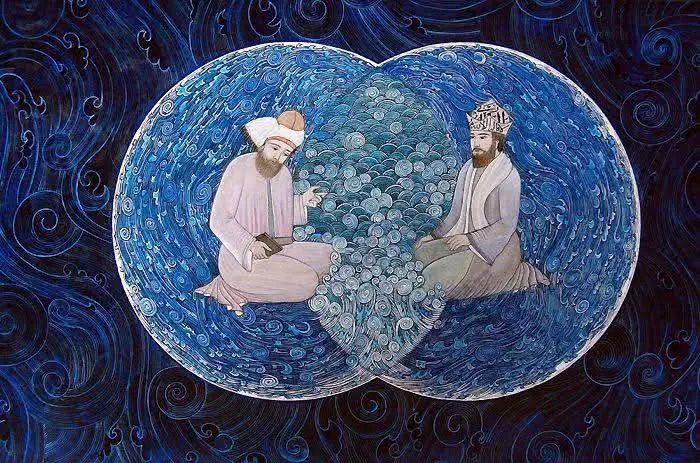
Wilayah (وِلایَت) is not merely a title or a rank—it is an ocean of divine authority and spiritual inheritance that flows through the hearts of those chosen by Allah. It is the sacred trust of Faiz (spiritual grace), passed down through the luminous path of the Ahl al-Bayt and the awliya (friends of God), manifesting as both guidance and protection for humanity. At its core, Wilayah is the bond between the Creator and His chosen ones, those who have transcended the veil of self and become reflections of divine light. It is the reality of spiritual leadership, guardianship, and sainthood, rooted in the Quranic essence and perfected through the eternal Prophetic reality.

Wilayah is not a single thread; it is a vast, interconnected web of divine transmission. At the heart of this transmission are two primary spiritual circles. The Circle of Mawla Ali (علیہ السلام) represents the Wilayah of Qutb (The Spiritual Pole), embodying Ma’rifah (Inner Knowledge), direct recognition of Divine Reality, Jihad al-Nafs (Struggle against the Lower Self), the path of purification and mastery over the ego, and Wilayah al-Kubra (The Supreme Authority), spiritual governance over creation, guiding seekers toward Truth. The Circle of Sayyida Fatima al-Zahra (سلام اللہ علیھا) represents the Wilayah of Faqr (Spiritual Poverty), embodying Noor (Divine Light), the hidden essence, manifesting the highest station of purity, Jamal (Beauty & Subtlety), the delicate yet powerful force of divine manifestation, and the feminine secret of creation, where divine wisdom is nurtured. These two streams of Wilayah flow directly from RasulAllah ﷺ, the ultimate source of divine guidance. Through them, the Faiz spreads from heart to heart, illuminating seekers with the radiance of divine love.

Wilayah is not just an earthly responsibility; it is an ancient trust given to the souls before time itself. When Allah gathered all souls and asked: “Alastu bi-Rabbikum?” (Am I not your Lord?) – (Surah Al-A’raf 7:172), every soul bore witness, acknowledging Allah as their Wali. From that moment, the essence of Wilayah was established. A Wali is someone who has not forgotten this pact—they carry divine authority as a Khalifah (Caliph) on Earth, bridging transcendence (Lahut, Hahut), the unseen divine reality, and manifestation (Nasūt, Mulk), the physical world we experience. Thus, Wilayah is not just political rule; it is spiritual stewardship—a sacred charge to uphold the balance between heaven and earth.

The Quran speaks of Wilayah in various forms. “Allah is the Wali of those who believe…” (Surah Al-Baqarah 2:257). “Indeed, your Wali is only Allah, His Messenger, and those who establish prayer and give Zakat while in Ruku’.” (Surah Al-Ma’idah 5:55). One of the most significant verses is 33:33 (Ayat al-Tathir): “Indeed, Allah only desires to remove impurity from you, O People of the House, and to purify you completely.” This verse confirms the Ahl al-Bayt’s spiritual purity and divine authority. A true Wali is purified of self, an empty vessel filled only with divine Noor.

A Wali is a prism—one who refracts divine light into the world. They do not hold the light for themselves; they channel it outward, illuminating those around them. Their presence acts as a spiritual bridge, connecting the Infinite (Lahut) to the Finite (Nasūt), the Hidden (Batin) to the Seen (Zahir), the Transcendent (Haqq) to the Manifested (Khalq). This aligns with Ibn Arabi’s concept of the “Perfect Man” (Insan al-Kamil)—the one who embodies divine attributes and serves as a conduit of Haqq.

Wilayah is not confined to human hearts—it resonates through the entire cosmos. Just as the planets orbit a central sun, all creation moves within the spiritual hierarchy of Wilayah. The Qutb (Pole) is the axis of divine authority, holding the universe in balance. The Awtad (Pillars) are spiritual guardians anchoring divine order. The Abdal (Substitutes) are hidden saints whose presence ensures the continuity of grace. This structure mirrors the movement of celestial bodies, influencing both earthly events and spiritual ascension. The universe itself follows the rhythm of Wilayah, and those attuned to it can align their souls with the cosmic dance of divine will.

Wilayah is more than a title—it is a state of being. To walk this path means to remember the primordial pact and live in divine presence, to become a bridge between essence and manifestation, to carry the light of Faiz and illuminate others. A Wali is not self-appointed; they are chosen by Allah, purified by divine will, and guided by the eternal Prophetic reality. Whether as a spiritual guide, a saint, or an unseen guardian, the Wali exists to uphold divine harmony—in hearts, in the cosmos, and in the unfolding destiny of the universe. The question remains: do we recognize this Wilayah within ourselves?

Realization is very important aspect of the waliya and the authority is given by the one who are in the authority may Allah allows us to walk on this path and allow us to carry these secrets inside ourselves in our core ,,
Sufi shah .