


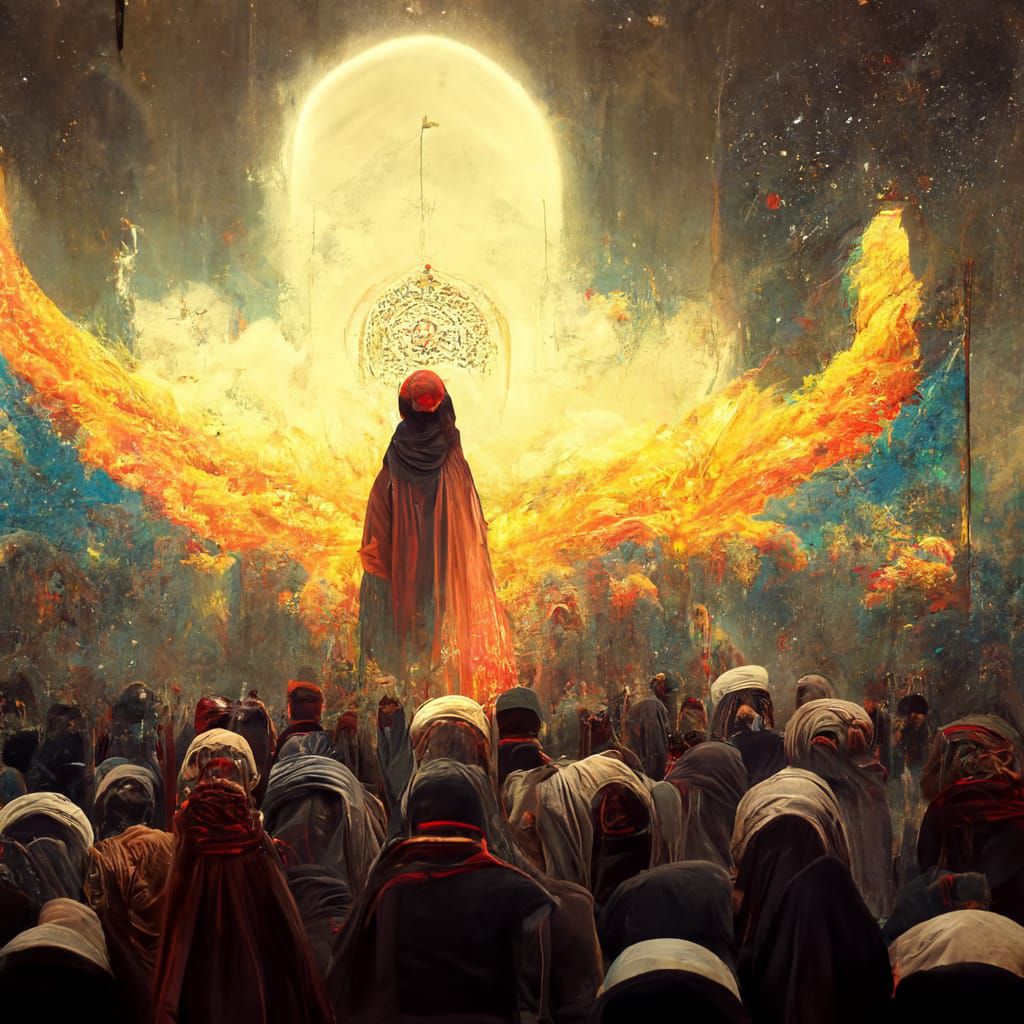
MOSES (MUSA)
The Birth and Early Life of Moses
The children of Israel came to Egypt during the days of Joseph and flourished with wealth and large progenies. Their growth in wealth and power became a threat to the rulers of Egypt. The adviser of the pharaohs devised several ways to reduce this threat. This brought great hardship to the children of Israel. Around the time of the birth of Moses there were rumors that a great prophet will be born that year amongst these people and that he will challenge the might of the Pharaoh and liberate the children of Israel. The Pharaoh ordered all male babies born. to these people to be killed so that the prophet may never challenge his power. This was extremely painful for the parents of many ill-fated infants who were slain as a result of this cruel decree.
God has His Divine Wisdom and nobody can avert what He has planned or designed.
Moses was born in the house of Imran, in the clan of Lavi (one of the twelve clans of Bani Israel). Fearful of the destiny of her child at the hands of the rulers of the time, his mother laid him in a basket and set on the waters of the mighty Nile. The basket drifted towards the gardens surrounding the palace of the Pharaoh. The maids in attendance to queen retrieved the basket and saw a handsome child in it. The queen who had no child of her own developed immediate love for the baby. She adopted him as her son. He was named Moses, which, in the old Egyptian language, meant, “pulled out of water.” God has His own ways of protecting and providing fo His chosen
servants.
The hungry baby needed to be fed but he did not accep any of the fostered mother: brought in. The sister of Moses ha followed the basket to the palace. She offered to bring one of th new mothers whose babies had recently been slain. She did no reveal her and her mothers association with the baby. The quee
agreed, as she had no other choice. When the mother of Moses was presented in the palace as one who had been deprived of her baby, Moses responded immediately to the nursing. The queen. hired her to nurse the baby in the palace and at her own home as needed. The infant prophet, a servant of God was thus returned to his own mother and household for care and for nurturing.
Moses as a teenager in the palace of Pharaoh
The Pharaoh saw the intellectual brilliance in this youth and appointed his top astrologers, magicians, scribes and priests to educate Moses in all aspects of the royal faculties. He must have intended to appoint Moses as his special advisor, or high priest, or even his successor. However, this could also be the Will of God to have Moses gain all the secrets of the Pharaoh that made him so powerful.
Moses in the service of Sho’ayb
Moses was naturally inclined to help his people. One day, while trying to free an Israelite in a scuffle with an Egyptian, Moses killed the Egyptian with one blow. This incidence reached the elite circle of the ruling class who branded Moses as a friend of the wretched Israelites whom the Egyptians hated from the core of their hearts. They passed a unanimous resolution to have a public trial of Moses to get him killed for his deed against an Egyptian. A noble person in the clan of the Pharaoh (called Mo’mine Ale-Fir’on in the Qur’an) informed. Moses of the plot and he helped him escape into the desert.
The desert journey was arduous. Moses reached the city of Midyan. He came to rest at a well where several shepherds. were busy watering their herds. He saw that there were two young and beautiful women waiting for their turn to serve their herd. The men took their turns assertively while the ladies waited patiently. Moses could not remain passive at the sight. He offered to help the young women by pulling the water from the well. They told him that their father was old and since he was unable to do this work, they had no choice but to come out to

serve their herd. Sometimes it could be quite late in the evening when they returned to their home.
Moses helped them water their herd expeditiously and they returned home early. Their father enquired about their unusual carly return. They told him of the incidence at the well. Sho’ayb recognised the deed to be that of a man of God and sent one of his daughters to bring him home. Moses had nowhere else to go, so he accompanied the lady to her home. Sho’ayb asked Moses the details of his travel. The story of Moses fascinated all in the audience. Sho’ayb offered Moses to stay with him and married one of his daughters to him. He lived in the clan for about ten years and led an extremely simple life in comparison to the comforts of the royal Egyptian palace. He tended the sheep and goats of the family and spent time in the solitude of the desert. Here he contemplated and reflected on his past and present experiences and have discussions with his father-in-law. which enriched his spiritual experience. Ile reflected over the plight of his people in Egypt and made a firm resolve to free them from the servitude of the Egyptians.
The Prophethood of Moses and his return to Egypt
After living ten years in Midyan, Moses left for Egypt, accompanied by his family. On their way, one night, they pitched their tents near Mount Sinai. It was cold and needed fire for warmth. He saw what looked like a fire higher up on the mountain. Moses told the family to stay in the tents while he would go up the mountain to bring the fire for then” comfort.
When he arrived at the site, instead of fire, he noticed a brilliant light emanating from a bush. Moses approached the bush cautiously when he heard a voice calling him to take off his shoes as he was in the presence of his Creator and that he was standing on sacred land. It was here that God bestowed upon Moses the gifts of miracles to be used while confronting the mighty Pharaoh. He was given a brilliant light in his hand (Yade- baiza) and a staff with miraculous powers. God told him that He would give him other great signs to help accomplish His mission. Moses was then instructed to proceed to Egypt
immediately.
Moses said that he was afraid of getting arrested on a previous murder charge and also because he could not speak fluently due to his stuttering. He prayed to God to grant him fluency of speech and had his brother Aaron (Haroon) help him and be a deputy to him in all his tasks ahead. God granted Moses his requests and told him that he could take his brother along with him and told him to be gentle in his language and be patient in all his dealings.
The Moses was overwhelmed by the experience. brilliant light emanating from the bush disappeared. For his own satisfaction, Moses verified the miracles of Yade-baiza and conversion of his staff into a serpent. He knew that it was not a dream and he indeed was in Devine presence.
Moses came down from the mountain, narrated his experience to his wife who acknowledged him to be the prophet of God and gave him the reassurance and comfort he needed. They made their way to Egypt and to the house of Imran. his father. He took Aaron aside and told him about his appointment as a prophet and his vicegerent. Aaron was pleased and assured to help his brother in the task that lay ahead.
The confrontation with the Pharaoh
Moses and Aaron arrived in the court of the Pharaoh and told him that his claim of god was false, for there is but one God who created the king and his people. He controls all that is in this world and beyond. The only reason for his return to Egypt was to obtain the release of his people from their bondage in Egypt.
The Pharaoh was not pleased with the dialogue and said that Moses was a fugitive of their law and was to be hanged for the crime of killing an Egyptian. Moses said that the final justice was in the hands of God and that the Pharaoh himself was committing the worst crime in defying his own Creator by forcing his false godhood over his subjects. Moses produced the miracle of Yade baiza and showed how, with the Will of God. his hand could produce blinding brilliance. The Pharaoh laughed and said that it was nothing but an act of magic. To impress
Moses, his magicians threw stick on the floor that became.
crawling and wriggling snakes. Moses threw his stick on the floor. It became a serpent and devoured all the wriggling snakes. Whereas the magic of the Pharaoh was beaten, he declined to acknowledge the superiority of God over him. As he defiantly refused to allow Israelis to leave Egypt, Moses had to unleash the punishment of God over him and his people. These punishments came in the form of unseasonal floods that demolished their dwellings, swarms of locusts that destroyed the crop, pestilence of lice that made life miserable, toads that croaked and sprang everywhere and the turning of all drinking water into blood. Each time the Pharaoh was subjected to humiliation his defiance became pervasive. Finally, when the first-born sons of all Egyptians started to die from no apparent cause, including the beloved son of the Pharaoh, he finally gave up his defiance and most reluctantly agreed to Israelis leaving Egypt.
The Exodus of Israel people from Egypt
Moses issued specific instructions for his people to collect all their belongings leave their homes before sunrise and gather outside the city periphery. The remains of Joseph had already been collected in a coffin box, which was hauled out the city with caution and respect. As the people had little time to cook their normal food early in the morning, they could only eat the bread baked from rapidly kneaded dough. Moses led his people out of the city and headed straight for the shores of Red Sea. When the day dawned and the Egyptians saw that their city would be devoid of the work force, they reported it to the Pharaoh. He could not believe that Moses could achieve this mobilisation so fast. His defiance resurged, into mad rage. He mounted his fastest chariot and in the company of his swiftest horsemen, chased Moses and his people and caught up with them at the Red Sea.

 Aal-e-Qutub Aal-e-Syed Abdullah Shah Ghazi