


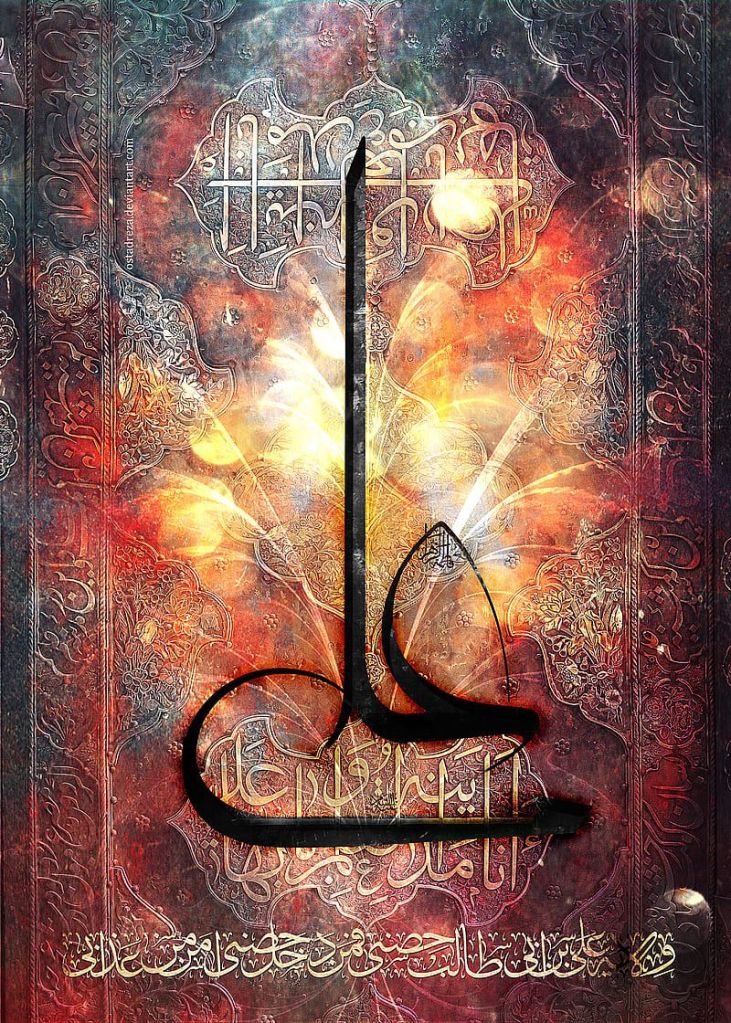
Operations against the Banu Zubuda.
Banu Zubuda was a clan living to the west of Medina. and had accepted Islam. Their leader was a warrior known as Omar bin Kurb. Omar had a feud with another warrior of the same clan named Ushus Khusee, who had killed his father. Anxious to avenge his father’s death. Omar took Ushus prisoner and desired to slay him. The matter went up to the Prophet for arbitration. The Holy Prophet decreed that after the acceptance of Islam, the seeking of revenge for the blood of relatives, which had become a system during the time before Islam, did not now arise. This decision upset Omar so much that he renounced Islam. Omar then killed Harrith Ibn Kaab, the chief of a tribe which had become a feudatory to Islam. This killing of an ally of the Muslims could not be tolerated by the Holy Prophet.
He deputed Ali to lead a force against the Banu Zubuda. Before the general battle began, Omar came out and challenged Ali to a single combat. At this Ali, The Lion
of God’, came thundering out of the ranks, and chanting verses in which he glorified the valour of the Muslim heroes. struck such awe in the heart of the adversary that he fled from the battlefield. This left the tribe of Banu Zubuda without a leader, and they promptly took to flight. Ali pursued them, took several of thein prisoners and returned to Medina in triumph.
The Tabuk expedition, and the appointment of All as Governor of Medina.
In the middle of 9 A.H. 631 A.D. news reached the Prophet that the Roman Emperor Heracles was mobilising a huge army to surprise the Muslims at Medina. Receiving this intelligence, the Prophet resolved to meet the enemy on their way, and issued explicit orders to his men to make preparations for the expedition. The Holy Prophet appointed Ali, his Vicegerent, as Governor of Medina. Besides commanding the Medina garrison, Ali was to officiate at prayers and to perform all those duties that had hitherto devolved on the Holy Prophet. In addition to maintaining law and order, he was also required to look after the Prophet’s household, a duty which more. than all others epitomised the love and trust in which he was held by his beloved Master. He accepted the trust with great reluctance, having been accustomed always to: accompany the Prophet and share all his perils.
After the departure of the Holy Prophet, rumours began to circulate to the effect that Ali had been deliberately left behind because the Prophet had been apprehensive about the dangers of the Tabuk expedition. These rumours were started by one of the leaders of the hypocrites, Abdullah ibn Ubay, an old enemy of Islam since the days of Badr.
To a man of Ali’s nature, accusations of cowardice were more than could be borne. Stung by this suggestion. Ali hastened after the Prophet, overtaking him on the road to Tabuk and informed him of the various rumours prevailing in Medina. The Holy Prophet managed to pacify Ali and spoke thus: “These men are liars. They are the party of the Hypocrites and Doubters, who would breed sedition in Medina. I left thee behind to keep watch over them, and to be a guardian to both our families. ‘I would have thee to be what Aaron was to Moses; excepting that thou canst not be like him, a Prophet; I being the last of the Prophets.” The Holy Prophet also explained to Ali that although Abu Sufyan had embraced Islam, the danger of an intrigue at Medina was still so great, that only Ali would be able to curb the mischievous designs of the enemies within the city.
Ali left post-haste for Medina where he sought out the house of Abdullah Ibn Ubay and dragging him outside proceeded to give him a bit of his mind. Though the Holy Prophet had been lenient in his dealings with the Hyprocrites, Ali made it very clear to them that he would not tolerate their double-dealings. He believed in harsher measures and he made it abundantly clear, that, as long as he was in charge of Medina, he would neither brook any insult nor endure any form of intimidation.

 Aal-e-Qutub Aal-e-Syed Abdullah Shah Ghazi