
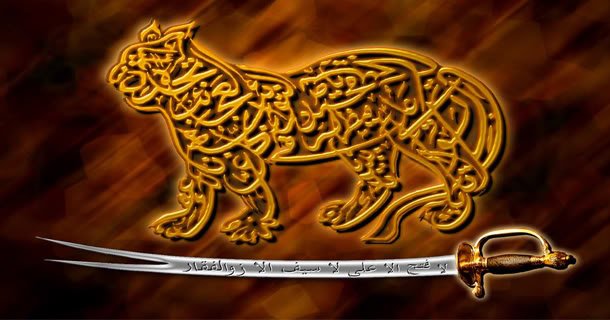
Origin Of Nara E Haideri from ahlae sunnat source
It is Ijma of Sahaba and the Ummah that Imam Ali is the most courageous and bravest amongst the followers of Mohammed Mustafa (Sallal Lahu Alaihi Wa Sallam). Just study the seerah and you will see Badr, Khandaq, Khayber, Hunain etc. For instance, in Badr, 72 kuffar were killed and 37 were killed by Imam Ali (Alaihi Asalam).
The origins of the Naara are from the battlefield and it is recited in praise of the one on whose hand Allah Taalah granted victory to the Muslims after others had failed. When Hazrat Ali (Alaihi Asalam) once defeated many foes by himself, and the Sahaba’s (Radi Allah Anum Ajma’een) said, Nara e Haideri – Ya Ali (Alaihi Asalam).
Sayidna Ali (Aliahi Asalaam) is known as Haider – Lion
Ya Ali (Aliahi Asalaam) is the reply for Naaray Haideri.
Naaray Haideri is the call for Sayidna Ali (Aliahi Asalaam) since he is Asadullah.
Sayidna Ali (Aliahi Asalaam) is also Mushkil Kusha, thus we say Ya Ali to call upon Sayidna Ali (Aliahi Asalaam) as a waseela (intermediately or intercessor).
Sayidna Ali (Aliahi Asalaam) is Imamul Auliya.
Day: March 15, 2025

Mulk, Malakut, and Jabarut: The Three Realms of Existence

Mulk, Malakut, and Jabarut: The Three Realms of Existence
In Sufi metaphysics, existence is structured into three realms—Mulk (ملک), Malakut (ملكوت), and Jabarut (جبروت)—which represent the progression of the soul from the material world to the realm of divine power and unity. These realms reflect the transcendence of the self from outward perception to inward reality, culminating in divine annihilation (Fana) and subsistence (Baqa).
Mulk is the lowest realm, the world of physical existence, where forms appear separate and distinct. It is governed by time, space, and causality, and it is the domain of material perception. This is the realm of Nasut, where the soul experiences separation, struggles with the ego (Nafs), and engages in external religious practice. The soul, entrapped by worldly distractions, begins its journey toward spiritual awakening.
Malakut is the unseen world of spirits, angels, and divine command. It is where divine decrees are carried out, and it governs the outward realm of Mulk. This is the realm of dreams, visions, and mystical experiences, where the seeker perceives realities beyond the material world. The divine names and attributes begin to manifest, and the illusion of separation starts to dissolve. The seeker witnesses the oneness of creation, realizing that the physical world is merely a veil over deeper truths.
Jabarut is the realm of divine power, where all multiplicity dissolves into unity. It is the domain of Kun fa-yakun (Be, and it is), where creation arises instantly by divine command. There is no duality here—only the presence of Al-Haqq. The seeker who reaches Jabarut has transcended the self and experiences Fana (annihilation in Allah), where all veils are lifted, and only the divine remains. This is the highest realization: Allah was, and nothing was with Him.
The journey from Mulk to Malakut to Jabarut is the soul’s ascension toward divine reality. The perfected Sufi does not abandon the world but returns to Mulk with transformed perception. This is the station of Insan al-Kamil (the Perfect Human), who lives in the world but is no longer veiled by it. The prophets and saints exist in this state, guiding others toward the same divine truth.
Though described as distinct, these realms are not separate layers but interwoven dimensions of the same reality. Just as the body, mind, and soul are connected, so too are these realms. The physical world is an outer reflection of the unseen world, which ultimately originates from divine presence. The journey of the soul is to awaken from the illusion of separation and realize that everything is, and has always been, a manifestation of Allah’s oneness.

Hazrat Khadija Tul Kubra R.A Ka Wisal | Islam Ki Pehli Aurat Ki Qurbani

Manaqib e Maula e Kaynat (Part 1)

*Manaqib e Maula e Kaynat (Part 1)*
*1. Rasool Allah ﷺ Ne Farmaya :-*
Ali Ko Meri Mitti Se Banaya Gaya Hain.
📚 *Reference* 📚
*1.* Tabrani, Al Muajjam Al Awsat, Jild 6, Safa 162-163, Hadees No 6085.
*2.* Haythami, Majma uz Zawa’id, Jild 9, Safa 168.
*2. Rasool Allah ﷺ Ne Farmaya :-*
Me Aur Ali Ek Hi Nasab Se Hain.
📚 *Reference* 📚
*1.* Imaam Alusi, Tafseer Rooh ul Ma’ani, Jild 6, Safa 186.
*2.* Imaam Tabrani, Al Muajjam Al Awsat, Jild 3.
*3. Rasool Allah ﷺ Ne Farmaya :-*
Ali Ka Gosh Mera Gosh Hain Aur Ali Ka Khoon Mera Khoon Hain.
📚 *Reference* 📚
*1.* Tabrani, Muajjam Al Kabeer, Jild 12, Safa 18, Hadees No 12341.
*2.* Haythami, Majma uz Zawa’id, Jild 9, Safa 111.
*4. Rasool Allah ﷺ Ne Farmaya :-*
Ali Mere Liye Aesa Hain Jese Haroon Alahis Salam Musa Alahis Salam Ke Liye.
📚 *Reference* 📚
*1.* Sahih Bukhari, Jild 4, Safa 1602, Hadees No 4154.
*2.* Sahih Muslim, Jild 4, Safa 1870-1871, Hadees No 2404.
*5. Rasool Allah ﷺ Ne Farmaya :-*
Ali Tum Dono Jahan Me Mere Bhai Ho.
📚 *Reference* 📚
*1.* Tirmizi, Jaame As Sahih, Jild 5, Safa 636, Hadees No 3720.
*2.* Hakim, Al Mustadrak, Jild 3, Safa 15, Hadees No 4288.

Jashne Imam E Hassan II Mola Hassan mea Jamal e Mustfa

 Aal-e-Qutub Aal-e-Syed Abdullah Shah Ghazi