
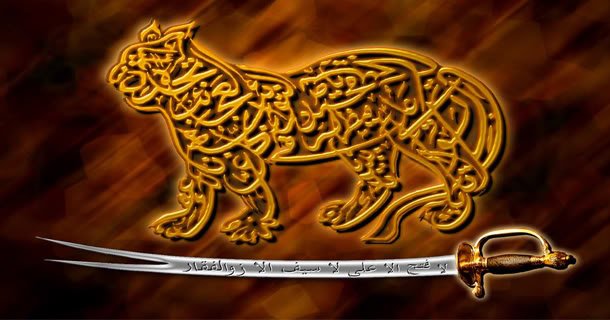


Operations against the People of Al-Tavef. 8 A. H.
After the battle of Hunain, Malik ibn Auf, fled to Tayef where he was given asylum. The people of Tayef were formidable warriors who worshipped an idol called. Allat, and attributed all their success to him. It was the Prophet’s desire to destroy this idol, and prove to the people of Tayef that only God was to be worshipped. Hence a force was sent to lay siege to Tayef.
The warriors of Tayef proved their mettle, and resolved to fight to a finish against the Muslim assaults, and they replied with counter assaults, until the casualties among the Muslims started piling up. When the Muslims laid waste their vineyards and date palms, they offered formidable resistance and refused to surrender.
Finally the Holy Prophet decided to send Ali to Tayef with an invitation to the people to accept Islam. On his arrival in the territories bordering on Tayef, Ali began to destroy the pagan symbols whenever he came across. one. This greatly incensed the local tribesmen, men of the Banu Khusham, who were feudatories of the Tafe- fites. In a skirmish with them Ali killed their formidable
leader, Shahab. This caused panic amongst the forces. of the Banu Khusham, who surrendered. Other feudatories of Tayef, the men of Hawazan and the Banu Thakeef were also quickly defeated by Ali, who marched on to Tayef, where he found its people now anxious to surrender. A deputation of the people of Tayef then went to the Holy Prophet to pray for forgiveness and to ask permission to: enter the Islamic fold.
The deputation asked the Holy Prophet to give them. short respite for the continued worship of their symbols, begging first for one year’s grace then for six months, and finally for just a month. The Holy Prophet rejected their request emphatically. “Then” said they, “Exempt us from the five daily prayers”. The Holy Prophet replied, “Faith without prayers is no faith at all”. As a last appeal they said, “Give us exemption from Zakat (the obligatory tax)”. The Holy Prophet said to them, “You have to observe prayers and fasting and to pay the obligatory tax if you accept Islam. These are all articles of Faith, and can never be dispensed with. And should you deviate a hair’s breadth from the Commands of God, I will send you a man, like me in all respects and he will put you to the sword, and ignominious will be your lot”. Then the Holy Prophet caught hold of Ali’s hand and said, “Verily he is the man who will do this job”.
All inspired with Divine Secrets.
During the period when the army was sitting round the besieged town of Tayef, the Prophet sent out a detachment under the command of Ali to invite the tribes inhabiting the vicinity of Tayef, to embrace Islam. Ali had some
encounters, especially the Khotham clan offered opposition but after their chief named Shabab was slain by Ali, they submitted. When Ali returned after faithfully and successfully executing his mission, the Prophet on seeing him exclaimed ‘Allaho Akbar’ and took him alone to his sacred apartment to have a long and confidential talk with him. His companions’ began to murmur, wondering why the Prophet so long engaged Ali in a secret conference, not allowing others to be present. Hearing this, the Prophet said that God Himself had inspired Ali with Divine Secrets, and it was for this reason that he was engaged in confidential discourse so long.
Wadi-al-Ramal or Zhat-al-Salasal Expedition.
In the year 9 A.H., the Prophet received intelligence that the tribes inhabiting the Wadi-al-Ramal valley contemplated a raid upon Medina, and that they were collecting arms and men for the purpose. The valley was surrounded on all sides by hills and thorny bushes and trees which served as ambuscade. Two expeditions failed due to the difficult terrain which was an asset to the enemy to ambush the Muslims.
At last, the Prophet despatched Ali at the head of an army. Ali, at the start, took another direction and after some stages turned suddenly towards his destination. through a rugged tract, marching by night and halting for rest in the day. His companions protested against the dangers of the route, but Ali paid no heed to them and proceeded on. At length one morning he surprised the enemy and ravaged the valley, avenging the loss they had inflicted upon the preceding expeditions.
1 Habib-al- Siyar; Maarij-al-Nabawat; Kanz-al-Ummal.
‘The Prophet received a revelation as contained in Sura of the Quran and he announced the glad tidings of Ali’s victory to his Companions. When Ali was coming back victorious, the Prophet went out with his followers to receive him. Seeing the Prophet, Ali got down from his horse, but the Prophet bade him remount, and told him his services were approved by God and His Prophet. On hearing this Ali wept with joy.
This expedition is known as Zhat-al-Salasal expedition. which is related by some historians as having taken place. in the year 8 A.H.

 Aal-e-Qutub Aal-e-Syed Abdullah Shah Ghazi