
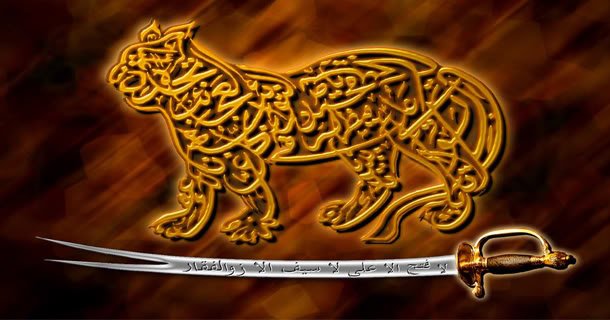


Ali an Encyclopaedia of Learning
Ali was a living encyclopaedia of learning, about whom the Holy Prophet said, “If I am the city of Knowledge verily Ali is the gate of it.” According to the Shi’ite legends he was the first “Imam” of Islam. Possessed of a prodigious memory he had learned the whole of the Qura’an by heart, to become the acknowledged authority on it. He also exhibited talents in all other fields of literature, including Arabic philology and poetry. In the storehouse of his brain was a vast stock of stories, limericks and riddles. Few have been endowed with talents such as his. Those sermons and writings which have come down to us show him to have been unique in his mastery of Arabic rhetoric and eloquence. They are rich in imagery and forceful in expression, the rhythm and power of his words flowing like a torrent from a high mountain to the valley below. Similes and metaphor pour forth to be resolved at last in the slow-moving clarity of the logical and systematic conclusions to which he always brought his arguments.
Ali’s Collected Works
Ali’s works have been collected into a vast compendium called the Najh-tu’l-Bulagha, an anthology of his sermons, letters, utterances on all sorts of occasions, exhortations, complaints, advice, judgments on penal, civil and commercial law, proposed solutions of fiscal
Literary Achievements
and economic problems, and what might today be called psychological discussions. There was no topic on which Ali could not express himself and his letters to contemporary rulers and his addresses on “Jihad” have become imperishable classics.
In its import and sanctity the work is regarded by the Shias as second only to the Qur’an and the “Sunna” of the Holy Prophet.
Ali’s Literary Style
Ali developed a highly individual style, discarding the high flown and elaborate forms which had hitherto been a convention of Arabic literature in favour of the flexibility and vigour of everyday speech. He spoke, and wrote, in the language current amongst the masses; he also delighted in coining a new word or phrase, often with great wit and humour. More than any other religious teacher or preacher, he possessed the common touch, the power to stir the human heart.
Authenticity of the Contents of the Najh-tu’l- Bulagha
This anthology of Ali’s works which epitomises the divine knowledge which Ali received from his Master, is greatly venerated by the Arabs who consider every word of it worthy to be weighed in gold. The work contains, (1) Ali’s discourses, speeches and addresses. (2) The letters which he wrote to his contemporaries, (3) Ali’s aphorisms and witty maxims, (4) Ali’s mystic sermons in which he so elaborately explained the doctrines of “Tauheed” (monotheism) and
other tenets of Islam.
These addresses, letters and pithy sayings were collected and edited by Sharif Rudi in the tenth century A.D. This work recalls a long-drawn controversy which still lingers between two major sects of Islam-the Shias and the Sunnis. The former maintain that the entire
ideals. work is of Ali-that super-man genius who, as wisdom personified, had illumined humanity by those sermons in which he made clear as crystal the Islamic code of Ethics and which portrayed Islamic virtues and Islamic In the eyes of the Sunnis, Ali was not the author of the entire Najh-tu’l-Bulagha. One of the first Sunni writers to challenge the authenticity of this work was Ibn Khallikan since which time a number of Sunni critics have questioned the validity of this work, maintaining that several of the addresses are nothing short of forgeries, especially fabricated by the Shias in order to legalise their doctrinal differences and not from the We need not enter here into the con- pen of Ali at all. troversy. Suffice it to say that it is generally presumed that by far the major portion of this work is from the pen or mouth of Ali. The book itself gives a most valuable and vivid picture of Arab life during Ali’s reign. that, during his lifetime, Ali deliv-
Masudi records ered some 500 addresses which the people learned by heart, passing them on from one generation to another by word or mouth until they were collected by Sharif Rudi towards the end of the tenth century A.D. Rudi was himself considered a literary genius, by his contemporaries and the publication of this work gave rise to a number of contemporary commentaries by scholars, copies of more than three dozen of which still exist.
The Addresses and Sermons
Ali’s sermons and addresses dwelt at length on human tragedy and display a fierce hatred of injustice, hypocrisy and the lust for self-aggrandizement. Many of the utterances border on pessimism, which may well be accounted for by the failure of his own political life. In his sermons Ali has tried to show the worthlessness of vice and folly and to lay bare the blessings of virtue. Herein lay the seeds of “Sufism” because of the esoteric element which creeps into his solution of the human enigma.
Literary Achievements
The most celebrated piece of Ali’s work has still to be deciphered. It is called “Jafr wa Jame” and is written in characters to which no one as yet has managed to find a key. The Shia legends say that the parchment is a record of all the big events that are to happen on earth from the advent of Islam to the end of the world. The Shi’ite Imam, Jafar as-Sadiq, is said to have deciphered parts of it while Mehdi, the twelfth Imam of the Shi’ites is said to have deciphered the whole, but, as he disappeared leaving no records, the contents still remain a mystery. It is believed that the Imam will re-appear just before the end of the world.
The brilliance of the remaining sermons and addresses, which have been preserved in intelligible language, provide a thrilling literary experience for all who read them. Irrespective of the march of time they still have the power to captivate the heart and elevate the spirit.
Quotations from some of the Sermons and Addresses
When the people of Busra sided with Ayesha and fought the battle of Camel against Ali, the latter is said to have censured them in a public sermon thus:
“O ye people of Busra! Your country is near the water but far away from the sky. You lack intelligence and wisdom. Your wisdom has been replaced by folly. That is why you have become the target of every archer, a delicious morsel for the hungry and a victim for every hunter.”
(Sermon No. 18. Najh-tu’l-Bulagha) While exhorting his people to remain steadfast and loyal to him, Ali addressed them thus:-

 Aal-e-Qutub Aal-e-Syed Abdullah Shah Ghazi