
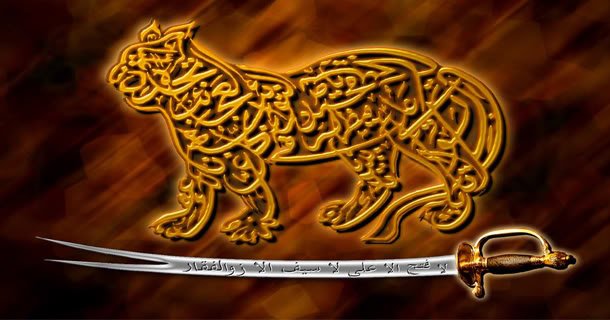


Ali’s Humility
Humble himself, Ali hated pomp and arrogance. Even as Caliph he used to sweep the floor of his own house, chop wood for fuel, carry water on his shoulders, mend his own shoes, wash his own clothes and milk his goat. Ali’s wife Fatima did similar domestic jobs with her own hands, grinding wheat in the hand-mill, baking bread, lighting the oven, washing the dishes and tending her children.
Returning one day with some dates from the bazar, he received many offers from people anxious to carry them for him. Ali refused them all, saying, “Whosoever is responsible for looking after his children, has the bigger responsibility of carrying the burden himself.” Ali was often seen walking barefoot and on one occasion when he happened to be riding a horse he was distressed to find people following him on foot. Asking them what they wanted, he was told that they felt elated by walking in his retinue. To this Ali replied “Go back to your business. By walking behind a rider, you will breed feelings of inferiority in yourselves and infect me with arrogance.”
On another occasion when Ali was discussing the essential qualities of a ruler in a Khutba, a member of the congregation rose and praised Ali for his eloquence. Ali said that his subjects ought not to praise him, for he wanted no flattery, being all too conscious of his own unworthiness. Concluding his sermon he said, “To a person who has been influenced by the superb Majesty of God, every thing else appears petty and frivolous. He looks upon all other things as shallow and trivial. The worst ruler is one who is given to pride and arrogance and hears flattering words from other. All praise is due to God. You should not praise me because, I herewith declare before God and all of you that are here that I have many responsibilities which lie still undischarged. In the face of it how can any one applaud me and consider me praiseworthy? You should not accord me that treatment which is only befitting to tyrants. Neither become afraid of me Do not show any nor ever hesitate to tell the truth. consideration to me If I am found wanting in I cannot justice, and never conceal truth from me. trust any flatterer because he might mislead me and his tempting talk might beguile me into vainglory. pray to God to save me from an erroneous path. We men are all alike and there is no other master than God.” I
All’s Patience
Another virtue, which Ali possessed in full measure was patience, which earned him the title of a “Second Job’. Of his patience in the face of physical suffering story may serve as an example:-
the following In the battle of Uhud, Ali received some sixty-one wounds on his person and when brought to the Prophet’s camp, even Um Salim and Um A’tiya the Muslim nurses refused to dress so many wounds saying that the whole body of Ali looked like one big wound so how The Holy Prophet could they begin to tackle it. then himself washed all the wounds, dressed them and said, “That very God in whose cause Ali had sustained injuries will heal them.” Ali although in mortal agony, replied: “May God grant me patience to bear this suffering. Is it not a favour of God that he gave me the courage to stand and fight and not to leave the field?”
When the Holy Prophet broke the sad news of his brother Jafar’s death to Ali, the latter bore the tidings patiently without a murmur. According to the Shi’ite legends, God revealed the following verse of the Qur’an
Ali’s Forbearance and Unbounded Mercy
His refusal to deny water to Mu’awiya’s troops at Siffin, even though Mu’awiya had attempted to cut off
at that juncture:
“155. And We will try you with something of fear and hunger and loss of wealth, and lives and fruits: but give good tidings to the patient.” “156. Who, when a misfortune overtakes them say, “Surely, to Allah we belong and to Him shall we return.” (2:155-156)
Ali used to say that, at no time in his life, had he ever known peace and tranquillity. From the time that he went, in infancy, to the home of the Holy Prophet it was a ferment of turbulence and turmoil. The Holy Prophet was constantly persecuted by the Meccan pagans. Then, from adolescence onwards, Ali was constantly fighting in Jihad (crusades); and after the death of the Holy Prophet he was embroiled, against his will, in the political intrigues of others, his rights were questioned, set at naught and usurped. Even when elected Caliph, the implacable enemies of Islam arose and rebelled against him yet he bore all these afflictions with patience, thanking God that he had acquitted himself well in the tests and trials to which the Almighty had thought fit to subject him.
After the Holy Prophet, if any one was praised for the nobility of his nature it was Ali. Not only was he gentle and affectionate towards his friends, but his kindness and lack of vindictiveness towards his enemies have become proverbial. His treatment of Merwan, the first cousin and secretary of Caliph Uthman, is one outstanding example of his clemency. Merwan had played a prominent part in inciting the rebels to take the field against Ali, yet when he was brought before Ali as a prisoner, after the Battle of Camel, Ali forgave him and set him at liberty without exacting any ransom. all supplies from his own men, is an even more forbearing and famous example of his humane treatment towards his fellow-men, whether they were friends or foes. “The water”, said Ali, “belongs to God and God alone and every living creature, man, bird and beast, has the right to it. Go on and fetch as much a water as you can. (Tarikh Kamal).
The habit of mutilating the corpses of the enemy was particularly abhorrent to Ali, who utterly forbade his men to touch the bodies of the enemy dead. Nor did he allow them to possess themselves of horse, the arms or accoutrements of the slain, a departure from custom which met with considerable opposition from his own. troops.
On one occassion when the wealthy Umar bin Ubda fell by Ali’s sword, an old Arab chief, observing that Ali did not touch the precious coat of mail, lost his temper and said, “This is a penny-wise and pound foolish policy which cannot be justified on any grounds.” Ali, however kept silent. When Umar bin Ubda’s sister came to the battlefield and saw the dead body of her brother still clothed in his armour and unmutilated, instead of weeping as was the custom of the Arab women, she uttered the following verses:-
“Had Umar’s murderer been any one else; Save the one that killed him, I would have wept uptil eternity; But his murderer is a gentleman; In whom no one can find any fault; Surely he is the son of a gentleman; A Sire, who is the light of the city.
Ali repeatedly enjoined his troops not to despoil the corpses of their enemies saying, “Never make naked the slain on the battlefield. The lion who enters the battlefield, either kills others or himself gets killed. He never bothers about the booty.” In the thick of a battle, if Ali’s opponent broke his sword, he would stop fighting until he had given his adversary a weapon to resume.
Mercy and love for his fellow men were so deep rooted in Ali’s character that they had become second nature to him. He could not bear to look on the sufferings of others. When Ibn Muljam, the assailant who had fatally wounded Ali with his poisoned sword was brought before him as a prisoner Ali saw to it that his enemy’s thirst was quenched and hunger satisfied, refusing to drink or eat in front of him until he had been fed.
On one occasion Mu’awiya is said to have asked Khalid bin Yamit why he held Ali so dear, and to have received as answer, “I love Ali for he never ceases to be merciful even when he is angered, is never less than righteous in conversation and is unfailingly just when deciding a case.”
When Mu’awiya was harassing Ali’s subjects by making continual border raids, Ali’s governor, Kameel bin Ziyad suggested that Ali should allow him to lead rétributive expeditions into Syria to spread similar alarm and despondency amongst Mu’awiya’s subjects. To this proposal Ali replied, “Two wrongs cannot make a right. Mu’awiya may take pleasure in harassing and oppressing God’s innocent men, how can I resort to such measures ייק
Innumerable acts have been recorded of Ali’s kindness on the actual field of battle. After the battle of Camel Ali gave decent burial to all the enemy dead while to Ayesha, he gave liberty and safe conduct back to Mecca. During the water shortage at Siffin he refused to quench his own thirst while his soldiers were parched saying, “Give this water to one who is thirstier than I.”
Consideration for his subordinates, clemency towards a fallen foe, benevolence towards those who remained inimical to him, moderation towards those who intrigued against his life, these were some of Ali’s many virtues, born of his unbounded love for humanity.
Among his Muslim enemies Ali’s humanity was frequently and wrongly interpreted as a sign of weak- ness. It is perhaps significant, however, that his non-
Muslim Persian subjects, who shared in the extreme generosity with which he had treated the rebellious Persian provinces, remembered his reign as one akin to that of their Sassanian ruler An-Nusherwan. the Just.
Protection for Illegitimate Children
Ali’s humane nature also showed itself in the decrees he enforced to protect illegitimate children from cruelty and hardship. Until the reign of Ali, a woman pregnant with an illegitimate child was punished for her adultery. The Caliph maintained that ro harm ought to come to the innocent child in the womb. Accordingly the bastard children were declared innocent and taken, from birth, into the care of the State, which not only fed and clothed them, but also saw to it that they got some education.
Care of Prisoners
Another social reform introduced in the reign of Ali was concerning the welfare of prisoners. Rich prisoners, in jail for offences for which the crown was prosecutor, were expected to pay for their food: but poor people, no matter what their crimes had been, were fed from money provided by the State Treasurer.
Reforms and Social Justice
Ali’s ideas of social justice were all based on the laws which had been revealed in the Holy Qur’an. He did not care a whit for the clap-trap of tribal custom and threw out many of the pagan practices which, belonging properly to the ‘Age of Ignorance’, had begun to creep back into Arab life since the death of the Holy Prophet.
The core of Ali’s ethical pronouncements was his interpretation of “Ummah”, the Islamic community, which he conceived of as an organic entity capable of
possessing moral and spiritual qualities. An individual could not lead his life in isolation but ought to live as part of the “Ummah”, safeguarding the “Haqooq’l Abad” (duties of individuals towards their fellow men), as ordained in the Qur’an. This could only be achieved by developing a sense of group-solidarity and loyalty and by each person striving to live in harmony with his fellows without encroaching upon or usurping the rights of others.
“Mankind” said Ali, “with all its spiritual faults and moral vices would lead to a crisis of the nations and could only survive by a corporate sense of responsibility. Individual responsibility would positively avouch solidarity.”
On the other hand, Ali realised that personal traits of character in individuals could exercise an influence over the life of the community. For this reason Ali urged the strong not to transgress the rights of the weak and he passed many decrees to safeguard the interests of the weaker members. He further held that a good government should not only be regulative but also reformative in its application. He defined the State as “a community in action” and the government as instrumental in achieving that end. A righteous government meant a righteous Caliph, for the Caliph was the agent of the community, charged to fulfil the responsibilities imposed on him by its moral laws.
Only by rightfully observing the “Haqooq’l Abad” or the social duties of the individuals” could a man perform “Haqooqu’l Allah” (duties and obligations to God). If men were found wanting in their duties towards God. He was Merciful enough to forgive them; but the violation of the rights of individuals involved infringements of the laws of society and the guilty parties could only be forgiven by those whom they had wronged.

 Aal-e-Qutub Aal-e-Syed Abdullah Shah Ghazi