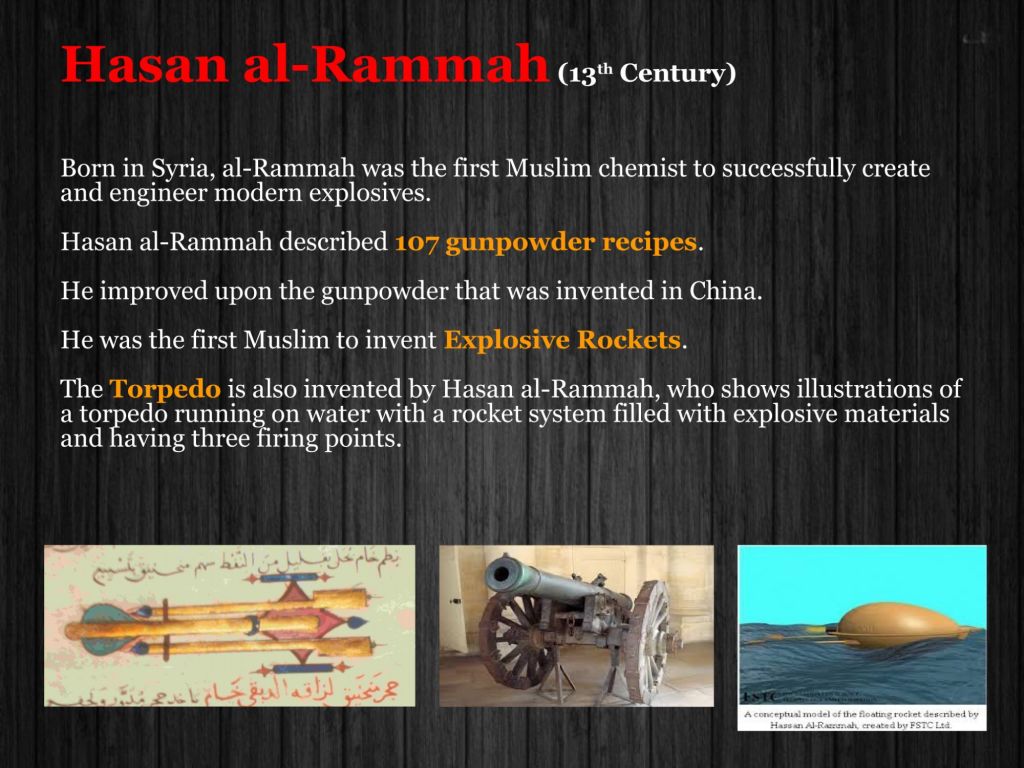

Hasan al Rammah


Ali the First in Many Fields
Ali, the ideal man, was endowed with many unique virtues that led him, according to the islamic traditions to be the first person to be or perform a number of things
(1) He was of noblest birth for both his father and mother were Hashimites.
(2) He was the only man to be born in the Kab’ah (the house of God).
(3) He was the first to offer homage to the Holy Prophet.
(4) He was the first to offer prayers after the Holy Prophet.
(5) He was the first to offer his services for “Jihad” (crusades).
(6) He was the first to receive religious instructions from the Holy Prophet.
(7) He was the first to compile and codify the Qur’an.

(8) He was the first to be styled as “brother” by the Prophet and on every occasion.
(9) He was pre-eminently loyal, standing firm by the Prophet until his last breath.
10) He was the first to give burial to the Prophet, after his death.
11) He was the only warrior to stick to his post on the battlefield in all battles and never once turned his back.
12) He was the first to offer to sleep in the Prophet’s bed on the night of his emigration to Medina.
13) He was the first to be appointed commander in all those battles in which the Holy Prophet did not participate personally.
14) He was pre-eminent in killing all his adversaries in all his duels.
15) The honour of the propagation of the Qur’anic Sura “Al-Bara’at” (the Immunity) fell to Ali’s lot, thereby raising him supreme above all others.
16) He was the only man on whom the Holy Prophet bestowed the title “a Second Aaron”.
17) The privilege of breaking idols in the Kab’ah, (after the conquest of Mecca) also fell to Ali’s good fortune.
18) The honour of owning a house which opened into the courtyard of the Prophet’s mosque was reserved for Ali alone
(19) Ali was the first to have such a unique wife as Fatima, and a unique father-in-law like the Prophet and sons like Hasan and Hussain.
(20) Ali was the first to have the honour of being nominated by the Holy Prophet as his successor, testator and vice-regent.
(21) Ali was also honoured by being styled “Moula” (master) of the “Ummah” (nation) by the Holy Prophet.

The Role of Great Men
The great German philosopher Goethe once remarked, “The more civilised a person becomes, the more urgently he feels that he has a dual role to play in the world, the real and the ideal; and he sees in this feeling the foundation of all that is noble. This is greatly true of great men, whose spirit lives on in the minds of others, and after their bodily death their legacy of ideas often helps to mould men’s lives. The picture of the great man thus perpetuated may become far removed from reality, it adopts as it were a life of its own, constantly mutated into ever new patterns, by the vicissitudes of history. Only gradually does the spiritual wealth of a great mind become fruitful: every new generation goes to school with him and learns to understand new aspects of his work, hitherto neglected, which have for them a special significance and thus shapes the great man’s image in the light of its own experience.”
Ali has meant many different things to many generations, each of whom has found something to inspire it out of all the diverse wealth of his mind. During his lifetime he was thought of primarily as a warrior fighting, at first, in the battles of God and later, for a decade, against schismatics like Mu’awiya. He was also respected for his knowledge and learning, and, in later years, many thought of him as a saint, but it was not until after his death that the effect which he had exercised over the ethical life of his time began to be appreciated.
Ali was the pioneer of a movement which aimed to re-juvenate the ethical life of the Muslims. Ali promulgated moral laws at a time when morality has been shaken to its foundations by Mu’awiya and other opportunists. The Arabs had begun to forsake the unity of Islam in favour of the old tribal laws of the “Days of Ignorance”, a disintegration which Mu’awiya found favourable to his ambitions and which he never ceased to exploit. The whole aristocracy of the Quriash, especially the Ummayyads, was anxious to see a reversion to the old fedual ways and they were all in league to destroy Ali, who continued to insist on the need for Islamic unity. It was an uphill struggle and one which had, not only theological implications, but political and social significance as well. Ali had to fight against the disintegrating social forces that were everywhere around him and attempt, almost single-handed to restore the religious polity of Islam.
Liberty and Tolerance his Greatest Contributions
As Caliph, Ali possessed two sublime qualities- tolerance and liberty. Perhaps his greatest contribution to Islam was that he considered tolerance and liberty the birth right of all and he granted unqualified liberty of speech and action to his subjects, even when by so doing he risked the gravest setbacks to his hopes. He regarded it as his responsibility to impart equitable justice to all, irrespective to whether or not the recipients were capable of good use of the freedom which he bestowed upon them or worthy of the trust that he might place in them. Even his worst enemies admitted that he never interfered with the private liberty of any of his subjects and it would be hard to find a single instance in which Ali’s government ever meddled with the opinions of individuals.
That entire liberty of speech was granted to his subjects can be gleaned from the fact that men openly criticised their Caliph and his actions while religious freedom was also given to all and sundry, his officials being expressly enjoined to safeguard the interests of the “Dhimmis” or Non-Muslim subjects.
 Aal-e-Qutub Aal-e-Syed Abdullah Shah Ghazi