


Kufa the new Capital
The Battle of the Camel had been won with the help of the Kufans and Ali now made Kufa the metropolis of his Caliphate. It is not difficult to find reasons for his decision. Ali had cause to be grateful to the Kufans for their loyalty, he had promised with them to make Kufa his capital if they helped him against Talha and Zubair; and it was essential that the Bedouine remained loyal to him if he were to fight Mu’awiya. The central geographical position of Kufa may also have influenced his decision, for Medina was too far away from the Bedouine settlements to exert much positive influence. Ali may well have felt that the restless and trouble-seeking Bedouine could be far more effectively controlled from a city of their own making.
On the face of it, the decision to move his headquarters seems to have been a reasonably practical one, but Ali was to lose more than he gained by the change. The religious idealism and sincerity of the Medinites was sadly lacking in the newly-chosen settlement of Ali’s Bedouine friends, as was the scholastic outlook, the seasoned judgment and the venerable traditions of the Medinites. Those eminent companions of the Holy Prophet who still survived were no longer to have any religious or political influence, in Arabia and, with the change to the new Capital, the old sanctity of the Caliphate was gone.
Medina’s New Role
In a world where Might was henceforward to determine Right the spiritual values of Medina, it might be thought, would find little place; but although, for several centuries, Medina was to suffer a total eclipse politically, its scholastic and spiritual importance was constantly to increase. The city became famous for its discussions of Muslim law and jurisprudence and for its preservation of the Traditions of the Holy Prophet, a branch of knowledge which was developing into a regularised science. To Medina were attracted all those Muslims who wished to renounce the world in favour of the life. of the spirit, religious devotees who treasured every word that Muhammad (may peace be upon him) had spoken. Among these, Ibn Abbas and Ibn Masud became famous for the schools they established, at first for purposes of research and, later, for public instruction. This puri- tannical city now became the seat of Muslim theology and out of the burning zeal of the Medinites there evolved. the culture which today is called Islamic and which was to spread from Medina to Baghdad, to Spain, to every part of Africa and to the rest of the world.
Character of the New Colonial Towns
Kufa, like its neighbouring city of Busra, was a new colonial town that had been founded by Bedouine from the Yemen. From the dawn of history the Yemenites. appear to have had a highly-developed culture which can be favourably compared with that of China and Ancient Egypt; indeed they boasted that it was they who took their culture to Egypt and they claimed to be the fathers of Arabian culture. Nevertheless their civilisation was strictly tribal and their newly-built city of Kufa was divided into numerous lanes, each one specifically reserved for a different tribe. The science of genealogy was the most revered of studies and everything was directed at the preservation of tribal individuality,incontra-distinction to the unity of the tribes that had hitherto been the aim of the Islamic communities.
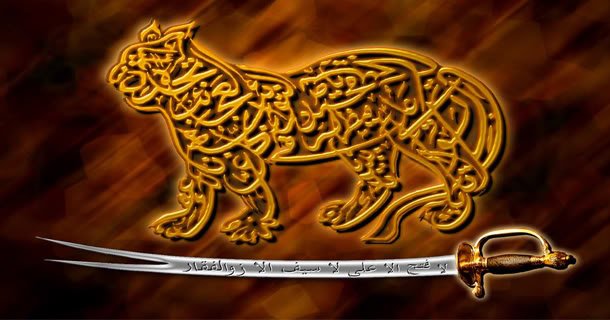
Next to the science of genealogy was the art of calligraphy, an art in which the Kufans achieved such distinction that even to-day, in the Twentieth Century, it is in Kufan script that the Holy Qur’an is written.
Rhetoric and oratory were also much cultivated in Kufa and it was here, to a most appreciative audience, that Ali delivered his famous sermons, thus increasing the fame that the city already enjoyed in these arts.
Joseph Hell comments as follows on the character of Kufa and Busra:-
“The character of these towns, which had sprung up in Babylonia out of military cantonments the towns of Busra and Kufa-stands in sharp contrast to that of the old Arab commercial towns- -so little effected by the changed circumstances.
Here in consequence of conquering campaigns, a new world had come into being. The contact between the Arabs and the gifted Persian population stirred the Arabs to their depths and transformed them, so to speak, into a new and special race of men. The rapid growth of these towns-about 50 A.H. each counted 150,000 to 200,000 inhabitants and the stimulation of the Persians called forth a lively intellectual movement; and thus Busra and Kufa became the most intellectually animated centres of Islam. The intermediary position- geographically and intellectually-which they held between Medina and Damascus tended to promote egotism and to foster a spirit of independence. There no authority was immune from challenge whereas every rebel was sure of a hearing. Just as they upheld freedom in politics, so also they upheld independence of thought in the domains of art and science. Here, earlier than elsewhere, attention was directed to the scientific study of the Arabic language. The contact between the Persian and Arabic on one hand, and the deviations between the
1. Joseph Hell -The Arab Civilization. p. 39. Publishers Muhammad Ashraf Lahore.
language of the Qur’an and the vernacular on the other, evoked the linguistic and philological activity.”
Character of the Kufans
The Kufans, stemming for the most part from the Bedouine of the desert were proud, fierce and by nature rebellious. Since they had taken a dominant part in the conquest of Persia, Iraq, Syria and Armenia they had considered themselves, in the earliest days of Islam, the pillar of strength in the Commonwealth. After the death of the Holy Prophet, however, they had quickly lapsed into apostasy but the stringent policy of Abu Bakr brought them back into the fold, albeit somewhat in disgrace. Caliph Umar was not disposed to trust them implicitly and although he was very willing to make use of them in the ranks of the Muslim army, both as infantry and cavalrymen, he refused to grant them commissions as commanders and other posts of trust and responsibility. During the reign of, Uthman, however, the Kufans managed to regain their former military importance, monopolising high army posts and coming to dominate military policy. They were a force to be reckoned with and Ali was obliged to give them his most careful consideration.
Nevertheless in spite of their independence, their liberalism, their pride and their intellectual vigour the Kufans became synonymous with perfidy and time- serving treachery. In breaking away from the conservative traditions they went too far in the opposite direction and it was small wonder that the Arabs of the Hijaz blood looked down on them. “The Bedouine element”, says, the Arab chronicler, “whether of Kufa or Busra, was the rabble of the Arabian edifice, which formed the population of the new commercial towns. “
It must also be remembered that the population of Kufa and Busra was by no means exclusively Arab. It consisted of those subject races who had accepted Islam (including Greek, Persian, and Byzantine elements) and
of the new Arab settlers who had chosen the towns as their home because they were ideally situated for the carrying on of commercial enterprises. Thus the population was bred out of an intermingling of races and commerce rather than from any religious or ethnological consideration. The egotistical, nationalistic spirit which the people displayed was not so much democratic as self-seeking-aggrandisement and irresponsible tribal warfare flared up on the slightest provocation and the fickle conduct of the Kufans became so notorious that even. now, in the Twentieth century, the proverb, “as treacherous as a Kufan” remains in current use.


 Aal-e-Qutub Aal-e-Syed Abdullah Shah Ghazi