His father was the infamous Abu Sufyan who joined the ranks of the Muslims after the conquest of Macca. If the prophet was born in year 570 and started preaching publicly at the age of 40 (year 610), and the conquest of Macca happened in year 630, this means Abu Sufyan spent about 20 years fighting against the prophet and his followers. He was a staunch enemy of the Islam. But in the end, he had no choice but to become a Muslim. All of those became Muslims during the conquest of Macca are called al-Tulaqa’. In my humble opinion and based on the big picture that I see, Abu Sufyan, his son Mua’awiya and his likes joined the ranks of the Muslims in order to destroy Islam from within, and not because of belief or conviction. This will become clear once you understand what this man has done to Islam and its followers, how he managed the affairs of the people, who his governors were and what they did.
His mother was the infamous Hind, who ordered one of her slaves to kill Hamzah, the uncle of the prophet, and to rip his liver off his dead body and bring it to her! Abu Sufyan’s hatred and enmity towards the prophet never ceased. His son Mua’awiyah, who is the product of Abu Sufyan, carried on his mission by opposing Ali during his legitimate caliphate and waging a war against him. Yazid, the son of Mua’awiyah and also his product, carried on the wicked mission by killing Imam Hussein and his followers in the battle of Karbala.
Yes! The enmity of Abu Sufyan never died, and how could it when their hatred for the prophet, his message and for Ali never stopped! These are the murderers of the progeny of the prophet that many Muslims dare to sympathize with and justify their satanic actions!
Mua’awiya ruled for about 19 years and died in 60 Hijra, then he forecefully secured the caliphate for his son Yazid through threats, bribery and coercion.
I could conclude this topic of Mua’awiya in few lines with clear evidence, in the following way: the first fact is that Mua’awiya established the practice of insulting Imam Ali on the pulpits of Bani Ummayya during every sermon, a practice that lasted 90 years and was abolished by Umar ibn Abdul Azziz. The second fact is that Mua’awiya and his governors turned the people of Damascus into hateful enemies of Imam Ali and his followers, enemies that reviled Imam Ali and wished his death. The third fact is that Mua’awiya fought the Imam of his time and the legitimate caliph of the Ummah. The fourth fact is that Mua’awiya continually persecuted the followers of Imam through his governors. The fifth fact is that Mua’awiya and his army are the rebellious and aggressive army that killed Ammar ibn Yassir:
Narrated ‘Ikrima: that Ibn ‘Abbas told him and ‘Ali bin ‘Abdullah to go to Abu Said and listen to some of his narrations; So they both went (and saw) Abu Said and his brother irrigating a garden belonging to them. When he saw them, he came up to them and sat down with his legs drawn up and wrapped in his garment and said, “(During the construction of the mosque of the Prophet) we carried the adobe of the mosque, one brick at a time while ‘Ammar used to carry two at a time. The Prophet passed by ‘Ammar and removed the dust off his head and said, “May Allah be merciful to ‘Ammar. He will be killed by a rebellious aggressive group. ‘Ammar will invite them to (obey) Allah and they will invite him to the (Hell) fire.”
The sixth fact is that Mua’awiya and his followers invited Imam Ali and his followers to Hell while the latter group invited the former one to Heaven. To the clear mind, these facts prove that Mua’awiya hated Imam Ali and his followers. And about that, the prophet said:
Um Salama narrated that she heard the prophet say to Ali: “None will love you but a believer and none will hate you but a hypocrite.”
عن مساور الحميري عن أمه عن أم سلمة قالت: سمعت رسول الله صلى الله عليه وسلم يقول لعلي: لا يحبك إلا مؤمن، ولا يبغضك إلا منافق
The prophet also said:
Umm Salamat asked Shabeeb: “does the prophet get insulted in your gatherings?” He responded in the negative. Umm Salamat asked: “Ali ibn Abi Talib? I heard the messenger of Allah say: ‘He who insults Ali, insults me and he who insults me insults Allah.”
أبو جعفر احمد بن عبيد الحافظ بهمدان ثنا احمد بن موسى بن اسحاق التميمي ثنا جندل بن والق ثنا بكير بنعثمان البجلى قال سمعت ابا اسحاق التميمي يقول سمعت ابا عبد الله الجدلي يقول حججت وانا غلام فمررت بالمدينة وإذا الناس عنق واحد فاتبعتهم فدخلوا على ام سلمة زوج النبي صلى الله عليه وآله فسمعتها تقول: يا شبيب بن ربعىز فأجابها رجل: جلف جاف لبيكيا امتاه . قالت يسب رسول الله صلى الله عليه وآله في ناديكم؟ قال: وانى ذلك؟ قالت فعلي بن ابي طالب قال: انا لنقول اشياء نريد عرض الدنيا. قالت فاني سمعت رسول الله صلى الله عليه وآله يقول: من سب عليا فقد سبنى ومن سبنى فقدسب الله تعالى
Another Hadith that is mutawatir is that of Ghadeer Khum:
al-Barra’ ibn A’azib narrated they were travelling with the prophet and stopped at Ghadeer Khum. We prayed in congregation the prayer of Noon time. He took the hand of Ali and said: “Do I not have more authority over you than you have over yourselves?” The people agreed. Then the prophet asked: “Do I not have more authority over every believer than he has over himself?” Then he took Ali by the hand and said: “Whomever I am his master, then this Ali is also his master. Oh Allah befriend who befriends him, be the enemy of his enemy.” Then Umar came and told him: “Congratulations to you O ibn Abi Talib. You have become the Mawla of every believer.”…
حدّثنا عفّان، حدّثنا حمّاد بن سلمة، أخبرنا عليّ بن زيد، عن عديّ بن ثابت، عن البّراء بن عازب قال: كنّا مع رسول الله(صلى الله عليه وآله) في سفر، فنزلنا بغدير خمّ، فنودي فينا الصلاة جامعة، وكُسح لرسول الله(صلى الله عليه وآله) تحت شجرتين، فصلّى الظهر وأخذ بيد علي(عليه السلام) فقال: ((أَلَسْتُمْ تَعْلَمون أَنِّي أَوْلَى بِالُمُؤْمِنِينَ مِنْ أَنْفُسِهِمْ))؟ قالوا: بلى. قال: ((أَلَسْتُمْ تَعْلَمون أَنِّي أَوْلَى بِكُلِّ ُمُؤْمِنٍ مِنْ نَفْسِهِ))؟ قالوا: بلى قال: فأخذ بيد عليّ فقال: ((مَنْ كُنْتُ مَوْلاَهُ فَعَلِيٌّ مَوْلاَهُ اللَّهُمَّ وَالِ مَـنْ وَالاَهُ وَعَادِ مَنْ عَادَاهُ))، قال: فلقيه عمر بعد ذلك فقال: هنيئاً يَا ابن أبي طالب، أصبحت وأمسيت مولى كلّ مؤمن ومؤمنة. قال أبو عبد الرحمن: حدّثنا هدبة بن خالد، حدّثنا حمّاد بن سلمة، عن عليّ بن زيد، عن عديّ بن ثابت، عن البرّاء بن عازب، عن النبيّ(صلى الله عليه وآله) نحوه
Lastly, just to cut this short, there is Hadith al-Thaqalayn, which is also mutawatir:
The messenger of Allah said: “I am leaving for you two precious and weighty Symbols that if you adhere to BOTH of them you shall not go astray after me. They are, the Book of Allah, and my progeny, my Ahlul-Bayt. The Merciful has informed me that These two shall not separate from each other till they come to me by the Pool (of Paradise). Watch out how you treat them after me.”
al-Tirmidhi said the hadith is hasan Ghareeb and al-Albani said the hadith is sahih.
حدثنا علي بن المنذر كوفي حدثنا محمد بن فضيل قال حدثنا الأعمش عن عطية عن أبي سعيد والأعمش عن حبيب بن أبي ثابت عن زيد بن أرقم رضي الله عنهما قالا قال رسول الله صلى الله عليه وسلم : إني تارك فيكم ما إن تمسكتم به لن تضلوا بعدي أحدهما أعظم من الآخر كتاب الله حبل ممدود من السماء إلى الأرض وعترتي أهل بيتي ولن يتفرقا حتى يردا علي الحوض فانظروا كيف تخلفوني فيهما قال هذا حديث حسن غريب قال الترمذي : حسن غريب قال الشيخ الألباني : صحيح
A man who hates Imam Ali is nothing but a hypocrite and this makes Mua’awiya a hypocrite. A man who insults Imam Ali also insults the prophet and Allah. Therefore, Mua’awiya has insulted the prophet and Allah, a practice that lasted 90 years! Muawiya was the enemy of the Imam Ali which makes him the enemy of Allah. Muaawiya did not hold fast to Ahlul Bayt but fiercely fought them until his last breath and persecuted their followers, which means he strayed a great stray. Every direction you look at, Mua’awiya has been despicable. Therefore, the verdict is clear and the abode of such people is surely clear.
Allah said:
Quran 4:93
If a man kills a believer intentionally, his recompense is Hell, to abide therein (For ever): And the wrath and the curse of Allah are upon him, and a dreadful penalty is prepared for him.
That is all there is to it. However, I am not satisfied with this because I want everyone in the world to know what this disgraceful and despicable man has done to the family of the prophet, to his companions and to Islam. I want everyone to know and understand why this individual deserves nothing but the wrath of Allah.
In Sahih Muslim (Book of Virtue, In-book reference: Book 45, Hadith 125):
Ibn Abbas reported: I was playing with children that Allah’s Messenger happened to pass by (us). I hid myself behind the door. He (the Prophet) came and patted my shoulders and said: Go and call Mu’awiya. I returned and said: He is busy in taking food. He again asked me to go and call Mu’awiya to him. I went (and came back) and said that he was busy in taking food, whereupon he said: May Allah not fill his belly! Ibn Muthanna, said: I asked Umm Umayya what he meant by the word Hatani. He said: It means “he patted my shoulders.”
In this narration, ibn Abbas does not specify whether he informed Mua’awiya that the prophet needed him. Is it possible that each time, ibn Abbas found Mua’awiya eating, so he did not bother to ask and headed back to the prophet instead to tell him that Mua’wiya was eating? If this is the case, why would the prophet curse him?? Has the prophet been unjust?? Most likely, what happened is that ibn Abbas asked Mua’awiya to answer the prophet’s call, but the latter wanted to finish his meal.
Kill Mua’awiya if you see him on my pulpit
إذا رأيتم معاوية على منبري فاقتلوه
In Musnad Ahmad ibn Hanbal:
Abdullah ibn Amru ibn al-Aass who said: “we were sitting with the messenger of Allah when he said: ‘A man will appear on this mountain pass who will die on a path different from mine.’ I said (Abdullah ibn Amru): my father was dressing up inside so he can come out and I was afraid that he comes out, but someone else did.
عبدالله بن عمرو بن العاص قال : كنا جلوسا مع رسول الله صلى الله عليه وسلم فقال : ( يطلع عليكم من هذا الفج رجل يموت يوم يموت على غير ملتي ) قال : وكنت تركت أبي يلبس ليخرج ، فخفت أن يطلع ، فطلع فـلان
al-Baladhari recorded the same exact hadith in his al-Tarikh al-Kabeer, which dates before Musnad ibn Hanbal, but the name of the person who appeared:
Abdullah ibn Amru ibn al-Aass who said: “we were sitting with the messenger of Allah when he said: ‘A man will appear on this mountain pass who will die on a path different from mine.’ I said (Abdullah ibn Amru): my father was dressing up inside so he can come out and I was afraid that he comes out, but Mua’awiya appeared.
قال: حدثني إسحاق ، حدثنا عبد الرزاق ، أنبأنا معمر ، عن ابن طاووس ، عن أبيه ، عن عبدالله بن عمرو بن العاص قال: كنت جالساً عند النبي(ص)فقال: يطلع عليكم من هذا الفج رجل يموت يوم يموت على غير ملتي ! قال: وتركت أبي يلبس ثيابه فخشيت أن يطلع فطلع معاوية
al-Hafedh Ahmad ibn al-Siddiq al-Ghumari commented on this Hadith in his book Ju’nat al-A’attar (جؤنة العطار) saying:
This hadith is authentic based on the criteria of Muslim, and it removes any distress from the believer that is confused about the matter of this tyrant, may Allah disgrace him, and it obliterates every beautiful image attributed to him.
وهذا حديث صحيح على شرط مسلم ، وهو يرفع كل غمة عن المؤمن ، المتحير في شأن هذا الطاغية قبحه الله ، ويقضي على كل ما يموِّه به المموهون في حقه !
Translation of Sahih Bukhari, Book 33: Retiring to a Mosque for Remembrance of Allah (I’tikaf) Volume 3, Book 33, Number 242:
Narrated Abdullah bin Umar:
Allah’s Apostle used to practise Itikaf in the last ten days of the month of Ramadan.
Volume 3, Book 33, Number 243: Narrated ‘Aisha:
(the wife of the Prophet) The Prophet used to practice Itikaf in the last ten days of Ramadan till he died and then his wives used to practice Itikaf after him.
Volume 3, Book 33, Number 244: Narrated Abu Said Al-Khudri:
Allah’s Apostle used to practice Itikaf in the middle ten days of Ramadan and once he stayed in Itikaf till the night of the twenty-first and it was the night in the morning of which he used to come out of his Itikaf. The Prophet said, “Whoever was in Itikaf with me should stay in Itikaf for the last ten days, for I was informed (of the date) of the Night (of Qadr) but I have been caused to forget it. (In the dream) I saw myself prostrating in mud and water in the morning of that night. So, look for it in the last ten nights and in the odd ones of them.” It rained that night and the roof of the mosque dribbled as it was made of leaf stalks of date-palms. I saw with my own eyes the mark of mud and water on the forehead of the Prophet (i.e. in the morning of the twenty-first).
Volume 3, Book 33, Number 245: Narrated ‘Aisha:
The Prophet used to (put) bend his head (out) to me while he was in Itikaf in the mosque during my monthly periods and I would comb and oil his hair.
Volume 3, Book 33, Number 246: Narrated ‘Aisha:
(the wife of the Prophet) Allah’s Apostle used to let his head in (the house) while he was in the mosque and I would comb and oil his hair. When in Itikaf he used not to enter the house except for a need.
Volume 3, Book 33, Number 247: Narrated ‘Aisha:
The Prophet used to embrace me during my menses. He also used to put his head out of the mosque while he was in Itikaf, and I would wash it during my menses.
Volume 3, Book 33, Number 248: Narrated Ibn ‘Umar:
Umar asked the Prophet “I vowed in the Pre-lslamic period of ignorance to stay in Itikaf for one night in Al-Masjid al-Haram.” The Prophet said to him, “Fulfill your vow.”
Volume 3, Book 33, Number 249: Narrated ‘Amra:
Aisha said, “the Prophet used to practice Itikaf in the last ten days of Ramadan and I used to pitch a tent for him, and after offering the morning prayer, he used to enter the tent.” Hafsa asked the permission of ‘Aisha to pitch a tent for her and she allowed her and she pitched her tent. When Zainab bint Jahsh saw it, she pitched another tent. In the morning the Prophet noticed the tents. He said, ‘What is this?” He was told of the whole situation. Then the Prophet said, “Do you think that they intended to do righteousness by doing this?” He therefore abandoned the Itikaf in that month and practiced Itikaf for ten days in the month of Shawwal.”
Volume 3, Book 33, Number 250: Narrated ‘Aisha:
The Prophet intended to practice Itikaf and when he reached the place where he intended to perform Itikaf, he saw some tents, the tents of ‘Aisha, Hafsa and Zainab. So, he said, “Do you consider that they intended to do righteousness by doing this?” And then he went away and did not perform Itikaf (in Ramadan) but performed it in the month of Shawwal for ten days.
Volume 3, Book 33, Number 251: Narrated Ali bin Al-Husain:
Safiya, the wife of the Prophet told me that she went to Allah’s Apostle to visit him in the mosque while he was in Itikaf in the last ten days of Ramadan. She had a talk with him for a while, then she got up in order to return home. The Prophet accompanied her. When they reached the gate of the mosque, opposite the door of Um-Salama, two Ansari men were passing by and they greeted Allah’s Apostle . He told them: Do not run away! And said, “She is (my wife) Safiya bint Huyai.” Both of them said, “Subhan Allah, (How dare we think of any evil) O Allah’s Apostle!” And they felt it. The Prophet said (to them), “Satan reaches everywhere in the human body as blood reaches in it, (everywhere in one’s body). I was afraid lest Satan might insert an evil thought in your minds.”
Volume 3, Book 33, Number 252: Narrated Abu Salama bin ‘Abdur-Rahman:
I asked Abu Said Al-Khudri, “Did you hear Allah’s Apostle talking about the Night of Qadr?” He replied in the affirmative and said, “Once we were in Itikaf with Allah’s Apostle in the middle ten days of (Ramadan) and we came out of it in the morning of the twentieth, and Allah’s Apostle- delivered a sermon on the 20th (of Ramadan) and said, ‘I was informed (of the date) of the Night of Qadr (in my dream) but had forgotten it. So, look for it in the odd nights of the last ten nights of the month of Ramadan. I saw myself prostrating in mud and water on that night (as a sign of the Night of Qadr). So, whoever had been in Itikaf with Allah’s Apostle should return for it.’ The people returned to the mosque (for Itikaf). There was no trace of clouds in the sky. But all of a sudden a cloud came and it rained. Then the prayer was established (they stood for the prayer) and Allah’s Apostle prostrated in mud and water and I saw mud over the forehead and the nose of the Prophet.
Volume 3, Book 33, Number 253: Narrated ‘Aisha:
One of the wives of Allah’s Apostle practiced Itikaf with him while she ad bleeding in between her periods and she would see red (blood) or yellowish traces, and sometimes we put a tray beneath her when she offered the prayer.
Volume 3, Book 33, Number 254: Narrated ‘Ali bin Al-Husain (from Safiya, the Prophet’s wife):
The wives of the Prophet were with him in the mosque (while he was in Itikaf) and then they departed and the Prophet said to Safiya bint Huyai, “Don’t hurry up, for I shall accompany you,” (and her dwelling was in the house of Usama). The Prophet went out and in the meantime two Ansari men met him and they looked at the Prophet and passed by. The Prophet said to them, “Come here. She is (my wife) Safiya bint Huyai.” They replied, “Subhan Allah, (How dare we think of evil) O Allah’s Apostle! (we never expect anything bad from you).” The Prophet replied, “Satan circulates in the human being as blood circulates in the body, and I was afraid lest Satan might insert an evil thought in your minds.”
Volume 3, Book 33, Number 255: Narrated ‘Ali bin Al-Husain from Safiya:
Safiya went to the Prophet while he was in Itikaf. When she returned, the Prophet accompanied her walking. An Ansari man saw him. When the Prophet noticed him, he called him and said, “Come here. She is Safiya. (Sufyan a sub-narrator perhaps said that the Prophet had said, “This is Safiya”). And Satan circulates in the body of Adam’s offspring as his blood circulates in it.”
(A sub-narrator asked Sufyan, “Did Safiya visit him at night?” He said, “Of course, at night.”)
Volume 3, Book 33, Number 256: Narrated Abu Said:
We practiced Itikaf with Allah’s Apostle in the middle ten days (of Ramadan). In the morning of the twentieth (of Ramadan) we shifted our baggage, but Allah’s Apostle came to us and said, “Whoever was m Itikaf should return to his place of Itikaf, for I saw (i.e. was informed about the date of) this Night (of Qadr) and saw myself prostrating in mud and water.” When I returned to my place the sky was overcast with clouds and it rained. By Him Who sent Muhammad with the Truth, the sky was covered with clouds from the end of that day, and the mosque which was roofed with leaf-stalks of date palm trees (leaked with rain) and I saw the trace of mud and water over the nose of the Prophet and its tip.
Volume 3, Book 33, Number 257: Narrated ‘Amra bint ‘Abdur-Rahman from ‘Aisha:
Allah’s Apostle used to practice Itikaf every year in the month of Ramadan. And after offering the morning prayer, he used to enter the place of his Itikaf. ‘Aisha asked his permission to let her practice Itikaf and he allowed her, and so she pitched a tent in the mosque. When Hafsa heard of that, she also pitched a tent (for herself), and when Zainab heard of that, she too pitched another tent. When, in the morning, Allah’s Apostle had finished the morning prayer, he saw four tents and asked, “What is this?” He was informed about it. He then said, “What made them do this? Is it righteousness? Remove the tents, for I do not want to see them.” So, the tents were removed. The Prophet did not perform Itikaf that year in the month of Ramadan, but did it in the last ten days of Shawwal.
Volume 3, Book 33, Number 258: Narrated Abdullah bin Umar:
‘Umar bin Al-Khattab said, “O Allah’s Apostle! I vowed in the Pre-lslamic period to perform Itikaf in Al-Masjid-al-Haram for one night.” The Prophet said, “Fulfill your vow.” So, he performed Itikaf for one night.
Volume 3, Book 33, Number 259: Narrated Ibn ‘Umar:
that ‘Umar had vowed in the Pre-lslamic period to perform Itikaf in Al-Masjid-al-Haram. (A sub-narrator thinks that ‘Umar vowed to perform Itikaf for one night.) Allah’s Apostle said to ‘Umar, “Fulfill your vow.”
Volume 3, Book 33, Number 260: Narrated Abu Huraira:
The Prophet used to perform Itikaf every year in the month of Ramadan for ten days, and when it was the year of his death, he stayed in Itikaf for twenty days.
Volume 3, Book 33, Number 261: Narrated ‘Amra bint ‘AbdurRahman from ‘Aisha: Allah’s Apostle mentioned that he would practice Itikaf in the last ten days of Ramadan. ‘Aisha asked his permission to perform Itikaf and he permitted her. Hafsa asked ‘Aisha to take his permission for
Volume 3, Book 33, Number 262: Narrated ‘Urwa:
Aisha during her menses used to comb and oil the hair of the Prophet while he used to be in Itikaf in the mosque. He would stretch out his head towards her while she was in her chamber.
Confession by a Man of Having Committed Adultery It has been reported that a man once came to Hazrat Ali (A) and confessed that he had committed adultery and requested him to purify him of his sin, but Hazrat Ali (A) turned his face to another direction. The man stood up again and said: “Ya Ali. ! I have committed adultery.”Hazrat Ali (A) again turned his face from his side to another direction and engaged himself in talking with some other people present there. But the man once again addressed Hazrat Ali (A) in the same way, confessed again before him of having committed adultery and requested Hazrat Ali (A) earnestly to purify him of his sin. Hazrat Ali (A) asked him: “Why are you saying this”? “For purification of my sin”, said the man. At first Hazrat Ali (A) said without addressing any man in particular: “Why people dont’ hide their own sins as Allah hides them …from the eyes of other people? The second time when the man requested him again to purify him of his sin, Hazrat Ali (A) remarked: “What else is there which is better than penitence? When the man stressed the point for the third time, Hazrat Ali (A) told him that if he repeated his words of confession once again he would have to punish him as had been ordered by Allah; But when the man, despite the warning by Hazrat Ali (A), repeated the words of confession once again, he asked him as to whether he was physically sound and if his mind was working all right. When the man replied in the affirmative, Hazrat Ali (A) said to him. “All right, let me make an enquiry about the soundness of your brain at my own as you have told me now. Therefore, you better wait a bit and come to me after some time when I have completed my enquiry.” After Amir-ul-Momineen Hazrat Ali (A) had made his private enquiry about the soundness of the man’s brain and it proved to be in proper form the man appeared before him again and insisted on the punishment for his above mentioned crime and for his purification thereby. Hazrat Ali (A) then asked the people to gather next day outside Kufa with the condition that all of them had each a veil on their faces. On the subsequent day when most of the residents of Kufa had collected outside the city of Kufa, Hazrat Ali (A) addressed them as follows:- “O the people of Kufa! You have all collected and come here to witness this man to be stoned to death, but I bind you in the name of Allah to do so only if none of you has committed a crime for which punishment was necessary.” Hearing the above words of Hazrat Ali (A) most of the spectators left the scene. But according to the report of Kulaini (may the peace of Allah be on him) only three persons were left on the scene. They were Hazrat Ali (A) himself and his two sons, Hazrat Imam Hasan (A) and Hazrat Imam Husain (A). When all other people had left, Hazrat Ali (A) hit the man with a big and heavy stone first, sounding the words or ‘Takbir’ (God is the greatest of all). Thereafter, Hazrat Imam Hasan and Hazrat Imam Husain (A) hit him with stones turn by turn till the man was dead and his soul (in all probability) had reached paradise. Therefore, Hazrat Ali (A) pulled the dead body of the man out of the ditch which was dug previously for the purpose of stoning him to death, brought him to the city of Kufa, led his funeral prayer and buried him.When people asked him as to why he had not given him the last bath, Hazrat Ali (A) replied as under: “The patience he manifested while being stoned to death gave him such a bath of purity that he did not require any bath thereafter “ (Biharul Anwar, vol. 9 p. 494 through Abu Turab (Urdu) by Allama Jazairi, vol. 2, pp. 129- l32).
Conditions of Confession Besides mentioning the perfect frame of mind, freedom to confess or not to confess and maturity as conditions of confession Hazrat Ali (A) has also said: “If an accused in some case of theft admits to have committed the crime in question his hand is not to be cut off” (Wafi, vol. 9, p. 64). Cases of Theft Allama Jazairi (need not remove the following explanation as it does not create fiqhi complications for common man)who has rendered the above story from Arabic into urdu has added the following explanation to it:- “In Islam the punishment for committing theft is the cutting off the hand. This is such a nice commandment of Allah in the ‘Holy Quran’ that in almost all the cases the possibility of repetition of the offence ends with it. Moreover a thief is always easily recognized thereafter and wherever this practice is in force people very seldom dare commit the offence.” “However”, says the Allama, the question which arises with regard to the punishment itself is that whether the hand of the thief should be cut off from the wrist, the elbow or the forearm? Because the ‘Holy Quran’ is silent after the main verse in this regard, i.e., “Cut off the hand of the thief, male or female.” “Those”, explains the Allama, “who argue in favour of cutting off the hand of the thief upto the wrist only cite the verse of the ‘Holy Quran’ wherein the word ‘hand’ applies upto that portion only, while some others cite another verse of the Holy Book regarding ablution the word hand precedes the words “upto the elbow.” ‘Therefore, the second group of theologians have recommended that the hand of a thief should be cut “upto” the elbow, which in the arabic language, at times, means “including.” There seems some major shortfall/mistake in quoting from the Urdu book. Since, I do not have the original Urdu book with me I cannot cross check. Please compare and corect. Proceeding further with his explanation regarding the orders of Hazrat Ali (A) for cutting off the hand of the thief by which only four fingers were cut off as in the case of the negro, AlIama Jazairi of Lahore has reproduced (Abu Turab vol. 2, p. 113) the account of an incident from Muntahi-ulAma1 (vol. 2, p. 234) relating the same question, which once took place in the court of Motasim Abbasi, the Abbasiad Caliph. The incident described by the author of Muntahi-al-Amal and reproduced by Allama Jazairi is as follows: Once a thief was produced in the court of Motasim Abbasi and the thief admitted that he had committed theft.“The Abbasiad Caliph turned to the theologians then present at the time in his court and asked them as to what portion of the thief’s hand should be cut off according to the religious law.” “’One of the groups of theologians referred to the first verse of thc Holy Quran mentioned above and another, to the second also cited above. Then, the Caliph consulted Imam Muhammad Taqi (A) who also happened to be present at that time in his court, and asked him as to what he had to say in the matter.” The Holy Imam (A) exclaimed: “You have already heard what the two opposite groups of the theologians have said about it.” But the caliph said to him: “I want your opinion, Sir” “Thereupon, the Holy Imam (A) referred to the order of Hazrat Ali (A) in that respect i.e., if only four fingers of the culprit are cut off, the commandment of Allah in the Holy Quran is fulfifled”. When called upon to explain his claim, the Holy Imam (A) elaborated the point as follows ; “In so far as the comments on the two verses of the Holy Quran by the theologians present here are concerned, they are correct and quite relevant in their respective places, but the words of the Holy Quran which were kept in view by Hazrat Ali (A) while awarding punishment to a thief were neither of the first verse nor of the second but of another verse which, I submit, has escaped the sight of the honourable theologians present here.” “The Holy Imam (A) recited the following verse of the ‘Holy Quran’: “The parts (of the body) with which Sajdah (putting of head on the ground while offering prayers to Allah) is perfonned are all for Allah.” Explaining the above verse of the Holy Quran, Imam Muhammad Taqi (A) said to Motasim Abbasi, the then Abbasiad Caliph: “If besides the forehead, palms of both the hands are not used while performing ‘Sajdah’ the ‘Sajdah’ would be incomplete and consequently the prayers also. This is what is meant by th verse I have just recited and followed by Hazrat Ali (A) when awarding punishment to a thief i.e., cutting off only four fingers of his or her hand”: When enlightened by the Holy Imam (A) on the point of punishment to a thief, Motasim did not only agree with the views presented to him by the Holy Imam (A) but followed them and the thief concerned was awarded the punishment accordingly.
The One Whose Hand is Amputated as Punishment for Committing Theft As reported by Imam Ja’far Sadiq (A) some thieves were brought to Hazrat Ali (A). The thieves admitted their crime and Hazrat Ali (A) ordered for cutting off their hands and when the order was carried out he said to them: “Your hands have gone to Hell. If you offer penitence and abstain from committing theft in future, you can get them out, otherwise they will pull you all there.” (Wafi, vol. 9, p. 66).
Acquital of an Accused Who Admitted His Crime of Theft. A person came to Hazrat Ali (A) and admitted before him that he had committed a theft. Hazrat Ali (A) asked him if he could read the Holy Quran. The man said that he could read Surah Baqarah of Holy Book of Allah. Hazrat Ali (A) said to him: “I acquit you of the crime for the sake of that part of the Holy Quran.” Hearing these words of Hazrat Ali (A), Asha’s bin Qais who happened to be present there said to him: “Ya Ali’. Do you want to suspend the order passed by Allah for this crime?” Hazrat Ali (A) replied: “O’ye ignorant t You do not know that an Imam who is just can acquit the accused who admit their crime themselves, but if they do not and two witnesses who are just and of good moral character are produced against each of them, he cannot. (Wafi, vol. 9, p. 78 through Abu Turab (Urdu), vol. 2, p. 118)
Slave Trade A trafficker in children i.e., a man who used to pick up children from the streets and then sell them as slaves was brought to Hazrat Ali (A). He punished that criminal by cutting off his hand. (Wafi, vol. 9, p. 67).
Punishment for a Pickpocket A pick-pocket was once brought to Hazrat Ali (A) with the accusation that he had picked the pocket of another person. Ali (A) said to the people present before him,: “If he has picked the inner pocket of this man his hand should be cut off but in case he has picked the complainant’s outer pocket his hand should not be cut off. (Wafi, vol. 9, p. 64). Abulula: How is that the hand, the penalty of which is five hundred Dinars is cut off for half Dinar only.
Committing Theft During Famine It has been reported by Hazrat Imam Jafar Sadiq (A) that Hazrat Ali (A) did not order for cutting off the hand of thief during a famine. ((Wafi, vol. 9, p. 64). . (Abu Turab (Urdu) vol. 2, p. 126-27).
According to Uqaba b. Amir : “One day the Prophet went out and offered the (funeral) prayer for the people (i.e., martyrs) of Ubud. He offered the funeral (prayer as like as he use to offer for any dead person), and then he ascended the pulpit and said, “I am your predecessor before you, and I am a witness over you, and I am looking at my Haud (Well of al-Kauthar) from here itself, and I have been given the keys of the treasures of the world or the keys of the world. By Allah 9, I am not afraid that you will worship others besides Allah after me, but I am afraid that you will compete with each other for (the pleasures of) this world.” Agreed upon by al-Bukhari and al-Muslim.
Set forth by al-Bukhari in al-Sahih, Bk.: al-Janaiz [The Funeral Cermonies], Ch.: The Prayer of Martyr 1/451 $ 1279 and in Bk.: al-Manaqib [The Virtues], Ch.: The Signs of Prophet صلى الله عليه وسلمhood al-Islam 3/1317, $ 3401 and in Bk.: al-Maghaazi [Milletary Expeditions], Ch.: Uhad Love us and We Love it, 2/585, $ 3857, and in Bk.: al-Raqaiq, 5/2361, $ 6061 and in Bk.: alHaud, 2/975, $ 6218. al-Muslim in al-Sahih, Bk.: al-Fadhail [The Virtues}, Ch.: The Prophet صلى الله عليه وسلمat Houd, 4/1795 $ 2296. Ahmed b. Hanbal in al-Musnad , 4/153. al-Bayhaqi in al-Sunan al-Kubra, 4/14. al-Tabarani in al-Mu’jam alKabir, 18/278, 280 $ 767, 770. al-Baghawi in Shra al-Sunnah, 14/40,41 $ 3823.
According to Uqaba b. Amir : “Allah’s Messenger offered the funeral prayers of the martyrs of the battle of Uhud eight years after (their Martyrdom), as if bidding farewell to the living and the dead.” Reported by al-Bukhari and Ahmad.
Set forth by al-Bukhari in al-Sahih, Bk.: al-Maghaazi [Milletary Expeditions], Ch.: The Battle Uhod, 4/1486 $ 3816. Ahmed b. Hanbal in alMusnad , 4/154 $ 17437. Abu Ya’la in al-Musnad, 3/286 $ 1748. al-Tabarani in al-Mu’jam al-Kabir, 17/279 $ 5,768. al-Baghawi in Shra al-Sunnah, 14/40,41 $ 3822.
Immediate and urgent preparations for war were ordered and even before the evening had set on the 9th of Moharrum, an attack was led against Husain without any prior notice, Omar Ibne Saad ordered his soldiers to attack before sunset. At that time Husain was sitting at the entrance of his tent and was leaning against his sword. Distress, fatigue and weariness had enveloped him and he momentarily became drowsy. Zainab stood guard on him. As the rage and uproar of the army drew nearer to the tents, Zainab now fully alarmed and perturbed, hastily awakened her brother and apprised him about the impending arrival of the army. Husain lifted his head and murmured, “I saw the Messenger of God PBUH in my dream and he told me that I am soon to be reunited with him.”
This added greatly to Zainab’s woes.
Zainab beat her face in agony and raised a cry of lamentation and moaning. Husain said, “Sister, I pray don’t agonize yourself. May Allah the almighty grant you patience; He is the Lord of everything. May God have mercy on you.
He ordered Abbas to approach the soldiers and inquire about their intentions. When informed that they aimed to begin battle soon, Abbas was sent back again to ask for a night’s respite so that they may spend the night in offering namaz and begging forgiveness from God. The next morning would bear witness to whether there would be a war or their terms would be accepted.
Omar Ibne Sad consulted his companions and one of them said, “Praise be to God! By God even if an infidel of Turk or Dailum had asked for a respite it would been imperative to accept it.” Cessation of war agreed upon till next morning.
Early in the evening, Husain assembled his friends and companions and after praise of God he said, “One should be grateful to Him, be it in prosperity as well as in adversity. Let it be known that I am not aware of the companions of anybody who have been more loyal or better than my comrades nor do I reckon the relatives of anyone else to have been more virtuous and dutiful than the members of my family. May God reward you for my sake. Take heed! A battle will be most certainly fought tomorrow. As of this moment, I set you all free from the oath of loyalty to me, and I give you full permission out of my own free will, to betake yourselves away wherever you may like. Utilize the cover of night and go. For my sake, every one of you may also hold each of my relatives by their hand and take them also. For, it is clear that the enemies are thirsty for my blood and my blood only. And once they have killed me, , they would not hound anyone else.”
The first person who stood up after hearing this speech was Husain’s brother Abul Fazlil Abbas. He said, “Why should we do so? In order to live after you are dead? No, by any manner of means! Would be to God that we may not live
to see such a black day.” Husain’s other kinsmen also spoke in the same strain.
Husain’s comrades also stood up and said, “God forbid that we turn our backs on you, forsaking you. Why, if we depart, what reply will we give to our people? Will we tell them that we have deserted our leader? The Sons of leaders, our revered guide? Shall we leave so that you may become the target of arrows of such ferocious human beasts? And be railed that we love our life so well, we preferred to run away? Never such thing can never happen. We are alive with you and we will die with you”
Soon another companion said, “If we are separated from you then what excuse we will offer before God? By God! I will not leave you until I pierce their chests with my lance and as long as I have my sword in my hand, I will murder them and if I don’t have any weapon in my hand and am still alive then I will shower stones on them.”
Imam was so touched by their sincerity and love that he wept. The companion also wept. Syeda Zainab and the other revered heartbroken ladies of the family too broke down and wept bitterly. Husain blessed his companions.
After that they retired to their respective tents. A deep silence slowly shrouded them and in its mantle enveloped the fervor and steely resolve to sacrifice their all in the name of Allah. Not much time had elapsed that sounds of wailing emanating from Hussain’s tent filled the air. Taking note of the wailing, Imam Husain looked somber and melancholy.
These heart tearing sounds originated from the deep recesses of a heartbroken lady. She was none other than Zainab, Aqeela Bani Hashim. She wailed, “O how I wish death would embrace me today! O my brother, O my leader,the last remembrance of my family! How are you so willing to fling yourself into the jaws of death leaving us hapless and guardianless?
Today my grandfather, Messenger of God PBUH, my mother Fatima Zehra and my father Ali Murtaza and my brother, Hasan are no more. You are the only Panjetan left. Is there no hope of assistance or help coming your way? Is there kindness relief?” Now we relate the eye witness account of event through the verbal description of Ali Ibnil Husain, Hazrat Zainul Abedin. no or
He says
That night on the morning of which my father was martyred, I was sitting and my aunt was attending to me. My exalted father having taken leave of his companions had departed to his tent. The slave of Abu Zar Ghafari (John) was shining his sword. My father recited some verses expressing sadness and disappointment which condemned the world and mentioned the fickle nature of the world.
He recited these verses two or three times, I could comprehend the purpose and I started crying, but I controlled myself. But when my aunt heard these verses she was inconsolable, she rushed out without her head gear, dragging her veil behind her and on reaching my father, wailed and said, “It may so happen that I may die today.” Husain looked at her with great affection and said
“O sister, have patience and don’t let go off fortitude, courage and strength of character.”
Zainab said, “O Aba Abdullah may I, my parents be sacrificed to save you.”
Husain could not control his voice; his eyes were filled with tears and said in a soft voice-Those verses were these
If there had been a legitimate reason for saving my life, then indeed I would not have been intent upon giving up my life.
Zainab again gave a cry of anguish and said, “Will these people forcibly martyr you? Oh! How distressing for my soul, surely my heart will shatter.” In a frenzy of despair, she slapped her cheeks and tore her garment and fainted.
Husain got up and said all denizen of this world will die one day. The inhabitants of sky will also not remain. Except the Glorious Luminous God, everything will be annihilated. My father, my mother, and my brother were better than me. We must always follow the path of the Messenger of God PBUH, the most worthy the most exalted leader. The night looked longer than before. Imam Husain and his companions spent their time in reciting the Holy Quran and performing Namaz.
Zainab used to glance at the darkness which had cloaked the wilderness. When it was not humanly possible to console herself, she circumambulated her sons, brothers, and nephews’
beds, as she wanted some moments which would be a source of consolation in the period of long separation, soon to come.
a It seemed to her that the morning had dawned too soon. Both the armies took position facing each other. Oh what a battle! On one side was Umar bin Saad, Commander of Kufa had strength.
On the other side was Husain with thirty-two horsemen and forty footmen. And behind them were children and ladies. Husain surveyed this huge army which would soon confront his seventy faithful companions. When they reached the vicinity, he ordered his camel to stop, and put the holy Quran before him. He approached the ranks of the hostile army and called out loudly. O gathering of men, listen to me! Let me discharge my sacred duty of giving you the guidance, I owe you, and let me put before you the real facts behind my coming to you. If you believe my words and act fairly towards me, it would indeed be fortunate for you. You will comprehend that you have no reason to oppose me. If, however, you do not trust what I say, and do not deal justly by me, you are welcome to rally your forces and spare no effort to put an end to my life. By all means, use all your might, and give me not a moment’s respite. My Creator is sufficient for me. As soon as the ladies in Husain’s camp heard these words, loud lamentations could be heard. Husain despatched Abbas and Ali Akbar to calm their feelings and compose them and bid
them to have patience. He said, “May God Almighty give them strength. They undoubtedly have much to weep and cry for.”
It would not be strange to think that he remembered his cousin Abdullah Ibne Abbas and in his imagination his voice may be echoing in his ears who had insisted that Husain should abstain from going to Kufa from Hejaz and if he does feel compelled to, he should not take ladies and children along with him. “I am exceedingly apprehensive that you will be murdered and like the ladies and children of Usman your children and ladies with witness you being murdered.
When the veiled ladies had slowly calmed down, he addressed the army of Kufa. After praising and eulogizing the glorious God, he said, “Give close attention to what I say and think about the exalted family to which I belong, and then condemn your souls. Think whether shedding my blood and disgracing me is lawful for you. Am I not the son of Fatima, daughter of the Messenger of God PBUH, and Ali, his cousin and true executor of his will? Ali was first to accept and vouch for Islam. Was Hamza, the prince of martyrs, not my father’s uncle, and Jafar Tayyar not my uncle? Have you not heard the Prophet’s oft repeated saying, that my brother Hasan and I were the leaders of young men of paradise?
Our presence is soothing and cooling for the eyes of true believers. Do these facts not prohibit you from murdering me? Is it not unlawful and forbidden?”
When they did not respond he proclaimed, “If you have any doubts about the facts just stated then I swear by God that there is no one else other than me who is the son of the beloved daughter of the Messenger of God PBUH, neither in the east nor in the west.” He then inquired, “Have I murderedany relative of yours? Have I usurped any of your material wealth? Have I perchance injured any of you for which you want to take retribution from me.” They again did not reply. Then Imam Husain addressed the leaders of the army by name and said, “Did you not write to me that our agriculture is green. Our fruits are ripe and our ponds are full with water. You are welcome whenever, you deem right, towards an army of loyal soldiers which is waiting for you and is eager to help you.”
None of the persons in the army except Hur Bin Yazeed did listen to his talk attentively. He was touched and he went to meet Umar Ibne Sad and inquired, “Will you fight with him?”
Umar replied. “Yes! By God! Such a battle will ensue in which heads and hands will be severed.”
Hur said, “Is it not possible that you may accept his willingness to give up his stay in Iraq? If deemed necessary, he may even leave Arabia and retire to some other place?”
Umar Sad said, “By God! If it had been in my authority then I would have accepted but your commander (Ibne Ziyad) is adamant. He would not accept it at any cost.”
After that Hur kept his own counsel. He was shivering and shaking with the dawning awareness of the hereafter. So, he slowly started making his way towards the army of Husain. One of his companions uttered in amazement, “By God! I have become doubtful about you. If someone had inquired from me who is the bravest person in Arab, I would have taken only your name. What has happened to you?”
Hur replied, “By God, I find myself in such a situation where I have been given the choice of selecting between aheaven and hell. If people toss me into a fiery conflagration or cut my body into pieces even then I would not accept hell in place of paradise.” Then he spurred his horse to race towards Imam Husain and addressed him, “O son of the Messenger of God! May I sacrifice my life for you. I am the very same person who had blocked your path and did prohibit you from going back to Mecca. I had indeed considered it unbelievable that a battle with the son of the Prophet PBUH would really assume a practical shape and the sad state of affairs will reach this far and these people will fail to accept your conditions. I am ashamed… By God, if I had known these facts, I would never have intercepted you. I am ashamed and I want to sacrifice my life for you.”
He went towards the army of Kufa and addressed them
“O the residents of Kufa! May your mother weep in your grief. You people had invited this exalted personality so that you could pay your allegiance to him. You had promised that you will sacrifice your life to help him. Now when Hussain does arrive, what do you do? You people turn hostile surround him and are intent on killing him. You even do not allow him to go away to some other place. You have stopped supply of water on them, the same water from which Christian, Jews and magicians quench their thirst. In the same water swine and dogs tumble and toss. You have stopped this same water to satisfy the thirst of Imam Husain, his friends and children. So much so that they are dying of thirst. How horribly you have treated the family of Mohammed PBUH! If you don’t repent, then on the day when everyone will be thirsty, God the Gracious will not quench your thirst on the Day of Judgement
The only answer that came from the side of Kufians was in the form of showering of arrows. Hur came back to meet
Husain and after taking permission he again went back to the battle field, faught very valiantly until he was martyred.
The atmosphere of the battle heated up. On one side, there were thousands of them, on the other side there were seventy. The companions of Imam Husain went to fight one after the other only to be martyred and in this way, war was fought fiercely up to the afternoon.
In the afternoon Imam Husain offered Namaze-e-Zuhar (Namaz Khauf) along with his remaining friends. After the Namaz they again got engulfed in the battle. When the companions felt that they will not be able to save their Imam they started taking precedence over others in getting killed and in the end all of them were martyred in front of the Imam. Except for his family members no one remained. Then the family members readied to go to the battle field.
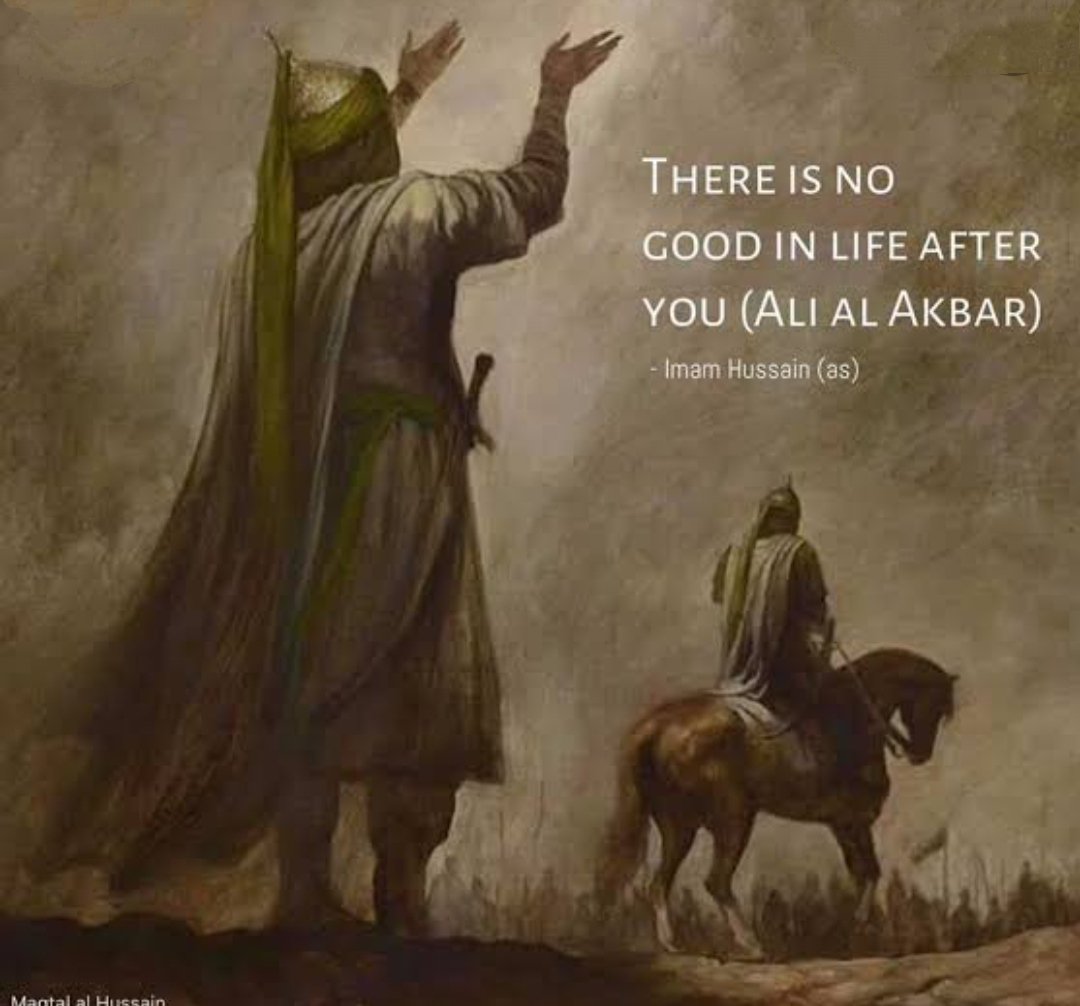
When all the friends had paid with their lives for their devotion to Hussain, Ali Akbar was the first of Imam Hussain’s relatives to have requested him for permission to participate in the jehad. Husain did not hesitate in giving him leave. He was very deeply moved. Raising his hands towards the sky and invoking the Almighty he said, “God be my witness of the oppression of these persons… towards whom, now goes that handsome youth who most of all resembled thy Prophet in looks and deportment. When we longed to see thy Prophet, We used to look at his face.”
He left for the battle field reciting verses, signifying, “I am Ali Bin Husain bin Ali. By God of Kaba, we have righteous claim to succeed His Prophet. By God, the progeny of one born in adultery cannot decide matters for us.”
Ali Akbar attacked the army several times. “Look at the might and valour of young men of Ali and Husain’s army.
After fighting valiantly for a long time, he returned to his father, and said, “Baba, I am the extremely thirsty.”
a Husain said, “My beloved son, be patient. Before setting of the night, Messenger of God PBUH will quench your thirst, with a goblet of milk.” The young man resumed the attack on the enemy’s army and fought magnificently with a sword but an enemy got his opportunity and struck Ali Akbar with a lance in the chest so forcibly that it pierced his body and the victim fell down on the ground and was surrounded on all sides by enemies, who cut his body to pieces.
“Ali Akbar’s death was undoubtedly a great calamity,” Husain exclaimed.
May God grant death to those who martyred you. What is it, which has made these men so disobidient towards God and his phet PBUH. O Ali Akbar, after your martyrdom this world is meaningless to me. It is as worthless as dust. Then he called the youngmen among the Hashemite to lift the body of their brother. Ali Akbar
It is mentioned that he had not yet completed his statement that a lady whose face was illuminated like the sun, came out of the tent wailing aloud, “My darling, son of my brother!”
People inquired, “Who is she?” They said, “She is Zainab, daughter of Fatima, daughter of Messenger of God PBUH. Zainab fell down on the corpse of her nephew. Husain came, held her by her hand and took her back to the tent. Then he came back to his martyred son, addressed the young men of his family, “Come lift the body of your brother. They brought the dead body to the tents. The Kufian encircled Husain. Abdullah Bin Hasan who was but a child а came running towards his uncle. Zainab wanted to restrain . him, but the child freed his hand and ran to Hussain. He reached his uncle at a time when one assailant was about to attack Husain with a sword. Abdullah put his hand infront of the sword and said
“O son of a wicked woman! Do you want to martyr my uncle?” The price of this statement was that first his hand was cut by the sword so that it hung by its skin and was later brutally attacked. He cried for help and called for his mother. Zainab ran towards him. She found Imam Husain cradling the head of the child and was saying, “By God, it is tormenting for me that you cried for help and I could not help you. Even though I did try, it was of no avail. I could not be of any use to you.” He lifted the child in the presence of Zainab and laid him by the side of his martyred son Ali Akbar.
Zainab was continuously in charge of laying down the dead bodies of persons who were martyred or those who were gasping for breath. Even as one martyr was placed on the ground, other dead bodies would soon be brought in and laid near the ones already there. All those who were martyred were placed in her charge. Their names are as follows:
Her sons Aun, Mohammad and Abdullah; her brothers Abbas, Jafar, Abdullah, Usman, Mohammed and Abubakar; her brother Imam Hasan’s sons Abubakar and Qasim; her uncle Ageel’s sons Jafar, Abdur Rehman, Abdullah and many more.
It appeared that the grind stone of death was cruelly and relentlessly moving. It appeared that it would continue to revolve until the entire family of Abu Talib was wiped out from the face of the earth. Hussain was now alone. His sons,
7 Qasim Bin Hasan: The other son of Imam Hasan fought the enemies in the battle field, where he was martyred. When he fell down from the horse, for assistance he called his uncle. But as the Imam had to disperse the army to reach him, he was delayed and his Qasim’s body was trampled. At that time Imam had uttered these sentences in despair.
brothers, relatives, companions had been martyred. In spite of this calamity, he was calm and composed. His valour and courage was indomitable.
a When the battle was nearing its end, ten soldiers from son of Ziyad’s army attempted to reach the tents of Imam Husain, and loot whatever material assets were possessed by the ladies. The Imam challenged them and said, “Woe to you! If you are not concerned with religion, at least live in the world like a decent man. After an hour when you are done with me, you can rob them.”
After listening to Imam Husain they went back and after an hour they returned.
Husain went to his tent to take his last leave and tore a Yemeny sheet at several places and put it on below his other garments next to his body. This he did possibly to ensure that his tattered covering might be left on his body when it was deprived of other garments after his death. He then left for the battle field.
Broken hearted and thirsty as Husain was, history bears witness that when all by himself, sword in hand, he charged at the opposing forces like a lion. The feats of all earlier war heroes were soon forgotten. The exploits of Ali, Hamza and Jafar were exhibited before those who had not seen them. At Karbala, Husain also remained the true representative of his grandfather. Now he had been left completely friendless, Husain displayed his valour and bravery which harked back to his grandfather’s bravery in battle. a
This vastly unequal combat quickly drew to its predestined conclusion. For how long could single man sustain a fight with thousands of enemies? But his valour drew awe. Husain inspired fear in the hearts of his foes and deprived every one
of them of the courage to meet him in combat. One witness said.
a “By God! I saw that Husain fighting with extreme fortitude that formidable army. All of a sudden, Zainab daughter of Fatima appeared and I still remember that her earings were dangling between her ears and neck and she was saying.
“I wish heaven would have fallen’ when Umar bin Sad reached Imam Husain. The grief stricken Zainab said, “O son of Sa’d! Your men are martyring Abu Abdullah and you are a spectator. .”8 The narrator says, “I still remember the tears of Umar Sad falling silently on his beard but he did nothing to prevent Husain from being martyred. Later, he shifted his gaze away from the slain Imam Hussain.
The narrator says that as yet no one as valiant and intrepid as him had ever been seen. A multitude of army had encircled him. Husain was now alone. His sons, brothers, relatives and companions had been martyred. In spite of this, he was calm and composed. His bravery and courage was indomitable.
Zainab came and stood close to him until he was grievously injured and it was very nigh possible that he would fall on ground. Zainab diverted her gaze from him and closed her eyes. She was very attentively trying to listen to his voice which . was audible inspite of the noise and clamor of thousands of men. It was the last protestation of Husain. (Yes, among all the ladies who were in Karbala, it was only Zainab who did not leave her brother up to the last moment). Remember that God will be exceedingly displeased if you put me to death. I swear that God would confer honour upon me if you put me to disgrace, and I shall be avenged in a manner which you
* The appearance of Hazrat Zainab outside the tent and calling Umar bin Sad is of the time when Imam Husain fell down on from the horse and came on earth.
cannot even imagine. By God, if you murder me, God, the Avenger will inflict punishment on you, by your very hands, so that you will let your own blood flow. God will not be contented until He doubles up your piteous torment.”
Husain survived fairly long moments after he had fallen down from the horse. His body was shattered, bleeding profusely and there was ostensibly nothing between him and death, but everybody tried to avoid partaking in the supremely wicked crime of putting him to death. It appeared as if the ground under the feet of the army was trembling. Husain remained in this position for a while. If someone had wanted
a
to martyr him, they could do it. They went near him one by one but when they tried to martyr him they were seized with shivering and trembling.
After a period of time, God’s order was completed. What had been pre decided by fate and destiny was accomplished. Yes, Husain was martyred. His head was severed from his body. And the head of the pious martyr who fought in the path of God, the martyr of truth was raised on a spear head.
It was on the sad day of the tenth of Moharrum 61 Hijri a Friday that this unfortunate event in human history took place.
After all his supporters, kith and kin and now Husain himself had been martyred. However, the outrageously shocking oppressions against him did not ease: his dead body was robbed of the garments worn last. Yazeed’s army then pillaged the tents occupied by the exalted ladies of Husain’s family and deprived them of all their belongings, snatching even the sheets covering their heads. The tents were set ablaze and Omar Bin Sa’d called out to his soldiers to trample Hussain’s
dead body under the hoofs of the horses.
The unholy grind stone of death which had been moving relentlessly insanely, with extreme intensity, when it could find no more of the family of the Prophet to grind, it stopped its
hideous revolution.
At a little distance from them the soldier of Ibne Ziyad were busy trying to out do each other in story telling and revelling while drinking wine. In the light of the torch they were
busy counting the heads and distributing the meagre looted
booty. Amidst all this revelry, a voice was heard addressing
the person
reward.
who had severed the head of Imam Husain. “You have murdered Husain bin Ali, son of Fatima. daughter of Messenger of God PBUH, the most venerated elder. You go to your commander and ask for
your Even if he empties his treasure for wages for this work, even then it will not suffice.” That man went to the entrance of Omar Bin Sa’d’s tent and said, “O commander! Fill my boat with gold and silver, because I have killed a king of kings. I have killed such a venerated personality, whose mother and father were the most admired and respected and his lineage was exalted and lofty.”
The fight came to an end. The fight of seventy-two persons who fought approximately forty thousand people until every one of them who set foot on this bloody field was killed.’
The sun of the 10th Moharrum of 61 Hijri set on such a tragic scene. The ground of Karbala was soaked in blood and the mercilessly mutilated bodies of the children of the Prophet of God PBUH were scattered on the field.
The moon slipped out of the clouds and spread its dim light sadly on the earth. In the moonlight, Zainab was seen
.amidst petrified children and wailing ladies. Their guardians and loved ones had all been killed and they were all alone. These parda nasheen ladies were sitting near the dead bodies of their beloved child or the shoulder of their benevolent husband or the feet of their loved ones.
Now Zainab had taken charge of this grief-stricken group
of women and children. Zainab never weakened in the face of
this heart scratching calamity even for a moment. This is the Zainab whose name will always be remembered in history as She is the same lady who had first heard the noise and clamour of the approaching army when she was standing beside her brother and had woken him up.
from his brief slumber. She was the same lady who nursed Hazrat Abid during his illness and consoled the crusaders in their last breaths. She the person who shed tears on the martyrs. This was the lady who protected the orphaned children of the Ahle Bait from the tyrants.
She is the one who from the very beginning of the battle to the last moments of the battle, did not leave Imam Husain ever alone.











 Aal-e-Qutub Aal-e-Syed Abdullah Shah Ghazi