The 14 Orginal Silsila’s

Silsila Zaidia:

 It is named after Khaja Zaid bin Abdul Wahid Rahmatullahi ‘alayh, the Khalipha of Hazrat Hasan Rahmatullahi ‘alayh  of Basra. Shaikh Zaid Rahmatullahi ‘alayh received another robe (khirqa) of khalafat from Shaikh Kumal bin Ziyad Rahmatullahi ‘alayh  as well. Five of the descendants of Hazrat Abdullah bin Auf Rahmatullahi ‘alayh, famous companion of Rasoolullah sallallahu alayhi wasallam, also joined this Sisila.

Towards the end of his life, Shaikh Zaid bin Abdul Wahid Rahmatullahi ‘alayhselected two of his promonent disciples and commissioned them as his deputies (Khalifas) to guide others. They were Shaikh Fuzail Ibn Ayaz Rahmatullahi ‘alayhand Shaikh Yaqub as-Susi Rahmatullahi ‘alayh.

Silsila Ayaziya:

This is named after Shaikh Fuzail Ibn Ayaz Rahmatullahi ‘alayh. He received spiritual guidance from other Mashaikh of the day as well, such as the members of the Blessed Family of Rasool Allah sallallahu alayhi wasallam, the Aima Ahl Bait Al Athar, He was also guided by the Companions of the Companions of Rasool Allah sallallahu alayhi wasallam known as the Tabiyin Rahmatullahi ‘alayh, who were living in the more prominent places of Arabia in large numbers and guiding the people in the esoteric sciences of Islam.

Silsila Adhmiya:

This Silsila is named after its head, Shaikh Ibrahim bin Adham Rahmatullahi ‘alayh who received spiritual guidance and khalafat at the hands of Shaikh Fuzail Ibn Ayaz Rahmatullahi ‘alayh and Sayyidinah Imam Baqir Rahmatullahi ‘alayh, grandson of Sayyidinah Hazrat Imam Hussein Alahis Salam, grandson of Rasool Allah sallallahu alayhi wasallam, on his Blessed Daughter’s side. This Silsila connects up with Sayyidinah Hazrat Ali Alayhis Salam, via Sayyidinah Hazrat Imam Hussein Alayhis Salam as well as Shaikh Hasan Rahmatullahi ‘alayh of Basra.

Silsila Hubairiya:

It is named after Khwaja Abu Hubaira Aminuddin Rahmatullahi ‘alayh  of Basra, who was a Khalifa of Khwaja Huzaifa Marashi Rahmatullahi ‘alayh, the Khalifa of Hazrat Ibrahim bin Adham Rahmatullahi ‘alayh, Khalifa of Shaikh Fuzail Ibn Ayaz Rahmatullahi ‘alayh, Khalifa of Shaikh Abdul Wahid bin Zaid Rahmatullahi ‘alayh, Khalifa of Shaikh Imam Hasan Rahmatullahi ‘alayh of Basra.

Silsila Chishtiya:

The head of this Silsila is Khwaja Mamshad Ali Dainuri  Rahmatullahi ‘alayh who was the Khalifa of Khwaja Abu Hubaira Aminuddin Basri Rahmatullahi ‘alayh. Khwaja Mamshad Ali Dainuri Rahmatullahi ‘alayh was succeeded by Khwaja Abu Ishaq Shami Rahmatullahi ‘alayh who was deputed by the Shaikh to settle down at a place called Chist in the neighbourhood of Herat in Afganistan. Shaikh Abu Ishaq Shami Rahmatullahi ‘alayh  was the first Shaikh who was called Abu Ishaq Chisti Rahmatullahi ‘alayh. It is thus that a great Silsila Chishtiya came into existence. He was succeeded by Khwaja Abu Ahmad Abdal Rahmatullahi ‘alayhwho was a dignitary of Chist. Khwaja Abu Ahmad Rahmatullahi ‘alayh was succeeded by Khwaja Abu Muhammad Chishti Rahmatullahi ‘alayh, who was succeeded by Khwaja Abu Yusuf Chishti Rahmatullahi ‘alayh, who was succeeded by Khwaja Qutubuddin Maudud Chishti Rahmatullahi ‘alayh.  These five Shaikhs are known as the pillars of Silsila Chishtiya and are buried at Chist.

Silsila Ajamiya:

It is named after Khwaja Habib Ajami Rahmatullahi ‘alayh who was the Khalifa of Shaikh Imam Hasan Rahmatullahi ‘alayh  of Basra.

Silsila Taifuriya:

It is named after Shaikh Sultan-al-Arifin, Khwaja Abu Yazid Bistami Rahmatullahi ‘alayh whose original name was Taifur. It is stated in Tazkarat-ul-Awliya by Shaikh Fariduddin Attar Rahmatullahi ‘alayh that Shaikh Abu Yazid Rahmatullahi ‘alayh received spiritual Faizan from a hundred and sixteen Shaikhs and that He lived twelve years with Sayyidina Imam Jafar as-Sadiq Alahis Salam, the sixth Imam of the family of Sayyidinah Rasoolullah sallallahu alayhi wasallam and received spiritual blessings and benefits. Some are of the opinion that he received inspiration from Sayyidinah Imam Jafar as-Sadiq Alayhis Salam by the way of Uwaisiya (i.e. after the latters demise through spiritual presence). However, both of these methods are recognised by the Spiritualists as effective. It is said that in Lataif Ashrafi that He received Khalafat from Khwaja Habib Ajami Rahmatullahi ‘alayh as well.

Silsila Karkhiya:

It is named after Khwaja Maaruf Karkhi Rahmatullahi ‘alayh who received Khalafat from Sayyidinah Imam Musa Kazim Alayhis Salam, the seventh Imam of the Blessed Family of Sayyidinah Rasoolullah sallallahu alayhi wasallam. He received another robe of Khalafat from Khwaja Daud Taiy Rahmatullahi ‘alayhwho was the Khalifa of Shaikh Habib Ajami Rahmatullahi alayh.

Silsila Saqtiya:

The head of this Silsila is Shaikh Khwaja Sari Sakti Rahmatullahi ‘alayh  who was the Khalifa of Shaikh Ma’ruf Kharki Rahmatullahi ‘alayh.

Silsila Junaidiya:

This Silsila is named after khwaja Junaid Rahmatullahi ‘alayh of Baghdad who was a Mureed and Khalifa of Khwaja Sari Saqti Rahmatullahi ‘alayh. These Shaikhs were so great that all the various branches and their offshoots were known after them under seperate names.

Silsila Gazruniya:

Which is known after the name of Khwaja Abu Ishaq Gazruni Rahmatullahi ‘alayh who was the king of Gazrun. He left his kingdom and became the mureed of Khwaja Abdullah Khafif Rahmatullahi ‘alayh who was the Khalifa of Khwaja Muhammad Roem, the Khalifa of Shaikh Junaid Rahmatullahi ‘alayh of Baghdad who traced his origin with Hazrat Ali Alayhis Salam.

Silsila Tusiya:

The head of this Silsila was Shaikh Ala ud-Din Tusi Rahmatullahi ‘alayh, Khalifa of Khwaja Wajhuddin Abu Hafs Rahmatullahi ‘alayh who was connected up with Shaikh Junaid Baghdadi Rahmatullahi ‘alayh  through intermediary Shaikhs. Shaikh Ala ud-Din Tusi was a friend of Shaikhs Najmuddin Kubra Rahmatullahi ‘alayh  of Firdaus.

Shaikh Najmuddin Rahmatullahi ‘alayh was a contemporary of St. Francis of Asisi who undertook the journey to Baghdad to see the former but could not reach there due to some unknown reasons. Shaikh Najmuddin Kubra Rahmatullahi ‘alayh  was a Khalifa of Shaikh Abu Najib Suharwardi Rahmatullahi ‘alayh.

Silsila Suharwardiya:

It is known after Shaikh Zia-ud-Din Najib Suharwardi Rahmatullahi ‘alayh who was a Khalifa of Shaikh Wajhuddin Abu Hafs Rahmatullahi ‘alayh. Shaikh Abu Najib Rahmatullahi ‘alayh received another robe of Khalafat from Shaikh Ahmad al-Urla Rahmatullahi ‘alayh  who traces his origin to Shaikh Junaid Baghdadi Rahmatullahi ‘alayh through five intermediary shaikhs.

Silsila Firdausiya:

The head of this Silsila is Shaikh Najmuddin Kubra Rahmatullahi ‘alayh who was a dignitary of Firdaus and was a Mureed and Khalifa of Shaikh Abu Najib Suharwardi Rahmatullahi ‘alayh. Mawlaanah Jami Rahmatullahi ‘alayh has said in his Nafahat al-Uns that Shaikh Najmuddin Rahmatullahi ‘alayh got another robe of Khalafat from Shaikh Ammar Yasir Rahmatullahi ‘alayh as well. Shaikh Ammar Yasir Rahmatullahi ‘alayh was one of the prominent Khalifas of Shaikh Abu Najib Suharwardi Rahmatullahi ‘alayh who was connected up with Shaikh Junaid Baghdadi Rahmatullahi ‘alayh  through six Shaikhs in-between.

Thus the four Silsilas, Firdausiya, Suharwardiya, Tusiya and Gazruniya, join up with Shaikh Junaid Baghdadi Rahmatullahi ‘alayh who is connected through another link of Tariqat with Imam Ali Raza Alayhis Salam, son of Imam Musa Kazim Alayhis Salam, son of Imam Jafar Sadiq Alayhis Salam, son of son of Imam Baqir Alayhis Salam, son of Imam Zainul Abidin Alayhis Salam, son of Amir ul-Mumineen Sayyidinah Imam Hussein Alayhis Salam, son of Amir ul-Mumineen Sayyidinah Hazrat Ali Alayhis Salam, the fourth Khalifa of Aaqaa e Do Jahan Sayyidinah Hazrat Muhammad Mustapha sallallahu alayhi wasallam. According to a tradition, Amir ul-Mumineen Sayyidinah Imam Hasan Alayhis Salam also comes in these four Silsilas.

Muawiya ki Hukumat ko Bura Mat Kaho- Fabricated Narration

Imam Ali (as) ne Kaha: Muawiya ki Hukumat ko Bura Na Kaho- Riwayat ka Ilmi Jayeza (Maud’u Riwayat)

Facebook aur Whatsapp par aajkal ye bohot aam ho raha hai ke Hazrat Ali عليه سلام ne Muawiya par jarah karne se tanqeed ki aur wo khud bhi muawiya ki bohot izzat karte thay. Is baat ko sabit karne ke liye in hone ek riwayat aagey ki, jiski picture mai yahan upload kar raha hu. Isse pehle ke ye riwayat ki jarah pesh ki jaye, mai ye baat wazeh kardena chahta hu ke muawiya ki shaan me koi sahih hadith maujood nahi hai, Yahi Imam Hakim aur Imam Nasa’i (رضوان الله يجمعن ) ka man na tha aur is qaul ko Imam Jalaluddin Suyuti ne bhi naqal kiya hai. 

Is riwayat ke mutabik, Imam Ali عليه سلام ne logon ko nasihat ki ke Muawiya ki hukumat ko bura na kaho. Fir unhe khone ke bad logo ki gardano ka alag hone ka zikr hai. Ye riwayat bil tahqeeq to kya bil lafz (wordings) se hi jhutti hai, par ye baat Shia’ne Muawiya ko kabhi hazam nahi hogi kyu ki Allah ne unse Aql cheen li hai. Is riwayat ka manghadat hone ki daleel ab pesh karte hain.
Ye riwayat poori nahi hai. Poori riwayat ye hai:
 لَمَّا رَجَعَ عَلِيٌّ مِنْ صِفِّينَ عَلِمَ أَنَّهُ لَا يَمْلِكُ أَبَدًا , فَتَكَلَّمَ بِأَشْيَاءَ كَانَ لَا يَتَكَلَّمُ بِهَا , وَحَدَّثَ بِأَحَادِيثَ كَانَ لَا يَتَحَدَّثُ بِهَا , فَقَالَ فِيمَا يَقُولُ: أَيُّهَا النَّاسُ , لَا تَكْرَهُوا إِمَارَةَ مُعَاوِيَةَ , وَاللَّهِ لَوْ قَدْ فَقَدْتُمُوهُ لَقَدْ رَأَيْتُمُ الرُّءُوسَ تَنْدُرُ مِنْ كَوَاهِلِهَا كَالْحَنْظَلِ
Translation: Jab Hazrat Ali عليه سلام ki fauj Jung e Siffin se wapas ho rahi thi, tab aap ne kuch logo ko (muawiya ke talluq se) aisi baatein kehte hue suna ki unse pehle wo baat kisi ne nahi ki. Tab Imam Ali ne kaha ki Muawiya ke hukumat ko bura na kaho….
Is riwayat ke kai references diye gaye hai lekin iske sirf 2 sanad maujood hai. Baaqi kitabon me sirf naqal kiya gaya hai. 
Pehli sanad: أَبُو أُسَامَةَ، عَنْ مُجَالِدٍ، عَنِ الشَّعْبِيِّ، عَنِ الْحَارِثِ. 
Abu Usamah > Mujalid > Al Shab’i > Al Harith.
Doosri sanad: خْبَرَنَا أَبُو عَبْدِ اللهِ الْحَافِظُ، حَدَّثَنَا أَبُو الْعَبَّاسِ مُحَمَّدُ بْنُ يَعْقُوبَ، حَدَّثَنَا الْحَسَنُ بْنُ عَلِيِّ بْنِ عَفَّانَ، حَدَّثَنَا أَبُو أُسَامَةَ، عَنْ مُجَالِدٍ عَنْ عَامِرٍ
Abu Abdullah Al Hafiz > Abu Abbas Muhammad bin Yaqoob > Hasan bin Ali Ibn Affan > Abu Usamah > Mujalid > Amir. (Amir yaani Amir Al Shab’i)
Dono sanad’on me Mujalid riwayat karte hai Al Shab’i se. “Mujalid” shadeed Zaeef hai. Inki Jarah kai Kitabon me maujood hai:
1) وَكَانَ ضَعِيفًا فِي الْحَدِيثِ قَالَ يَحْيَى بْنُ سَعِيدٍ الْقَطَّانُ: مَا كُنْتُ أَشَاءُ أَنْ يَقُولَ لِي مُجَالِدٌ مِنْ حَدِيثِ مِنْ رَأَى الشَّعْبِيِّ عَنْ مَسْرُوقٍ إِلَّا فَعَلَ , وَقَدْ رَوَى عَنْهُ يَحْيَى بْنُ سَعِيدٍ الْقَطَّانُ مَعَ هَذَا
Imam Ibn Sa’ad (d.230H) ne apni Tabaqat me likha hai, “Mujalid Zaeef fil Hadith hai”. Agey likhte hai ki Imam Yahya Ibn Qattan (d.198H) ne kaha ki 

“Mai kabhi bhi Mujalid ke riwayatein, jo Al Shab’i aur Mashrooq se riwayat hai, likhna nahi chahta tha lekin mujhe likhna pada.” 

Tabaqat Al Kabir, Vol 6, Pg 349, Darr Al Sadr, Beirut publications.
2) كَانَ يحيى يضعف مجَالد بن سعيد بن عُمَيْر الْهَمدَانِي الكوفى وَكَانَ بن مهْدي لَا يروي عَنهُ
Imam Bukhari ne apni Tarikh Al Awsat me likha, Yahya (Ibn Sa’eed) ne inhe “Zaeef” kaha. Ibn Mahdi ne kaha, “Iski riwayatein na lein”.
Imam Bukhari (d.256H), Tarikh Al Awsat, Vol 2, Pg 79, Narrator no 1864, Dar Al Wa’ee aur Maktabah Darr Al Tarash, Halb, Cairo publications. 
3)  مجالد بْن سَعِيد بْن عمير بْن ذي مران (2) الهمداني كوفِي كَانَ يحيى القطان يضعفه وكَانَ ابْن مهدي لا يروي عنه، عَنِ الشَّعْبِيّ وقيس بْن أَبِي حازم
Imam Bukhari fir apni Tarikh Al Kabir me likhte hai ki Ibn Sae’ed ne inhe Zaeef kaha aur Ibn Mahdi ne kaha ki

“Inki wo riwayein jo Al Shab’i aur Qais Ibn Abi Hazm se riwayat hai, wo bilkul na liya jaye yaani la qabil e qubool hai.” 

Imam Bukhari (d.256H), Tarikh Al Kabir, Vol 8, Pg 9, Narrator 1950, Darr Al Marifah publications.
وَقَالَ أَحْمد مُجَاهِد لَيْسَ يشيء
Imam Ahmed ne kaha, “Mujalid ki riwayatein mazboot nahi hai.”
Al Dha’eef As Sagheer, Imam Bukhair (d.256H), Vol 1, Pg 130, Narrator 384, Maktabah Ibn Abbas.
4) مجالد بن سعيد يضعف حديثه
Imam Juzjani (d.259H) ne apni kitab Hawl Al Rijal me farmaya ke, “Mujalid Dha’eef ul Hadith” hai.
Hawl Al Rijal, Imam Juzjani (d.259H), Vol 1, Pg 144, Narrator no 126.
5)  مجالد بن سعيد الهمداني أبو عمر الكوفي: ليس بالقوي
“Mujalid ke riwayatein Mazboot nahi.”
Imam Ajuli (d.261H), Al Thiqat, Vol 1, Pg 66, Narrator no 91, Darr bin Bazz, Riyadh publications.
Maktabah Darr Madina Al Munawwara se chappi gayi kitab me Mujalid ko “Hasan Al Hadith” kaha hai lekin saat me Imam Yahya Ibn Sae’ed ka ek aur qaul darj hai ki apne kaha, 

“Mujalid ke, Al Shab’i aur Qais Ibn Abi Hazam se riwayatein sahih nahi hai.” (Vol 2, Pg 64, Narrator 1682).

6) مجَالد بن سعيد كُوفِي ضَعِيف
Mujalid bin Saeed Dha’eef hai.
Imam Nasa’i (d.303H), Al Dha’eef wal Matrokeen, Vol 1, Pg 95, Narration no 552, Darr Al Wa’ee, Halb, Cairo publications.
7)  يحيى بن معين انه قال: مجالد لا يحتج بحديثه
Imam Abi Hatim (d.327H) ne apni kitab “Al Jarah O Tadeel” me Imam Yahya Ibn Maeen ka qaul riwayat kiya hai ki “Mujalid ki riwayatein hujjat/ qabeel e qubool nahi hai.” Imam Abi Hatim ne doosre Imam’on ka qaul bhi darj kiya hai.
Al Jarah O Tadeel, Imam Abi Hatim, Vol 8, Pg 361, Narrator no: 1653, Darr Al Tarash Al Arabiyya, Cairo publications.
8) Imam Ibn Hibban (d.365H) ne Mujalid ko apni “Majrooheen” (Zaeef aur Kazzab raawi’on ki kitab) me zikr kiya hai. 
Majroheen Ibn Hibban, Vol 3, Pg 10, Narrator no 1039, Dar Al Wa’ee, Halb, Cairo publications.
Ye 8 riwayatein to sirf Salaf us saliheen se hai. Imam Daraqutni (d.385H) ne, Imam Abu Hafs Al Baghdadi (d.385H) ne, Imam Mazzi (d.742H) ne, Imam Dhahabi (d.748H), Imam Ibn Hajr (d.852H) ne apni apni kitabon me sirf Mujallid ki Jarah hi ki hai.
Ye riwayat manghadat aur jhutti hai. Khawarij, Ahle Hadith aur Barelwi razvi ke baaton me na aayein. Jitni bhi inki riwayatein hoti hai wo isi tarah jhutti hori hai.

The Verses of Al Falaq Concerning Magic.

The Verses of Al Falaq Concerning Magic.

The following passages are taken from the works of Dr Ilyas Celebi, Approaches to Occultism in the Qur’an and Sunnah.

Al Sihr in the perspective of Qur’an:

In the Qur’an, the words from the root “shr, are cited 63 times, and three of them mean dawn time. The statements dealing with magic, more respectively, take place in the verses about Moses and Aaron (33 times), and then Prophet Muhammad (17 times) صلى الله عليه وسلم. Most of the verses which consist of magic include all the expressions said by deniers in order to reject the prophecies of the Prophets, or to declare that things to be shown as miracles to the peoples are deceitful. So, Qur’an informs us. that the people of Samud condemned the Prophet Saleh being charmed; People of Aykah made the same condemnation over the prophet Shuayb [1]. Pharaoh and his staff did say that to Moses, and even condemning him as being magician [2], and that lsraelites had claimed that Jesus Christ applied to perform the magic [3], and that Meccan pagans have condemned the Prophet Muhammad being magician or charmed one [4] all that, Qur’an continues to say, are just a calumny, and it states that the deniers have been behaving to the prophets by this manner.

The verses of Surah Falaq revealed to the Prophet صلى الله عليه وسلم:

It is ordered in the Surah of al-Falaq that we have to seek refuge to Allah because of the evil-doings of who breathes over the knots [5] . The given surah mentions naffasat, meaning “blowers.” In the time of the Prophet Muhammad صلى الله عليه وسلم, there had been someone who were breathing the prayers which they recited over the strings, and knotting them, by this way, committing the magic. Ibn Haldun recorded that he passed by such persons in Egypt [6]. The expression ” who blow over the knots”, according to Kurayb bin Abu Muslim, must be also understood metaphorically as women who pervert, by various coquetry and amorous glances, the men’s mind [7], therefore, basing on this meaning, it is also said that term naffasat could be meant who try to attempt to shake the will-powers of the peoples as well as the magicians. And these persons broke down the spirituality of the peoples by the means of false news, calumnies and gossips, and make them anxious and get them means for their desires. This kind of interpretation seems both in accordance with the classification of Fahruddin al-Razi [8] who considers the gossip within the limits of magic, and with the word “Hasid” Of the following verse of al-Falaq. Some interpreters criticized this kind of interpretation on the term naffasat, having suggested that because this is in contradiction with the reason of the occasion (sabab al nuzul) of al-Alaq and of al-Nas, and also with the reports concerning with the news that Muhammad was also charmed and they concluded that magic can also have somewhat truth. 

There have been two various reports one coming from Aisha [9], the other Zayd bin Arkam [10], which cited that the Prophet صلى الله عليه وسلم was charmed, in both of which is mentioned that some one, especially, naıned Labid bin A’sam charmed the prophet Muhammad, and as the result of this charm, the Prophet صلى الله عليه وسلم started to imagine to having pretended of what he really did not do, and also cited that two angels had come to the prophet to  inform him that a charm committed against him and thrown in to a well named Zarwan. In a part of the report coming from Aishah, it is not stated that Labid was a Jew, is recorded that the Prophet of Allah صلى الله عليه وسلم himself had gone to the well, having taking with some of his companions. On the other hand in the report of Zayd bin Arkam there is an information saying of that “some companions of the Prophet had been sent over there”. In addition to these, in the report of Aisha while there are some expressions about the pretending of the prophet, it is not recorded in the report of Zayd; yet, in another variant of the report coming from Aisha as cited in Musnad of Ahmad bin Hanbal it is stated that the Prophet’s صلى الله عليه وسلم sickness has lasted six months, however, in that of Zayd cited that when the string had been come out of the well and being undo the knots, the Prophet felt relieved as if he had been saved off his bonds and bandages.

The reports concerning of being charmed of the Prophet صلى الله عليه وسلم can be criticized by the textual criticism in the methodology of the Hadith, as well as they can be considered by their contents in contradiction with the nature and the requirements of the Prophet’s messages. Since, to assert that a prophet who gets revelations from Allah could be fell under the effects of the magic may be understood both to have an admission of that some human elements could be mixed within the divine revelation, and may justify the claims of the rejectors of Islam asserting that the Prophet of Allah has been charmed. However, in many verses of the Qur’an the Prophet is said of as he is under the protection of Allah, and recorded that the fact that the revelation had been gradually sent down in his heart has been taken into consideration [11]. Some early scholars such as Abu Bakr al-Asam, Jassas, Qadi Abdul Jabbar, and some late scholars such as Qasimi’, Muhammad Abduh, Sayed Qutb and Muhammad Izzat Darwaza, considering these features, refused the report saying that the Prophet was charmed [12]. Some of them cited that so called charming over the Prophet might have been occurred in Medinah, however in some report coming from Hasan al-Basri:, Ata, İkrimah, Jabir bin Abdullah and Kurayb bin Abu Muslim, citing that these surahs were revealed in Makkah, they also recorded some reason, saying that with khabar al wahed, we could not perform in practice especially in the matters of the belief. On the contrary of this the most of the scholars regarded the reports as sound (saheeh) and said that the magic had influenced not the mind and the heart of the Prophet but his body, and this is not an obstacle to the idea of the protection of the Prophet by Allah, so in the result they concluded that he was charmed [13]. However in some of the verses under the subject, there cited some expressions that the Prophet imagined something to have pretended even though he did not do and this situation lasted at least six months. In fact, this is only an occasion directly related with his mind. Indeed, some of the scholars, following a conciliatory attitude, state that the Prophet might have been charmed, being related with the consideration of his enemies, but with the protection by Allah, he was not influenced by their magic. Never the less this interpretation also include some conclusions regarding that magic did not occur, as cited in the hadiths, and by this way the Prophet did not enter under any influence so, it is in unity with the first idea [14].

A prophet, according to the Abrahamic Religions, receives his revelations from Allah (God) and communicates it to the people, and he shows miracles to prove its truths. To get revelation (i.e., get information from the invisible world) and to show some miracles are two main features differing them from other people. As for divinator and magician, they are two persons, one asserting that he/she informs from the invisible world, and the other is in a position of being an alternate-one to the prophets, claiming that he can possess over the beings or on the events. For this reason, when dealt with the miracles in Islam, it is especially be taken into account that magic is not an alternate to the miracle.

Allah almighty completed his religion and this religion prohibited the divination along with many other things of pre-Islamic era (jahiliyyah /ignorant age). Since the revelation has come to the end by the Prophet’s death, new requirements needed for the social life would be done, under the leading of the reason, by some methods like analogy (qiyas) and juridical opinions (ijtihad) from now on [15]. Therefore, Islam eliminates magic, fortune-telling, considering omen looking at the balls and all the divination. This attitude was kept also during the first four caliphs with a great sensitivity. For instance, the first caliph, Abu Bakr, of whose servant made him eat a food, having been bought by the money earned for the divination before his embracing Islam, was so much sensitive on the matter that he vomited all the food from his stomach by inserting his hand into his mouth [16]. The second caliph, Umar, too, sending a letter to the governor of Egypt, ordered him to follow all people who practice divination and magic in that area and to punish them all [17].

[1]  Al-Shuara’, 153-154, 185-187.
[2]  Al-Isra, 101; Al-Naml, 13; AI-Qasass, 36,48; Ghafir, 24; AI-Zuhruf, 43/46-50; Al-Zariyat,39.
[3]  Al-Maidah, 110; A-Saff, 6
[4]  Al-An’am, 7; Yunus, 2; Hud, 7; AI-Hijr, 14-15; AI-Isra, 47; Al-Anbiya, 3; AI-Mu’minun, 89; Al          Furqan, 8; Saba, 43; Al-Saffat, 15; Sa’d,4; Al-Zuhruf, 30; Al-Zariyat, 52
[5]  Al-Falaq, 4.
[6]  Ibn Haldun, op.cit., III, 152.
[7]  Razi, op. cit., XXXII, 179.
[8]  ibid., III,  193.
[9]  Musnad, VI, 57,63, 96, Bukhari, “Tibb” 47; Muslim, “Salam” 43; Ibn Majah, “Tibb” 45.
[10] Musnad, IV, 367; Nasai, “Tahrim” 20.
[11] Al-Nisa’,113; Al-Maidah, 42, 67; Al-Furqan, 32; Al-Shuara’, 153, 185.
[12] Maturidi, Ta’wilat Al-Qur’an, (Istanbul) Hacı Selim Ağa Libr, nr. 40, fol., 907a; Jassas, op, cit.,
I, 60; Jamaladdin Al-Qasmi, Mahasin Al-Tawil, Beirut 1978, XVII, 304; Muhammad Abduh,
Tafsiru Juz’i Amma’, Cairo 1904, s 181-183, Sayed Qutb, Fi Zhilal Al-Qur’an, Beirut 1985, VI,
4008; Darwazah, Al-Tafsi’r Al Hadis (trans., in Turkish Şaban Karatas), Istanbul 1997, I, 199.
[13] Ibn Qutaibah, Ta’wilu Muhtalif Al-Hadis, Cairo 1966, 178-186; Maturidi, fol. 907a; Qadi lyad,
Al-Shifa’, Cairo 1977, Il, 865-868; Ibn Qayyim Al-Jawziyyah, Tafsir Al-Muawwizatayn, (ed.
Dar Al-Hadis), undated,. 44-51.
[14]  Hadidi, lsmat Al-Anbiya, Cairo 1979, 100-104. For more information on this subject see; Ibn
Qayyim Al-Jawziyyah, op. cit., 46-51; Mizzl, Tahzib Al-Kamal, Beirut 1992, XIX, 332-354; Ibn
Hajar, Fath Al-Bari, X, 226-227; Ali Osman Ates, Kur’an ve Hadisiere Göre Cin ve Büyü, Istanbul 1995, 274-277, 292-294.
[15]  Bukhari, “Manaqib Al-Ansar, 26; Ahmad b. Hanbal, op. dt., IV, 118.
[16]  Bukhari, op. cit., 26
[17] M. Hamidullah, Al-Wasaiq Al-Siyasiyyah, Beirut 1983, 509-510.

Mari’fat in Muslim Theology (Kalam) and Mysticism

MARIF’AH IN THE KALAM OF AL MATURIDI, AL ASHARI AND AHL AL SUFFIYA

Al Maturidi’s view on ma‘rifa (the highest level of knowledge to know of Allah) is based on the human thought and reason. It can be understood either that ma‘rifa can be obtained by the use of merely human reasoning and also that human reasoning is capable of obtaining ma‘rifa. It is reasonable that Al-Maturidi comes to the opinion that everything has its own character of good and bad.
On the contrary, Al-Ash‘ari viewed that ma‘rifa is based on God’s provision and guide. Consequently, good and bad are also decided by Syari (naturally).
Compared to that of Al-Ash‘ari, it is understandable that Al Maturidi’s views on human thought and reasoning seem to fit with Mu‘tazila’s way of thinking. But it  does not mean that Al-Maturidi is a Mu’tazili, however. Despite Al-Maturidi’s acceptance of human thought and reasoning that makes him, to some extent, close to Mu‘tazila’s way of thinking, he is still different from Mu‘tazila. It is in this sense, actually that Shaykh Muhammad Abu Zahrah shares his opinion and states that:

“…such is close to the opinion of Mu‘tazila. However, Mu‘tazila followers think that ma‘rifatullah is obliged in mind. The followers of Al-Maturidiyya do not decide such thought, but they think that the obligation of ma‘rifatullah may be found through the fact of mind. This obligation never brings into reality, except Allah, the Supreme One.

The term marifa does not figure in the Quran, [ilm being the term used for knowledge; and Al-Alim, the All-Knowing, is given as a Divine Name, whereas Al-arif is not. Likewise, in the Hadith literature, ilm greatly overshadows marifa. In this regard, two points should be made: first, the notion of ilm in the first generations of
Islam was flexible enough to encompass knowledge both of the contingent domain and the transcendent order. The concept of knowledge at this time, along with a range of other concepts, had a suppleness, a polyvalence, and a depth that was plumbed by the individual in the measure of his spiritual sensitivity: there was no need for a separate word to designate a specifically spiritual kind of knowledge.
Secondly, the Sufis who came to discuss marifa as a distinct form of knowledge were able to quote and interpret certain key verses and ahadith as referring implicitly to the kind of knowledge they were seeking to elucidate.[1] One verse of central importance in this connection is the following:
I created not the jinn and mankind except that they might worship Me. (51: 56)
In his Kitab Al-Luma, Abu Nasr Al-Sarraj (d. 378/988) in common with many other Sufis,[2] reports the comment of Ibn Abbas: the word ‘worship’ here means ‘knowledge’ (marifa), so that the phrase illa li-yabuduni (except that they might worship Me) becomes illa li-yarifuni (except that they might know Me).[3] The very purpose of the creation of man thus comes to be equated with that knowledge of God which constitutes the most profound form of worship. This view dovetails with the hadith qudsi, (a holy utterance by God through the Prophet) so frequently cited by the Sufis: ‘I was a hidden treasure and I loved to be known, so I created the world.’ The word for ‘known’ here is u’raf: ma’rifa thus appears again here as the ultimate purpose of creation in general, a purpose which is realized and mirrored most perfectly through the sage who knows God through knowing himself. For, according to another much-stressed hadith: ‘Whose knoweth himself knows his Lord’-again, the word for knowing is ar’afa. We shall return to this altogether fundamental principle in the final section of this essay. The question that presents itself at this point is why it should have been necessary for the Sufis to adopt the term marifa in contradistinction to ilm, [4] a process that becomes visible from around the third/ninth century.[5] The answer to this question can be stated thus: it was in this period that various dimensions of the intellectual tradition of Islam- theology, jurisprudence, philosophy, to mention the most important—began to crystallize into distinct ‘sciences’ (ulu’m) each of which laid claim to ilm as its preserve, thus imparting to ilm its own particular accentuation and content.[6] What these disciplines had in common was a confinement of the notion of ilm within the boundaries of formal, discursive, abstract processes of thought. For the Sufis to give the name [ilm to their direct, concrete, spiritual mode of knowledge was henceforth to risk associating the spiritual path of realization with a mental process of investigation. This is how Hujwiri expresses the difference between the two types of knowledge:

“The Sufi Shaykhs give the name of marifat (gnosis) to every knowledge that is allied with (religious) practice and feeling (hal) [7] and the knower thereof they call a’rif: On the other hand, they give the name of ilm to every knowledge that is stripped of spiritual meaning and devoid of religious practice, and one who has such knowledge they call alim”.[8]

 [1]  Also, it was held that through mari’fa the less obvious, underlying, and esoteric dimensions of scripture could be grasped. Al-Ghazali (d. 505/1111) writes that the inner meaning of many verses and ahadıth can be understood only through muka’shafa i.e mystical unveiling; muka’shafa is closely connected with marifa, sometimes being synonymous with it and at other times being a path leading to it as the final goal. See F. Jabre, La Notion de la ma’rifa chez Ghazali (Paris: Traditions des Lettres Orientales, 1958), 24–6.

[2] Data Ali Hujweri, Kashf Al-Mahjub p. 267, and Qushayri (d. 465/1074) in his famous Risala, trans. by B. R. von Schlegel as Principles of Sufism (Berkeley, Calif.: Mizan Press, 1990), 316. 
[3] R. A. Nicholson (ed.), Kitab Al-Luma (London: E. J. Gibb Memorial Series, 22, 1963), Arabic text, 40.
[4] It would be wrong to say that this process was either uniform or unilateral. The two terms were frequently to be found as synonyms within Sufi texts; sometimes marifa would be described as a form of ilm, and vice versa; and there was no unanimity on the question of marifa being superior to ilm. See Kalabadhi’s (d. 385/995) Kitab Al Ta’arruf li madhhab Ahl Al-tasawwuf: The Doctrine of the Sufis, trans. by A. J. Arberry (Cambridge: Cambridge University Press, 1935), ch. 22, Their variance as to the nature of gnosis’. For the use of the two terms as synonyms, see Abu Sa’id Al-Kharraz’s (d. 286/899) Kitab Al-Sidq: The Book of Truthfulness, trans. A. J. Arberry (Oxford: Oxford University Press, 1937), 49–50, Arabic text, 60. Also it should be noted that even the Sufi most frequently cited in connection with the first formal articulation of ma’rifa. D’hul-Nun Al-Misri (d. 245/859), speaks of the marifa of the common folk, and that of the [ulama], and that of the saints. See Farıd Al-Din Attar’s Tadhkirat al-Awliya], ed. R. A. Nicholson, (London: Luzac, 1905), part 1, Persian text 127. Finally, regarding the question of which is superior, ma’rifa or ilm, Ibn Al-Arabi writes that the apparent disagreement is only a verbal one: it is the selfsame knowledge of the supernal verities that is in question, whether this be called ma’rifa or ilm. See W. C. Chittick, The Sufi Path of Knowledge: Ibn Al Arabi’s Metaphysics of Imagination (New York: State University of New York Press,1989), 149
[5] One can find, prior to this time, scattered references to the term in a specifically Sufi context. For example: Ibrahim bin Adham (d. 160/777) is said to have developed the notion of ma’rifa (M. Smith, An Early Mystic of Baghdad: A Study of the Life and Teachings of Harith bin Asad Al Muhasibi (London: Sheldon Press, 1935), 73. The lady Umm al-Darda], a traditionist of the first century Hijra, was reported as saying, ‘The most excellent knowledge (ilm) is the gnosis (al-marifa)’ (cited in Franz Rosenthal, Knowledge Triumphant: The Concept of Knowledge in Medieval Islam (Leiden: E. J. Brill, 1970), 139). 
[6] The presumption by others of ilm as a technical term prevented the Sufis permanently from selecting ilm for employment as one of the numerous technical terms of their own vocabulary and from using it to designate by it one of their specific states and stations. Since ma’rifa and yaqin lent themselves without much difficulty to doubling for ilm, they were indeed widely substituted for it (ibid. 165). 13 See V. Danner, ‘The Early Development of Sufism in S. H. Nasr (ed.), Islamic Spirituality (London: Routledge and Kegan Paul, 1987), i. 254. 
[7] This should be translated as ‘spiritual state’. The word ‘feeling’ is far too vague a translation of hal. 
[8] Kashf Al-Mahjub, 382. Much the same is said by Qushayri in his Risala, in the chapter titled Al- Marifatu bi-Llah’, 316.
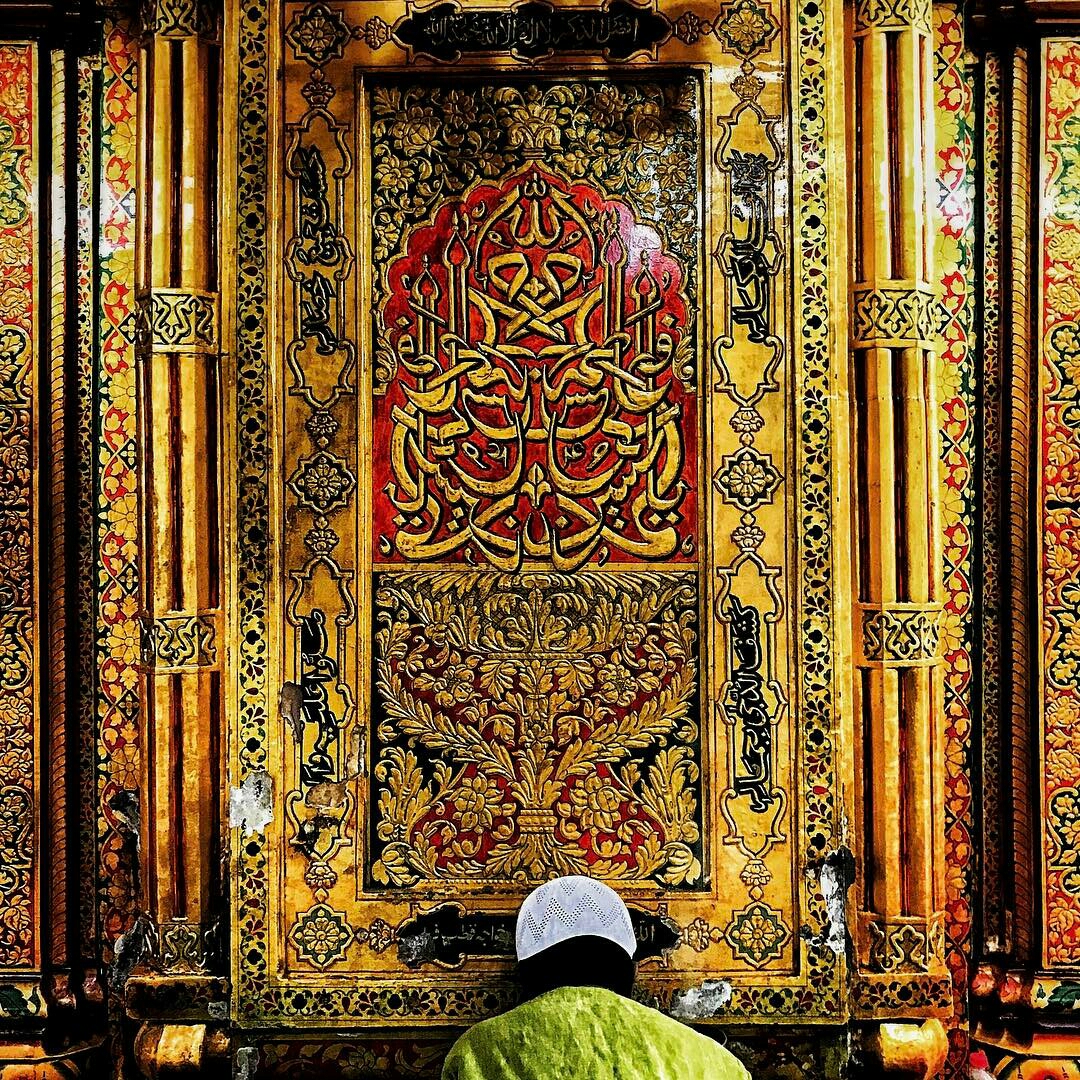
[Pic of a believer seeking Intercession in the shrine of Hazrat Nizamuddin Auliya (RA)]