
Name: Hazrat Sheikh Khwaja Sayed Muhammad Moinuddin Chisty
Titles: Sultan-ul-Hind, Gharib Nawaz
Silsila: Chistiya
Predecessor: Hazrat Khwaja Usman-e-Harooni رحمتہ اللہ علیہ
Successor: Hazrat Khwaja Qutbuddin Bakhtiyar Kaaki رحمتہ اللہ علیہ
Date of Birth: 1141 A.D
Date of Wisaal: 6th of Rajab 627 A.H. / 16th March 1236 A.D.
Date of Urs: 6th, Rajab
Resting at: Ajmer, Rajasthan, India.
Birth, Early Life and Education:
Khwaja Moinuddin Chisty رحمتہ اللہ علیہ was born in Seistan (East Persia) also known as Sejistan, around 537 Hijri in a respected family. His father Khwaja Ghayasuddin رحمتہ اللہ علیہ and mother Syeda Bibi Ummalwara alias Bibi Mahe-Noor رحمتہ اللہ علیہ were the descendants of Hazrat Ali رضي الله عنه through his sons Imam Hassan رضي الله عنه and Imam Hussain رضي الله عنه, Khwaja Saheb lost both his Father and Mother at an early age of sixteen years. He inherited an orchard and a wind mill which serve as his means of livelihood. One day when Khwaja Saheb was working in his orchard, a pious dervish and Majzoob, Ebrahim Qandoozi رحمتہ اللہ علیہ, came and took his seat under the shade of a tree. When Khwaja Saheb saw him, he brought a bunch of grapes and presented it to his guest. The visitor ate those grapes and was delighted, and took something out of his bag, chewed it, and then offered it to his young host. Khwaja Saheb ate it without any hesitation, and at once the light of wisdom and knowledge dawned upon the young Khwaja. Thereafter he disposed of all his worldly belongings, and distributed the money amongst the poor. Having thus broken all the ties with worldly affairs, he started for Samarqand and Bukhra, then the great centers of learning for acquiring religious education and knowledge.
Lineage and Family
Khwaja Moinuddin Chisti (ra) was both a Hasani (maternal) and Husseini (paternal) Syed.
He was blessed with direct lineage to the Holy Prophet ﷺ through his father, Khwaja Ghiyasuddin Hasan (ra), who was a direct descendant of Hazrat Imam Hussein  , son of Hazrat Ali . His silsila-e-nasab (family lineage) is as follows:
- Hazrat Khwaja Moinuddin Chisti (ra), son of
- Hazrat Khwaja Ghiyasuddin Hasan (ra), son of
- Syed Ahmed Hassan (ra), son of
- Syed Hassan Ahmed (ra), son of
- Syed Najmuddin Tahir (ra), son of
- Syed Khwaja Abdul Aziz Hussain (ra), son of
- Syed Imam Mohammad Mehdi (ra), son of
- Syed Imam Askari (ra), son of
- Hazrat Imam Musa (ra), son of
- Imam Ali Naqi (ra), son of
- Hazrat Imam Mohammad Taqi (ra), son of
- Hazrat Imam Ali Musa Raza (ra), son of
- Hazrat Imam Musa (ra), son of
- Hazrat Imam Mohammad Jafar Sadiq (ra), son of
- Hazrat Imam Mohammad Baqir (ra), son of
- Hazrat Imam Zainul Abedin (ra), son of
- Hazrat Imam Hussain
 , son of
 - Hazrat Imam Ali , son-in-law of
- The Holy Prophet Hazrat Mohammad Mostafa ﷺ
His father, an accomplished man, was well-educated and trained, and a great Sufi of his time. His piety and scholarship won him widespread respect and regard, and was held in high esteem by the Sufis of Khorasan.
Khwaja Moinuddin Chisti (ra) was also blessed with direct lineage to the Holy Prophet ﷺ through his mother, Umm-ul-Warah (ra) (alias Bibi Mah Noor), who was a descendant of Hazrat Imam Hasan .
His great grandfather, Khwaja Syed Ahmad Husain, migrated from Samarra in Iraq and eventually settled in Sanjar, within the region of Sistan.
He was also closely related to al-Ghawth al-A’zam, Sheikh Abdul Qadir Jilani (ra).
It is also said that he had two brothers.
ख़्वाजा ग़रीबनवाज़ؓ का नसब नामा
पांच चिश्त
हेरात के पास एक कस्बे का नाम चिश्त है। हज़रत अबू इसहाक़ शामी चिश्तीؓ की रूहानी मौजूदगी से ये कस्बा रूहानियत का मरकज़ बन गया। आप पहले बुजूर्ग हैं जिनके नाम के आगे चिश्ती लगा। आपके बाद इस सिलसिले आलिया के पांच जलीलुल कद्र मशायख, चिश्त ही में रहे। इन्हें पांच चिश्त कहा जाता है। ये हैं. हज़रत सैय्यद अहमद अब्दाल चिश्तीؓ, हज़रत ख़्वाजा मुहम्मद मोहर्रम चिश्तीؓ, हज़रत नासीरुद्दीन अबूयूसफु चिश्तीؓ, हज़रत ख़्वाजा सैय्यद मौदूद चिश्तीؓ व हज़रत सैय्यद शरीफ़ ज़न्दनीؓ। लेकिन सिलसिलए चिश्ती को हज़रत ख़्वाजा मोईनुद्दीन चिश्तीؓ के नाम से जाना जाता है।
चिश्ती निस्बत की खासियत
निस्बते चिश्तिया यानी निस्बते इशि्क़या। बिल्कुल इन्सानी फि़तरत के मुताबिक है। यही इसकी कामयाबी व उरुजि़यत की वजह है। क्योंकि क़ल्ब में ‘‘मैंने इन्सान में अपनी रूह फूंकी (कुरान 38:82)’’ और ‘‘मोमीन वो है जो शिद्दत से अल्लाह से मुहब्बत करता है (कुरान 2:165)’’ के मुताबिक़, इश्क़े इलाही कूट कूट कर भरा हुआ है। इसी वजह से चिश्ती लोग अक्सर केसरिया रंग के कपड़े पहनते हैं, जो आग का रंग है, इश्क़ की आग का। आज चिश्ती सिलसिले की बुलंदी किसी से छिपी नहीं। बल्कि दिगर सिलसिलों में ‘चिश्ती रंग’ साफ तौर पर देखा जा सकता है। और ये सब ख़्वाजा ग़रीबनवाज़ؓ की रूहानियत की वजह से है।
सिलसिल ए तरीक़त
हज़रत ख़्वाजा ग़रीबनवाज़ؓ
हज़रत ख़्वाजा उस्मान हारूनीؓ
हज़रत सैय्यद शरीफ़ जि़न्दनीؓ
हज़रत ख़्वाजा सैय्यद मौदूद चिश्तीؓ
हज़रत नासीरुद्दीन अबूयूसफु चिश्तीؓ
हज़रत ख़्वाजा मुहम्मद मोहर्रम चिश्तीؓ
हज़रत सैय्यद अहमद अब्दाल चिश्तीؓ
हज़रत अबू इसहाक़ शामी चिश्तीؓ
हज़रत मुमशाद अली दीनवरी चिश्तीؓ
हज़रत अमीनुद्दीन अबू हबीरा बसरीؓ
हज़रत ख़्वाजा सैय्यद हुज़फै़ा मरअ़शीؓ
हज़रत सुल्तान इब्राहीम अदहम बल्ख़ीؓ
हज़रत जमालुद्दीन फुज़ैल बिन अयाज़ؓ
हज़रत ख़्वाजा वाहिद बिन ज़ैदؓ
हज़रत ख़्वाजा हसन बसरीؓ
हज़रत इमाम मौला अलीؓ
हज़रत मुहम्मद मुस्तफ़ाﷺ
नस्ब नामा पिदरी (पैतृक वंशावली)
हज़रत ख़्वाजा ग़रीबनवाज़ؓ
हज़रत ग़यासुद्दीनؓ
हज़रत नजमुद्दीन ताहिरؓ
हज़रत सय्यद इब्राहीमؓ
हज़रत सय्यद इदरीसؓ
हज़रत इमाम काजि़मؓ
हज़रत इमाम जाफ़र सादिक़ؓ
हज़रत इमाम बाक़रؓ
हज़रत इमाम ज़ैनुल आबेदीनؓ
हज़रत इमाम हुसैनؓ
हज़रत इमाम मौला अलीؓ
नस्ब नामा मादरी (मातृक वंशावली)
हज़रत ख़्वाजा ग़रीबनवाज़ؓ
हज़रत बीबी उम्मुल विदाअؓ
हज़रत सय्यद दाउदؓ
हज़रत सय्यद अब्दुल्लाहؓ
हज़रत सय्यद ज़ाहिदؓ
हज़रत मुहम्मद मोरिसؓ
हज़रत सय्यद दाउदؓ
हज़रत सय्यद मूसाؓ
हज़रत अब्दुल्लाह मख़्फ़ीؓ
हज़रत हसन मसनीؓ
हज़रत इमाम हसनؓ
हज़रत इमाम मौला अलीؓ
Spiritual Guidance:
When Khwaja Saheb had acquired the best knowledge and wisdom of the time, he traveled widely in search of a pir (Spiritual guide) who could provide him the best spiritual guidance. He came to know of Hazrat Khwaja Usman Haruni رحمتہ اللہ علیہ who was the greatest scholar and unrivalled spiritual guide of that period. In the very first meeting Khwaja Saheb completely submitted himself to his Murshid and remained in the company of this great divine spiritual leader for twenty years and served him devotedly, passing through the various stages of the spiritual life. Thus the great Murshid trained and elevated Khwaja Saheb to the highest spiritual attainments.
Hajj and Prophets Command:
As the great Khwaja became accomplished and perfect in every respect, the divine tutor honoured him with his robe and took him to HAJ. Both, then proceeded to Makkah and performed the HAJJ, and then went to MADINA and stayed there for some time, to get the blessings of The Prophet of Islam (صلى الله عليه وسلم) .
One night in a trance, he was ordered by The Holy Prophet (صلى الله عليه وسلم).
“O Moinuddin you are a prop of our faith. Proceed to India and show the path of truth to the people there”. In compliance with the above spiritual command, Khwaja Saheb left Madina for India. He continued his journey, passing through Isphahan, Bukhara, Heart, Lahore and Delhi meeting several prominent Sufis of the period. He arrived at the barren and desolated land of Rajputana which is now known as Rajasthan. On his way to INDIA, he enrolled large number of people in his fold and blessed thousands of others with spiritual power.
Khwaja Saheb at Ajmer:
Hazrat Khwaja Moinuddin Chisty رحمتہ اللہ علیہ arrived in AJMER at the age of 52 years around 587 A.H./1190 A.D., on his divine mission, unique in the annals of Islam. His only Armour for the success of his great mission was the greatest “invisible power” the pervades and sustains the whole universe. At that time Ajmer was ruled by Prithvi Raj Chauhan, the famous Rajput king. In his court, he had a large number of powerful magicians with Ajai Pal as their leader. Khwaja Saheb stayed at a hill close to Ana Sagar lake. Now known as the Chilla Khwaja Saheb. When news spread, that a very pious Dervish had come to Ajmer people began to flock to him in increasing number. Whosoever came to him, received the kindest treatment and blessing and simplicity that they began to embrace Islam. Many became his disciples. Even Ajai Pal submitted himself to the divine powers of Khwaja Saheb, gave up all his magic and became his disciple.
While this was going on at Ajmer Shahabuddin Ghori again attacked India, in 1192 A.D. and in the famous battle of Tarain defeated Prithvi Raj. When Shahabuddin Ghori came to know of the presence of Khwaja Saheb at Ajmer, he personally came to see him at his place, and enjoyed the grace of his meeting.
Khwaja Saheb continued his noble and magnificent mission, showing the path of truth to the people. He also sent his disciples and successors to different parts of country who too served the people and preached the tenants of Islam.
Some of his prominent successors are:
1.) Hazrat Khwaja Qutubuddin Bakhtiar Kaki رحمتہ اللہ علیہ (Delhi ob. 1236).
2.) Hazrat Shaikh Fariduddin Ganjshker رحمتہ اللہ علیہ (Pak Pattan ob. 1265).
3.) Hazrat Shaikh Nizamuddin Aulia رحمتہ اللہ علیہ (Delhi ob. 1325).
4.) Hazrat Shaikh Nasiruddin Chirage Dehlvi رحمتہ اللہ علیہ (Delhi ob. 1356).
Marriages and Children:
At the age of 50 years, when he was almost settled in Ajmer and the preachings were on the top, he dreamt of Prophet Mohammed (صلى الله عليه وسلم) who said, “O Moinuddin! You have been very active in obeying ALLAH’s orders but why didn’t you follow my Sunnat.” Thus, Khwaja Sahib رحمتہ اللہ علیہ made two marraiges one after another.
In those days a Saint Wajihuddin Mash-hadi رحمتہ اللہ علیہ was staying in Ajmer. One night he saw Imam Jafer Sadiq رضي الله عنه in dream, who quoted Prophet Mohammed (صلى الله عليه وسلم) as saying to give his daughter in marriage to Khwaja Moinuddin Chishti رحمتہ اللہ علیہ as he is one of the loving persons of ALLAH and His Prophet (صلى الله عليه وسلم).
When he woke up, he was very happy. He went to Khwaja Sahib and told about his dream. Khwaja Sahib said, “Though he is on the verge of his life and has no need to marry but obedience of Prophet Mohammed (صلى الله عليه وسلم) is also necessary, so I accept the offer whole heartedly and ready for the marriage. This made Syed Sahib رحمتہ اللہ علیہ very happy and he married his daughter Bibi Asmat رحمتہ اللہ علیہ with him.
Khwaja Sahib رحمتہ اللہ علیہ also had a second marraige. Some historians write that his second wife Ummatullah رحمتہ اللہ علیہ was the daughter of a Raja, who accepted Islam willingly.
Three sons and one Daughter were born to the two wives whose names are :
1. Hazrat Khwaja Fakhruddin رحمتہ اللہ علیہ
2. Hazrat Khwaja Hisamuddin رحمتہ اللہ علیہ
3. Hazrat Khwaja Ziauddin Abu Sayeed رحمتہ اللہ علیہ
4. Hazrat Bibi Hafiza Jamal رحمتہ اللہ علیہ
Hazrat Khwaja Fakhruddin رحمتہ اللہ علیہ:
He was the eldest son of Khwaja Sahib رحمتہ اللہ علیہ who earned his livelihood by farming in Mandal town. He was a great saint and a scholar as well . Agter twenty years of Khwaja Sahib رحمتہ اللہ علیہ death he died in Sarwar town, some 40 miles away from Ajmer. His Mazar is located near a pond in the town. His Urs is celebrated on the 3rd of Shaban every year with great fervour. He was blessed with five sons. One of his sons, Hazrat Khwaja Hussamuddin رحمتہ اللہ علیہ was a perfect Sufi. His grave is at Sanbar Sharif. Every year on 13 and 14 Rajab Urs is organised.
Hazrat Khwaja Hisamuddin رحمتہ اللہ علیہ:
He was the second son and he was a great saint, as well as possessing the quality of revelation. He made very tough exercises for self purification. At the age of 45, he disappeared from the human eyes and joined invisible religious fraternity.
Hazrat Khwaja Ziauddin Abu Sayeed رحمتہ اللہ علیہ:
He was the youngest son of Khwaja Gharib Nawaz رحمتہ اللہ علیہ and was a great religious person. He died. He died at the age of 50. His Mazar is on a platform near Jhalara Ghat in Ajmer Sharif. His Urs-e-Mubarak is celebrated on 13th Zil-Hijja every year.
Hazrat Bibi Hafiza Jamal رحمتہ اللہ علیہ:
She was the only daughter of Khwaja Sahib رحمتہ اللہ علیہ. She was a great religious personality. Khwaja Sahib granted her Khilafat. She guided thousands of women to the righteous path. She was married to Hazrat Shaikh Raziuddin رحمتہ اللہ علیہ. He was the son of Qazi Hamiduddin Nagori رحمتہ اللہ علیہ. Her Mazar-e-Mubarak is located below the Mazar of Khwaja Sahib.
Khwaja Saheb breathed his last:
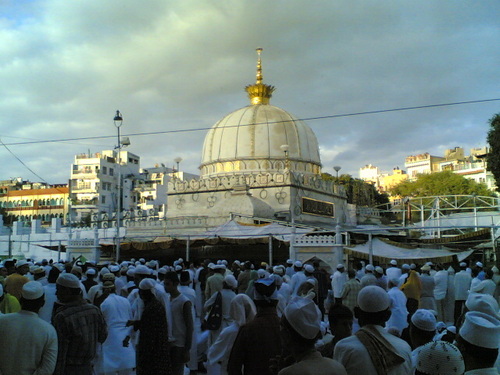
After achieving the objectives of his mission and complying with the command given to him by the Holy Prophet (صلى الله عليه وسلم), his noble soul left the corporeal body on the 6th of Rajab 633 A.H. / 16th March 1236 at the age of 97. He was buried in the same cell (Hujrah) which was the center of his divine activities, throughout his stay at Ajmer. Today his tomb is popularly known as “Dargah Khwaja Saheb, Ajmer”. People of all walks of life and faith from all over the world, irrespective of their caste, creed and beliefs visit this great shrine to offer flowers of there esteem and devotion. The rich and the poor stand side by side to pay their homage and respect to the divine soul.
“Nigaah-e-Lutf Payghambar Muinuddin Ajmeri
Ataae Khaaliq-e-Akbar Muinuddin Ajmeri”
फ़रमाने पीर
यहां हम ख़्वाजा ए चिश्तिया के मल्फूज़ात से फ़ैज़ हासिल करेंगे। मल्फूज़ात, सूफ़ीयों की जि़ंदगी के उस वक़्त के हालात और तालीमात का ख़जाना होती है। जिसे कोई ऐसे मुरीद ही लिख सकते है, जो ज़्यादा से ज़्यादा पीर की सोहबत से फ़ैज़याब हुए हों। इस बार हम हज़रत ख़्वाजा ग़रीबनवाज़ मोईनुद्दीन चिश्ती अजमेरीؓ के मल्फूज़ात ‘‘दलील उल आरेफि़न’’ में से कुछ हिस्सा नकल कर रहे हैं, जिसे उनके मुरीद व ख़लीफ़ा हज़रत कुतुबुद्दीन बिख़्तयार काकीؓ ने लिखा है।
बतारीख़ 5 रजब 814हिजरी को इस दरवेश कुतबुद्दीन बख्तियार को सुल्तानुस सालेकिन हज़रत ख़्वाजा मुईनुद्दीन हसन चिश्ती संजरी अजमेरीؓ की क़दमबोसी का शर्फ हासिल हुआ। आपने मुझे शर्फे बैअ़त से नवाज़ा और चहारतरकीताज मेरे सर पर रखी। अल्हमदोलिल्लाह अला ज़ालेका। उस दिन वहां आपके साथ शहाबुद्दीन सोहरवर्दी, शैख दाउद करमानी, शैख बुरहानुद्दीन चिश्ती व शैख ताजुद्दीन सफाहानी एक ही जगह मौजूद थे और नमाज़ के बारे में गुफ्तगू हो रही थी।
आपने फ़रमाया. नमाज़ में सरे निगाहे इज़्ज़त से लोग नज़दीक हो सकते हैं। इस वास्ते कि नमाज़ मोमीन की मेराज़ है। तमाम मक़ामों से बढ़कर यही नमाज़ है। रब से मिलना इसी से शुरू होता है। नमाज़ एक राज़ है जो बंदा अपने परवरदिगार से बयान करता है। राज़ कहने के लिए मिलने की ज़रुरत होती है और रब के नज़दीक वही जा सकता है, जो इसके लायक़ हो।
फिर मुझ नाचीज़ (कुतबुद्दीन बख्तियार) की तरफ़ रूख करके फ़रमाने लगे. मैं जब सुल्तानुल मशायख ख्वाजा उस्मान हारूनीؓ से मुरीद हुआ तो मुसलसल आठ साल आपकी खि़दमत में रहा, एक दम भी आराम न किया, न दिन देखा न रात। जहां आप सफ़र को जाते तो आपका सामान उठाकर आपके साथ चलता। इस खि़दमत व मेहनत को देख ऐसी नेअमत से नवाज़ा कि जिसकी कोई इन्तेहा नहीं।
जिसने कुछ पाया खि़दमत से पाया। मुरीद को लाजि़म है कि पीर के फ़रमान से ज़र्रा बराबर भी न हटे। जो भी अमल (अवराद नमाज़ तस्बीह व दीगर इबादात) उससे फ़रमाया जाए पुरे होश से सुने और उसे ठीक ठीक अदा करे। क्योंकि पीर मुरीद का संवारनेवाला है। पीर जो कुछ भी फ़रमाएगा वो मुरीद के कमाल के लिए ही फ़रमाएगा।


Gharibnawaz(R.A) >Birth And Early Life
When Hazrat Khwaja Muinuddin was born (536 AH) at Chisht in Sistan, which is also known as Sajistan, East Persia. The peace of the Muslim world was horribly disturbed. Sistan and its surrounding lands were experiencing unprecedented bloodshed and plunder at the hands of barbarous Tartars and other rebels. These intruders had taken advantage of the weak government of Sultan Sanjar. The life and honour of the people were in constant danger. The wild Tartars had completely destroyed the follower of the Muslim nation. They outraged humanity practically in all the centers of the 600-year old Muslim civilisation and culture.
Gharibnawaz(R.A) >Birth And Early Life >Migration To Neshapur
Due to these intermittent political disturbances in sistan, khawaja Ghiyasuddin Hasan, father of khawaja Muinuddin, one day decided to pack up and leave Sistan for a safer place. He migrated with his family to Neshapur the Capital city, which was one of the most flourishing cities in those days. It was a great centre of intellectual and economic activities and possessed the famous “Nizamia” university with a precious library that contained rare collection of Original literature. There lived learned Ulama and reputed Sufis who imparted knowledge in moral and spiritual enlightenment to scholars drawn from far and near. There lived physicians and artists of rare qualifications. There were rich gardens and canals with flourishing agricultural fields. One of the suburbs was called Rewand which was famous for its grape orchards. It is recorded that khawaja Ghiyasuddin Hasan bought an orchard with a windmill in this vicinity to settle down for a peaceful life.
Gharibnawaz(R.A) >Birth And Early Life > No Peace Of Mind
“Man proposes but God disposes” is an old saying. The peace in search of which Khawaja Ghiyasuddin Hasan had migrated to Neshapur was not to be had even in this great city. Here too the people were hanging in a terrible suspense between life and death. The brave Sultan Sanjar had been fighting the Tartars at the border to check them for a long time without success. Due to his prolonged absence from the capital, his administrative machinery was showing signs of disintegration. Internally, the Fidayees of the ‘Qarmti’ and ‘Baatini’ sects (one of whose members had already murdered the able Wazeer Nizamul Mulk) had also come out of their hideouts and were roaming about the country unabated, spreading wild fire of rebellion all round. These armed hordes were busy in wholesale plunder and massacre of the innocent people.
These awe-inspiring events had a very deep impression on the mind of the young Khawaja Muinuddin who was watching the whole barbarous drama objectively at his impressionable young age.
The ‘Qarmti’ and Baatani’ intriguers had carried centuries old grudge against the Hanafi Muslims who held both temporal and spiritual powers in succession for more than 500 years after the death of the Holy Prophet (May peace of God be on him). Although it was an age-old grudge but. As Islamic history shows they utterly failed in all their designs to destroy their rivals. Islam has survived many vicissitudes of history and Quran has promised its survival up to the last Day-of-Judgment.
Gharibnawaz(R.A) >Birth And Early Life > Defeat Of Sultan
In spite of all his best efforts to turn out the invaders from his country and to control the internal rebels, Sultan Sanjar unfortunately could not succeed. He was engulfed in mutual wars between himself and his unfaithful brothers on the one hand, and the Fidayees and barbarous Tartars on the other. It was indeed a terrible situation for him, yet they fought the forces of evil to the bitter end though he was ultimately defeated and had to run for his life.
Gharibnawaz(R.A) >Birth And Early Life > General Massacre
After the defeat of Sultan Sanjar, the invaders had a free hand to plunder every town in Khorasan. Flourishing fields were destroyed, cities were razed to the ground, inhabitants, Ulama and Sufis were mercilessly murdered honour of the woman was brutally outraged, girls and boys were taken as salves mosques, hospitals and the historic educational institutions were destroyed.
Gharibnawaz(R.A) >Birth And Early Life >Destruction Of Neshapur
When the news of this terrible destruction reached the defeated sultan, he once more summed up his courage and collected his shattered army to save his country. But Sultan Sanjar was born under most unlucky stars and his luck once more betrayed him. He failed to check the invaders and this time he was arrested. When this bad news reached Neshapur, the capital was plunged into indescribable grief. It was now at the mercy of the enemy. The invaders entered Khorasan and destroyed the cities of Tus and Mashhed, reaching Neshapur like a sweeping storm. Everything was destroyed leaving this once flourishing city of Islamic culture and learning into a heap of rubble and ruin.
Gharibnawaz(R.A) >Birth And Early Life > Death Of Khawaja’s Parents
Khawaja Muinuddin again saw all this ghastly drama at his early age. But this was not all for him. Just at this time he lost his dear father (551 AD) and the worst part of it was that he had already lost his dear mother too. The young orphan was now left all alone to take care of himself in a world full of hate, murder and greed. Although by virtue of legacy he had enough material resources to sustain himself in his traditional standard of life but the sack of Neshapur coupled with the death of his dear parents plunged him into deep thinking. At times he was over whelmed with grief and saw a very vague picture of this terrible world though he bore it out with courage and exemplary forbearance. He was a hard working youth and looked after his orchard, personally trimming and watering the plants with his own hands.
Gharibnawaz(R.A) >Birth And Early Life > Yet Another Shock
Hardly a year had passed after the death of Khawaja Muinuddin’s father, when the mischievous Tartars once more ransacked Khorasan and repeated the same bloody drama of murder arson and loot. This time Sultan Mahmood, one of the brothers of Sultan Sanjar, came forward to check the invaders but he too failed to rout them. Neshapur was again the scene of the same ghastly tragedies. And once more Khawaja Muinuddin was overwhelmingly dismayed to see these scenes of terrible devastation. He often plunged himself into deeper thoughts about these ugly events in order to try to come to some definite conclusion about his own future course of life. The thought of helping the helpless humanity against all such persistent pillage always tormented his tender heart. Yet they could not come to any definite conclusion.
Gharibnawaz(R.A) >Birth And Early Life > Destined For A Sacred Mission
As helpless human beings, we can never understand the will of the Almighty God. Should we surmise that by exhibiting these tragedies perhaps God Almighty meant to show Khawaja Muinuddin the sins of this wretched world in order to prepare him for a mighty divine mission of reform and peace for the mankind? As it will be seen later on that Heavenly Father did mean this for which He enlightened the mind of the young Khawaja quite unexpectedly. Whenever injustice, oppression and greed reigned supreme in this world, God has always been merciful to mankind by sending His saviours to fight the satanic forces and put the people on the path of righteousness and mutual love.
Gharibnawaz(R.A) >Birth And Early Life >Khawaja Sahib’s Genealogy And Childhood
Hazrat Khawaja Muinuddin Chishty was one of the descendants of the illustrious family of Hazrat Ali, the son-in-law and cousin of the Holy Prophet Mohammed (May peace of God be on him). His father Syed Ghiyasuddin Hasan was a very pious personality and a well to do and influential gentleman. His mother, Syeda Bibi Ummul-wara alias Babi Mah-e-Noor was the daughter of Syed Daud. While Khawaja Muinuddin’s paternal genealogy is traced from Hazrat Imam Husain, the younger son of Hazrat Ali Karam Allah Wajahu, his maternal genealogy is traced from Hazrat Imam Hasan, the elder son of Hazrat Ali.
Childhood
According to historians, Khwaja Muinuddin Chishty even during his childhood gave early promise of his rare piety and sacrifice for others. Whenever any woman with a baby came to see his mother and if the baby cried for feeding,”the infant saint of the future” used to make a sign to his mother to feed the crying baby from her own breast. When his mother did this, the spectacle pleased the little Muinuddin very much. At the age of 3 or 4 he used to share his own food with his playmates.
Once he was going to Idgah for the Id prayers in rich clothes. On the way he saw a blind boy in rags. He pitied the boy so much that he at once gave him some of his own clothes and led him to Idgah with all due affection.
Gharibnawaz(R.A) >Birth And Early Life >Khawaja Sahib’s Genealogy
Paternal Genealogy
Khawaja Muinuddin Hasan Chishty, son of Khawaja Syed Ghyasuddin Hasan, son of Syed Ahmed Muddin Tahir, son of Syed Khawaja Abdul Aziz Husain, son of Syed Imam Mohammed Mehdi, son of Syed Imam Hasan Askari, son of Imam Ali Naqi, son of Syed Imam Mohammed Taqi, son of Imam Ali Musi Raza, son of Imam Musi Kazim Raza, son of Imam Mohammed Jafar Sadiq, son of Imam Mohammed Baqar, son of Hazrat Syed Imam Zain-ul-Abideen, son of Syed-ul-Shohoda Syed Imam Husain, son of Amir-ul-Momineen Hazrat Ali, son-in-law of the Holy Prophet Mohammed.
Maternal Genealogy
Syeda Bidi Mah-e-Noor, daughter of Syed Daud, son of Hazrat Abdulla, son of Syed Zahid, son of Syed Mooris, son of Syed Daud I, son of Syedna Moosa, son of Syedna Abdulla Mahaz, son of Syedna Hasan Musana, son of Syedna Hazrat Imam Hasan, son of Syedna Hazrat Ali Karam Allah Wajahu.
Gharibnawaz(R.A) > Renouncement And Initiation
Khawaja Muinuddin used to ponder for hours together over the ugly scenes of the ghastly massacre in Khorasan which he had been witnessing with great pain for several years ever since his younger days. With these tragic impressions his interest in worldly life and pleasures was diminishing fast. Inwardly he was very much worried and longed to be away from such a mad world if he could manage to see a way out.
Gharibnawaz(R.A) > Renouncement And Initiation > Renouncement
One day (in 556 AD), he came across a ‘Majzoob’ (a divine person constantly engrossed in communion with God) in the person of one Sheikh Ibrahim Qandozi who happened to come to his orchard. The young Khawaja Muinuddin was watering the plants at that time. Immediately he saw the dervish, he welcomed him enthusiastically and after kissing his hands reverently made him sit down under a shady tree. He then brought a bunch of fresh grapes and requested the holy man to eat it. The request was complied with. The divine seemed to admire the manners and this gesture of the young Khawaja’s hospitality and at once perceived, by his intuitive powers, that his host was inwardly worried and upset, had a spark of divine love in his heart and was an ardent seeker after Truth. Over whelmed by the pleasure of this understanding the dervish brought out a bit of ‘Khul’ (the substance left after the oil was extracted from the sesame seed or Til – some historians say it was a piece of bread) from his wallet and after chewing it put it in the mouth of Khawaja Muinuddin. No sooner had he eaten it, than the veil of all worldly imagination was lifted from his mind and he found himself in quite a strange world radiating with ‘divine manifestation.’ When Khawaja Muinuddin recovered from this extraordinary experience, he found that Sheikh Ibrahim Qandozi had gone.
Gharibnawaz(R.A) > Renouncement And Initiation>Not A Fable
This strange spiritual experience, which laid the foundation of Khawaja Muinuddin’s divine career, would look like a queer fable from the Arabian Nights to the present world engrossed in materialism. But it is neither a fable nor a dream because such miracles have happened with the spiritualists or Sufi dervishes or Rishis and Munis of the highest order in the East. And they do happen even today if one is lucky enough to come across any ‘real’ divine (who prefers to live in perpetual obscurity away from all worldly gaze to avoid interruption in his devotional career). Such miracles are amply supported by the old religious books or Scriptures of nearly all the leading and recognised religions of the world all of which are based on spiritualism. The people of this 20th century in which materialism overwhelmingly dominates spiritualism may ridicule and refuse to believe in such superhuman feats and may naturally demand some substantial logical or scientific proofs to support them. But such doubts can be easily dispelled by a minute study of their own respective religious Scriptures. The philosophies of Islamic Sufism and the ancient Yogic and Vedantic sciences of Hindu civilisation also help us to believe in such miracles unquestionably. In this hidden science of spiritual communion or oneness with God all logical arguments are deliberately rejected because logic and Sufism do not go hand-in-hand, which was the creed of Khawaja Muinuddin and numerous other great Sufis and saints of the East. It is neither taught in our modern Universities nor can it be analysed in our scientific laboratories. It is Knowledge from God that comes to His “beloved” devotees only.
Gharibnawaz(R.A) > Renouncement And Initiation>Departure for Bokhara
The immediate inspiration of the above-mentioned miraculous experience with Sheikh Ibrahim Qandozi was that Khawaja Muinuddin renounced the world. He lost no time in selling away his orchard and the windmill along with all his other worldly belongings and distributed every pie of the sale proceeds among the poor and the needy. He then cut off all his ties with his dear and near ones, bade them a last goodbye and left Neshapur for Bokhara, which was the seat of learning in those days in search of religious knowledge and moral education.
A handsome youth who had renounced the world in his early teens was seen walking all alone on the Neshapur-Bokhara highway amidst jungle and animal life, without a friend without a penny in his pocket and without any present or future hope of provision for his livelihood resolutely determined to seek Truth. The ever-growing discontentment of his earlier years in spite of all his rich traditions and material possessions had suddenly changed into a perfect contentment immediately after a divine vision received through the help of a great ‘Majzoob’. He seemed to be very happy with his apparently gloomy lot. At this stage, however he did not know that one day he would be one of the greatest holy saints and ‘Mujaheds’ of his day in the history of Islam who would turn the tables of the evil world, who would apply the balm of solace and salvation to the wounds of the afflicted humanity and who would cause downfall of the redeem the suffering of the oppressed? This youthful traveler in a friendless world was none but Khawaja Muinuddin playing in the hands of Destiny for a exceedingly grand mission and amazing career dedicated to the cause of peace and happiness of mankind.
This illustrious son of Islam and dutiful servant of the oppressed humanity, had decided to go to Bokhara for his education because the famous oriental universities of Baghdad and Neshapur had suffered damage due to the ravages of continuous wars and plunder but Bokhara had still some of the best educational institutions and the learned ‘Ulama’ of his time.
Nothing is recorded by historians about Khawaja Muinuddin’s primary education but considering his noble heritage; it is safe to presume that he must have received at least his early Quranic lessons at home. One historian reports that he had learned Quran by heart at the age of 7.
While in Bokhara, Khawaja Muinuddin received his education in all the oriental sciences and literature from many learned ‘Ulama’ of the day, prominent of whom was Maulana Hissamuddin Bokhari from whom he received his ‘jubba’ (cloak) and ‘Dastaar-e-Fazilat’ (turban of learning) the two highest academic diplomas or “robes of learning” of that time.
Gharibnawaz(R.A) > Renouncement And Initiation>At Samaqand
Having completed his education at Bokhara, Khawaja Muinuddin went to Samarqand which was also a great seat of learning in those days. There too he attended many leading institutions to perfect his knowledge in Theology, Philosophy and Grammar. The years of his education in Bokhara and Samarqand are reported to be between 1150 and 1160 AD or 552 AH.
Gharibnawaz(R.A) > Renouncement And Initiation>In Quest For A Spritual Preceptor
After equipping himself with all the best available education (moral and religious) which he could obtain, Khawaja Muinuddin now diverted his attention to the spiritual side of his training. He now needed a ‘spiritual preceptor’ and decided to leave Samarqand in quest of the country towards Baghdad. On this journey he came to the town of Harwan or Haroon where one of the greatest Sufi dervishes of his time Hazrat Khawaja Usman Harooni, lived. (Born 510 A.H. died 617 A.H. and buried at Mecca.) This great saint had a resounding fame which attracted scores of persons from far and near for their spiritual enlightenment and religious and moral training under him.
Gharibnawaz(R.A) > Renouncement And Initiation>At the feet of Murshid
One day Khawaja Muinuddin decided to present himself before this great saint. When he approached the saint, he kissed the ground with all due reverence and pleaded: “Sir, may I request you to enlist man as one of your humble and devoted ‘mureeds’ (disciples)’? Hazrat Khawaja Usman at once perceived by his intuitive powers that Muinuddin was the fittest candidate to join the circle of his disciples, and granted his request without hesitation.
Gharibnawaz(R.A) > Renouncement And Initiation>Initiation
Khawaja Muinuddin says, in his own words, about his spiritual initiation “I had the honour of appearing before Hazrat Usman when many other spiritual luminaries were also present. I bowed my head in solemn reverence. Hazur Usman asked me to offer 2 ‘rakaats’ of Namaaz (prayers). I did it. He then directed me to sit facing the Kaaba (Mecca). I did it. He told me to repeat Darud Sharif (praise and blessings for the holy prophet and his family) 21 times and to say ‘Subhan Allah’ (God be praised) 60 times. I did it. After that he stood up took my hand in his own and looked towards the heaven saying: “Let me present you to God”. After that he cut off my hair with a scissors and then put a special Tarki cap (Kolah Chahaar Tarki) on my head and asked me to sit down. He then asked me to repeat ‘Surah Ikhlas’ (a Quranic verse) one thousand times. I did it. He then said, “among our followers there is only one day and one night’s Mujaheda (probation) hence go and do it today” Accordingly I spent one day and one night in prayers and reappeared before him. He asked me to sit down and repeat ‘Surah Ikhlas’ again one thousand times. I did so. “Look towards the heaven”, he then asked me. When I raised my eyes towards the heaven he enquired “how far do you see?” I said, upto Arsh-e-Moalla (zenith). He then asked me “look below” . I said upto Tahtu-Sara (abyss). He then asked me to sit sown and repeat ‘Surah Ikhlas’ one thousand times and I did it. He then asked me ” Look towards the heaven “. When I did so, he enquired “how far do you see now? ” I said upto Hijaab-e-Azmat (dazzling glory of God). He then asked me “close your eyes”. I did so, and, after a moment, he told me “open your eyes.” I did so. Then he showed me his two fingers and enquired “what do you see through them?” I said, I see 18,000 Aalam (worlds). When he heard this, he said, “now your work is over”. Then he looked towards a brick lying nearby and asked me to pick it up. When I did so. I found some deenars’ (gold coins) under it. He asked me to go and distribute them among the poor and the needy which I did. I was then instructed to remain with him for some time.”
Gharibnawaz(R.A) >His Days With Murshid> At Mecca and Medina
Khawaja Muinuddin says he was taken to Kaaba (Mecca) in 562 A.H. from Baghdad by his Murshid, Khawaja Usman, where the master prayed for his disciple’s success and salvation. His prayer was answered by a ‘Nida’ (voice) declaring: ‘O Usman, We have accepted Muinuddin as one of our beloved devotees”. (Hazrat Sheikh Shahabuddin Suhrawardy says he was himself present in Mecca when Khawaja Muinuddin Chishti’s attendance took place.) Khawaja Usman then took Khawaja Muinuddin to Medina and asked him to offer his homage and salutations at the shrine of the Holy Prophet Mohammed. In this connection, Khawaja Muinuddin says: “I did so and heard a ‘Nida’ in response declaring: ‘Wa-alaikum-us-Salaam Ya Qutbul Mashaikh-e-bahr-o-bar’ (Peace be on you also O spiritual leader of all the saints on earth”). Upon this Khawaja Usman informed his disciple that he had now reached the stage of perfection as a dervish.
Gharibnawaz(R.A) >His Days With Murshid>Strange Experience On Travels
Describing his extensive travels with his ‘Pir-o-Murshid’ Khawaja Muinuddin says, “I was once travelling with Hazrat Khawaja Usman in Sewastan. One day we reached a ‘Som-Aa’ (monastery) where Hazrat Sadruddin Ahmed Sewastani lived and remained deeply absorbed in the devotion of God. For several days I remained in his attendance. When anybody came to him, he used to get out something from ‘gheb’ (invisible source) and present the same to the newcomer and requested him to pray for the dervish so that he may carry his unflinching faith in God and his holy prophet Mohammed to the grave. Whenever he heard of the torture that awaits the sinful dead in their graves (according to Islamic belief) he used to shiver like a cane even at this horrible thought. He very often bitterly wept for days together and did this so loudly that even the onlookers could not resist their pitiful emotions. When I attended on him, he was in this state of mind. When he recovered he told me, “My dear, I have to face the death. How can one whose enemy is Malik-ul-Maut (the angel of death) and who has to render the account of his worldly deeds or the Day-of-judgement (Qayamat) laugh or be happily engaged in any worldly affairs?” He went on, “If you people ever knew even a little about the condition of those persons who are interned in their graves with scorpions and snakes torturing them you would melt like salt. “Hazrat Sadruddin added, “One day I was sitting with a god fearing dervish in the graveyard of Basrah. By his intuition the divine understood that the internee of a nearby grave was being subjected to questions about his religious belief, etc. (according to Islamic conviction) with horrible torture. On realising the horror of this torture this dervish made a violent ‘Nara’ (loud shriek) and the next moment he was dead. I have never seen a dervish more horrified at the thought of after death questioning and torture of the sinful in their graves than this one. Hazrat Sadruddin further went on, ” It is due to this thought of the horrible torture in grave that I am in seclusion for the past 30 years and you are the first person whom I have related this story. Therefore my dear, it is better to spend our time in the devotion of God than in the company of worldly people because so long as people spend their time in the company of worldly people they are away from God. We must avoid such association and prepare ourselves for the next world. “After this he gave me two ‘ Khurmas’ (dry dates) and retired to his seclusion only to resume his repentance.”
Hazarat Khawaja Muinuddin continues, “Once I, Hazrat Khawaja Usman Harooni Shiekh Ahaduddin Kirmani and Janab Aarif Revigiri were sitting in the company of some other dervishes in mosque of Damascus. In the course of conversation Janab Mohammed Arif said; “ On the day-of-judgement (Qaya- mat) the rich will have to finish an account of their doings and conduct before God but the dervishes will be exempted.” One of the dervishes however hesitated to believe this and demanded an authority on such a divine ‘fireman’ from an authentic book. After a little contemplation, Janab Arif gave out ‘Kashful-Mahjoob’ as the name of the book but the dervish insisted to see the said book and the ‘firam’ with his own eyes. Upon this Janab Aarif prayed to the Almighty God for help and by His grace the angels presented the particular book to him. When it was shown to the arguing dervish he bowed down his head at the feet of Janab Aarif apologetically. Afterwards it was decided that each of the 4 dervishes present should show his ‘Karamat’ (miracle). Hazrat Usman Harooni put his hand under his ‘Mussalla’ (prayer carpet) and brought out some pieces of gold and asked one of the company present to go and fetch some ‘Halwa’ (a kind of sweet paste prepared with refined flour butter and sugar for all. Shiekh Ahaduddin Kirmani then touched a dead branch of a tree lying nearby which immediately came to life and became green and flourishing. Owing to great regard I had for my ‘murshid’, I did nothing. Hazrat Usman then turned to me and said, “Muinuddin you did nothing”. Upon this I took out 4 fresh breads from my wallet and handed them over to the dervishes who were feeling too hungry but did not express their desire before the company due to shame. Janab Aarif then said, “A dervish who had no such powers did not deserve to be called a dervish. “
Hazrat Khawaja Muinuddin says, “Once I, Hazrat Usman and another dervish were on a journey when we reached the town of Awash where we met Shiekh Bahauddin Awashi. He was a great dervish and it was his custom that whosoever went to him at his Khanqah (secluded place of meditation), he was offered something. He used to distribute clothes also, which he received from ‘gheb’ (invisible sources). When we left him, he gave me a precious parting advice. He said, “O dervish, whatever you get give it away in charity in the name of Allah and never hoard any wealth. Feed the humble and the poor people of God so that you may become one of His beloved.”
Hazrat Khawaja Muinuddin continues, “Our next halt was at Badakhshan where we met a venerable old dervish one of whose feet was amputated. He was 100 years old and was wholly absorbed in the devotion of God. When I enquired about his amputated foot, he said, “One day, overpowered by my ‘nafs’ (appetitive desire) I put this foot out of the ‘Som Aa’ (monastery) when I heard a ‘nida’ (voice), “O devotee, have you forgotten your pledge with me? I immediately felt ashamed and cut off my foot and threw it away because it had led me out of the ‘Som Aa’ and was the cause of breaking my pledge with God. I do not know how shall I be able to show my face and wipe off this disgrace before other dervishes on the Day-of-Judgement.”
Gharibnawaz(R.A) >His Days With Murshid> Conversion Of Fire Worshippers
All historians report a wonderful miracle about Hazrat Khawaja Usman Harooni when he was no one of his tours with Khawaja Muinuddin from Harwan to Baghdad. In the town of Ray, which was a big center of fire-worshippers, they had a big fire temple wherein 20 wagonloads of firewood were consumed daily to keep the fire alive for all the 24 hours. Hazrat Khawaja Usman stayed here under a shady tree. While he engaged himself in his evening prayers, he asked his attendant Fakhruddin to arrange for the fire and prepare some food to end the day’s fast. Fakruddin went to the fire worshippers and begged for some burning coal in order to prepare his fire but they refused and said, “This is our god we cannot give any fire out of it. “The attendant returned and reported the matter to his master. Hazrat Khawaja Usman then himself went and found that an old man, whose name was Mukhtar, was sitting on a raised wooden platform with a 7 year old boy in his lap and many persons were busy in worshipping the fire around him. Hazrat Usman questioned him, “What is the use of worshipping fire which is but an insignificant creation of the Almighty God and which can be extinguished with a little water, why didn’t you worship that real and true God, the Creator of this fire and of all the universe, so that you may derive benefit and have eternal salivation. “The old man replied, “Fire in our religion is very sacred and it is the source of our salvation, we worship it so that it would not burn us on the Day-of-Reckoning.”
Hazrat Usman: Very well. Since you have been worshipping it for ages now put your hand in it. If it is a source of your salvation it should not burn you.
The Old Man: But burning is the nature of the fire, who can dare to put his hand in it and yet be safe from it?
Hazrat Usman: Fire is under the command of the Almighty God, the Creator of the whole universe without His command it cannot burn even a hair.
Having said this, Hazrat Usman took the boy from the arms of the old man and reciting, “Bismillah-Ar-Rehman-ir-Rahim-Yaa Naaro kuni bar da-wassalaam-un-ala-Ibrahim” (In the name of merciful and Compassionate God, O fire be thou cool and a means of safety for Abraham) (Quran), he suddenly disappeared in the burning fire. The fire worshippers began to cry and wail. It was after some time that by the grace of God, Hazrat Usman emerged out of the fire quite unscathed with the boy in his arms, hale and hearty. The fire could do them no harm. The old priest and his companions were surprisingly too happy to see the boy safe and sound, and asked him, ” what did you see in the fire? ” The boy replied, “I was playing in a garden because of the blessings of this Sheikh.”
All the fire-worshippers, after seeing this miracle, embraced Islam and became Hazrat Khawaja Usman’s devoted disciples. Mukhtar’s name was changed into Abdulla and the boy’s into Ibrahim after the Islamic fashion. Hazrat Usman stayed in Ray for 2 and half years and imparted necessary Islamic teachings and lessons to the new converts. Instead of the fire temple, a magnificent mosque was built in Ray which stands even to this day.
Gharibnawaz(R.A) >His Days With Murshid>Punctuality Of Namaz
According to Khawaja Muinuddin Chishti, “One day my Murshid Hazrat Usman said “Tomorrow, when the day-of-judgement will come,when all-prophets saints and Muslims will be interrogated by God Almighty about their responsibility to ‘Namaz’ (prayers). Those who have discharged this duty punctually will be spared but those who have not, or who have been lethargic, will be hurled in Waile which is a well in hell and where the punishment is dreadful.”
Gharibnawaz(R.A) >His Days With Murshid>Crossing Of Tigris
Recounting another journey with Pir-o-Murshid Hazrat Khawaja Usman, Khawaja Muinuddin says, “We were on a journey, when we reached the bank of the river Tigris, it was horribly overflowing under a furious storm. I was disturbed about crossing it. Hazrat Usman understood my apprehension and asked me to “close the eyes”. I did so. When I opened my eyes after a little while I found him and myself both on the other side of the river. I reverently enquired as to how it happened? The great Murshid said, “We repeated Al-hamd Sharif (Surah Fatiha from the Quran) five times and crossed the river.
Gharibnawaz(R.A) >Succession As Khalifa>Meeting With Khawaja Qutubuddin
During this tour, when he visited the famous city of Asfahan, he met Sheikh Mohammed Asfahani. The 14-year old Qutubuddin Bakhtiyear Awashi (born 569 AH) was in search of a Murshid (Master) in those days and was thinking of approaching Sheikh Mohammed in this matter but, in the meantime he came across Hazrat Khawaja Muinuddin who read in him a very promising spiritual career and accepted him as a ‘mureed’. Khawaja Qutubuddin accompanied him on his tour in 583 AH and later on was initiated as Khawaja Sahib’s Khalifa in 586 AH as the result of the ‘Bahsharat’ (prophesy in dream) from the Holy Prophet of Islam at the early age of 17. Khawaja Qutubuddin was a born saint in as much as he had learnt half of the Holy Quran by God’s grace while he was still in his mother’s womb and used to recite it.
Gharibnawaz(R.A) >Succession As Khalifa>Visits To Mecca And Medina
During this tour (583-585 AH), Khawaja Muinuddin visited several other places including Mecca, performed Haj and offered incessant prayers for sometime there. One day he heard a ‘Nida’ declaring, “O Muinuddin, we are pleased with you; you may ask anything you like.” The Khawaja Sahib replied, “O Almighty God, I only pray for the grace of your pardon of Muinuddin’s ‘Silsila’ of mureeds”. The ‘Nida’ answered, “O Muinuddin, you are our beloved devotee, we shall pardon your ‘mureeds ‘ and also others who became so in your ‘silsila’ upto Qayamat (the Day-of-Reckoning).
Gharibnawaz(R.A) >Succession As Khalifa>Prophetic Direction To Go To Ajmer
Khawaja Muinuddin then went to Medina. There also he remained in devotion for a long time. One night he had a ‘Basharat’ (prophetic dream) from the Holy Prophet who said, “O Muinuddin you are the promoter of our religion. We give India under your charge where darkness prevails. Go to Ajmer. With your presence, the darkness shall disappear and Islam shall shine. Allah will help you. “Khawaja Muinuddin was much pleased at this ‘Basharat’ but wondered about the geographical situation of Ajmer. In another spiritual communion with the Holy Prophet, he was however shown a map with the exact position of Ajmer with its surrounding hills and the fort.
Resuming his journey the Khawaja Sahib visited Khirqan and Sheikh Abul Hasan Khirqani and then Astrabad where he met Shiekh Naasiruddin Astrabadi. He then left for Herat where he stayed at the tomb of Hazrat Abdulla Ansari for some time
Gharibnawaz(R.A) >Succession As Khalifa>Yadgar Mohammad’s Conversion
When his reputation attracted large number of people in Herat he moved on to Sabzawar in Afghanistan. The governor of this place, named Yadgar Mohammed, was a very cruel and haughty ruler. He was a Baatani and did not recognise or respect the first 3 Caliphs of Islam, neither had he any regard for Sufi dervishes and holy personalities. He owned a fine garden in the suburbs of the town. Hazrat Khawaja Sahib was tired, so he went into the garden for a little rest and, after having a bath in hauz’ (a small reservoir of water), engaged himself in the study of the Holy Quaran.
At this time news of the expected arrival of Yadgar Mohammed perturbed the attendant of Khawaja Sahib. Apprehending insult of trespass at the hands of the haughty governor he approached his master and informed, ” Sir, the owner of this garden is coming; I think, we should move out lest he may insult your honour for trespass in his garden.” The Khawaja Sahib merely smiled and said, “If you are so afraid, you may go and sit under that tree and watch the scene of Allah’s wonder. “Immediately after this, Yadgar’s servants appeared on the scene and started sweeping and carpeting of the place for their master’s reception. Due to the extraordinary saintly dignity and awe of Khawaja Sahib, they could not however dare to ask him to get out. In the meantime, Yadgar Mohammed arrived at the scene with his retinue.
When he saw Khawaja Muinuddin there, he got wild and vehemently rebuked his servants, “Why did you allow this ‘fakir’ here and did not turn him out of my garden?” On hearing this, the Khawaja Sahib simply raised his eyes (from the Holy Quran which he was reading) towards Yadgar Mohammed and the next moment the proud and haughty governor shivered like a cane and fell down unconscious on the ground. His servants and retinue were thunder struck by this incident and begged Khawaja Sahib to forgive their master for his impertinent behaviour. Upon this the Khawaja Sahib asked his attendant to get some water from the ‘hauz’ and sprinkle the same on Yadgar Mohammed’s face.
The next moment he regained consciousness and knelt down at the feel of the saint apologetically. The Khawaja Sahib then delivered a brief sermon of advice to him and his people who repented shamefully for their past sins and wrong convictions. He reminded Yadgar Mohammed that it was highly contradictory and shameful to be a believer of the Holy Prophet on the one hand and to disobey and flout his commands and the Islamic principles on the other. Yadgar Mohammed offered prayers in lieu of his ‘tauba’ (repentance) and pledged strict abstinence for future. He wanted to give all his vast wealth to Khawaja Sahib, but it was contemptuously refused. He was however advised to distribute it among the poor and the needy which he did promptly. He divorced his many wives, freed all his slaves and renouncing the world, became one of the ardent devotees of Hazrat Khawaja Muinuddin Chishti.
Gharibnawaz(R.A) >Succession As Khalifa>In Ghazni
From Balakh, Khawaja Muinuddin is reported to have gone to Ghazni at a time when none could have dared to enter that city due to the terrible turmoil and disturbances that prevailed there consequent upon the fall of Sultan Mahmud’s power and the rise of that of the Ghauris. The city was dangerously ablaze and life was unsafe on account of the general massacre, arson and loot. But Khawaja Muinuddin was too big to be afraid of such dangers. If he was afraid of anything on earth he was afraid of the Almighty God alone. In Ghazni he met Hazrat Shamsul-Aarifin Sheikh Abdul Waahid and stayed with him for some time. In the tone and temper of this horrible time in Ghazni, the Khawaja Sahib applied his healing balm of spiritualism to the wounds of the afflicted which was the supreme need of the hour.
Gharibnawaz(R.A) >Succession As Khalifa>Entry In India
It was in the year of grace, 587 AH or 1191 AD that Khawaja Muinuddin Chishti entered India and proceeded to Delhi via Fort Shaadman, Multan, Lahore and Samana (a town of the old Patiala state). At Lahore he stayed for 40 days at the shrine of Hazrat Data Ganj Baksh, a great saint who had come to India before Khawaja Sahib and enjoyed considerable respect and popularity in the Punjab. While leaving Lahore, Hazrat Khawaja Muinuddin offered the following Persian couplet in appreciation of this great saint:
“Ganj bakhsh-e-faize-e-Alam mazhar-e-nur-e-khuda.
Naaqisan ra pir-e-kamil Kaamilaan raa naakhuda. ”
(Ganj Baksh is a radiant ray of Divinity and a bestower of the treasure of divine knowledge for the salvation of mankind. To the unworthy he is a supreme guide or murshid but to the supreme guides or murshids themselves he is a superlative guide like the captain of a ship.)
Gharibnawaz(R.A) >Succession As Khalifa>Warning of Raja Prithviraj’s Mother
Mother of Raja Prithviraj Chauhan, who ruled Ajmer and Delhi at that time, had warned her son 12 years ago by her astrological knowledge that a ‘fakir’ would enter his kingdom from the North one day and destroy it if he would not be wise enough to respect him and compromise with him. The Raja had therefore, deputed intelligent spies all over the North-Western frontier to watch the expected fakir with a view to foil his entry and finish him before he could do any mischief. When Khawaja Sahib reached Samana (a town of the old Patiala state), the spies were shrewd enough to recognise him and wanted to harm him by intrigue. They invited him to stay with them as their guest and accept their hospitality. But a ‘Basharat’ from the Holy Prophet warned him not to trust them but to continue his journey toward Ajmer.
Gharibnawaz(R.A) >Succession As Khalifa>Courageoues Entry In Delhi
A great political event coincided with the journey of Hazrat Khawaja Sahib from Lahore to Delhi. On the decline of Sultan Mahmud’s reign in Ghazni, Sultan Ghiyasuddin Ghauri and his brother Shahabuddin Ghauri had assumed power and captured Lahore from the last Ghazni governor Khusro Shah. Before returning to his capital, Shahabuddin Ghauri was however challenged (after he had captured Bhatinda) by and suffered a crushing defeat at the hands of Raja Prithviraj Chauhan of Ajmer in the first battle of Trawri or Tarain (40 miles from Delhi) in 587 A H or 1191 AD. He escaped miraculously with his wounds by the help of a faithful Khilji slave who carried him safe on his horseback from the battlefield.
The Khawaja Sahib on his journey to Delhi met some Khilji and Pathan sepoys-remnants of Shahabuddin Ghauri’s defeated army-who warned the saint not to venture his entry into Delhi at such a dangerous time. But it has always been proved, he was too big for such a warning and despite all natural prejudice against Muslims in such atmosphere he continued his journey courageously towards Delhi.
Gharibnawaz(R.A) >Succession As Khalifa>Entity & Conversions In Delhi
It can be easily surmised that the Khawaja Sahib’s entry in Delhi, under such a prejudiced atmosphere must have taxed his and his few followers courage and perseverance to the utmost capacity specially faith in Allah. And indeed nothing could disturb or prevent him and his resolute mission even when his appearance actually infuriated the inhabitants of Delhi. A citizen’s deputation approached Khandey Rao, the cousin of Raja Prithviraj and governor of Delhi under his regime and easily obtained these orders for the immediate expulsion of Khawaja Sahib and his few companions from Delhi. But whosoever went to execute the order he was so irresistibly over powered and subdued by the great saint’s magnetic personality and affectionate demeanour that he was on the contrary, obliged to listen to Khawaja Sahib’s sermon and embrace Islam instead of evicting him from the site. This was the great saint’s first miracle on the soil of India which killed all the prejudice against his religion surprisingly and converted the same into a deep affection and reverence for him. As this news went round the city, people began to flock around him in ever-increasing number and embraced Islam unhesitatingly. When sufficient seed of Islamic faith was thus scattered in the soil of Delhi the Khawaja Sahib deputed Khawaja Qutubuddin Bakhtiyar Kaki (his beloved Khalifa) to carry on the good work there and himself proceeded to Ajmer.
Gharibnawaz(R.A) >Karamat (Miracles)>Why These Miracles?
According to the natural principle of “seeing is believing”, man appreciates and believes quickly a practical demonstration if he sees it with his own eyes instead of being convinced by any other kind of mere theoretical education or appeal for any good cause. There has been no greater and more sacred cause than the cause of religion in the history of mankind. Religious belief has always been a question of strong conviction with humanity, and there can be no perfect or unshakable religious belief without perfect and solemn conviction in the establishment of which nothing but miracles have played a most convincing part. Miracles, as a rule, are rare phenomena emanating from, or performed by, only those superhuman beings who are entrusted with, the sublime service of God and His creation.
When man is woefully steeped in sin, he refuses to return to the path of righteousness easily, and ignores all ordinary human appeals for abstinence. He needs something more powerful i.e. some ‘supernatural’ power to convince him that sinful life was contrary to the “Divine Law” and would lead him only to an ignominious disaster and severe penalties in both the worlds if he did not return to virtue. Only divine personalities like the Prophets, Saints and Auvtaars, who have no selfish axe to grind, are capable of performing by the grace of God to uphold the cause of eternal TRUTH for the emancipation of mankind.
Gharibnawaz(R.A) >Karamat (Miracles)>Miracles And Modern Science
The votaries of modern science do not believe in miracles. They take them as mere myths. But, in Islam, miracles have the authority of the Holy Quran. They must be believed because, firstly, they actually happen; secondly, because they are incontestable historical facts; and thirdly, because science is only a weapon of sceptics and unbelievers against thing ‘supernatural’. Scientists maintain that except the priest craft and some credulous victims, no intelligent person living in 20th century believers in miracles, which are looked upon as mere fables invented by wily priests maddened by superstition and medieval moonshine. This tempest of mere verbal camouflage is, however, a poor instrument to thrash out the truth about miracles.
Gharibnawaz(R.A) >Karamat (Miracles)>Khawaja Sahib’s Pilgrimage To Mecca Every Year
As is evident from his life history Khawaja Moinuddin is reported to have performed two Haj pilgrimages to Mecca before coming out to India. But the Hajis (pilgrims who visit Mecca during the Haj) who undertook pilgrimage to Mecca during Khawaja Sahib’s stay in Ajmer bore evidence to the fact on their return to Indian that they saw the great saint in Mecca personally during the Haj every year. It was indeed one of his marvellous miracles. How could he do this feat in the absence of any modern means of transport 700 years ago, is a mystery beyond human perception and yet it is a fact corroborated by eye witness and history. During the Haj period, he was seen both in Ajmer and Mecca.
Gharibnawaz(R.A) >Karamat (Miracles)>Murderer Becomes A Devotee
Once a person appeared before Hazrat Khawaja Sahib and pretended to say that he was eager to pay his homage to the great saint on that particular day. The Khawaja Sahib replied “Here I am, but first fulfil your promise that brings you here”. The man began to tremble with the idea that his secret was out before he could act and, admitting his guilt, he at once offered his profound apologies. As a matter of fact, this man was a hireling of some of the enemies of Hazrat Khawaja and had come with theprecise intention of murdering the holy saint, a fact which the great saint came to know by his intuitive powers. The man prayed for the pardon of the saint who forgave him magnanimously. The men then embraced Islam and became one of the devoted `mureeds’ of Khawaja Moinuddin for the rest of his life.
Gharibnawaz(R.A) >Karamat (Miracles)>Milk From An Immature Cow?
One day Khawaja Moinuddin Chishty was sitting on the bank of the Ana-sagar lake at Ajmer. A shepherd-boy happened to pass before him with a herd of young cows who had not yet acquired their maturity. The Khawaja Sahib asked the boy for some milk from his herd. The boy took it to be a joke and said, “Baba they are all young calf of immature age; they do not yield any milk at this age.” The Khawaja Sahib smiled and, pointing towards a young cow, said, “I would like to drink the milk of that cow, go and milk her.” The boy obeyed rather hesitatingly. When he went to milk this particular cow, he was simply astonished to find her teats fully developed and over-flowing with milk. The boy filled several receptacles with milk which 40 persons drank to their full satisfaction. He was so much impressed by this strange miracle that he became great devotee of Khawaja Sahib.
Gharibnawaz(R.A) >Karamat (Miracles)>A Prediction
One day, ‘mureed’ (disciple) of Khawaja Sahib came to him and complained, “Sir, the governor of the city has made my life most miserable by intolerable harassment so much so that today he has order my banishment from the city.” The Khawaja Sahib replied, “But where is he now, he has already been punished by God?” When the man returned to his home, he heard the news of the governor’s sudden death due to a fall from his horse while hunting.
Gharibnawaz(R.A) >Karamat (Miracles)>Restoration Of Murdered Man
One day a waiting old woman came to Hazrat Khawaja Moinuddin who was busy with his ‘wazoo’ (ablution). The woman complained that the governor of the city had murdered her son without any fault and that she had come to him to beg for justice. The Khawaja Sahib, after finishing with his ‘wazoo’ picked up his ‘asa-e-mubarak’ (holy staff) and went out with the old lady to go to the place where the murdered corpse of her son was lying. His close devotees also followed him in attendance. The Khawaja Sahib placed the severed heard in its proper position on the body of the murdered young man and prayed to the Almighty God, “O Allah, if this man was murdered with any fault, then grant him his life”. After this prayer, the Khawaja Sahib put his staff on the corpse and said, “Get up by the command of Allah if you are innocent.” The young man got up, hale and hearty, and the next moment both he and his old mother fell down at the feet of the great saint of Ajmer in solemn gratitude
Gharibnawaz(R.A) >Karamat (Miracles)>To The Rescue Of Sheikh Ali
One day Hazrat Khawaja Moinuddin was passing through a street of Ajmer with his attendant Sheikh Ali. Suddenly a creditor of Sheikh Ali appeared on the scene and, holding him by his garment insisted upon the payment of his debt in a very insolent manner. Pleading on behalf of his attendant, the Great Khawaja assured the creditor that his debt would now be paid soon and requested him to let Sheikh Ali go for the time being. But the creditor would not allow the attendant to move until his money was paid on the spot. This obduracy at last invoked Khawaja Sahib’s proverbial sympathy for human shortcomings. In a state of ‘jazba’ (intense feeling) he took off his ‘Chadar’ (the wrapper which he wore) and flung the same on to the ground. And as soon as the ‘Chadar’ was flung, it was covered with a big heap of precious silver and gold coins. The Khawaja Sahib then asked the creditor, “Please take away your debt, counting honestly as much as it is due to you, from this heap but be careful not to pick up even a single coin more than what is your legitimate due.” Overpowered by greed at the sight of such a vast wealth, the creditor mischievously thought of picking up more than what was actually due to him. But as soon as he stretched his hand towards the money with this evil intention, it dried up and his arm became as stiff as an iron rod. The creditor and the onlookers were wonder-struck at this awful experience. Realising his guilt, the creditor fell at the feet of the great saint and begged for mercy. The Khawaja Sahib accepted the man’s apology with his characteristic benevolence and prayed to God for the restoration of his arm to its normal condition.
Gharibnawaz(R.A) >Arrival ,Preaching And Miracles
“The seer by devotion and contemplation, prepared himself for the duties of Guide and Leader to mankind but when there comes the clear call, he must stand forth and proclaim the Message, in purity unselfish devotion and patient long suffering; to save men the distress of the Final Day. For Manu there be who glory in life of ease and plenty. arrogant splendour and the applause of men who scorn God’s Truth and reject the divine. How will they fare when the Judgement come, and the penalty? Every fact in life’s pageant is but a portent for the future. Every soul is in the pledge and must redeem itself by Faith, Prayer, by Charity and earnest care for the Realities of life. Bring but the will, and God will guide-the Lord of Righteousness, the Lord of Mercy and Forgiveness. “(Quran: LXXIV: C. 254 by Abdulla Yusuf Ali).
Hazrat Khawaja Moinuddin Chishty arrived in Ajmer at the age of 52 in 587 AH or 1191 AD on his divine mission, unique in the annals of Islam and also in the history of India. As we have seen, for the success of his grand mission he had already been suitably trained by his Pir-o-Murshid Hazrat Khawaja Usman Harooni and divinely equipped by the blessings of the Holy Prophet Mohammed. He was thus an apostle of God dedicated to the cause of Truth which “always and invariably prevails though in the long run.” His only armour for the success of his great mission was that greatest invisible power that pervades and sustains the whole universe.
Truth Always Prevails
Again and again through all successive ages, the apostles of God have successfully fought and defeated the forces of evil. Prophet David succeeded in overthrowing Goliath. Prophet Abraham survived the torture of a huge fire made by Namrood to destroy him but it turned into a garden of fragrant flowers and Namrood himself was destroyed by a gnat. Shree Ramchandra, the exiled but dutiful son of Raja Dashratha secured a mighty victory over Ravana the demon king of Ceylon, in righteous cause. In spite of all torture, the Holy Christ and his religion did survive even after his crucifixion and the Holy Prophet gave noble lessons of Christianity to the world. Prophet Mohammed was tormented by Abu Jehal and Abu Lehab with superior forces but he succeeded triumphantly in the end with his grand religious mission. The whole history of the world is replete with such illuminating and noble examples of the success of ‘Truth’ against evil and repeats itself again and again. Whenever and wherever there is a struggle between Truth and falsehood the former is ultimately a victor. Raja Prithvi Raj of Ajmer unfortunately adopted a false policy of arrogance, persecution and insult against a harmless dervish and had to go down before the divine dispensation of the Almighty God.
Natural & Inevitable
Whenever the ‘Divine will’ ordains to inspire a band of righteous people to work as “Torchbearers of Truth” to a corrupt humanity, there never fails to appear a band of those diehards who pitch themselves in deadly opposition to inflict on the victims all sorts of tortures and troubles. Truth and Righteousness come out all the more shining when tried and tested by hardships and such a period of adversity cannot also fail to bring out the best character in the martyrs, their patience fortitude, humiliation unflinchingly faith, etc. In fact they live if they can for the Truth and die, if they must for the Truth. Moral perfection can be attained and moral virtue can reach their highest standard of persecution. And the ultimate success after fighting against odds, goes to prove beyond all doubt how the “Divine Movement ” and the Divine help and guidance work behind it. Their severe trials are so to say, a blessing in disguise. In the furnace of trials and persecution the one of character becomes burnished gold. Adversity and hardships bring out some of the finest qualities in man. They either make of him an everlasting character, the light which shall shine always and everywhere or reduce him to nothingness and oblivion. Therefore those who aspire after success must be prepared to tread the road of hardships and trials.
Greatest Preacher Of Islam In India
It is a historic fact that Hazrat Khawaja Moinuddin Chishty was the greatest preacher and founder of Islam in India. It was he who laid the real foundation of Islam in India by his peaceful mission and unparalleled forbearance. He brought the message of ‘Universal Love and Peace’ and paved the way for his succeeding Khalifas for the peaceful propagation of Islam in this country without any compulsion whatsoever in the true spirit of the Holy Quran which says, “Let there be no compulsion in religion. Wilt thou compel men to become believers? No soul can believe but by the persuasion of God.” Khawaja Moinuddin followed this dictum through out his mission. Before his arrival, Muslims in India were in a most negligible minority. His piety and sympathetic preaching made a profound impression upon all he came across.
The invasions of Mohammed-bin-Qasim and Sultan Mahmud of Ghazni contrary to general belief, did little or nothing for any real or permanent promotion of Islam in India. They were more or less military campaigns for the economic exploitation like the British and bear no comparison whatsoever with the grand mission of Hazrat Khawaja Moinuddin who did wonders with his peaceful preaching of Islam in this country. He did not bring any armies with him but came with only a few companions; he feared none on earth except Allah. He did not come out to conquer the wealth of India, he came out to endear and win the hearts of Indian people by free conviction in order to put them on the right path of “Truth and Love” and thus give them happiness and prosperity in life and salvation after death.
Here was the God’s chosen man for a particular mission at a particular period of history Khawaja Moinuddin had renounced the world at an early age and braved self-imposed mortification and contentment when he could have easily lulled himself in a luxurious life on the rich traditions of his illustrious family. But, like all other great prophets and redeemers of the oppressed world his heart ached at the persecution and suffering which the barbarous man perpetrated upon his innocent fellow beings. Here was the man of destiny who was a penniless and friendless orphan when he renounced the world and left Neshapur in quest of education. And yet by exemplary self-denial and diligent industry, he was able to obtain the highest moral and religious training at the leading institutions of Samarqand and Bokhara.
Miracles & Sufi Derveshes
The ‘Karamaat’ or miracles, which formed a most prominent part of Khawaja Moinuddin life and mission, have always been intimately associated with the lives of other Sufi saints and Hindu seers in the East. As a matter of fact, miracles emanate from the supernatural powers bestowed upon these holy persons by God as the result of their life long devotion, probation (Mujahedas) and trials, and are beyond the scope of common conception of ordinary human beings, their experiences and knowledge. Modern science and logic have no place in the ‘hidden’ calculation and determination of miracles. They are displayed only when there is a great emergency to justify them. In fact they are used as a `last remedy’ when all other common sense persuasion failed to convince the devil in man or the teachings and principles of the divine doctrines of Truth or the laws of God, in order to maintain a harmonious equilibrium among mankind in the “Divine Scheme of God.” so essential for the happiness of His creation on earth. Highly talented and enlightened Sufis and seers are extremely few and rare in this age. They are ranked as Walees in Muslim terminology who as the lives of Khawaja Moinuddin and others of his most distinguished order prove, were obliged to use their supernatural powers to meet the circumstances of each situation strictly in accordance with the divine law and will in the cause of Truth and nothing else.
Round the Anasagar lake where the Khawaja Sahib’s party was camping there were many temples. The followers of the saint used to draw water and sometimes catch the fish also from this lake for their food. The Brahman priests of these temples naturally remonstrated against this and reported the matter to the Raja who ordered immediate removal of “these Muslim fakirs” from the place. The servants of the Raja not only demanded Khawaja Sahib’s movement from this place but also asked him to leave Ajmer at once, and this demand was made in very insolent and unbecoming manner. But it was impossible for Khawaja Sahib to agree because he was there by the will of God and the command of his Holy Prophet of Islam. When the rude crowd of Brahmans tried to mob and molest these innocent fakirs with the ultimate intention of murdering them the Khawaja Sahib only threw some dust upon them which forced them not only to shrink back but caused the loss of their senses and vitality also.
Persistent Prejudice & Attacks
The priests had carried the news of palpable miracles to Raja Prithviraj who naturally got furious in spite of his mother’s warning to control his temper. She reminded him calmly of her 12-year-old prophecy about the entry of a fakir in his kingdom and warned him to treat the dervish with restraint if he wanted to preserve his kingdom. But the warning did not pacify the Raja. He lost no time in summoning one of his most trusted councilors, Ajaipal, (who was also his spiritual ‘guru’) for an urgent conference. Ajaipal was recognised to be the greatest exponent of the sciences of black art magic and witchcraft, astronomy, astrology, and the like. He also expounded these sciences to many hundreds of his chelas (disciples). When he heard the news of Khawaja Sahib’s miracles, he assured the Raja not to worry at all and informed him that this fakir was only a fake juggler of occult sciences and that he would turn him out of Ajmer without any difficulty. He advised Prithviraj to go to the fakir with his bodyguard, promising to follow him very soon with his own army of chelas and the necessary paraphernalia of his witchcraft etc. to meet the emergency.
Ajapal’s Magic Attacks
While on his way to Khawaja Sahib, Prithviraj fired by his lingering wrath, thought of hurting the saint terribly but as soon as this evil thought occurred, he lost his vision and could not move forward. But when he recollected his mother’s pacifying warning to treat the fakir reverently his heart suddenly softened and he regained his eyesight. By the time he actually appeared before the saint, he had such miraculous experiences no less than 7 times. At last when he reached Anasagar, he was encouraged to see Ajaipal also arriving at the spot in time with his promised troop of disciples.
Strange Experience
Ajaipal immediately started one of his magical attacks upon the unarmed and peaceful saint whose few followers got frightened for a while. To ward off their fear, the Khawaja Sahib asked them to draw a circle on the ground around their party for protection against Ajaipal’s magical attacks which produced horrible scenes.
First of all, Ajaipal made a violent attack through a whirlwind of “chakras” (a sharpedged disc that terribly revolved in the air and cut everything it touched). But instead of harming the Khawaja Sahib and his party, these hundreds of Chakras, whirling violently in the air only reacted back on Ajakpal’s own men and caused no harm to the saint’s party.
The attacks which followed were more dreadful than the first. But these could do not a bit of harm to the small party of God’s innocent fakirs. On the contrary, they did a lot of damage in the ranks of Ajaipal’s men.
Frustrated by his Chela’s persistent failures, Ajaipal now made a last desperate bid in order to regain his damaged prestige in the eyes of his people by trying a masterpiece of his magical art. He enquired Khawaja Sahib of his position in the realm of the spiritual world. The saint replied, “Let us first see what status you hold in your spiritual world? After that God willing we shall also show you our position.”
It was now a lost game for Ajaipal and he surrendered himself to the mercy of Khawaja Sahib finally. While Ajaipal was the redoubtable master of all the evil science of his day, the Khawaja Sahib was only a humble devotee of none but the all-powerful the all pervading and the Almighty God of the universe.
Ajaipals Attacks
Having lost his battles, Ajaipal now embraced Islam, and became one of Khawaja Sahib’s devoted disciples. He now requested the saint to show his unique position in the realm of the spiritual world as promised by him and wonderland of the 7th heaven through Khawaja Sahib’s spiritual powers which had no limit. Amazed at the wonderful powers of Khawaja Sahib, Ajaipal aspired to have an ‘eternal life’ so that he could gain time to seek God’s pardon for his past sins. He begged the saint to have this wish fulfilled and the Khawaja Sahib did pray to the Almighty God accordingly. The prayer was granted on the condition that Ajaipal’s spirit will remain immortal only for the service of mankind, although he will not be seen in his mortal form which must decay in due course of time under the unchangeable Divine Law. Although Ajaipal died in 694 AH and cannot be seen in his mortal form but his immortal spirit, according to a legend exists for the service of humanity even to this day. This immortal spirit is known as Abdulla Bayabani, a name given to him by Khawaja Shaib.
Now that so many people embraced Islam and had become Khawaja Muinuddin’s devoted followers, they requested the saint to shift from Anasagar hill to the former’s house in the city-the site of the saint’s present shrine-to enable the citizens of Ajmer to derive best advantage from his divine preaching. The Khawaja Sahib agreed to this suggestion and his missionary work began to flourish here so much so that within a short time thousands of people from the surrounding districts of Ajmer embraced Islam.
Gharibnawaz(R.A) >Married Life
How could a great Sufi saint, who had renounced all worldly pleasures in his early ‘teens’, ever think of a married life? Yet Khawaja Moinuddin Chishty was obliged to marry twice at a very advanced age under Islamic Shariat at the commandment of the Holy Prophet. Throughout his blooming youth he was devoutly engaged in his difficult spiritual training under his Pir-o-Murshid, Hazrat Khawaja Usman Harooni, as a whole time devotee. The Sufis, leading a strictly austere and religious life, generally denied matrimony; their only object of life being complete renunciation and staunch dedication to God in the service of Islam and humanity
First Marriage
When he had settled down in Ajmer, the Khawaja Sahib had a special reminder about his marriage through a ‘Basharat’ (prophetic dream) from the Holy prophet sometime in 590 AH or 1193 AD. The Prophet said, “O Moinuddin, You are a great preceptor of our religion. You should not depart from our ‘sunnah’ (meaning marriage which is incumbent upon every Muslim under the laws of Shariat). Coincidentally that very night Malik-a-Khitab devotee of Hazrat Khawaja Sahib gave his sister Bibi Ummutulla to marry him.
Second Marriage
Once again the Khawaja Sahib was asked to marry (in 620 AH or 1223 AD) Bibi Asmat, daughter of Syed Wajihuddin Mashhadi who was the commissioner of Ajmer since Qutubuddin Aibak’s regime.
Maulana Ahmed, who was a Khadim (attendant) of Hazrat Khawaja Sahib, states that Syed Wajihuddin Mashadi had a grown up daughter. He was worried about her marriage, as no suitable match was available. One night Hazrat Imam Jafar gave him this, `basharat’, `O Son, it is the commandment of the Holy Prophet that you should marry your daughter to Sheikh Moinuddin.’ Syed Wajihuddin mentioned this to Hazrat Khawaja Sahib and he replied, “Although I am now too old to marry, but the commandment of the Holy Prophet must be obeyed. I accept this relation.” And so the Khawaja Sahib married a second time.
Children From Both Wives
It is an irrefutable fact that Khawaja Moinuddin Chishty had three sons and one daughter, viz. Khawaja Fakhruddin, Khawaja Hissamuddin, Khawaja Ziaddin Abu Sayeed and Bibi Hafiza Jamal.
It is generally agreed that Khawaja Ziauddin Abu Sayeed was born of Bibi Asmat while Khawaja Fakhruddin, Khawaja Hissammuddin and Bibi Hafiza Jamal from Bibi Ummatulla Hazrat Syed Mahmud Gesudraz of Gulbarga and his group of Sufis are, however, of the opinion that both the later sons were also born of Bibi Asmat, but Maulana Shamsuddin Taher and his group maintain that they were born of Bibi Ummatulla.
Khawaja Sahib’s Sons
Khawaja Fakhruddin, the eldest son of Hazrat Khawaja Sahib, was a great dervish and followed strictly in the footsteps of his illustrious father. He spent most of his time in spiritual development with Hazrat Nizamuddin Aulia of Delhi who was himself a great and well-known Sufi dervish. He adopted agriculture as his profession and lived in a village (Mandal) near Ajmer. He is reported to have died in 1265 AD and is buried at Sarwar, 37 miles from Ajmer on the Ajmer-Kekri Road which is an attraction to hundreds of pilgrims during his Urs every year
Khawaja Hissammuddin, the second son of Hazrat Sahib, is reported to have disappeared in his early age. All that is known of him is that he died in 1255 AD. He is said to have acquired the stage of an “abdaal” (certain holy person by whom God continues the world in existence, according to Islamic belief.)
Khawaja Ziauddin Abu Sayeed, the 3rd son of Hazrat Khawaja Sahib, left two sons of whom nothing is further known. He was buried in the precincts of Khawaja Sahib’s Dargah at Ajmer and died at the age of 50.
The Khawaja Sahib’s only daughter, Bibi Hafiza Jamal was a very pious lady and had leaned Quran by heart at the age of 7. She was married to Sheikh Raziuddin son of Sultan-ul-Tarikin Hazrat Khawaja Hameed-ud-din Nagauri; a saintly dervish who lies buried at Nagaur in Jodhpur district. She was buried in a tomb on the south of Khawaja Sahib’s shrine at Ajmer. Both Bibi Asmat and bibi Ummatulla are also buried in the precincts of the Dargah of Khawaja Sahib at Ajmer.
Death Of Khawaja Saheb
The passing away of Hazrat Khawaja Moinuddin (may peace of god be upon his soul) from this world to the next which took place on 6th of Rajab 633 AH (1233 AD) at the ripe age of 97 was also one of the greatest mysteries of his life.
It goes without saying that by virtue of his divine life Khawaja Moinuddin is immortal. In the past 750 years, millions of people of all classes and faiths inspired by his love and pious preaching, are attracted to his shrine from all over the world to pay their loving homage and receive his ungainly blessings to solve their problems. Such a devotion has never been offered to the tomb of any the mightiest monarchs of the world and it is a rare distinction in the history of Islam and Sufism.
The life and mission of Hazrat Khawaja Moinuddin have been of an exceptional character as compared to any other saints of India. His simple teachings penetrated even stony hearts, his affectionate looks tamed his fiercest enemies, his matchless piety and blessings knew no distinction and his spiritual amazed and defied his bitterest adversaries who came to harm him but were compelled to embrace Isalm and become his devotees for the rest of their lives. These exceedingly rare gifts are bestowed by the Almighty God only upon his “chosen few” whom He deputes to reform mankind whenever is goes astray from the right path of Truth
Mystery Of Khawaja Saheb’s Death
On the night of 5th of Rajab 634 AH the great saint as usual, retired to his cell after the ‘Isha’ prayer (the prescribed time of this prayer is between 8-30 p.m. and midnight) and closed the door, instructing his attending devotees not to disturb him that night. They stayed away but heard a noise of something like ‘wajd’ (ecstasy) throughout that particular night. In the early hours of the morning, this noise however ceased. When as usual, the door of the cell did not open at the time of the morning prayers (5 to 6am), anxiety was felt all round and ultimately it was forced open by Khawaja Saheb’s devotees. Their great saint had relinquished his mortal remains and the following sentence in Arabic was radiantly glittering on his forehead:
“Haaza Habib-Allah Mata Fee Hoob-Allah”
(He is God’s beloved and he died in God’s love)
Gharibnawaz(R.A) >Indian Political Scenario
The political scenario of India, before Hazrat Khawaja Muinuddin’s arrival, was such that he had to face insurmountably difficulties against all sorts of opposition immediately after his arrival in Delhi. It was not Raja Prithviraj alone who stubbornly resisted the entry and stay of Khawaja Sahib of Ajmer. In the preceding centuries also when Muslim visitors came to India and endeavoured to spread the light of Islam, they had to encounter tough opposition in various forms.
As the early Muslims did not come with a missionary zeal or the spirit of a ‘world movement’, the ephemeral success of Islam was short-lived because they came to conquer and exploit the land. Moreover, the original impetus of the Islamic movement had been spent out when the Ghaznavi, Lodi and Ghauri conquerors tried to establish their rule in India. But Islamic history records in golden letters that the everlasting spirit of Islam was instituted in India only by Khawaja Muinuddin Chishty and no one else. While the early Arabs were true representatives of Islam, the latter Muslims from the North were actuated to conquer the Indian States and not the hearts of the Indian people. The Khawaja Sahib had no armies and did not come to conquer any Indian territory he conquered the hearts of the Indian people, a grand spiritual victory that must stand high among all the political victories of the world. No single person has ever performed such a marvelous miracle. It was the ” Will” of God.
To achieve such a unique victory a new approach was necessary and this was given by Khawaja Muinuddin’s mission and was altogether different from all previous and subsequent attempts. He did not come to India with the object of political exploitation or rule. He came to deliver the simple message of ” Peace and Love”. As enjoyed by Islam as a God’s missionary with a view to endear the hearts of the Indian people for a world movement. And he succeeded triumphantly because of his own inherent spiritual strength and the characteristic qualities of Islam in spite of all the bitter and mighty opposition. There was thus a great difference between Khawaja Sahib’s pious mission and the peaceful way of his approach and the ways of the other Muslim conquerors or invaders who came to India before or after him.
History shows that in the early period of Islam (34 AH to 400 AH) or long before Khawaja Sahib’s mission, Islam had already reached India through the Arab traders and travelers who used to visit the western coast. In 200 AH. a Raja of Malabar is also reported to have embraced Islam. Prior to this, Sind had already been conquered in 93 AH by one of the emissaries of the Caliph of Islam. Later on, with the increasing Islamic influence in Malabar and the simultaneous rise of Rajput power in Northern India, the Islamic influence had faded gradually in the north. In any case the Indian rulers of that time were not unmindful of the incursions of Islam in India and had continually been trying to check its influence in this country.
Subuktagin, Mahmud. Jaipal
After the decline of the Abbasside and Saljuki Kingdoms, the distant provinces of Islamic dominions had gradually become independent of the center and Naasiruddin Subuktagin a slave of Sultan Alaptagin, had become the master of Ghazni. (977 to 997 AD)
With the appearance of Sultan Naasiruddin Subuktagin and his notorious son Sultan Mahmud on the throne of Ghazni, the attention of the Hindu Rajas of India was diverted to the conquest of Muslim territories in the North. By the middle of 400 AH they were so much encouraged by their rising power that they wanted to conquer and bring even Afghanistan under their suzerainty. When Raja Jaipal of Punjab took a lead to fulfil this ambitious scheme in 363AH, he was naturally engaged in a defensive war by Subuktagin and was ultimately defeated and captured. He however, escaped with the promise paying 1 lakh gold mohars and 50 elephants as ransom. But immediately on reaching his capital, Lahore, he repudiated this pledge upon which the Sultan was compelled to march on India in retaliation. This time Jaipal formed a strong united front with the help of the rulers of Delhi, Ajmer, Kanauj and Kalahjar and raised an army of 1 lakh with a very large number of foot soldiers. All this mighty force however failed to win the war and Jaipal was once more captured. But the Raja again sought his liberty and the magnanimous Sultan against set him free.
Jaipal’s Third Attack
After the death of Sultan Naasiruddin Subuktagin, Raja Jaipal thought he had great chance of conquering Afghanistan. In 1001 AD he therefore, attacked again but was defeated and arrested for the third time near Peshawar by Sultan Mahmud, son of Subuktagin. Jaipal repeated the same old story of regret and he once again succeeded in securing his release. But the moral affect of his three consecutive attacks and defeats was so heavy upon his self-respect this time that he burned himself alive in a ‘Chita’ (pyre).
After Raja Jaipal’s death his son Raja Anandpal succeed him. He proved to be a haughtier ruler than his father. Fired by old vigilance and hatred, he made an appeal to all his brother princess of India to unite and support him in a crusade against Afghanistan’s ruler in the name of ‘dhun, dharam and dharti’ (wealth, religion and land). On this propaganda, a very large army relied under his banner and he started in 1003 AD via Peshawar to invade the territory of the Sultan of Ghazni. Mahmud Ghaznavi was thus forced to defend his country again and fought a furious war for 40 days. Anandpal was defeated and his allies deserted him to be captured and brought up before the sultan. But the same old story of regret was repeated once more. Like his father he also begged the Sultan to forgive on promise of paying a ransom and the Sultan did set him free.
Whatever may be the verdict of historians against Mahmud Ghaznavi’s 17 notorious invasions of India, the above historical facts of the repeated attacks against him and his father should not be overlooked by all impartial observers when Mahmud is accused for his intermittent invasions of India. The Sultan had no other alternative to safeguard his own kingdom except adopting the policy of a curious strategy of a campaign of regular invasions over India form 1003 to 1026 AD in order to keep his adversaries at bay, and in a state of constant confusion and insecurity. This was his defensive policy.
Rajput Rivalries
Just before Khawaja Moiunddin’s arrival in India in 1191 AD this country was divided into various smaller states which were ruled by different Rajput clans. Rajputana was under the Sisodia Rajputs of Mewar, Ajmer was ruled by the Chauhans. Delhi was under Tomars, Kanauj was ruled by Rathors, Gujarat by Baghelas, Bundelkand by Chandellas and Bengal and Bihar by Paul and Sen dynasties respectively.
Among the above principalities, Kanauj and Delhi were most powerful but there existed a bitter enmity between Raja Prithvi Raj (ruler of Ajmer and Delhi) and Raja Jaychand Rathor (ruler of Kanauj). They were cousin brothers by blood relation. Raja Anandpal of Delhi was their grandfather on maternal side. Jaychand was the son of Raja Anandpal’s elder daughter and Prithviraj was the son of his younger daughter. Raja Anandpal had no male issue. At the time of this death, he nominated Prithviraj as his heir and successor to the throne of Delhi as he was both brave and handsome. This naturally enraged Jaychand who, by virtue of being the son of the elder daughter of Raja Anandpal, claimed to be his rightful heir and successor to the throne of Delhi.
Emperor Prithviraj Chauhan
Emperor Prithviraj Chauhan ruled from 1179 to 1192 AD. He was a legendary figure in the Rajput history of India. He was the son of Raja Someshwara who ruled from 1169 to 1179 A D over a big northern part of India. Raja Somdshwara was the 29th ruler in the lineage of Raja Vasudeva who descended form Chahuman the founder of the “Chauhan” clan of Rajputs whose date is untraceable. Raja Vasudeva is however reported to have flourished in Vikram Samvat 608 or 551 AD according to the genealogical tree given at the end of Prabhandakosh.
Emperor Prithvi Raj was the last Hindu Emperor of India who ruled over a mighty empire from Taragarh Fort of Ajmer and Delhi. He enjoyed the unique distinction of being the “flower of Rajput chivalry and human beauty” of his time. His famous bard, Chand has described his heroic exploits and romantic career in “Prithvi Raj Rasa ,” a very rare but historic documentary on the contemporary history of Rajputs in India.
It was during the reign of this emperor Prithvi Raj that Hazrat Khawaja Moinuddin Chishty arrived in Ajmer on his holy mission in 1191 AD. The Khawaja Sahib had to resist all the stubborn opposition of Prithvi Raj with his amazing spiritual powers.
Why Ajmer
Apart from the 4606 recorded and unrecorded ‘Karamaat’ or miracles emanating from Hazrat Khawaja Moinuddin the choice of Ajmer for the center of his spiritual mission was itself a most remarkable feature of his illuminating work in India. It was not the work of any human brain or ingenuity, but it was indeed the result of a “divine decree” from Medina or the Holy Prophet of Islam that suited the great saint’s mission so admirably from every conceivable point of its vantage. Politically Ajmer was the pivot of a mighty kingdom that swayed over the most prominent part of India. Geographically it was the heart of India from which the life blood flowed through all the vital veins of the country and socially and economically it was at the zenith of Hindu superiority and power during the time of Khawaja Sahib’s arrival in India. There could, therefore be no other suitable place for the seat of his spiritual mission and to pilot the movement of Islam in this country. In short, it was an ideal center from every point of view to conduct one of the toughest encounters between the forces of materialism and spiritualism the world has ever witnessed in which the latter as always, triumphed over the former by the infinite grace of God without recourse to any kind of armed conflict, pressure or coercion.
Gharibnawaz(R.A) >Descendants and `Khadims’
History & Geneological Trace
According to the authentic historical sources it is evident that a small batch of the pious followers had escorted Hazrat Khawaja Moinuddin Chishty on his Indian mission. Their number is said to be around 40, but one of them was certainly Hazrat Khawaja Syed Fakhruddin Ahmad Gurdezi (R.A.) also known as Maulana Ahmad.
When Hazrat Khawaja Moinuddin proceeded for India, his Peer – o – Murshid (spiritual mentor) Hazrat Khawaja Usman Haruni asked him to take one of his blood relations and follower, Hazrat Khawaja Fakhruddin Gurdezi (R.A.) along with him. Hazrat Khawaja Syed Fakhruddin Gurdezi, the khadim – e- khas used to attend on Hazrat Khawaja Moinuddin Chishty (R.A.) day in and out, therefore, he and his descendants the present khadim community took pride and deemed it an honour to be called “KHADIM”of Hazrat Khawaja Ghareeb Nawaz (R.A.).
Syed Fakhrudin stayed with the great Khawaja upto his last breath and when Khawaja Sahib kept himself busy in prayer and meditation or in seclusion for a number of days he looked after his affairs and management of Khangah and Langar Khana. Hazrat Syed Fakhruddin Gurdezi (R.A.) died at Ajmer, on 25th of Rajab 642 A.H./1245 (nearly a decade after the “Wissal” (death) of Hazrat Khawaja Gharib Nawaz (R.A.) and was buried near Mazar – e- Pak of Khawaja Saheb in the Hujra, which is known as “Tosh – e- Khana” (Toshak – Khana). His annual Urs is celebrated on the 25th of Rajab, with all religious ceremonies by the Khuddam, Khawaja Saheb (Syedzadgan).
The khuddam of khawaja Sahib known as “Syedzaddgan” trace their descent from Hazrat Khawaja Syed Fakhruddin Gurdezi (R.A.) through his sons. Khawaja Syed Masood, Khawaja Syed Mahoob Bahlol and Khawaja Syed Ibrahim. Thus the ‘Khadims’ are performing their religious duties as their fore – fathers had done in the past.
They served the Mazar – e- Pak (Shrine) and pray also on behalf of those unable to come to Ajmer and have faith in Khawaja Sahib and are desirous of obtaining his blessings. Their rights to serve the Shrine, to perform religious rituals and arrange spiritual functions and to receive all kinds of Nazar are hereditary and have also been judicially recognised. The documentary evidence in the “Malfoozat” (Sayings) of Chishtia order and historical literature, Shahi Faramin, Sanads etc. (imperial orders) Jagirs, honours and rewards conferred upon them from time to time not only by Muslim Rulers but also by many Hindu Rajas and Chieftains of India, which was also conferred by the British Government during their succeeding regimes indicate that they are the real custodians of the Shrine, as the whole management, control of all the affairs, inside the tomb (Gumbad Mubrak) of the Shrine, are exclusively in their hands. Although the Khadims have faced a number of revolutions and changes of Government, but under all circumstances and worst political upheavals they kept themselves attached to the Shrine and performed all their traditional duties and services.
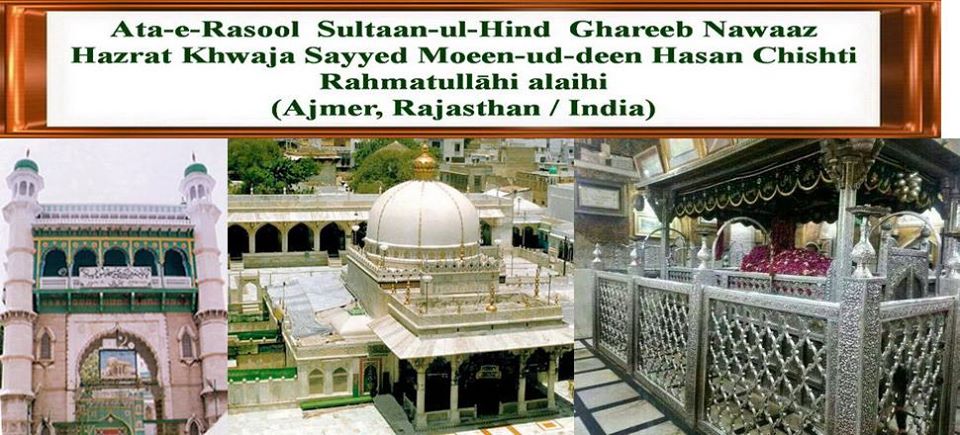
Hazrat Khwaja Sayyed Moeen-ud-deen Hasan Chishti rahmatullāhi alaihi :
♦♦♦♦♦♦♦♦♦♦♦♦♦♦♦♦♦♦♦♦♦♦♦♦♦
Alqaab :
‾‾‾‾‾‾‾‾‾‾‾
Khwaaja Ghareeb Nawaaz, Ata-e-Rasool, Naa’ib-e-Rasool-fil-Hind, Qutb-ul-Mashaa’ikh e Behr o bar, Sultaan-ul-Hind, Hind-al-Wali, Khwaaja e Khwaajgaan, Aaftab e Chishtiya, Daleel-ul-Aarifeen.
********************
Aap ki wilaadat Sajistan (Iran) me 536 Hijri (1141 A.D.) me hui.
Aap ke waalid ka naam Hazrat Khwaja Sayyed Ghayas-ud-deen bin Ahmad Hasan rahmatullāhi alaihi hai (Jo Husaini saadaat hain) aur waalida ka naam Hazrat Bibi Ummal wara Maahe Noor binte Hazrat Sayyed Daawūd rahmatullāhi alaihi hai (Jo Hasani saadaat hain).
Aap ki waalida maajida farmaati hain ke ‘Jab mere bete mere shikam me the tab mere pet se zikre ilāhi ki aawaaz sunai deti thi aur jab mere bete Moeen-ud-deen Hasan ki wilaadat hui to aisa Noor zaahir hua ke mera ghar hi nahi pura mohalla Roshan o munawwar ho gaya.’
*****************
Sajistan par baar baar Taataari hamla karte the. Is liye Aap ke waalidain Sajistan chhodkar Sanjar aa gaye. Tab aap ki umr 2 saal ki thi.
Aap aam bacho ki tarah kabhi khel kood me shareek nahi hue. Bachpan se hi aap Hum-dardi, Sakhaawat aur Husn e aklaaq ka muzaahira karte rahe.
Ek baar Eid ke din aap Eidgaah ki taraf ja rahe the. Raaste me aap ne andhe bache ko phate puraane kapde me dekha. Aap ne apne paas jo ache kapde the wo use pehna diya aur khud ghar jaakar dusre kapde pehne aur us bache ko apne saath eidgaah lekar gaye.
8 saal ki umr me aap ke waalid ka inteqaal hua aur 16 saal ki aap ki waalida ka inteqaal hua.
********************
Aap ne Khurasan me taalim haasil ki.
9 saal ki umr me aap Haafiz e Qur’an hue.
***************************
544 Hijri me Ek baar aap apne phalo ke bagheeche me kaam kar rahe the, tab Hazrat Ibrāheem Qandoozi naam ke ek durwesh waha aae aur baithe. Aap ne un ko apne bageeche me se angoor ka guchha paish kiya aur Unho ne use khaaya aur mehmaan nawaazi se khush hokar apne thaile me kuchh nikala aur use chabakar Khwaja ko khaane ke liye diya. Aap ne khushi ke saath use khaya to un ke fayuzo barkaat se aap ke liye ilm o hikmat ke darwaaze khul gaye. Aur aap ne apna sab kuchh bech diya aur us raqam ko gareebo aur mohtaajo ko khairaat kar diya aur phir aap Samarkand and Bukhara ki taraf ilm e deen sikhne ke liye rawaana ho gaye.
544 se 550 Hijri tak aap waha Hazrat Maulana Hisaam-ud-een aur Hazrat Maulana Sharf-ud-deen ke paas taalim haasil karte rahe.
Aap ne Hadees aur Fiqh ki taalim haasil ki.
551 Hijri (1156 A.D.) me aap ki mulaaqaat Huzoor Ghauṡ e aazam Abdul Qaadir Jeelaani radiy-Allāhu ta’ala anhu se hui.
************************
Aap ek peer e kaamil ki talaash kar rahe the ke Aap ne Khwaja Uṡmaan Haarooni rahmatullāhi alaihi ke baare me suna.
552 Hijri (1128 A.D.) me Aap Hazrat ki baargaah me gaye aur un ke mureed hue. Aur Ibaadat e ilāhi aur Khidmat e murshid karte rahe.
Aap ne 22 saal peer ki khidmat me guzaare.
Khwaja Uṡmaan Haarooni farmaate hain ‘Moeen-ud-deen Mehboob e khuda hai aur mujhe us ki Mureedi par naaz hai.’
************************
Aap Peer o murshid ki sohbat me taaleem haasil karte rahe aur murshid ke har hukm ki taameel karte rahe aur farmaane murshid ke mutaabiq mujaahida karte rahe.
Ek martaba Khwaja Uṡmaan Haarooni ne Aap ko apna kurta diya aur farmaaya ke ‘Ise dhokar laao aur is ke dhovan ka paani aisi jagah par daalna jaha kisi makhlooq ka pair na pade.’ Aap Peer ke kurte ko dhokar sukhaakar laaye aur Peer ko waapas diya to unho ne puchha ke ‘Is ke paani ka kya kiya?’ Aap ne farmaaya ‘Huzoor! Mujhe aisi koi jagah nazar nahi aai jaha kisi makhlooq ka pair na pade. Is liye maine us paani ko pee liya.’ Peer ne khush hokar dua farmai ke ‘Tum ne rahmat e ilāhi ko paa liya hai aur us paani ki barkat se mera ilm tumhe haasil ho gaya hai.’
Ek martaba Aap ke Peer ne Aap ko paani laane ke liye kaha. Aap paani lekar gaye pahunche to peer ne kaha ‘Piyaala patak do.’ Aap ne piyaala patak diya. Peer ne farmaaya ‘Are ye kya kiya itna qeemati piyaala tod daala.’ Aap ne farmaaya ‘Mujh se galti ho gai. Aap is ke liye jo chaahe saza den.’
Khwaja Uṡmaan Haarooni ne aap ko apne qareeb bulaakar apni do ungliya aap ki dono aankho ke bich me rakhi aur phir farmaaya ‘Moeen-ud-deen! neeche dekho, kya dikhta hai?’ Aap ne neeche dekhkar kaha ‘Main tehtussara tak dekh sakta hu.’ Phir peer ne kaha ‘Ab upar dekho, Kya dikhta hai?’ Aap ne upar dekhkar kaha ‘Main arsh e aazam tak dekh sakta hu.’
Peer ne farmaaya ‘Moeen-ud-deen! Tum ban gaye.’ Aap ne farmaaya ‘Huzoor! Agar ban bhi gaya hu to aap hi ka hu.’
Khwaja Uṡmaan Harooni ne khush hokar aap ko khilaafat ata farmai.
***************************
Ek baar aAap ke peer Khwaja Uṡmaan Haarooni rahmatullāhi alaihi ne apne sab mureedo ko jama karke kaha ke ‘Maine tumhe jo ilm sikhaya hai us se kuchh karaamat paish karo.’ Sab mureedo ne baari baari karaamat se alag alag cheez paish ki. Kisi ne sona, kisi ne chaandi, kisi ne hire jawaaharat, kisi ne deenaar o dirham paish kiye. Khwaja Moin-ud-deen ne roti ke tukde pesh kiye. Sab mureed hansane lage.
Itne me darwaaze par ek saa’il ne aawaaz di ke ‘Main kai din se bhuka hu. Mujhe khaane ke liye kuchh de do.’ Sab ne apni apni cheeze us ko dena chaaha. Magar us saa’il ne kaha ke ‘Main is sona -chaandi, heere jawaaharat, deenaro dirham ka kya karun? Mujhe to khane ke liye kuchh do.’
Phir Khwaja ne apne roti ke tukde us ko de diye. Us ne use lekar bahot saari duaen di.
Is ke baad Khwaja Uṡmaan Haarooni ne farmaaya ki ‘Aye Moin-ud-deen! Tum Ghareeb nawaaz ho’.
***************************
555 Hijri me Hazrat Shaikh Ziya-ud-deen Abul Najeeb Abdul Qaahir Suharwardi rahmatullāhi alaihi se mulaaqaat hui.
561 Hijri me Hazrat Daata Ganj Bakhsh rahmatullāhi alaihi ke mazaar par Chilla-kashi ki.
***************************
563 Hijri (1167 A.D.) me Khwaja Uṡmaan Haarooni ne Aap ko khirqa mubarak ata kiya aur apne saath hajj ko lekar gaye.
Ek baar aap Makka shareef me Masjide Haram me ibaadat me mashgool the. Itne me ghaib se aawaaz aai ‘Aye Moeen-ud-deen! Hum ne ise qubool farmaaya.’
Is ke baad jab Madeena shareef pahunche aur Huzoor Sarwar e kaunain sallallāhu alaihi wa sallam ko Salaam pesh kiya ‘Assalatu wassalaamu alayka Ya Rahmatullil aalameen’ to Roza mubarak me se jawaab aaya ‘Wa alaikum assalaam Ya Qutb ul Mashaa’ikh e Bahr o Bar’ (Aur tum par bhi salaamati ho, Aye zameen aur samundar ke buzurgho ke Qutub’).
***************************
581 Hijri (1185 A.D.) me Gail me Huzoor Ghauṡ e aazam radi-Allāhu ta’ala anhu se dobaara mulaqaat hui aur aap un ke saath 57 din tak rahe.
582 Hijri me Isfahaan me Khwaja Qutb-ud-deen Bhakhtiar Kaaki ko mureed banaaya aur 585 Hijri me Samarqand me un ko khilaafat ata farmai.
************************
585 Hijri me aap Khwaja Qutb-ud-deen Bhakhtiar Kaaki rahmatullāhi alaihi ke saath Harmain shareefain gaye.
Aap Makka shareef me Masjid e Haram me ibaadat me mashgool the. Itne me ghaib se aawaaz aai ‘Tera Rab tujh se raazi hai, jo chaaho maang lo.’ Aap ne farmaaya ‘Aye mere Rab! Silsila e chishtiya me daakhil hone waalo ko bakhsh de.’ Phir aawaaz aai ke ‘ Maine tumhari dua qubool farmai hai aur Qayaamat tak ke silsila e chishtiya me daakhil hone waale ummat e Mohammadi ko bakhsh diya hai.’
Is ke baad Madeena shareef me the tab Huzoor Sarkare Madeena Huzoor sallallāhu alaihi wa sallam ne khwaab me tashreef laakar farmaya ke ‘Aye Moeen-ud-deen! Tum deen ke madadgaar ho. Tum ab Hindustan jaao aur waha jaahiliyat ko door karke logo ko deene islaam ka sahi rasta dikhao.’ Aur ek anaar ata farmaaya. Jab Khwaja ne us anaar ko dekha to us me Hindustan ka aur Ajmer ka naqsha dikhaai diya.
*************************
Raaste me bahot saare sufi auliya se faiz haasil karte hue aur hazaaro logo ko apna faiz ata karte aur deen ki sahi raah dikhaate hue aap Hindustan me Lahore me kuchh arse ke liye rooke aur phir waha se 587 hijri (1190 A.D.) me 52 saal ki umr me Rajputana (Rajasthan) ilaaqe ke Ajmer me pahunche. Jaha Prithvi-Raaj Chauhan ki hukoomat thi.
Ek baar Khwaja apne saathiyo ke saath ek darakht ke neeche baithe the. Itne me Raja ke sipaahiyo ne aakar kaha ke ‘Tum sab yaha se khade ho jaao. Ye raja ke oonto ke bethne ki jagah hai.’ Aap ne kaha ke ‘Ye oont dusri koi jagah par bhi baith sakte hain.’ To unho ne kaha ke ‘Nahi, Ye oont roz yahi par baithte hain.’ To aap waha se khade ho gaye aur farmaaya ke ‘Theek hai. Ab ye oont yahi par baithenge.’ Aur aap door chale gaye.
Phir kuchh waqt ke baad sipaahiyo ne oonto ko khade karne ki koshish ki to wo waha se khade na hue. Bahot koshish karne ke baad nakaam hokar wo sab Raaja ke darbaar me haazir he aur saari baaten bayaan ki. To us ne kaha ke ‘Tum us faqeer ke paas jaao aur us se maafi maango.’
Wo sipaahi khwaja ko dhundhte hue waha pahunche aur maafi maangi. Khwaja ne farmaaya ke ‘Jaao, tumhare oont khade ho gaye hain.’ Unho ne waha jaakar dekha to wo oont khade ho gaye the.
************************
Is ke baad aap ne bahot saari karaamat dikhaai.
Jis me Ana saagar ko apne kaanse me sama lena aur Ajaypal Jogi jadoogar ke phenke gaye patthar ko aasmaan me hi rok dena aur us ko musalman banaana mash’hoor hai.
************************
589 Hijri me Ajmer me Shahaab-ud-deen Ghori aap ke mureed bane.
611 Hijri me aap Delhi tashreef le gaye.
***********************
Aap rozaana ek Qur’an majeed mukammal kiya karte the.
************************
Karaamat :
‾‾‾‾‾‾‾‾‾‾‾‾‾‾
(1) Ek baar Aap ne apne khaadim ko paani laane ke liye bheja. Wo jab Ana sagar par pahuncha to waha ke pehredaar ne kaha ‘Yaha ke Raaja ka hukm hai ke tum logo ko paani na diya jaaye. Is liye tumhe paani nahi milega.’ Us ne waapas aakar Khawja ko bataaya. Aap ne use ek kaansa dekar Ana sagar par waapas jaane ke liye kaha aur farmaaya ‘Ana sagar se kehna ke tumhe Khwaja ne bulaaya hai.’ Khaadim ne waisa hi kiya. Aur foran saara paani kaanse me aa gaya aur Ana sagar khaali ho gaya aur saath me pure ilaake me se bhi paani khaali ho gaya.
Tamaam log paani na milne ki wajah se pareshaan ho gaye aur Raaja se fariyaad ki. Raja ne Khwaja ki baargaah me aakar maafi maangi. Aap ne farmaaya ‘Paani to us Rab ta’ala ki ata ki hui ne’amat hai jo saare jahaan ka Maalik hai aur paani insaan, jaanwar aur tamaam makhlooq ke liye hai. Kisi ko paani istemaal karne se rokna galat hai.’
Phir aap ne apne khaadim ko kaanse ka paani ana sagar me waapas daalne ke liye farmaaya. Jab khaadim ne paani waapas daala to ana sagar pehle ki tarah paani se bhar gaya aur pure ilaake sab jagah paani aa gaya.
(2) Ek martaba ek budhi aurat Khwaja ki baargaah me aai aur rote hue bataaya ke ‘Us ke be-gunaah naujawaan bete ko phaansi de di gai hai.’ Aur madad talab karne lagi. Sarkar Ghareeb nawaaz ne apna asaa mubarak haath me liya aur us budhiya ke saath chal pade. Jab phaansi dene ki jagah par pahunche to apne asaa se murde ki taraf ishaara karke farmaya ki ‘Agar tum be-gun-ah ho to ALLĀH ke hukm se zinda ho jaao.’ Foran wo murda ladka zinda ho gaya ur phaansi se utarkar neeche aaya. Aur wo ladka aur us ki maa Ghareeb nawaaz ke qadmo me gir pade. Aap ne dono ko tasalli di aur ghar ki jaanib rawaana kiya.
(3) Ek baar Aap Ana sagar ke paas se guzar rahe the ki aap ne ek aurat ki rone ki aawaaz suni. Puchhne par pata chala ke wo aurat bahot ghareeb thi aur us ki gaaye mar gai thi. Aap us ke saath us gaaye ke paas gaye aur dua ki to wo gaaye zinda ho gai. Ye dekhkar wo aurat aap ke qadmo me gir gai.
(4) Ek baar aap Ana sagar ke kinaare baithe the. Itne me ek charwaaha kuchh gaayen ke saath waha se guzra. Aap ne use doodh dene ke liye kaha. Us ne kaha ‘Ye gaayen kam umr ki hain aur doodh nahi deti.’ Aap ne un me ek gaaye ki taraf ishaara karke us ladke ko us gaaye ka doodh nikaalne ke liye farmaya. Jab us ladke ne us gaaen ko dekha to use ye dekhkar ta’ajjub hua ki wo gaaen ke pistaan doodh se bhar gaye the. Us ne doodh nikalkar Khwaja ko diya. Wo doodh itna tha ki 40 aadamiyo ke liye kaafi ho jaaye. Ye dekhkar wo ladka Khwaja saahib ka mureed ban gaya.
(5) Ek baar Khwaja ki baargaah me ek shakhs haazir hua aur arz ki ‘Ajmer se kuchh faasle par mera ek baagh hai. Jis ke darakht bilkul sukh gaye hain.’ Aap ne foran mitti ke ek lote me paani bharkar diya aur farmaaya ke ‘Is paani ko darakhto ki jado me daal do.’ Baagh ke maalik ne wo paani laakar darakhto ki jado me daal diya. Us paani ki barkat se baagh ke tamaam darakht sar sabz wa shaadaab ho gaye aur phal dene lage.
(6) Ek martaba Ajmer me aap apne mureed Shaikh Ali ke saath raaste se guzar rahe the. Itne me ek shakhs saamne aaya. Jis se Shaikh Ali ne qarz liya tha. Wo Shaikh Ali se apne qarz ki raqam waapas karne ke liye kehne laga. Khwaja ne us shakhs se farmaaya ‘Tum kuchh mohlat aur de do. Jald hi tumhari raqam tumhe mil jaayegi.’ Magar wo nahi maana. Aap ne jalaal me aakar apni chaadar zameen par bichha di. Aur foran us chaadar ke upar sona aur chaandi ka dhair ban gaya. Aap ne us qarz khwaah se farmaaya ‘Is me se jitni tumhari raqam hoti hain utna le lo.’ Jab wo shakhs ne us dhair me se maal lene ke liye haath aage badhaaya to us ke dil me laalach paida hua. Lekin jab wo apni raqam se ziyada maal lene laga to us ne dekha ke wo saara sona aur chaandi gaayab ho gaya aur us ka haath usi haal me reh gaya aur wo apne haath ko hila bhi nahi paaya. Wo foran Khwaja ke qadmo me gir gaya aur raham ki bhik maangne laga. Aap ne use maaf kiya aur us ka haath theek kar diya.
(7) Ek ameer khaatoon ko 7 ladkiya thi. Us ka shohar ladkiyo ki kasrat ki wajah se naraaz tha aur us ne dusri shaadi karne ka iraada kiya. Is dauraan wo aurat haamila hui. Wo Khwaja ki baargaah me haazir hui aur dua ke liye ilteja ki. Sarkaar Khwaja Ghareeb nawaaz ne farmaaya ‘Jaa, Tera maqsad pura hoga.’
Kuchh mahine baad ALLĀH ke fazl se us ke batan se nihaayat hi khoobsurat ladka paida hua.
(8) Ek baar aap ke Khalifa Khwaja Qutb-ud-deen Bakhtiar Kaaki rahmatullāhi alaihi Sultaan Shams-ud-deen Altamash aur us ke sipaahiyo ke saath Delhi me raaste se guzar rahe the. Itne me ek aurat saamne aai aur Khwaja Qutb-ud-deen Bakhtiar Kaaki par iljaam lagaaya ki ‘Mere pait me Khwaja Qutb-ud-deen Bakhtiar Kaaki ka bacha hai aur un se mera nikaah karaaya jaaye.’ Sultaan aur waha maujood tamaam log hairaan ho gaye. Khwaja Qutb-ud-deen Bakhtiar Kaaki ne apne Peer se madad ke liye Ajmer ki jaanib dekha aur foran Khwaja Ghareeb nawaaz waha haazir ho gaye. Aap ko dekhkar Khwaja Qutb-ud-deen Bakhtiar Kaaki ki aankho me aansoo aa gaye.
Khwaja ne us aurat ki taraf dekhkar kaha ‘Aye bache, Teri maa Khwaja Qutub-ud-deen par iljaam laga rahi hai. Tu hi pait me se bata ki ye baat sach hai ya nahi?’ Us aurat ke pait me se bache ne jawaab diya ‘Huzoor ye aurat jhut bol rahi hai. Khwaja Qutb-ud-deen Bakhtiar Kaaki ke dushman is aurat ke zariye un ko zaleel karna chaahte the.’
Ye sunkar us aurat ne apna gunaah qubool kar liya.
Phir aap waha se gaayab ho gaye. Khwaja Qutb-ud-deen Bakhtiar Kaaki ke ilaawa kisi ko aap ke tashreef laane ka aur foran rukhsat hone ka raaz samajh me nahi aaya.
(9) Ek baar aap ke ek mureed ne Khwaja ki baargaah me haazir hokar arz kiya ‘Shaher ke governor ne kisi wajah se shaher chhodkar chale jaane ki saza di hai.’ Aap ne farmaaya ‘Apne ghar waapas jaao. ALLĀH ta’ala ne us governor ko saza de di hai.’
Wo mureed jab apne ghar waapas pahuncha to pata chala ki wo governor ghode par se gir gaya aur mar gaya.
*****************
Aap har saal ayyaam e Hajj ke dauraan Ajmer me hi maujood rehte the. Magar Hajj ke liye jaane waale log us waqt aap ko Makka shareef me aur Hajj ke maqaamaat par haazir dekhte.
*****************
Aap ki khaanqah me Langar chalaaya jaata tha. Jis me roz hazaaro logo ko khaana khilaaya jaata tha. Magar aap kabhi kisi se koi madad nahi lete the.
*****************
Aap 7wi sadi ke Mujaddid e Islaam hain.
Aap ne apne Faiz, Taaleem aur Karaamat aur Husn e akhlaaq se Hinadustan me Islaam ki bunyaad mazboot ki aur bulandi aur waqaar ata farmaaya.
Aap ne 90 laakh logo ko Islaam me daakhil kiya.
Beshumaar logo ne hidaayat paai aur Aap ki baargaah me tauba karke sahi raah apnaai.
*****************
Tasannif :
‾‾‾‾‾‾‾‾‾‾‾‾
Aap ki likhi hui mash’hoor kitaaben :
(1) Anees-ul-Arwaah
(2) Hadeeṡ-ul-Ma’arif
(3) Risaala Maujoodia
(5) Kanj-ul-Israar
(6) Kashf-ul-Israar
(7) Afaaq-o-Anfaas.
♦ Aap ki taaleemaat aur dars wa naseehat ko jama karke Khwaja Qutb-ud-deen Bakhtiar Kaaki ne ek kitaab likhi hai jo ‘Daleel-ul-Aarifeen’ naam se mash’hoor hai.
***********************
Aqwaal :
‾‾‾‾‾‾‾‾‾‾‾
Aap farmaate hain :
(1) Haqeeqi aashiq ke dil me ishq ki aag is tarah jalti rehti hai ke jis me khwaahishat lakdiyo ki tarah jalkar khaak ban jaati hain.
(2) Kuchh achha karke kisi ka dil jitna ye bahot achhi baat hai magar apne nafs ko jitna ye us se bhi achhi baat hai.
(3) Asl Roza tamaam dunyaawi khwaahishat se parhez karna hai.
(4) Nek logo ki sohbat me rehna ye neki karne se bhi afzal hai. Aur gunaahgaaro ki sohbat me rehna ye gunaah karne se bhi badtar hai.
(5) Kisi ka dil na dukhaao,
Ho sakta hai ki wo aansoo tumhari saza ban jaaye.
Dukhiyo ki madad karna aur un ki fariyaad sunna afzal Ibaadat hai.
(6) Jhuti Qasam khaane se ghar me se Barkat chali jaati hai.
Hamesha sach baat kaha karo.
(7) Apne dil ko Adaawat aur Nafrat ke jazbe se paak rakho.
(8) Beshak jab log kisi Khilaaf e Shariat baat ko dekhe aur us ko na roke to anqareeb ALLĀH un sab par apna azaab e aam bhej dega.
(9) Aalim e deen ki Ziyarat aur Durwesho ki Dosti nuzool e Barkat ka sabab hoti hai.
***********************
Pariwaar :
‾‾‾‾‾‾‾‾‾‾‾‾
Aap ki 2 biwiya hain aur 3 saahabzaade aur 1 saahabzaadi hain.
Bibi Ummatullāh (Nikaah 590 Hijri) se 2 bete aur 1 beti :
(1) Khwaja Fakhr-ud-deen Abul Khair rahmatullāhi alaihi (Sajjaada nasheen) (Sarwar)
(2) Khwaja Hisaam-ud-deen rahmatullāhi alaihi
(3) Bibi Hafeeza Jamaal rahmatullāhi alaihi (Jin ka nikaah Shaikh Razi-ud-deen bin Khwaja Hameed-ud-deen Nagori se hua).
Bibi Asmatullāh binte Sayyed Wajih-ud-deen Mash’hadi (Nikah 620 Hijri) se 1 beta :
Hazrat Khwaja Zia-ud-deen Abu Saeed rahmatullāhi alaihi (Ajmer).
************************
Aap Hazrat Khwaja Uṡmaan Haarooni rahmatullāhi alaihi ke mureed aur khalifa hain.
Aap se Hindustan me Chishtiya silsila jaari hai.
Aap ke bahot saare mureedo ne Hindustan me deen e Islaam ki isha’at ka kaam jaari rakha.
Aap ke khulfa :
(1) Hazrat Khwaja Qutb-ud-deen Bakhtiar Kaaki rahmatullāhi alaihi (Delhi);
(2) Hazrat Khwaja Soofi Hameed-ud-deen Naagori rahmatullāhi alaihi (Nagor, Rajasthan);
(3) Hazrat Khwaja Fakhr-ud-deen Chishti rahmatullāhi alaihi (Sarwar, Rajasthan);
(4) Hazrat Khwaja Taaj-ud-deen Delhawi rahmatullāhi alaihi;
(5) Hazrat Shaikh Shams-ud-deen Faqari rahmatullāhi alaihi.
In ke ilaawa Aap ke silsile (khalifa ke khalifa) me bahot saare Auliya Allāh mash’hoor hain :
Hazrat Khwaja Fareed-ud-deen Mas’ood Ganje-shakar rahmatullāhi alaihi (Pak Pattan),
Hazrat Khwaja Khizr Roomi rahmatullahi alaihi,
Hazrat Khwaja Ala-ud-deen Ali Ahmad Saabir Kaliyari rahmatullāhi alaihi,
Hazrat Khwaja Nizaam-udd-een Auliya rahmatullāhi alaihi (Delhi),
Hazrat Khwaja Shaikh Jamaal-ud-deen Ahmad rahmatullāhi alaihi
Hazrat Khwaja Shams-ud-deen Turk Panipati rahmatullahi alaihi,
Hazrat Shaah Jalaal-ud-deen Mahmood Kabeer ul Auliya rahmatullāhi alaihi,
Hazrat Makhdoom Shaikh Ahmad Abdul Haq Rudaulwi rahmatullāhi alaihi
Hazrat Khwaja Abdul Quddoos Gangohi rahmatullahi alaihi,
Hazrat Haaji Imdaadullāh Muhaajir Makki rahmatullāhi alaihi,
Hazrat Sayyed Muhammad Jahaangir Shaah Kambal posh rahmatullāhi alaihi,
Hazrat Yamin-ud-deen Ameer Khusro rahmatullāhi alaihi (Delhi), Hazrat Khwaja Nasir-ud-deen Chiraagh e Delhi rahmatullāhi alaihi (Delhi), Hazrat Maulana Wajeeh-ud-deen Yousuf rahmatullāhi alaihi, Hazrat Shams-ud-deen Yahyā rahmatullaāhi alaihi, Hazrat Ala-ud-deen Neeli rahmatullāhi alaihi, Hazrat Khwaja Abu Bakr Chishti rahmatullāhi alaihi, Hazrat Fakhr-ud-deen Zaraadi rahmatullāhi alaihi, Hazrat Khwaja Ahmad Hankori rahmatullaāhi alaihi (Ahmedabad), Hazrat Baarakullāh Chishti rahmatullāhi alaihi (Ahmedabad), Hazrat Husaam-ud-deen Multani rahmatullāhi alaihi (Patan [Gujarat]), Hazrat Sayyed Hasan Khateeb Urfe Shaah Baaba rahmatullāhi alaihi (Dholka [Gujarat]), Hazrat Shaah Wilaayat rahmatullaāhi alaihi (Gujarat), Hazrat Shaah Muntajeeb-ud-deen Zar Zari Zar Bakhsh rahmatullāhi alaihi, Hazrat Burhan-ud-deen Ghareeb (Khuldabad [Maharashtra]), Hazrat Jalaal-ud-deen Bhandari (Fatehabad [Maharashtra]), Hazrat Sayyed Ahmad Badepaa (Lancer [Hyderabad]), Hazrat Shaikh Muhammad rahmatullaāhi alaihi (Manikpur), Hazrat Shaikh Kamaal-ud-deen (Malwa), Hazrat Siraaj-ud-deen Akhi Siraaj Aa’ina-e-Hind rahmatullāhi alaihi (Gaur [West Bengal]), Hazrat Nizaam-ud-deen Maghribi rahmatullāhi alaihi (Bihar), Hazrat Shaikh Sharaf-ud-deen Bu Ali Shaah Qalandar rahmatullāhi alaihi (Panipat [Haryana]), Sayyed Mahmood Kashkinakar rahmatullāhi alaihi, Hazrat Khwaja Mohiy-ud-deen Kashani rahmatullāhi alaihi,
Hazrat Shaikh Ala-ul-Haq Pandawi rahmatullāhi alaihi, Hazrat Shaikh Noor-ul-Haq Noor Qutb-e-aalam rahmatullāhi alaihi, Hazrat Auhad-ud-deen Makhdoom Ashraf Simnani rahmatullāhi alaihi (Kichauchha), Hazrat Sayyed Abdur Razzaaq Noor-ul-ain rahmatullāhi alaihi,
Hazrat Ata Husain Faani rahmatullāhi alaihi.
Hazrat Muhammad Husain Gesudaraaz Banda-nawaaz rahmatullāhi alaihi (Gulbarga [Karnataka]), Sayyed Shaah Jamaalullāh Maghribi Husaini Hazrat Maulana Ala-ud-deen Gwaliori;
Hazrat Khwaja Sayyed Kamaal-ud-deen Allama, Khwaja Siraaj-ud-deen aur Khwaja Muhammad Ilm-ud-deen (Piran Patan, Gujarat), Khwaja Mahmood Raajan, Khwaja Jamaal-ud-deen Jumman, aur Hazrat Khwaja Abu Saalih Hasan Muhammad (Ahmedabad), Hazrat Khwaja Shams-ud-deen Muhammad, Hazrat Khwaja Yahyā Madani, Hazrat Khwaja Kaleemullāh Jahanabadi (Shah Jahanabad), Hazrat Nizaam-ud-deen Aurangabadi, Hazrat Khwaja Fakhr-ud-deen Muhammad Fakhr-e-Jahaan Dehalwi, Hazrat Noor Muhammad Maharvi, Hazrat Shams-ud-deen Muhammad Sialwi, Hazrat Khwaja Haafiz Muhammad Ali Shaah Khairabadi, Hazrat Khwaja Sayyed Haafiz Bahaadur Ali Shaah urfe Daada Miyan Sarkaar (Jabalpur), Hazrat Khwaja Haaji Najm-ud-deen Muhammad Sulaimāni, Hazrat Khwaja Habeeb Ali Shaah, Hazrat Shaah Ghulaam Muhammad Soofi (Durban / South Africa), Hazrat Khwaja Peer Meher Ali Shaah Golrawi; Hazrat Ghulaam Qutb-ud-deen, Hazrat Sufi Inaayat Khan; Hazrat Shaah Niyaaz Ahmad Bareilwi rahmatullāhi alaihi, Hazrat Nizaam-ud-deen Husain, Hazrat Shaah Muhammad Fakhr-e-Alam Niyaazi;
Hazrat Shaikh Ibrāheem Fareed e saani, Hazrat Shaikh Saleem Chishti, Shaikh Husain Ahmad Chishti;
Hazrat Makhdoom Shaah Meena, Hazrat Makhdoom Shaikh Sa’ad-ud-deen Khairabadi, Hazrat Makhdoom Shaah Safi Abdus Samad,
Hazrat Zain-ud-deen Shirazi (Khuldabad);
Hazrat Mirza Agha Muhammad, Hazrat Muhammad Meera Husaini, Hazrat Hisaam-ud-deen Mankpuri.
Hazrat Khwaja Faiz Mohmmad Chishti Shah-Jamali, Hazrat Khwaja Ghulaam Yāseen Chishti Shah-Jamali;
**********************
Wisaal se pehle aap apne hujre me Tilaawat e Qur’an karte rahe.
Aap ka wisaal 6 Rajab 633 Hijri (16 March 1236 A.D.) ko Peer ke din 97 saal ki umr me hua.
Aap ki namaaz e janaaza Khwaza Fakhr-ud-deen Chishti rahmatullāhi alaihi ne padhai.
Aap ko aap ka mazaar Ajmer (Rajasthan) me hai.
***********************
Wisaal ke baad bhi aap ka faiz aur karaamat jari hai.
Aap ke mazaar par haazir hone walo aur aap ke waseele se dua maangne walo ko
ALLĀH ta’ala har nek jaaiz muraad ata farmaata hai.
Jis me ye qissa bahot mash’hoor hai.
Ek baar Baadshaah Aurangzeb rahmatullāhi alaihi Khwaja Ghareeb nawaaz rahmatullāhi alaihi ke mazaar ki ziyarat ke liye Ajmer gaye.
Aap jab khwaja ke mazaar par pahunche to waha ek andha shakhs baithkar ilteja kar raha tha.
Aap ne puchha ke ‘Aye shakhs kya muamala hai?’ Us shakhs ne kaha ke ‘Main bahot arse se Khwaja ke waseele se dua kar raha hu ke mujhe aankho ki roshni mil jaaye. Lekin koi faa’ida nahi hua.’
Aap ne us se kaha ke ‘Main mazaar me salaam karke aata hu, agar tujhe aankh ki roshni nahi mili to talwaar se teri gardan alag kar daalunga.’
Wo andha shakhs pareshaan ho gaya ke ab to aankh ke saath jaan par baat aa gai hai. Wo aur zor se Khwaja ke waseele se dua maangne laga aur istegaasah karne laga.
Jab Aurangzeb ne Khwaja ko salaam kiya to us ka jawaab na mila, dobaara salaam kiya to jawaab na mila, phir jab teesri bar salaam kiya to aahista se jawaab mila ‘Wa alaikum assalaam Ya Aalamgeer Hujjati’.
Phir Khwaja ne mazaar me se farmaaya ke ‘Aye Aurangzeb, Aa’inda kabhi aisi zeed mat karna. Tumhari zeed ki wajah se us andhe shakhs ki aankho ki roshni laane ke liye main arsh e ilāhi par gaya tha. Aur is liye salaam ka jawaab dene me thodi der ho gai.’
************************
ALLĀH ta’ala us ke Habeeb sallallāhu alaihi wa sallam ke sadqe me
Aur Hazrat Khwaja Ghareeb nawaaz rahmtullāhi alaihi aur Ahle bait aur Auliya Allāh ke waseele se
Sab ko mukammal ishq e Rasool ata farmae aur sab ke Eiman ki hifaazat farmae aur sab ko nek amal karne ki taufiq ata farmae.
Aur sab ko dunya wa aakhirat me kaamyaabi ata farmae aur sab ki nek jaa’iz muraado ko puri farmae.
Aameen.
 Aal-e-Qutub Aal-e-Syed Abdullah Shah Ghazi