



Allah said in Soorah al-Anbiya after the story of Ayyub (Job):
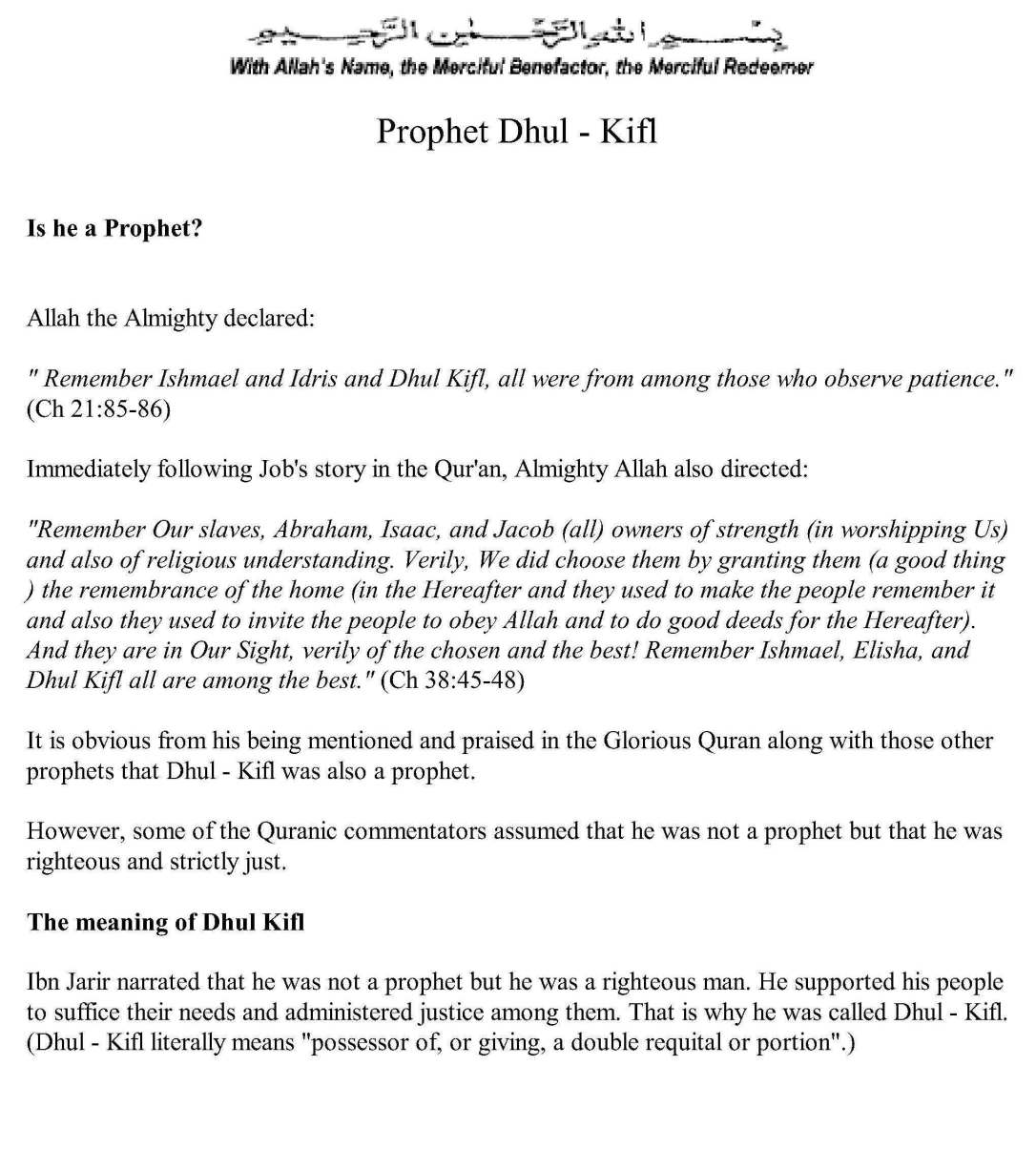
“And Ismateel, Idris, and Dhul Kifl, all of them were among the patient ones. And we admitted them to Our mercy, verily they were among the righteous.” (Qur’an 21:85-86)
And in Soorah Sid after the story of Ayyub:
“And mention Our slaves Ibraheem, Ishag, and Ya’qoob, they all were owners of strength and of righteous understanding. Verily, We did choose them by granting them [a good thing], the remembrance of the home [in the Hereafter]. And they are with Us, verily of the chosen and the best. And remember Isma’eel, Alyasa, and Dhul Kifl, all are among the best.”
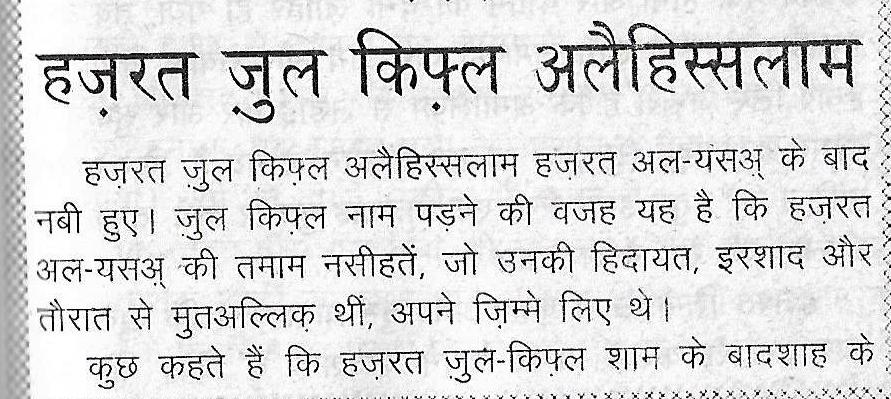
The fact that he is praised in the verses mentioned above and that his name came alongside the names of other great Prophets shows that he too was a Prophet. May the blessings and peace of Allah be upon him. This is the popular opinion among the scholars.
Some others, however, claim that he was not a Prophet, he was rather only a pious, just and wise man. Ibn Jareer did not give his opinion on this issue. And Allah knows best.
Ibn Jareer and Abu Nujayh reported from Mujahid that he was not a Prophet, he was rather a pious man. He had volunteered to be the people’s guide and judge between them with justice. This was the reason that he was called by the name Dhul Kifl.
Ibn Jareer and Ibn Abi Hatim reported from Mujahid that: successor. Iblees thereafter ordered his fellow devils saying, ‘Go after that man.’ However, the devils were unable to mislead him. So Iblees then said to them, ‘Leave him to me.’ He then came to him in the guise of a poor old man at the time of siesta. He used not to sleep in the day or at night except that particular occasion. So Iblees knocked at his door and the man asked, ‘Who is at the door?’ (Iblees replied, ‘An oppressed old man.’ So he got up and when he opened the door, Iblees started telling him a story, saying, ‘There is a problem between me and my people, for verily they have wronged me and did with me what they did.’ He intentionally prolonged his story so much that the time for siesta passed and afternoon approached. The man said, ‘When I do, I will take your rights.’ Then he went to his work-place and searched for that old man but could not find him. On the next day, when he was judging between people in their matters, he waited for him but he again could not see him. Then again when it was time for siesta, he went home and just when he was about to sleep, the same man turned up and knocked the door. He asked, ‘Who is at the door?’ The man replied, ‘The oppressed old man.’ He opened the door and said, ‘Did I not tell you that when I go to my court to judge that you should come to me?’ The old man said, ‘My people are the worst. When they came to know that you are sitting in the court to judge between us, they said to me, ‘We will give your rights. But then when you left, they again started refusing to give me my rights.” He said, ‘Go now and when I am in my court, come to me.’
So he was again unable to have his siesta. He then went to his court and waited for the old man but he did not turn up again. He felt very drowsy and so said to one of his household, ‘Do not let anyone come to this door so I can get some sleep because I am feeling very sleepy.’ Then when that time of the day came, the old man came. The watchman at the door said to him, ‘Go back, go back.’ The old man said, ‘I came to him yesterday and informed him of my story.’ The man at the door replied, ‘By Allah we have been ordered not to let anyone come close.’ Then when he felt that he could not get past the watchman, he looked up and found that there was an opening from which he could get inside the house. Thus he did that and then knocked the door from inside, waking the man up. He said to the watchman, ‘Did I not tell you not to let anyone in?’ The watchman replied, ‘He did not enter the house from where I was watching, so ask him where he got in.’ He then recognised the old man, who was inside by that time. He asked him, ‘Are you an enemy of Allah?’ He replied, ‘Yes and you outwitted me in everything, so I did this to make you angry.’ Thus Allah named him Dhul Kifl because he took responsibility of something and then fulfilled it.”
Ibn Abi Hatim reported that Abu Moosa al-Ash’ari said while standing on the minbar. “Dhul Kifl was not a Prophet. Rather he was a pious man who prayed one hundred prayers every day. After that he took it up as his duty to pray one hundred prayers daily and thus he was named Dhul Kifl.”
Dhu al-Kifl: A Prophet or a Saint?
By Mufti Muhammad Shafi Usmani

“And (remember) Isma’il and Idris and Dhul-Kifl. Each one of them was of those who observed patience. And We admitted them to Our mercy. Surely, they were of the righteous.” (Qur’an, 21:85-86)
Was Sayyiduna Dhu al-Kifl a Prophet or a Saint
Three persons are mentioned in the above two verses. Out of these three, there is no doubt about the prophethood of Sayyiduna Isma’il `alayhi al-salam and Sayyiduna Idris `alayhi al-salam as they are mentioned in the Qur’an as such several times. Ibn Kathir is of the opinion that the mention of the name of Sayyiduna Dhul-Kifl along with the other two prophets in the above verse shows that he too was a prophet. However, some other versions do not include him in the category of prophets. They say that he was a saint or a pious person.
Dhu al-Kifl’s Strange Story
Imam of Tafsir Ibn Jarir, may Allah have mercy upon him, has reported on the authority of Mujahid, may Allah have mercy upon him, that [when] Sayyiduna Yas`a `alayhi al-salam (who is referred to as a prophet in the Holy Qur’an) became old and weak, he thought of appointing some one who could perform the duties of a prophet on his behalf during his life time. He assembled all his companions for this purpose and told them of his desire to appoint someone who would act as his deputy but who must fulfill three conditions, namely that he should fast all the year round, should spend the nights in prayers, and does not ever lose his temper. A relatively unknown person who was held in contempt by the people, stood up and offered himself for the job. Sayyiduna Yas`a `alayhi al-salam asked him whether he fasted all year round, spent his nights in prayers, and never lost his temper. The man replied in the affirmative and confirmed that he fulfilled all three conditions. Perhaps Sayyiduna Yas`a `alayhi al-salam did not believe his claim and rejected him.
After a few days Sayyiduna Yas`a `alayhi al-salam reconvened the meeting and repeated his conditions and asked his companions if any of them met the requirements. Everyone remained seated but the same man stood up again and claimed that he fulfilled the three conditions. Then Yas`a `alayhi al-salamappointed him his deputy. When Satan realized that Sayyiduna Dhul-Kifl had been selected as a deputy to Yas`a `alayhi al-salam, he asked all his aides to go to Sayyiduna Dhul-Kifl and inveigle him into doing something which would result in his removal from the post of deputy. All his aides excused themselves and said that he was beyond their power to harm. The Satan (Iblis) then said, “Alright, leave him to me. I will take care of him.”
Sayyiduna Dhul-Kifl, true to his claim, used to fast during the day and pray the whole night and had a little nap in the afternoon. Satan went to him just when he was about to take his afternoon nap and knocked at the door. He got up and inquired who was there. The Satan replied, “I am an old tortured man.”
So he opened the door and let him in. The Satan came in and started a yarn about the cruelty and injustice which he suffered at the hands of his community and relatives. He stretched the story so long that no time was left for Sayyiduna Dhul-Kifl to take his usual nap. So he told the old man (Satan) that he should come to him at the time when he came out, and he would cause justice to be done to him.
Later on Sayyiduna Dhul-Kifl sat in his court and waited for the old man but he did not turn up. Next morning he again waited for the old man in his court but again he did not come. Then in the afternoon, when he was about to have his nap, the old man came and started beating at the door. He inquired who he was, and the Satan replied again – “an old tortured man,” so he opened the door and asked him, “Didn’t I tell you to come to my court yesterday, but you failed to appear, nor did you come this morning?”
To this the Satan answered, “Sir, my enemies are very wicked people; when they learnt that you were sitting in your court and would force them to give back to me what was my due, they agreed to settle the matter out of court. But as soon as you left your court, they went back on their promise.”
Sayyidna Dhul-Kifl asked him again to come to his court when he was there. All this conversation continued for such a long time that he could not have his usual nap on that day also. He then went to the court and waited for the old man, who again did not turn up. The next day again he waited for him until late in the noon but to no avail. When he returned home on that day, he was very sleepy because of lack of sleep for the last two days. Therefore, he asked the family members not to allow anyone to knock at the door. The old man came again and wanted to knock at the door but the family members stopped him, so he entered the house through a ventilator, and started knocking at the door of his room. Sayyiduna Dhul-Kifl got up again and saw that the old man had come inside the house while the door was still closed. So he asked him as to how he had entered the house.
Then suddenly he became aware that the man standing before him was Satan and asked him, “Are you the God’s enemy: Iblis?”
He admitted that he was Satan and remarked, “You have thwarted all my plans and frustrated all my efforts to entice you in my design. My intention was to make you angry somehow, so that one of your claims before Yas`a could be proved false.”
It was because of this episode that he was given the title Dhul-Kifl, which means a person who is true to his covenant and performs his duties faithfully, and this title was fully deserved by him. (Ibn Kathir)
Al-Kifl or Dhu al-Kifl?
Another narrative is quoted in Musnad of Ahmad but has the name of the person Al-Kifl instead of Dhul-Kifl. That is why Ibn Kathir has observed after quoting this narrative that he was a different person and not Dhul-Kifl, who is mentioned in this verse.
The narrative is as follows:
Sayyiduna ‘Abdullah Ibn ‘Umar radiyallahu `anhu has reported that he had heard a Hadith from the Holy Prophet sallallahu `alayhi wa sallam not once, but more than seven times that there was a man by the name Kifl among the Bani Isra’il who did not abstain from any type of sin. Once a woman came to him and he persuaded her to have sexual intercourse with him on payment of sixty guineas. When he got down to start the intercourse, the woman started crying and trembling. So he inquired from her as to what the matter was because he had not used any kind of force on her. The woman replied that the cause of her distress was that she had never in all her life committed adultery and that it was only her adverse circumstances which had forced her to agree to the act. Hearing this the man got up and told her to go away and keep the money he had given her. He also promised her that he would never again indulge in any sin. Then it so happened that he died the same night and in the morning it was seen that there was a hidden writing on his door that Kifl had been pardoned by Allah: غفرالله للكفل.
Ibn Kathir observed, after quoting this from Musnad of Ahmad, that none of the six authentic books on Hadith has reported this tradition and its authority is weak. Even if the tradition is true, it mentioned the name as Kifl and not Dhul-Kifl, which means he was some other person. (Allah knows best)
The sum and substance of this story is that Dhul-Kifl was the deputy of Prophet Yas`a `alayhi al-salam and it is possible that because of his virtuous deeds his name has been mentioned along with prophets. It is also possible that initially he was the deputy of Sayyidna Yas`a `alayhi al-salam and later on he was elevated to the status of a prophet by Allah Ta’ala.
 Aal-e-Qutub Aal-e-Syed Abdullah Shah Ghazi