


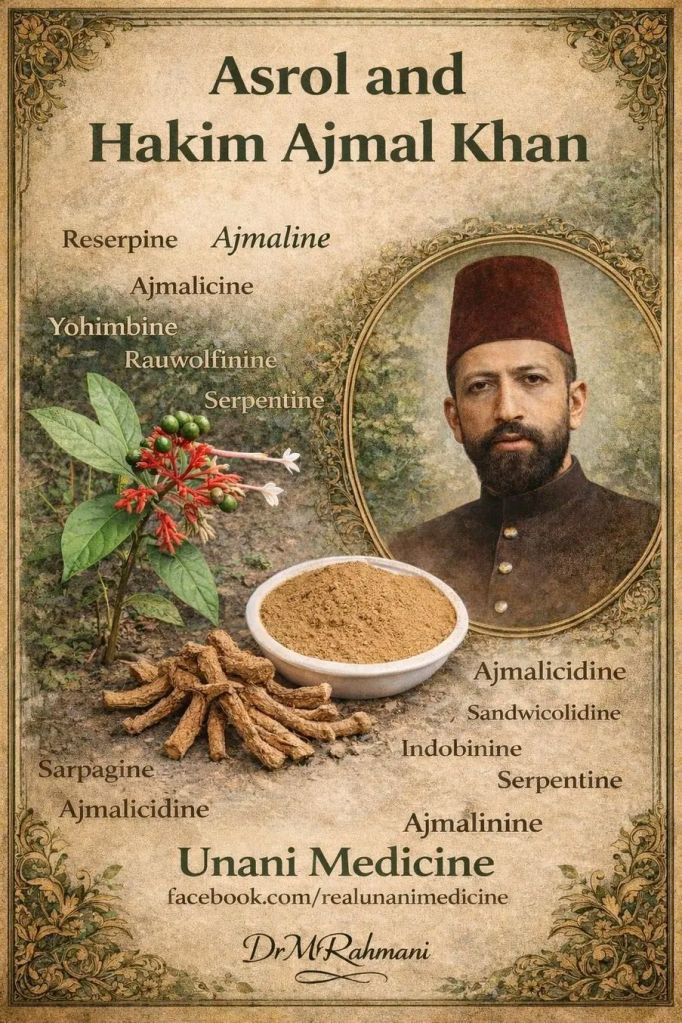
Contribution of Hakim Ajmal Khan to Alkaloid Research on Asrol-
(#unaniday2026 special)
Historical and Scientific Role-
Hakim Ajmal Khan played a pivotal role in bridging traditional Unani medicine and modern scientific research in India. Although he was not a laboratory chemist himself, his visionary leadership laid the foundation for systematic scientific investigation of Unani drugs, including Rauwolfia serpentina (Asrol).
Hakim Ajmal Khan strongly advocated for the chemical and pharmacological validation of traditional medicines. During the early 20th century, he actively encouraged young Indian scientists to investigate medicinal plants used in Unani and Ayurveda using modern scientific methods.
Association with Dr. Salimuzzaman Siddiqui-
One of the most significant outcomes of Hakim Ajmal Khan’s vision was his association with Salimuzzaman Siddiqui, a pioneering organic chemist.
Under the intellectual patronage and encouragement of Hakim Ajmal Khan, Dr. Salimuzzaman Siddiqui conducted extensive chemical research on Rauwolfia serpentina. In 1931, he successfully isolated an important indole alkaloid from Asrol and named it Ajmaline, in honour of Hakim Ajmal Khan.
This act was not merely symbolic; it acknowledged Hakim Ajmal Khan’s decisive role in Promoting scientific research on indigenous drugs.
Creating an academic environment for Unani–modern medicine integration
Supporting young scientists working on medicinal plants
Scientific Importance of Ajmaline
Ajmaline later gained international recognition as:
A potent antiarrhythmic agent.
A valuable drug in cardiac electrophysiology.
A diagnostic tool in Brugada syndrome.

 Aal-e-Qutub Aal-e-Syed Abdullah Shah Ghazi