

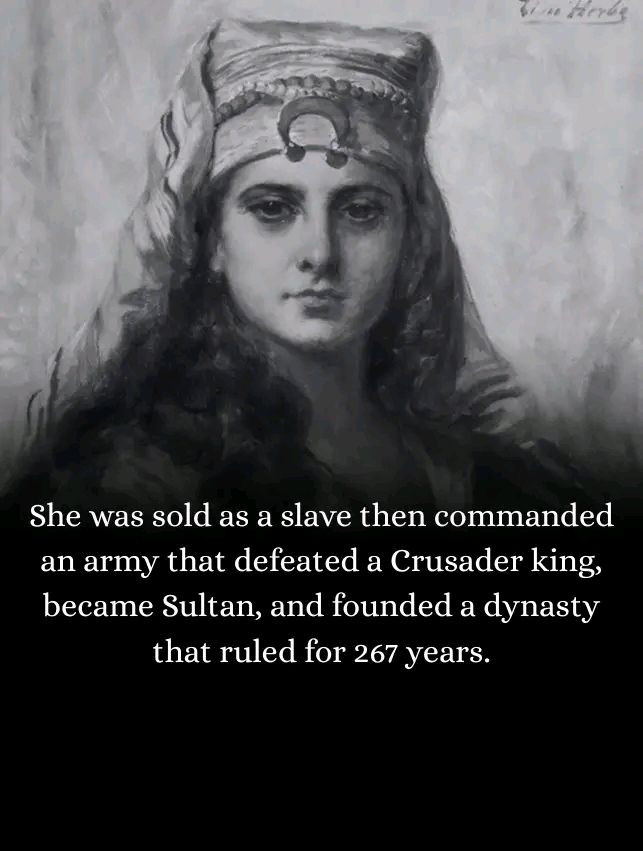
She was sold as a slave—then commanded an army that defeated a Crusader king, became Sultan, and founded a dynasty that ruled for 267 years. December 1249. Mansourah, Egypt.The most powerful king in Europe—Louis IX of France, leading the Seventh Crusade—has invaded Egypt with a massive Crusader army. They’ve captured the port city of Damietta. They’re camped near Mansourah, preparing to march on Cairo. The Egyptian Sultan, al-Salih Ayyub, is dying. Tuberculosis is killing him slowly, and everyone knows it. The Crusaders know it. They’re waiting for him to die so the Egyptian leadership will collapse into chaos. What they don’t know is that when the Sultan dies, someone extraordinary will take his place. Her name is Shajar al-Durr. “Tree of Pearls.” And she’s about to do something almost no woman in medieval history ever did: command an army in a major battle against a European king—and win. But to understand how a woman came to command armies in 13th-century Egypt, you have to understand where she came from. Shajar al-Durr was born in the early 1200s, likely in the Turkic regions of Central Asia. Her early life is mostly unknown, but here’s what we know for certain: she was enslaved and sold in Egypt. In the medieval Islamic world, slavery was different from the chattel slavery of the Americas. Slaves could rise to positions of power, especially if they had intelligence, beauty, or skills. The Mamluks—who would eventually rule Egypt—were originally slave soldiers who became the military elite. Shajar was exceptionally intelligent, politically savvy, and strikingly beautiful. She caught the attention of al-Salih Ayyub, who would become the last Ayyubid Sultan of Egypt. Al-Salih Ayyub freed her and married her. But Shajar wasn’t content to be a decorative wife sitting in a harem. She involved herself in state affairs. She advised her husband on military and political matters. She became his most trusted confidant. When al-Salih Ayyub became Sultan in 1240, Shajar effectively became his co-ruler, though she held no official title. Then, in 1249, disaster strikes. King Louis IX of France launches the Seventh Crusade—not against Jerusalem, but against Egypt. Louis believes that if he can conquer Egypt, he can use it as a base to retake the Holy Land. In June 1249, the Crusader army lands in Egypt and quickly captures Damietta. It’s a catastrophic loss for Egypt. And Sultan al-Salih Ayyub, already gravely ill with tuberculosis, is in no condition to lead the defense. In November 1249, while the Crusader army is marching toward Cairo, al-Salih Ayyub dies. This should be the moment Egypt collapses. Medieval armies without a leader typically fell apart. Succession crises could paralyze kingdoms for months. The Crusaders are expecting exactly this. Instead, Shajar al-Durr makes a decision that will change history. She conceals her husband’s death. She announces that the Sultan is ill and recovering. She signs orders in his name. She maintains the fiction that he’s still alive and commanding the army. No one outside the inner circle knows he’s dead. Meanwhile, Shajar takes actual command. She organizes the Egyptian forces. She coordinates with the Mamluk military commanders. She prepares the defense of Mansourah. And she sends urgent word to her husband’s son and heir, Turanshah, who’s in Syria, to return immediately. By February 1250, the Crusader army reaches Mansourah. King Louis IX believes he’s facing a demoralized Egyptian force led by a dying or dead sultan. He expects an easy victory. Instead, he walks into a trap. On February 8, 1250, the Battle of Mansourah begins. The Crusaders initially push into the city, but the Egyptian forces—commanded by the Mamluks under Shajar’s strategic direction—counterattack with devastating effectiveness. The battle becomes a slaughter. The Crusaders are surrounded, cut off, overwhelmed. The elite French cavalry is decimated. Thousands of Crusaders are killed. And King Louis IX of France—the man who thought he would conquer Egypt—is captured. One of the most powerful monarchs in Europe becomes a prisoner of an Egyptian army secretly commanded by a woman who’d been born a slave. After the victory, Shajar finally reveals that her husband is dead. Turanshah arrives and is proclaimed Sultan. The crisis is over. Egypt has defeated the Seventh Crusade. You’d think Shajar would fade into the background now. That’s what women were supposed to do—help in crisis, then step aside when men took over. Shajar al-Durr had other plans. Turanshah proves to be an incompetent, paranoid ruler. Within months, the Mamluk commanders—the men who actually won the Battle of Mansourah—have had enough. In May 1250, they assassinate Turanshah. Then they do something unprecedented in Islamic history: they proclaim Shajar al-Durr as Sultan of Egypt. Not regent. Not queen consort. Sultan. The actual, official ruler of Egypt. She has coins minted with her name. Her name is recited in Friday prayers at mosques—the ultimate sign of sovereignty in the Islamic world. She signs state documents as Sultan. For 80 days, Shajar al-Durr is the first and only female Sultan in Egyptian history. But not everyone is happy about this. The Abbasid Caliph in Baghdad—the religious authority of the Sunni Muslim world—is outraged. He sends a message essentially saying: “If Egypt has no men capable of ruling, we’ll send you one. “The Mamluk commanders, while they supported Shajar initially, face pressure from religious conservatives and foreign powers who refuse to recognize a female ruler. So a deal is struck: Shajar will marry Izz al-Din Aybak, a Mamluk commander, and “step down” as Sultan in his favor. Technically, Aybak will rule. In practice, Shajar continues to wield enormous power behind the scenes. Together, they firmly establish the Mamluk Sultanate—a new dynasty that will rule Egypt and Syria for over 250 years. But palace politics are treacherous. In 1257, tensions arise between Shajar and Aybak. He plans to take another wife to form a political alliance. Shajar, who’d helped make him Sultan, who’d commanded armies and defeated Crusader kings, is being sidelined. According to historical accounts, Shajar has Aybak murdered. Then, in April 1257, Aybak’s first wife takes revenge. Shajar al-Durr is beaten to death with wooden clogs by slave women, then her body is thrown over the palace walls. She was approximately 50 years old. She’d been Sultan for 80 days and the real power behind the throne for years longer. She’d commanded an army that defeated King Louis IX of France. She’d founded a dynasty that would last centuries. And she died violently, murdered in palace intrigue. But here’s what makes Shajar al-Durr’s story extraordinary: The Mamluk Sultanate she helped establish went on to become the most powerful force in the Middle East. In 1260, the Mamluks defeated the Mongol Empire at the Battle of Ain Jalut—one of the most important battles in history, stopping the Mongol advance into Africa and the Middle East. The Mamluks expelled the last Crusader strongholds from the Holy Land, ending the Crusader presence in the region by 1291.The Mamluk Sultanate ruled Egypt and Syria until 1517, when the Ottomans finally conquered them—267 years after Shajar al-Durr helped establish their power. Everything that came after—the defeat of the Mongols, the end of the Crusades in the Middle East, centuries of Mamluk rule—was built on the foundation Shajar al-Durr created when she concealed her husband’s death, commanded an army, defeated a Crusader king, and became Sultan. Sir John Glubb, the British military historian, wrote: “Capable and beautiful, [she] must have been one of the very few women in history who commanded an army in a major battle, as she did against Louis IX, King of France. “He’s right. Across all of medieval history, you can count on one hand the number of women who commanded armies in major battles. Shajar al-Durr is one of them. She was born a slave. She became a Sultan. She defeated kings. She founded dynasties. And then she was murdered with wooden shoes and her body thrown over a wall like garbage. History is not fair. Power is not permanent. But legacy endures.Shajar al-Durr ruled for 80 days. The dynasty she helped create ruled for 267 years. She commanded one battle. That battle changed the course of the Crusades. She was a slave who became a Sultan—and no one could ever take that away from her. Shajar al-Durr (c. 1220-1257): Slave. Sultan. Commander. The woman who concealed a king’s death, defeated another king in battle, ruled Egypt, and founded a dynasty that reshaped the Middle East for centuries. Tree of Pearls. That’s what her name meant. And she was worth more than all the pearls in the world.


 Aal-e-Qutub Aal-e-Syed Abdullah Shah Ghazi