

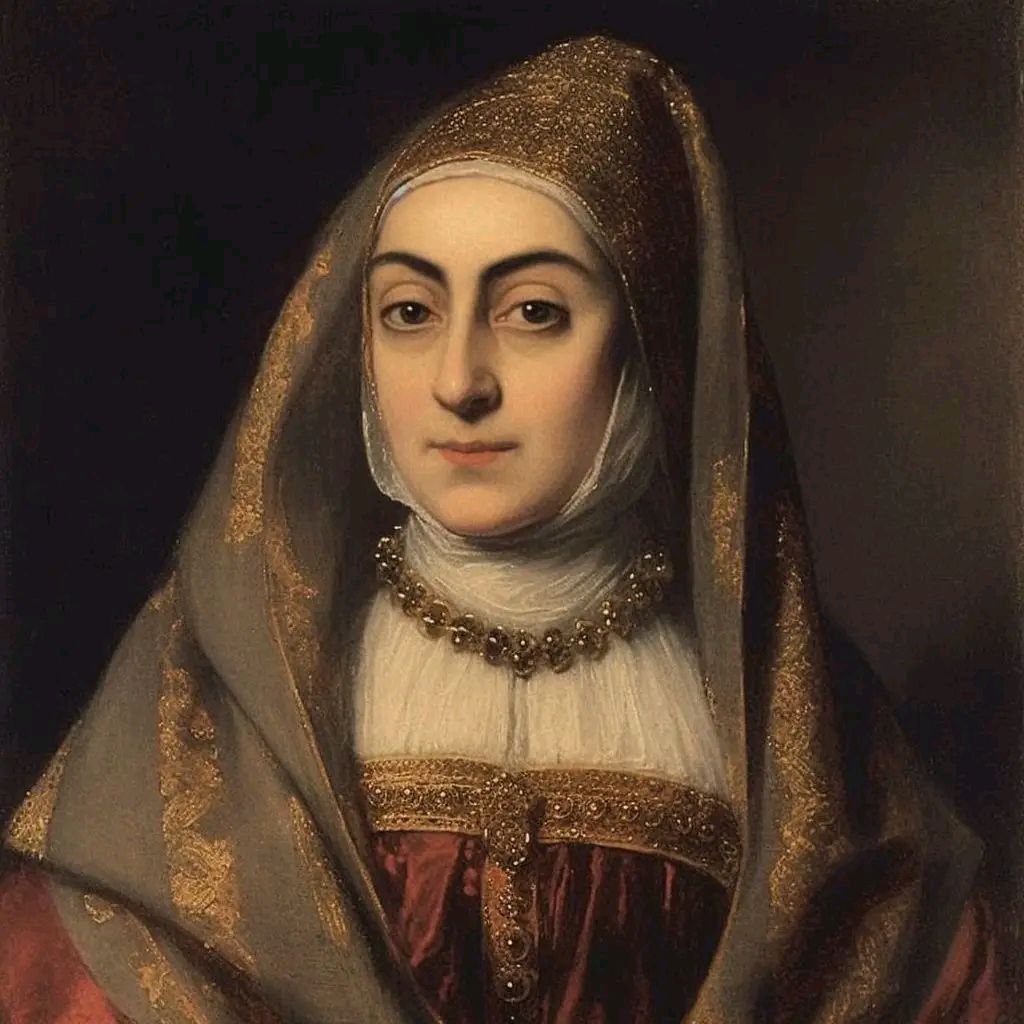
Lubna of Cordoba (Lubna Al-Qortobia) was an extraordinary Andalusian intellectual, mathematician, and poet who lived in the second half of the 10th century during the flourishing period of Islamic Spain (Al-Andalus). Her life story is a testament to her remarkable talent, hard work, and the intellectual openness of Cordoba’s golden age.
* From Slavery to Scholar: Lubna was born into slavery and raised within the Madīnat al-Zahrā palace, a grand royal city near Cordoba. Despite her origins, she received an exceptional education, a testament to the period’s emphasis on learning, even for enslaved individuals who sometimes found paths to freedom and high positions. Caliph Al-Hakam II eventually freed her, recognizing her immense capabilities.
* A Renaissance Woman of Her Time: Lubna excelled in numerous fields, demonstrating a truly multidisciplinary intellect:
* Royal Secretary and Administrator: She served as the personal secretary to Caliph Al-Hakam II, a renowned patron of arts and sciences. This was a position of immense trust and influence, requiring sharp organizational skills, diplomatic acumen, and excellent writing abilities.
* Librarian Extraordinaire: Perhaps her most famous role was overseeing the vast Royal Library of Cordoba, which was one of the largest and most significant libraries in the world at the time, housing hundreds of thousands of books (some sources claim up to 500,000 volumes). She was responsible for acquiring, transcribing, translating, and annotating countless manuscripts.
* Master Calligrapher: She was highly skilled in calligraphy, a respected art form in Islamic culture.
* Mathematician and Astronomer: Lubna possessed a profound understanding of mathematics and other sciences. She was known for her ability to solve complex geometric and algebraic problems. Some accounts even suggest she tutored children in mathematics outside the palace, with them following her reciting multiplication tables.
* Poet and Grammarian: Her talents extended to literature, with chronicles praising the quality of her poetry and her deep knowledge of grammar.
* Polyglot: She was proficient in several languages, including Arabic, Latin, and Hebrew, which was crucial for her work in the library.
* Acquisition Expeditions: To expand the royal library’s collection, Lubna reportedly traveled extensively across the Middle East and North Africa, visiting cities like Cairo, Damascus, and Baghdad to acquire rare books and manuscripts. This makes her one of the earliest known female solo travelers undertaking such intellectually driven journeys.
* Impact on Al-Andalus: Lubna’s work played a critical role in the intellectual vibrancy of Al-Andalus during its Golden Age. By overseeing the immense library and ensuring the transcription and translation of countless works, she contributed significantly to the preservation and dissemination of knowledge, including ancient Greek texts that might otherwise have been lost. Her presence also highlights the relatively progressive role women could play in the intellectual and administrative life of Islamic Spain.
📖 Legacy: Though details of her personal life are scarce, her intellectual achievements and high position are well-documented by contemporary Arab chroniclers like Ibn Bashkuwāl, who described her as “an intelligent writer, grammarian, poetess, knowledgeable in arithmetic, comprehensive in her learning; none in the palace was as noble as she.” Today, a street in Cordoba is named after her, acknowledging her significant contributions to history.




 Aal-e-Qutub Aal-e-Syed Abdullah Shah Ghazi