


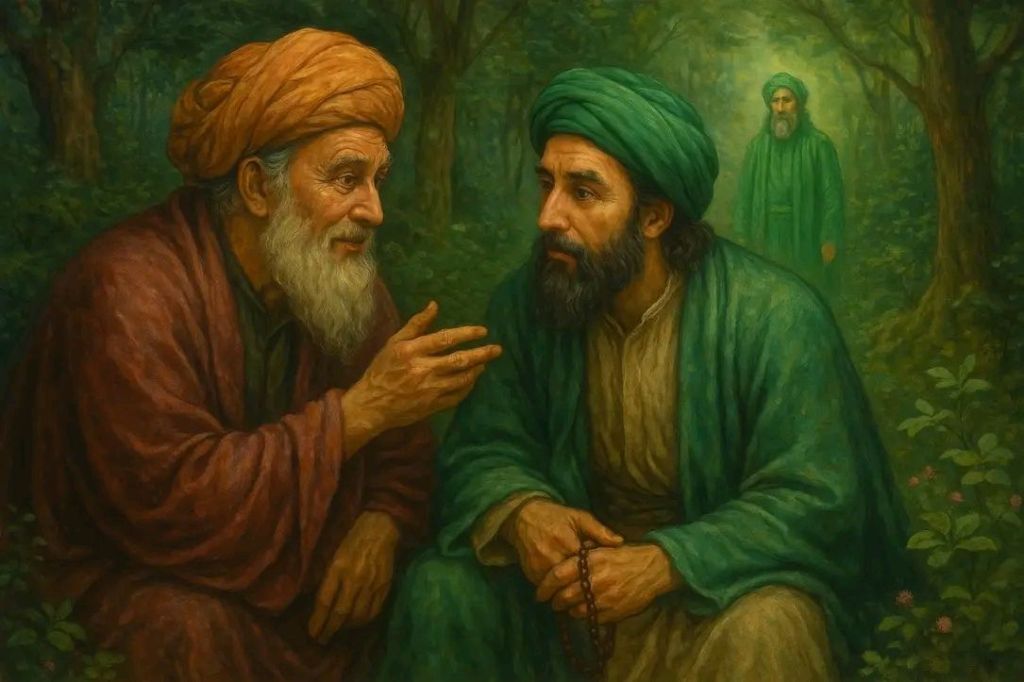
■ Who Are the Hidden Wali (Abdaal) and What’s the Secret of Hazrat Khizar (ع)?
You see, in every age, the world doesn’t just run on politics, technology, or markets. It runs on barakah — hidden blessings, flowing silently, like fragrance from a rose no one can see, but everyone can feel. That barakah often comes through the Abdaal — the hidden Aulia, the spiritual powerhouses whose identities are known only to Allah ﷻ. And among them shines a legendary friend of Allah ﷻ whose story refuses to fade: Hazrat Khizar (ع) — the green one, the guide of seekers, the unseen wanderer of divine roads.
These are not your regular people. These are the quiet ones in the background, the unknown servants of Allah ﷻ who don’t wear labels, don’t show miracles on stage, and might just be selling tea at a corner or sweeping a mosque floor somewhere — but because of their hearts, rain falls, wars are diverted, and entire nations are spared from punishment.
SubhanAllah! How some scholars get a little too uptight or strict when discussing Hadith about the Abdaal. But love doesn’t live in narrowness. And spiritual truths often come dressed in gentle metaphors — the kind that only lovers of Allah ﷻ truly understand.
From Imam Ahmad bin Hanbal (ر), there’s a narration that traces back to Mawla Ali bin Abi Talib (ع), who said: There are 40 men in Syria — these are the Abdaal. Every time one of them dies, Allah ﷻ replaces him. Because of them, it rains, enemies are defeated, and punishments are kept far from the people. SubhanAllah. Isn’t that beautiful?
Another narration from Hazrat Ubada bin Samit (ر) shares the same meaning but mentions 30 Abdaal. Different numbers, yes — but the same deep fragrance of truth.
And guess what? Imam Zurqani, a big name among scholars, says this Hadith from Hazrat Ali (ر) is reliable. And other respected Imams — like Imam Ismail Al-Hilmi — comment that Hazrat Ubada’s narration gains strength when heard through multiple authentic chains.
In fact, even some collectors of Hadith, like those behind Sunan Abi Dawood and Sunan Ibn Majah, believed certain pious people in their time were Abdaal!
Now, imagine this SubhanAllah: great Imams of Islamic history — like Imam Shafi’i (ر) — being called an Awtaad, a kind of spiritual pole, by none other than Hazrat Khizar (ع) himself!
And Imam Ahmad bin Hanbal (ر)? SubhanAllah! Hazrat Khizar is said to have referred to him as a Siddiq — a title usually reserved for the highest level of truthful lovers!
And what about Imam Abdul Rahman al-Sulami (ر)? SubhanAllah! Imam Abu Abdullah Hakim Nishapuri said that if this man wasn’t a wali, then there were no friends of Allah on Earth! Allah Allah! That’s how radiant his inner light was.
The list continues: Hazrat Hammad bin Salama (ر) was also counted among the Abdaal by the noble Imam Nawawi (ر).
But my favorite part? Allahu Akbat! SubhanAllah! Shaykh-ul-Akbar Imam Ibn Arabi (ر), the great traveler of spiritual galaxies, once asked a wise elder how one becomes an Abdaal. The answer is that Not fame, not miracles, not speeches. Just four simple secrets of lovers:
Silence
Solitude
Hunger
Wakefulness
Four keys that unlock the door of divine nearness… and open the heart to becoming one of Allah’s hidden friends.
Ok now this part might make your heart skip a beat: there’s a Hadith mentioned in Kitab al-Adhkar by Imam Nawawi (ر), where Prophet Muhammad ﷺ said that if your ride runs away in a desert, call out:
❝O servants of Allah, stop it!
O servants of Allah, stop it!❞
Because Allah ﷻ has soldiers walking this Earth — unseen to the eye, but always near.
Sufis have always believed that every city, every small town — even your own village — has someone among them: a Qutb, or an Abdal, whose presence keeps harm away and mercy flowing like a breeze in the air.
Ah Allah Allah, now we come to the one whose name makes the hearts of seekers flutter like leaves in spring: Hazrat Sayyidna Abul Abbas Khizar (ع) — the luminous traveler who met Prophet Musa (ع) and taught him the secrets of divine wisdom in Surah Al-Kahf.
He’s known as the Naqeeb al-Aulia — the leader of all Aulia Allah. The one whose feet walk both the seen and the unseen worlds.
He holds ‘Ilm Ladunni’, divine knowledge directly from Allah ﷻ — not through books or teachers, but through inspiration poured directly into the heart.
Wherever he sat, the barren land would become green — and that’s how he got the name “Khizar”, from the word green. SubhanAllah.
His lineage was discussed by Scholars like Imam Hajar Asqalani (ر) say he goes all the way back to Prophet Nuh (ع), through Baliya bin Malkan. Some call him Khizoon, a name that softened over time into Khizar.
This is a big question in the halls of spirituality.
Many great scholars say: Yes, he was a Prophet. Because in Surah Al-Kahf, he shows knowledge greater than Prophet Musa (ع) in certain matters — and how can a Prophet follow someone less than a Prophet?
Imam Ibn Jarir Tabari, Imam Thalabi, and even Imam Abu Hayyan (ر) all said he’s a Prophet whose knowledge came through hidden divine revelation.
But… wait.
Some Sufis, with hearts full of love, say he wasn’t a Prophet, but rather a Wali — a friend of Allah ﷻ whose nearness allowed him to carry that divine light without being a prophet.
Imam Qushayri (ر), in his famous Risala, sides with this view.
Others Imam Abu Mansoor Maturidi say maybe he’s an angel in human form, or simply a righteous servant.
And you know what? SubhanAllah! That’s the beauty of it. In the world of Wilayah, not everything is black and white. Sometimes, it’s all green — like Khizar’s touch — soft, alive, and full of secrets.
In the end, whether he’s a Prophet or a Wali, whether the Abdaal are 30 or 40, the message is the same:
There are people walking this Earth — hidden, humble, and holy — whose very presence holds back storms.
And there are mysteries Allah ﷻ hides in the folds of time, only revealing them to those whose hearts are open like flowers in the morning.
So my dear readers, walk gently. You never know who the Abdaal are. It might even be the one who serves you chai today. Or the one who sweeps your local masjid before Fajr.
And remember, the one who seeks Allah ﷻ sincerely… may just be on their own quiet path to becoming one of them.
اللّٰهُمَّ صَلِّ عَلَىٰ مُحَمَّدٍ وَّعَلَىٰ اٰلِ مُحَمَّ





 Aal-e-Qutub Aal-e-Syed Abdullah Shah Ghazi