The Rationale behind the Scientific Study of Qur’an.

The Rationale behind the Scientific…

Conflict between Religion and Science

The relationship between science and religion has often been a turbulent one. Historically, scientists have scorned the advent of religious ideas seeing them as in conflict with rational thinking. Much of this prejudice has stemmed from opposition by religious authorities to new scientific discoveries in the past. Christendom in particular displays a history of confrontations between the Church and scientists. This conflicting situation made the Bible subject to adulterations. The European Bishops mutilated its teachings, changed its concepts and beliefs and added philosophy to it. Scientific errors were also assorted in it. The Christian followers adopted that belief as their own, which in fact was not theirs but was an outcome of the wrong concepts added by the priests. When the scientists, after having researched, raised voice against such wrong concepts, the priests started thinking that the scientists were negating religion as against science. So they started giving the verdict of infidelity against such scientists. Scientists were tortured and tormented. Countless scientists were uried alive as a result of their prejudiced laws. In the Sixteenth century the Polish philosopher

Copernicus came to know of the Heliocentric Hypothesis, that the earth and other planets revolved around the sun, but was frightened to publish his findings for fear of Papal disapproval. However, it was Copernicus’s successor Galileo who suffered the full force of the Church’s
Creation of Man

disapproval. When he published his work “The Dialogue Concerning the Two Chief World Systems”, a masterful piece agreeing with the Copernican theory, Galileo was brought to trial by the Inquisition in Rome in 1632. He died in prison. These actions laid the foundations of a continuous struggle between scientific discoveries and church authorities. During the Renaissance period scientists inevitably took their revenge, which is still evident today.

Qur’ān and Invitation to Scientific Study

Qur’an The case with Islam differs. In the midst of ignorance and benightedness where scientific knowledge was scorned, the Qur’an eloquently pointed out many new found facts with such remarkable accuracy that only the Creator of man could do. It has only been in the last three centuries with specific regard being given to the present century that scientific research has unfolded and clarified the workings of the universe. This has ranged from the development and function of our own bodies to the environment that we live in. Yet the Qur’an has already described these natural phenomena to focus man’s attention on the wisdom, benevolence and authority of the Creator. Such liberal and advanced thinking led the way to an entire host of Islamic academics and scientists between the 8th and 12th centuries’ s’ (A.D). MinhaiBooks.com

At a time when Christianity laid down heavy penalties on scientific development, Muslim scholars flocked to the University of Cordoba, the cultural center of Islam, making new discoveries. There is a long list of scientists and scholars who made remarkable contributions in different fields of science. Abul Qāsim az-Zahrawī was a renowned

The Rationale behind the Scientific…

Muslim surgeon and physician. His fame rests in his book “al-Tasrif”. This was an amazing work on medical science which laid the foundation of the development of surgery in Europe. Abu Ishaq was a great philosopher and translator. He translated and wrote commentaries on the philosophical works of Aristotle. He was also a famous mathematician, astronomer, optician, physicist and pharmacologist. Abū sicist Raihān al-Bayrūni was the first to discover that light travels faster than sound. He was also a learned philosopher, geograph pher and a physicist. Abul Wafa al-Buzajānī was a notable mathematician. His contributions to the development of Trigonometry are remarkable. Ibn al- Haytham was a prominent Muslim physicist who made the first significant contributions to the optical theory. Ibn Sinā, a renowned Muslim scientist, produced a book “Kitab-ush-Shifa””. It discusses the natural sciences including Metaphysics, Astronomy, Geometry and Psychology. Muhammad bin Mūsa al-Khawarzimi was a famous mathematician and astronomer. He accomplished the oldest works on Arithmetic and Algebra. He was the first person to use Zero. Al-Fārābī was a great Islamic thinker who transmitted the doctrines of Greek philosophers Plato and Aristotle to the Arab world. And last but not the least Jābir bin Hayyan is recognised as the father of odern Chemistry. He introduced experimental research in chemical sciences.

In the eleventh and the succeeding centuries the Arabic knowledge gained popularity in the West. Since the twelfth century knowledge seekers from all over Europe traveled to the East and the Islamic West. The books of the Arab scientists were translated on a large scale in that era. The  Christian rulers of Spain followed the footsteps of the Muslim sovereigns, opened the doors of their courts to scientists and scholars and patronized dissemination of intellectual and scientific learning. Al-Fanso VI occupied Teetlah (renowned cultural city of Islamic Spain) in 1085. This conquest opened the way for the promotion of Arabic culture in Europe. A centre named “Madrasa-tul- Mutarajjimin” (centre of translators) was established in Teetlah to introduce Arabic science to Europe. Here, Jewish scholars were appointed to translate the Muslim authors’ books on Mathematics, Astronomy, Physics, Chemistry, Medicine, Philosophy, Logic and Politics. Educational centres were also set up on Islamic style in the twelfth and the subsequent centuries. In fact the more, the modern science unfolds the reality of these phenomena, the more the truth of the Qur’ān becomes evident to us. At a time when scientific research did not even exist, let alone different fields of science, such precise knowledge could not come from any source but from the knowledge and wisdom of Allāh the Highest. For many this is a paradox, as religion has always been seen the bane of science, its antithesis. The legacy of Galileo has prejudiced the scientific community against religion, including the ambit of Islam. The following pages, therefore, present the verses of these scientific facts scattered through the ver: the Qur’an for the benefit of Muslims and non- Muslims alike. These verses of the Qur’ān not only proclaim the truth of the book itself but also beautifully demonstrate that attribute of Allah, the Blessed, the source of sustenance for everything in the universe.
The Rationale behind the Scientific..

Here I would like to clearly state my position that I do not justify changing the meaning of the Qur’ānic verses to bring them in line with scientific discoveries, nor do I regard the scientific interpretation of the Qur’ān as final, because scientific knowledge itself constantly changes and evolves. Science has very little in it, which can be called final and absolute. On the other hand the word of the Creator of the universe is not subject to any change; it is final and absolute. With these words of caution, however, I feel there are two important reasons to study the Qur’an in the light of modern sciences.

Firstly, the Qur’an is a supreme source of knowledge which is multidimensional, all-comprehensive and all- embracing. None of the revealed books has this unique characteristic of the Qur’an. Science is nothing but an empirical interpretation of the Holy Qur’an. Since the development of science is at its zenith in our times, when we correlate the Qur’anic studies with man’s own scientific discoveries and experiments, this opens up new avenues to strengthen the faith. Furthermore, this kind of rational thinking to enable better understanding of its verses, is also stressed by the Qur’an itself. aj Books.com

Biological and Physical facts of the Universe and the Qur’ān

Secondly, biological and physical facts of the universe, as described by the Qur’an, could not be known before modern technological advancements. If these descriptions of
the Qur’an are proved beyond any doubt, then an unbiased person should not have any hesitation to accept the rest of the teachings of the Qur’an, especially so when the clarity, simplicity and practical application of these teachings is superior to anything existing in the world.

These reasons necessitate the study of the Qur’ān in the light of science, of course keeping in mind the factor of probability and variant interpretations of scientific observations. Such differences are similar to those which arise in application of logic, grammar and other linguistic criteria.

With this introduction let us proceed to study the subject in question.

Jibreel in the presence of the Holy Prophet Hadhrat Muhammad (Sallallahu alaihi wa sallam) part 5

Jibreel (May peace be upon him) kissing the heels of the Holy Prophet (Sallallahu alaihi wa sallam)

In the incident of the heavenly journey of Meraj, we see the best example of Jibreel’s (May peace be upon him) reverence of the Holy Prophet (Sallallahu alaihi wa sallam).

Mulla Muhammad Moin Kaashfi Haravi (May Allah Ta’ala shower His mercy on him) narrates a Hadith about Meraj:

Translation: The second narration is from Jibreel (May peace be upon him): I got to know from the Wahi of Allah Ta’ala that my body has been fashioned out of camphor of Jannah, but I didn’t know the reason for this. I realized this on the night of Meraj. In spite of my purity and fineness, I was hesitating to awaken the Holy Prophet (Sallallahu alaihi wa sallam) and I was anxious as to how should I do it. I was ordered that I should rub my face on the heel of the blessed foot of the Holy Prophet (Sallallahu alaihi wa sallam). When I did so, the coolness of camphor met the warmth (of the feet of the Holy Prophet (Sallallahu alaihi wa sallam)) and the Holy Prophet (Sallallahu alaihi wa sallam) easily awakened from sleep. At that time, I realized the reason of me being created from camphor. (Ma’arij Un Nubuwwah, Pg. No. 601)

Jibreel (May peace be upon him) came to the presence of the Holy Prophet (Sallallahu alaihi wa sallam) along with 210000 angels.

On the night of Meraj, Jibreel (May peace be upon him) had the good fortune of serving the Holy Prophet (Sallallahu alaihi wa sallam). As given in Tafseer Ruh Al Bayan Vol. 5, Pg. No. 109:

Translation: The night of Meraj, Jibreel, Mikail, Israfeel and Izrail (May peace be upon them) all came. Each one of them had 70,000 angels. When the Holy Prophet (Sallallahu alaihi wa sallam) mounted the Burraq, Jibreel (May peace be upon him) held the reins, Mikail (May peace be upon him) held the stirrup and Israfeel (May peace be upon him) held the saddle.

The angels received the service of the Holy Prophet (Sallallahu alaihi wa sallam) in lieu of their worship

Zubdatul Muhaddithin Hadhrat Abul Hasanaat Syed Abdullah Shah Naqshbandi Qadri (May Allah shower His mercy on him) writes in his work Miladnama:

The Holy Prophet (Sallallahu alaihi wa sallam) said: I was embarassed by their service and stopped them. These angels said: O Prophet of Allah (Sallallahu alaihi wa sallam)! We have taken this service in lieu of thousands of years of worship. O Prophet of Allah (Sallallahu alaihi wa sallam), the fact is that after thousands of years of worship, one day Allah Ta’ala asked us: What do you want as a reward for this worship? We entreated: Let us serve the One whose name is written along with your name on the ‘Arsh. Allah Ta’ala said: When He (Sallallahu alaihi wa sallam) will be born, I will take Him from

Makkah to Bait ul Muqaddis. I will let you serve Him in that journey. O Prophet of Allah (Sallallahu alaihi wa sallam), we got this service in this manner.

The Holy Prophet (Sallallahu alaihi wa sallam) is Wastae-Uzma for Jibreel

Jibreel (May peace be upon him) always used to think about pleasing the Holy Prophet (Sallallahu alaihi wa sallam). It was in this connection that the he requested permission to spread his wings on the Sirat on the Day of Judgment. He conveyed his wish to Allah Ta’ala through the Holy Prophet (Sallallahu alaihi wa sallam)


The Holy Prophet (Sallallahu alaihi wa sallam) said: Does a friend leave a friend in such a place? Jibreel (May peace be upon him) said: O Prophet of Allah (Sallallahu alaihi wa sallam), if I step forward, I’ll be burned by the radiance of Allah Ta’ala. In another Hadith, it is recorded thus: If I step forward even to the extent of a finger pad, I will be burned to ashes. The Holy Prophet (Sallallahu alaihi wa sallam) said: Do you have any wish that you would like to have conveyed to Allah Ta’ala? Jibreel (May peace be upon him) said: O Muhammad (Sallallahu alaihi wa sallam)! you please convey to Allah Ta’ala that I would like to spread my wings on the Siraat for Your Ummah, so that they can pass over it easily.

ABRAHAM (IBRAHIM) Alahissalam part 2

The Miraculous escape of Abraham from the fire

The pit was dug and a large fire was lit in it. When it was roaring with flames and the heat could be felt from a distance, Abraham was thrown in it. Abraham prayed to the true God for His mercy in that hour of trial. By the Grace of God, neither the fire nor the heat touched Abraham. He walked around as if in a garden and left the pit totally unharmed. This indeed was a miracle that convinced some of the onlookers who bowed. to the true God and accepted the true religion of God and gave up idolatry.

Abraham left his ancestral city of Ur and migrated north to Haran where he stayed for a short period of time. Then he moved west to Canaan (Kin’an), alongwith his wife Sarah and nephew Lot (Lut). After awhile. Lot was appointed messenger by God to the people of Sodom and Gomorrah who lived north of Canaan.

The Progeny of Abraham

Before finally settling in Canaan, Abraham visited Egypt where the king gave him a maiden (according to some, his daughter) in marriage. Her name was Hager (Hajiral). God gave Ishmael as the first-born child to Abraham through his second wife Hager at the old age of eighty-sixes years. Sarah was infertile and became jealous of Hager. Under instructions from God, Abraham took his son Ishmael and his wife Hager from Canaan and brought them down south in the land of Arabia where they were left to live for the rest of their lives. Ishmael grew up to be handsome and tall young man who had many children and is popularly known as the patriarch of the Arabs. Back in Canaan, after a few years, Sarah who had grown

old and given up hope of ever bearing a child of her own, also conceived and bore a son to Abraham named Isaac (Isshaq). It is worth noting here that Abraham had then turned ninety-nine years of age. Isaac was a great prophet of God in the land of Canaan. He remained settled in Canaan and had several prominent prophets amongst his progeny.
After the death of his wife Sarah, Abraham took another wife named Qutura from whom he had many sons and daughters. These children of Abraham settled and populated the lands of Madain, Midyan and Saba.

The Trial of Abraham by God

One night Abraham saw in his dream that he had sacrificed his son Ishmael to please God. He wondered about this dream and pondered over its meaning. He saw the same dream during three consecutive nights. He called his son Ishmael and told him about his dreams. The son asked his father to do exactly what he had seen in his dreams if that was the wish of the Creator Almighty and that he would find him patient. Abraham tied his son just as he would tie a sacrificial lamb and placed the knife on the throat of his son to carry out the sacrifice. The Sustainer of life and of all mankind sent the archangel Gabriel with salutations from God and told the father and the son that their belief in God and their resolve to give their most valued possession in life in His way had pleased Him greatly. God had sent a lamb to be sacrificed in place of Ishmael, Abraham thanked the Lord for the acceptance of his service and returned home with humility and gratitude towards God. This act of has been perpetuated by God forever and is celebrated Muslims all over the world every year when they sacrifice a . This festival is known as Eid-al-Adha,

Construction of Ka’ba and Pilgrimage (Hajj)

Abraham and his son Ishmael built the Ka’ba and the Black Stone in one of the comers of the building in with the Will of God. The ritual of pilgrimage (Hajj) was initiated at that time and has continued to this day.

to the question of Death and Resurrection

Once Abraham asked God how would He bring them to
life again when the living had died and perished? God asked Abraham if he had doubts about that question. He said he had no doubt about the absolute powers of his Lord but he wanted to satisfy his curiosity over the mechanism of resurrection.

God instructed Abraham to “gather four birds, let them become familiar with you, then sacrifice them, mix their meat and scatter it on four hills across one another. Then call the birds by their names and they will come to you.” Abraham did as instructed and verily the same happened as predicted by the Supreme God. Thus Abraham solved the riddle of resurrection of the dead on the Day of Judgement. God will call His creation, as He Wills and they will all rise from their graves.

The Ritual of Circumcision

When Abraham turned ninety-nine years of age. God ordained that he himself, his male progeny and all believers be circumcised. The divine order was obeyed. It might be noted here that Isaac was born to Abraham at that old age and after the ritual of circumcision. This ritual is practised by the Muslims and the Jews, the followers of Abraham and all those who recognize the hygienic advantages of circumcision.

The Death of Abraham

This great prophet and a friend of God, also known as the patriarch of all subsequent prophets, died at the age of one hundred and seventy five years.

Major Lessons from the Life of Abraham

1. Do not remain ignorant about religion, nor be stubborn about the old ways of our forefathers. Seek the truth. Accept when discovered.

2.Do not associate any thing or any one with The Creator

Nothing can share with Him the glory of His Oneness.

3. Submit to God in total submission to enjoy His bounty and benevolence.

4. When it is difficult to practise your faith in safety and in peace, move to another place, for His territory is vast and His bounty limitless.

5. Whenever occasions arise requiring sacrifice to preserve or protect Faith, do not hesitate, for all we have, came from Him. We are independent owners of nothing in this world.

References: The Qur’an: Sura Baqarah, ale Imran, Nisaa’, An’am, Taubah, Hud, Yusuf, Ibrahim, Hajar, Nahl, Mariyam, Anbiya, Hajj, Shu’ra, A’nkaboot, Sa’fat, Jinn, Zakhraf, Hadeed, Mumtahna, Zariyat, Najam and Taha.

ALI, THE MAGNIFICENT part 17

The Siege of The Citadel

The siege of Al-Qamus was an extremely difficult task for the Muslims, who had never before forced their way into such a stronghold. It lasted for some time and tried the skill and patience of the Muslims, who had fallen short of provisions, and the country all around was laid waste by the Jews during the period-about a month – when they were engaged in storming the minor fortresses. The Jews had destroyed even the date palms round their citadel to starve the enemy; and, having resolved to fight desperately, they had posted themselves in front of the citadel. The besiegers attempted to force their approach, but every attack was repulsed. The Prophet, who was during these days suffering badly from a headache, handed over his Standard to Abubekr b.Abu Oohafa, directing him to lead the assault, but the latter was strongly repulsed by the Jews and forced to retreat. Next the Prophet sent his men headed by Omar b. Al-Khattab, carrying his Standard, but the result was no better than a forced retreat. The Prophet, having thus been disappointed by the failure of his prominent Companions, exclaimed, “Tomorrow I shall hand over my Flag to one who loves God and His Prophet, and who is the beloved of the Lord and His Prophet, and who is a fearless charger who never turns his back upon a foe; at his hands the Lord will give victory”. Every one of the Prophet’s Companions was anxious to be signalized on the morrow as the “beloved of God and His Prophet.” They passed the night in great anxiety as to which one would prove to be the blessed one. No one thought of Ali, the cousin and the Vicegerent of the Prophet, the hero of all previous wars, because he was suffering badly from sore eyes and could not see anything. The longed for morning dawned, but the Prophet appeared not to take notice of any particular individual. When he broke the silence he asked for Ali, and all of them with one voice answered, that he was at a considerable distance at the time and was also badly suffering from sore eyes, and that he was utterly unable to look around. The Prophet commanded them. to bring Ali to him. Selma b. Aku fetched Ali. The Prophet taking Ali’s head into his lap, applied the saliva of his mouth to his eyes. Instantaneously his eyes became so clear as if he had never suffered from the disease. It is said that throughout his life, he never had any trouble. with his eyes again.

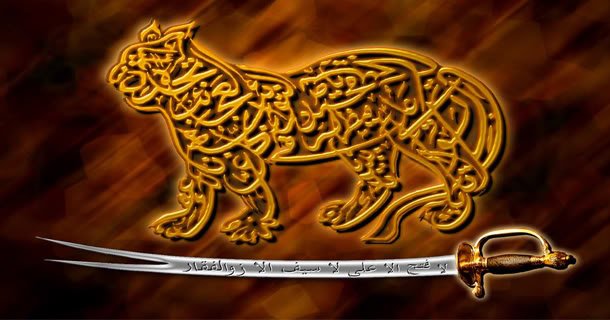
The Prophet confided his Sacred Banner into the hands of Ali, armed him with his sword the Zulfiqar, and thus designated him the man whom God and His Prophet
loved. He directed him to lead the assault and to fight till the Jews acknowledged submission. Ali, clad in a scarlet vest over which was buckled a cuirass of steel, issued forth with his followers and scrambling up the great stony rock in front of the fortress planted the Standard over its top, and resolved never to recede until the citadel was taken.

A The Jews sallied forth to drive down the assailants. Jewish monk asked Ali his name, which he gave out as Ali b. Abi Talib or Haidar. The monk, hearing the name, warned his men that the assailant would not withdraw without capturing the citadel. However, Harith, a Jewish champion, who had vigorously repulsed the previous attacks, stepped forward and slew several of his Muslim antagonists. Perceiving this, Ali himself advanced and slew Harith, in a hand to hand fight. The brother of Harith was a man of gigantic stature and huge form. He was unequalled in valour among the Jews. To revenge the death of his brother, he came out, covered from his neck to the waist with a double coat of mail, having on his head a helmet for protection from the stroke of a scimitar. He had a huge gird on both his sides and brandished a big spear with tripleforked sharp pointed heads. Stepping forward from the Jewish lines, he challenged his adversaries to a single combat. “I am Marhab”, he cried, “as all Khaibar knoweth, the greatest warrior in the world. None among the Muslims could dare come forward to confront him. Ali himself advanced from the Muslim line in response to his vainglorious challenge saying, “I am he whom his mother named Haidar, a lion of the wilderness; I weigh my foes in a gigantic balance(i.e. I make short work of my enemies.)” Ali’s words were not meaningless. Ali knew, through inspiration that Marhab had lately dreamt of a rugged lion tearing him to pieces; so he reminded Marhab of the dream. The words had their effect; as when the two combatants accosted each other, Ali measured him with the eye and found him wavering. As they closed, Marhab made a thrust at Ali with his three-pronged lance, which Ali dexterously warded off, and before he could recover himself, Ali dealt him a blow with his irresistible scimitar, the Zulfiqar, which divided his buckler, passed through his head in two, head in two, through the through the helmet, right down to his chest or down to his saddle, as some traditions say, severing him in twain. He fell lifeless to the ground and the winner announced his victory. by his usual shout, “Allah-o-Akbar,” i.e. Great is the All Powerful Lord. And everyone knew that Ali was victorious.

Hazrat Adi Ibn Musafir R.A and Hazrat Ali Ibn Bakkar Shami R.A


Ali Ibn Bakkar Shami

Ali Ibn Bakkar Shami was in a battle. The Muslims were defeated and he was defeated with them. His horse was injured. At this calamity he read out loud ‘To Allah we belong and to him we return’. The horse also said “To Allah we belong and to him we return.” (Jame’ Karamaatul Auliya)


Adi Ibn Musafir

Adi Ibn Musafir is from amongst the great saints of Iraq. Siraj states that Shaykh Abu Israel says I bid Adi Ibn Musafir farewell one day and left for Abadaan. He said to me when you see a dangerous wild animal that you are afraid of say,, Adi Ibn Musafir says to you ‘go away and leave me alone. When you come to a dangerous sea then say. ‘Oh tremendous waves Adi Ibn Musafir tells you to calm down’. It so happened that when he met a dangerous wild animal he did as he had been taught. The animal would lower its head and go away. On one occasion when they were near to drowning he said he had been commanded. The wind calmed down and the sea became safe.

(Jame’ Karamaatul Auliya)