


The Qoraitza Jews breaking their Pact of Neutrality.
The Nadzirite Hoyay b. Akhtab, the most zealous promoter of opposition against Muhammad was sent to negotiate with Ka’b b. Asad, the prince of the Qoraitza Jews, and he succeeded in winning him over to the side of Abu Sufyan, disregarding the pact of neutrality with the Prophet. It was agreed that the Qoraitza would assist the Quraish after ten days’ preparation, and would attack the rear of the Muslim army from the northwestern quarter of the town, which lay on the south-east of their fortress and was easily accessible to them.
Rumours of this reached the Prophet, who deputed two chief men of the Aws and the Khazraj, Sa’d b. Moazh and Sa’d b. Obada respectively, to ascertain the truth.
They proceeded towards the Jews, and, after making searching enquiries, came back and reported to the Prophet that the temper of the Jews was even worse than feared.
This news alarmed him. These apprehensions having been confirmed, it was necessary to guard against surprise or treachery. The north-western quarter of the town, which lay on the side of the Jewish stronghold, was the least capable of defence. To protect the families of his followers throughout the city, the Prophet could do nothing but to detach a considerable number of men from his force of three thousand, which was barely adequate for the long line of the entrenchment. To meet this emergency, he had to deploy two parties, one of three hundred men under Zaid bin Haritha, his freed man, and another of two hundred men under a chief of Medina, to patrol the streets and lanes of the town day and night.
Thus the strength of the force at the Defence was reduced to 2,500 men, as against the 10,000 of the enemy. The prolongation of the siege was still more troublesome to the Muslims, as the already inadequate number of men guarding the outposts of the entrenchment line got no relief; they were wearied with keeping a vigilant watch unceasingly day and night. Besides hunger, on account of having fallen short of provisions, they had to suffer very much from the heat of the sunny days and the chill of the cold nights in the open air.
The Enemy clearing The Ditch.
More than a fortnight had thus elapsed, when at length a select party of the besiegers’ horsemen found the narrowest and weakly guarded part of the Ditch. Amr b. Abd Wudd, Nawfal b. Abdallah and Dzarar b. Al-Khattab
led by Ikrima b. Abu Jahl, spurring their horses leaped forward towards the Muslims, and challenged them to single combat. Abu Sufyan with Khalid b. Walid waited on the other side of the trench to witness the issue of the fight.
In the battle of the ‘Khandaq’ (or the Ditch) when Muhammad had to meet the maximum strength of the forces of the heathens from Mecca and when everyone in the Muslim camp had refused to go against Amr, the challenging hero of the enemy, it was only Ali who, although a youth, readily offered to fight the giant warrior. When Ali stepped forward against the giant warrior the Apostle of God exclaimed: ‘Goeth forth the whole of Faith against the whole of infidelity.”
Ali wins the day.
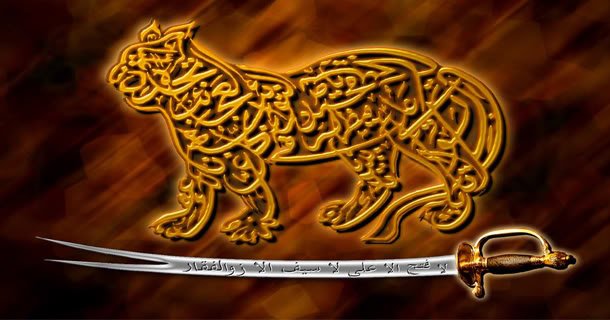
‘The Muslims at the sight of Amr were awe-struck and paralysed. None of them ventured to come forward as his antagonist, as he was famous for his prowess and was reckoned among the Arabs as one equal to one thousand antagonists. None but Ali stood up, but the Prophet bade him wait. Again Amr roared for his opponent and again Ali was forthcoming, but the Prophet stopped him. At his third call, he tauntingly asked the Muslims whether none of them wished to enter Paradise as a martyr. Still no one was found to respond to the challenge except Ali, who impatiently stepped forward. The Prophet, now permitted Ali, and putting his own turban upon his head, his own coat of mail over his body, armed him with his own sword the Zulfiqar and sent him to his adversary.
1 Rawdzat-al-Ahbab; Tarikh-al-Khamis; Rawdzat-al-Safa; Habib- al-Siyar.
“It is a struggle between Faith and infidelity; the embodiment of the former is bound to crush the entirety of the latter, exclaimed the Prophet, when Ali, the illustrious hero of Islam was proceeding onward to Amr b. Abd Wudd, the famous giant of the infidels. Then lifting up his hands Muhammad prayed: “O God! Obeida my cousin, was taken away from me in the battle of Badr, Hamza my uncle in Ohad. Be merciful not to leave me alone and undefended. Spare Ali to defend me. Thou art the best of Defenders.”
“When the two (Amr and Ali) stood face to face, Amr said to Ali: “Nephew, (as he was a friend of Abu Talib, the father of Ali) by God, I do not like to put thee to death.” Ali replied: “But by God, I am here to kill thee.” Amr, enraged at this reply, immediately alighted and advanced towards Ali. Ali sprang forward and so started a duel which will always be remembered, for it decided the fate of the Meccans, as their morale was being destroyed by the death of Amr. It did not take Ali long to realize that Amr, in spite of his age was as agile as his reputation had made him out to be. The duel went on for some time, finally like a flash of lightning Ali darted. forward and in one sweep of his scimitar struck off Amr’s leg. Amr tottering on one leg, denounced the Holy Prophet and Ali and their family. Picking up the severed limb, he flung it at Ali with all his might. It was his last effort, and Ali was nearly stunned, but in a moment he had recovered and plunged his sword into Amr. At last the voice of Ali, sounding ‘Allaho Akbar’ (Great is the Lord) was heard, which in ‘icated victory. The Divine Decree which the Prophet saw inscribed in letters of Celestial
1 Sirat-al-Mohammediya; Hayat- 1-Haiwan. 2 Ibn Athir; Abul Fida.
Light in the Heavens on the night of Meraj was found by him fulfilled on every such occasion.
‘Beholding the fate of their renowned champion. Amr’s comrades in the enterprise rushed back to escape, spurred their horses and all gained the opposite side of the ditch except Nawfal, whose horse failed in the leap and fell into the ditch. Being overwhelmed with a shower, of stones by the Muslims, he cried out, “I would rather die by the sword than thus.” Hearing this appeal Ali leaped into the ditch and dispatched him.
The Sister of Amr B. Abd Wudd.
Contrary to the custom, Ali did not strip Amr of his armour or clothes. When Amr’s sister came to the corpse she was struck with admiration at the noble behaviour of her slain brother’s adversary; and finding out who he was, she felt proud of her brother having met his fate at the hands of the person who was known as the Unique Champion of spotless character. She expressed herself thus “Had his conqueror been other than the one who killed him, I would have wept over Amr all my life. But (I feel proud that) his antagonist was the Unique Spotless Champion.”
Ali’s valour praised by The Prophet.
“The ever-victorious Ali, the ‘Lion of God’ was thus signalized in this Defence, as on previous occasions in the battles of Badr and Ohad. The Prophet declared that
1 Rawdzat-al-Ahbab; Izalatal Khifa, Tarikh-al-Khamis.
2 Tarikh-al-Khamis.
3 Madarijal Nabowat; Hakim in his Mustadrak; Firdows-al- Akhbar; Rawdzat-al-Ahbab.
Ali’s one stroke on the day of the Ditch is superior to the devotional worships performed by both the worlds (Men and Angels) till the day of Judgment. (Vide Hakim’s Mus- tadrik Vol. I, Page 32 and Dailami’s Firdous-ul-Akhbar).

 Aal-e-Qutub Aal-e-Syed Abdullah Shah Ghazi