

Battle of OHAD.
The Prophet reached Ohad in the morning of Saturday, the 7th of Shawwal, 3 A.H. (January or February 625 A.D.) and found the Meccan forces face to face, ready to advance for the battle. The Quraish advanced in the form of a crescent and the right wing of their cavalry was led by Khalid b. Walid, a notorious warrior. Abu Amir, a Meccan champion, stepping forward with his fifty archers, showered the arrows first towards the Muslims, who retaliated promptly. Thus the fight began. The Meccan archers turned back and their standard bearer, Talha b. Abi Talha, coming forth, challenged the Muslims. Ali stepped forward and struck off one of his legs. He fell down and another champion hoisted the standard. He was killed by Hamza. A third now took the standard and he was slain by Ali. Thus nine or ten standard bearers fell one after the other only by Ali’s sword. It is a noteworthy incident that Talha the first standard bearer of the Meccans lost one of his legs by a stroke of Ali’s. sword, fell down and his lower garment being loosened, he became naked. Ali, instead of finishing him, turned his face from him and hit him no more. The Prophet marked the event and exclaimed, “Allah O Akbar” (Great is the Lord), and when he asked Ali why he had spared the man, he said the man was nude and entreated for the sake of Allah to spare his life. Ali and Hamza, the champions of Badr, unsparingly dealing out death, worked havoc among the enemy. Hamza, however, while duelling with Saba b. Abd-al-Uzza, a Meccan champion, was treacherously speared from behind by Wahshi, an Ethiopian slave, who lurked behind a rock with that intent, having been promised by Hinda, the wife of Abu Sofyan, his freedom, if he could avenge the death of her father and brother slain by Ali and Hamza in the battle of Badr. Now Ali, taking Abu Dajana’ Mos’ab b. Omeir and Sahel b. Honeif, Muslim champions with him, charged the enemy. The force of the charge broke the ranks of the enemy, the whole host wavered and Ali with his Muslim champions, gained the enemy’s camp. They made the Meccan army turn and flee, leaving their camp to the Muslims, who at once proceeded to approp- priate it.
‘But their eagerness for spoil turned the tide of victory, which was already gained by Ali and his Muslim champions. The archers posted at the defile deserted their posts to join in the plunder, leaving the subaltern, Abdallah b. Jobeir, in spite of his protests, with only about ten men. Khalid, the Meccan commander of the cavalry, who behind the defile was awaiting a suitable chance to effect his charge, succeeded in dexterously emerging through and cutting down the small guard of the ten men, and charged furiously the rear of the Muslims. Mos ab b. Omeir, a champion of Nabi Pak, who bore a great resemblance to him, fell dead. Ibn Soraqa proclaimed aloud that Nabi Pak was slain. The flying Meccans turned back. Their banner, which was lying low on the ground, was picked up by a Meccan named Omra bint Alqama and then lifted high up by a slave named Sowab and the Meccans clustered around it. Most of the Muslims, including many of the Companions of the Prophet took to flight.
This sudden change of fortune checked the Muslims, who found themselves surrounded by the Meccans. It was all confusion so that it was not easy to distinguish friend from foe. Discipline could not be restored.
Some were saying that Nabi Pak would not have been killed had he been a true Prophet, others were talking of seeking pardon of Abu Sufyan and taking refuge with him. (Sur. III-138 refers to these people thus: “And Muhammad is no more than an Apostle; already there have passed before him Apostles: what then! if he dies or is killed, will ye turn back on your heels? But he who turneth back on his heels will not harm God at all; surely God will reward the grateful.” Sur.. III-142 refers to them thus: “O ye who believe, if ye follow those who disbelieve, they will turn ye back upon your heels, and ye shall be turned back losers.”)
Some of the Prophet’s adherents, however, resolved. not to survive him and they fought and perished in the struggle. Anas b. Nadzar, uncle to Anas b. Malik, having seen Omar b. Khattab and Talha b. Obeidallah sitting leisurely along with some others, asked them what they were doing. They said they had nothing to do since Nabi Pak was slain. Hearing these words Anas addressed them aloud thus: “My friends! Though Mu- hammad be slain, certainly Nabi Pak Lord liveth and dieth not therefore value not your lives since the Prophet. is dead, but fight for the cause for which he fought.” Then he cried out, “O God! I am excused before Thee, and acquitted in Thy sight of what they say,” and drawing his sword fought valiantly till he was killed.The Angel Gabriel appeared to the Prophet with the verse which meant to inform him that among his followers there were persons who looked only to this life and also those who cared for the next life. (Sur-iii-146 “Of you are those who chose this present world and of you are those who adopted the world to come hereafter.”)
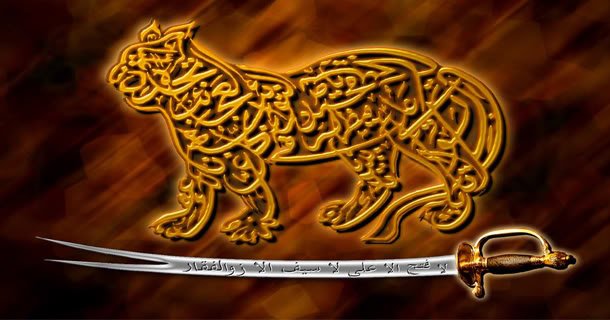
Ali, who was still defending bravely, ran to the Prophet who was all alone, and stood by his side. The Prophet inquired why he did not flee with the others, to which he replied that he belonged to him and had no business with the others and that he being a believer would not like to turn a disbeliever or an infidel. Presently, one after the other two parties of the Quraish were sent to attack the Prophet. He asked Ali to defend him, and the gallant hero repulsed them with such intrepidity that he was praised by Angels, whose voice was heard saying: “Zulfiqar is the only effective sword and Ali the unique champion.”
Ali helped by Gabriel.
“Ali received sixteen wounds, four of which were so serious that he was falling down from his horse, but on. each of these occasions a beautiful youth took hold of him, lifted him up to his saddle and soothed him with these encouraging words: “Go on fighting, O hero! God and His Prophet appreciate thy services.” This was none other than Gabriel the Evangel, who praised Ali to the Prophet for his zeal and ardent devotion to him at the time when all others had deserted him. The Prophet told Gabriel: “No wonder! Ali comes of me and I
myself come of him,” i.c. both of us are part and parcel of one and the same Celestial Light;” whereupon Gabriel remarked that he also comes of both of them, i.e. he also was created from the same Light as Nabi Pak and Ali.
The Prophet Wounded.
In the melee above referred to, Obba b. Khalf, a Meccan champion, rushed towards the Prophet aiming at him with his spear; but he was himself killed with his own spear; the Prophet snatching it out of his hands and dealing him a blow, striking him dead. Another tradition¹ says that he had received a wound from the Prophet’s own hand but died of the same wound on his return to Mecca. Soon after this, the Prophet was wounded by a stone from a sling aimed at him by Otba, brother of Sa’d b. Abi Waqqas, which struck the Prophet on the mouth, cutting his lips and shattering two of his front teeth.* He was wounded on the face also by an arrow, the iron head of which could not be extracted by himself, and he lay bleeding for some time on the ground. Blessed the timely aid and friendly hand of Ali, who, repulsing the enemy, came back and finding the Prophet in this condition. conveyed him to a place of safety, extracted the arrowhead, staunched his blood and tended him, aided by his wife Fatima, the daughter of the Prophet. No doubt. Ali proved himself now, as before and as hereafter, the defender or right-hand of the Prophet on all occasions of danger, in confirmity with God’s Decree which the Prophet had seen inscribed in Heaven on the night of his Me’raj.The reader may also recall the way Ali risked his own life in defending the Prophet, on the occasion of his escape from Mecca, by laying himself upon the couch in place of the Prophet, covering himself with the Prophet’s well- known green mantle, and thus misleading the Meccans. for some hours in their search and pursuit of the Prophet, who succeeded during the interval to hide himself in a cave on mount Thaur a hill to the South of Mecca.
The end of the Battle.
On finding out that the Prophet was only wounded and not killed, the Muslims began to rally round him. The Meccans, having no courage to rout them, contented themselves with the honour of snatching back the victory from Nabi Pak; and left the field after mangling and mutilating the dead bodies of the Muslims. Halting at Rowha, 8 miles homeward from Ohad, Abu Sufyan felt uneasy at the utter fruitlessness of his campaign and began to contemplate a raid upon Medina. The Prophet, on the other hand, suspecting some treachery at the enemy’s hasty retreat, resolved on immediate action and so pursued them next morning as far as Hamra-al-Asad, where he was informed that the Meccans receiving intelligence of his advance had already taken their road home.
The Meccans lost one hundred and three men in the battle; of these, twenty-one had fallen under the sword of Ali. Among the Muslims there were seventy martyrs. The bravest of the Muslims who fell dead in the battle, were Hamza b. Abd-al-Mottalib, Mos’ab b. Omeir, Sa’d b. Al-Rabi, Ammara b. Ziyad and Hantzala a son of Abu Amir, the Meccan champion, who was the first to come forward from the ranks of the Meccans with fifty archers to charge the Muslims. Among the slain, the body of the Prophet’s uncle Hamza b. Abd-al-Mottalib was found mutilated. The fiend Hinda, wife of Abu Sufyan, had his liver taken out, sucked it and quenched her thirst for avenging the death of her father who was killed by Hamza in Badr. The Prophet collected all the dead bodies of the Muslims and buried them, offering prayers for each. He observed that the martyrs were his companions, for whose perfection in faith he would bear witness on the Day of Judgment.
1 Al Bedzawi 2 Ibn Athir; Tarik-al-Khamis, 3 Tarikh Islam by Zakir Hosain (vol. ii. page 1000).
33
1 Tabari Ibn Athir; Madarij-al-Nabowat, Habib-ql-Siyar; Rawdzat-al-Ahbab.. 2 Habib-al-Siyar; Rawdzat-al-Ahbab. 3 Madarij-al-Nabowat; Ma’arij-al-Nabowat.Sale p. 52, from Al-Beidzawi.
1 Tabari; Ibn Hisham. 2 Tarikh-al-Khamis. 3 Tabari-vol-iii, Ibn, Athir; Tarikh-al-Khamis.
I Ibn Athir Tarikh-al-Khamis.. Tabari: Tarikh al-Khamis; Tafsir Kabir; Minhaj-al-Nabowat. ikh al-Khamis, Tabari, Tafsir Kabir, Tafsir Dur-re-MansoSuvuti, Tafsir Gharaib-ul-Bajan Neshapuri, Mustadrik and end-un-Nabowa
1 Tabari; Ibn Athir.
1 Ibn Athir, Ibn Hisham; Tabari

 Aal-e-Qutub Aal-e-Syed Abdullah Shah Ghazi