Medical & Life Sciences Professor: Megahid Abu Elmagd.
Professor: Samy Hilal.
Facts of fertilization as mentioned in the holy Quran:
Fact (1):
So let man see from what he is created. He is created from a water gushing forth. Water gushing forth: a water with automaticity due to the presence of motile sperms that emitted during ejaculation.
The Tenth World Conference on Scientific Signs in the Qur’an and Sunnah
Water gushing forth means in Arabic exessive rains.
Water gushing forth means also a rapid hurry walking.
In order for The semen to be able to fertilize the ovum it must fulfill these criteria:
1. Viability>
2. Huge number more than 20 million per ejaculate>
3. Rapid motility of sperms>
4. Normal shape and function of the sperms.
All these criteria are present in the Quranic word ☺ls a water gushing forth.
Fact (2):
The embryo is created from a fluid emitted from both male and female> when the prophet peace be upon him was asked by a Jewish who said ” O Mohammed, What is man created from? The prophet answered O Jewish he is created from both the fluid (Nutfah) of the man and the fluid (Nutfah) of the woman musnad Ahmed, vol 2 p 465
Fact (3):
Not from all the fluid is the offspring created. Sahih Muslim. Kitab El Nikah Bab el Azl.
Fact (4):
Genetic programming “Taqdir” occurs immediately after the formation of the zygote (fertilized ovum).
The Quran refers these early successive events in Al- alalqa creation and Al Taqdir (genetic programming that occurs at the early stages of the Nutfah amshag]
“woe to man what made him reject god? From what substance has he created him? from Nutfah he has created him and immediately planned or programmed him”)surah Abbassa 80 ayat 17-19.
Part 2
Causes of infertility and sterility as revealed by the Holy Quran:
Infertility means: the diminished ability to conceive or produce an offspring.
Sterility is the complete inability to conceive or produce an offspring.
Infertility was mentioned in verses 40 Allomran,5 and 8 Mariam.
While sterility was mentioned in verses 55 El Haj, 50 El shora, 29 El Zariat 41,42 Elzariat also.
We observed from these verses the following:
The wife of Zakaria was mentioned as a woman with while the wife of Ibrahim was called a sterile infertility . عقيم woman .
The wind and the day of resurrection were called as . عقیم Sterile
What is the meaning of land (infertility and sterility in Arabic dictionaries)
First sterility a sterile man who can`t give offspring while sterility means the complete disability to conceive or produce offspring
So the Quran is the first book to realize the fact that the inability to produce offspring is related to two main causes infertility and sterility.
So the Quran mentioned in Surrah El Anbia the repair and وأصلحنا له زوجه towards the wife of Zakaria only cured his wife (to bear a child) for him. This is not mentioned towards the wife of Ibrahim who was described in the .. عاقر holy Quran as sterile
Section 13 – The modesty of the Prophet and lowering of his gaze
The modesty of the Prophet, praise and peace be upon him, is unparalleled and is yet another of his excellent virtues. Modesty is that which causes a person to turn his face away from a matter when something dislikeable occurs, or to leave something alone when it is best left undone. Lowering of one’s gaze is to restrain one’s eyes from something one finds disagreeable or has the element of temptation.
Commenting upon the shyness of the Prophet, praise and peace be upon him, Abu Sayeid Al Khudri said, “The Messenger of Allah was more modest than a cloistered virgin. When he disliked something, it was easily discernable upon him face.”
The Prophet, praise and peace be upon him, was extremely sensitive, his modesty and generosity prevented him from saying or thinking of anything that a person would dislike to hear.
Lady Ayesha, Mother of Believers, may Allah be pleased with her said, “When the Prophet heard something he disliked about someone, he would not say, ‘What do you think about so-and-so doing or saying this?’ Rather he would say, ‘What do you think about a people who do such a thing or say this?’ so he could forbid it without mentioning the name of the person who had done it.”
Anas tells us of the occasion when a man went to the Prophet, praise and peace be upon him, with traces of saffron on him. However, he did not say anything to him because it was not his habit to confront anyone with something he disliked. When the man left, the Prophet, praise and peace be upon him, asked one of his Companions to either ask him to wash if off or remove it.
Lady Ayesha also tells us that the Prophet, praise and peace be upon him, was
not vulgar neither did he use obscene language. In the market place he neither shouted nor repaid evil with evil, and that his disposition was to forgive and overlook.
The son of Salaam and Abdullah, Abbas’ son who were both knowledgeable of the Torah and commented that the Torah mentions these qualities would be found in the awaited Prophet.
Another facet of his modesty is that he would never stare directly at someone’s face. When someone was persistent he addressed them in an affectionate, respectful way with the familiar expression “father or mother of so-and-so.”
Abul Farj Baghdadi narrates that I was present in the gathering of Abu Abdullah Muhammad Basri in Baghdad when a woman entered. She said addressing Abu Abdullah, “Hadhrat you were present at the time when my mahr was agreed and set. Unfortunately I have lost my written proof. I would like you to accompany me to the court as a witness to the amount. He replied I will not do so until you present me with a sweet. The woman surprised assumed the Shaykh was jesting with her, but he assured her he was not joking and asked her to hurry as he would not attend court unless she gave him the sweet. At this the woman went away. Returning later, she took from her pocket a dry piece of sweet meat wrapped in paper, and handed it to the Shaykh. All in the gathering were astonished at the peculiar behaviour of the saint but watched on. Hadhrat took the sweet, reducing it to crumbs discarded it amongst the gathering. Then he opened and read the paper in which it was wrapped and said, this is the very written proof that you have been searching for. Witnessing this whole incident the gathering was astounded.
(Jame’ Karamaatul Auliya)
Abu Abdullah Muhammad Ibn Ashraf Randi
Once a man invited Abu Abdullah Muhammad Ibn Ashraf Randi as guest in his home as he was keen to witness the miracles performed by him. In his desire to see a miracle the host delayed lighting a lamp after the sun had set that evening. Hadhrat Ashraf Randi took a handful of grass and whilst placing his finger in it said, “This is fire”. At this a fire began to burn. Using this we lit our candle lamps. lamps. Hadhrat Hadhrat could often take fire into his hands and it would cause him no harm.
Ali spent his youth in the shadow of the sword and his early manhood in wielding it. He quickly proved himself a great leader of men, possessed not only of a strong right arm but also of the brain needed to plan campaigns and the personality to inspire those he commanded. He possessed, too, and in more than usual measure, a high degree of personal courage. Never once did he retreat or turn his back on the enemy. In single combat he never allowed himself to be overawed by the prowess of his opponent, and in general battle the numerical superiority of the enemy forces did not influence his decisions. On several occasions Ali fought single-handed against overwhelming odds and emerged out victorious. At the battle of Siffin he penetrated into the front ranks of the Syrian forces, dressed only in a cotton uniform and without any protective armour. One after another his assailants fell before the fury of his onslaught and when Hasan, (Ali’s son) said to him,” O father, is this the way for the Believers to acquit themselves?” Ali replied “Yes my son. It is immaterial to your father whether he falls on death or death falls on him. I love death as much as a suckling babe loves the milk of his mother.” In the thick of battle Ali was wont to encourage the spirits of his men by shouting in a tremendous
I swear flagging voice,” O thou men! If you do not fall in this battle even then death is bound to overtake you. by Almighty God that Ali would prefer a death from the sword-strokes of his enemies to lying in bed amidst ailments and giving up his ghost after suffering for several months.”
Once a soldier asked Ali why he preferred a mule to a horse when going into action. Ali replied, “A horse can gallop at a great pace, but a mule only ambles along, faltering little in its slow and steady pace. As I have neither to chase one who flies from the battlefield nor any inclination to seek safety in flight myself, I prefer a mule to a horse.”
For much the same reason Ali wore protective armour on the front part of his body only, while his backlay open and unprotected. Some one asked him, “Are you not afraid that you will be attacked from behind?”. “God forbid,” was Ali’s reply, “that I may live to see the day when an enemy would have the dexterity to attack me from the rear.” 35
Ali’s Code of Chivalry
Ali’s ferocity on the field of battle seems, at first sight, to be strangely at odds with his gentleness on all other occasions until one recalls that, although his mighty blows frequently cleft his enemies in two, he never departed from his own chivalrous code. This code of chivalry is admirably summed up in the instructions which he gave to his son, Muhammad ibn Hanfia, on presenting him with the flag of command at the battle of Siffin:-
O son! Let the mountains move from their places but your foot should not falter from that place that has been assigned to you in the battlefield. Instal your feet firmly on the ground as though a nail had been driven into it. Let your one jaw of teeth rest firmly on the ather jaw. Keep an eye on the rear of your enemy. Enter the battle with a firm determination that you have sold your head to God. With all this, always think that success lies in the hands of God. Above all never raise your hand against the sick, women, aged and children. Even if they abuse you, it behoves you to give them refuge. Never mutilate the limbs of the enemy or any other person. Give decent burial to the dead bodies of your enemies.”
Ali’s own behaviour at the Battle of the Ditch also illustrates his adherence to this code. While fighting a duel Ali had thrown his opponent, Umar on the ground and had drawn his sword to cut off his head, when the latter spat on his face. Ali then left his enemy and sheathed his sword. Asked why he left such a dangerous foe alive, Ali said, “I would have killed Umar in the way of God, but when he spat on myface, I lost my temper and his death at that juncture would have been caused from motives of retaliation rather than in the spirit of Jehad.”
Ali’s Mysticism and consciousness of God
Though he cannot be considered as a Prophet, for Muhammad (may peace be upon him) had categorically stated that he was the last of the long line of Prophets and ‘the final Seal of prophethood’ Ali was nevertheless the ALTER Ego of the Holy Prophets’ spirit. He was the first to lay down the fundamentals of the mystical conception of God, which were later to be formulated as the science of “Tasu-uf” (mysticism). He was personally aware of a sense of oneness with God and of the divine unity behind all the diversity of this world of men. Although Ali’s approach to God was from the door of mysticism, yet he never forgot to stress the practical implications of this side.
Ali possessed to a remarkable degree what theologians call “God consciousness”, but his awareness of God was no isolated, sterile escape from the world. Rather he saw God as omnipresent in the world. He realised that the rise and fall of nations was an inevitable phenomenon and that permanence in human affairs could only be achieved by obeying divine decrees. He- was not a visionary but self-introspection had convinced him that God’s Kingdom would be established on earth and all the nations would be at peace and in a condition of bliss, but this could only materialise when every nation had accepted Islam.
All his sermons stressed the need for men to act in such a way as to hasten the establishment of God’s kingdom on earth. That was why Ali laid so much emphasis on men to live in right relationship with each other which was a necessary requisite for establishing right relationship with God. On the other hand Ali made it clear that nearness to God could not be attained by rank or secular glory but by service and sacrifice alone, for said he, “to get into Allah’s kingdom there can be no precedence of birth, wealth, rank and position but He judges men for the life that they live in the service of others. It is one’s actions that ensure entrance to Paradise and not a lip-service confession of the formulae and doctrines of Islam”. The stress was laid on sympathy, service and self-sacrifice as the principal means of attaining heavenly bliss. Ali’s sermons exhorted, “let us all bow down to the will of God, the fulfilment of which lies in the service of fellow-brethren, succour of the needy and fallen, care of the sick and afflicted and veneration of the aged and infirm.”
Because of Ali’s piety and consciousness of God he had been called the “Imamu’l Muttaqeen” (the leader) of the pious). The Holy Prophet used to call hita “Leader of the Holy of Holies” while Shi’ite traditions see him as the torch of light in the darkness, the “Faroc- i-Azim” (discriminator of Truth from Falsehood), tie “Waris-i-Alu’m-i-Anbeya” (inheritor and witness of Divine Knowledge) and the “Saqe-i-Kothur” (the distributor of water from the stream of Heaven). Because of his nearness to God he is also unanimously regarded as the “Emperor of Saints” without whose intervention no one can become “Wali” (saint).
Some of Ali’s Counsels on Religion
As in all Semitic religions, so too in Islam, we find that its founder was constrained to use the language of sensuous imagery in an endeavour to make its doctrines intelligible to the layman. Ali, employed the same terminology and avoided metaphysical discussions by adopting a practical basis for all his expositions. He explained the origin of things. Heaven and Hell, the doctrine of retribution and all the tenets of Islam in the plainest and simplest language so that they could be understood by even the most untutored of the Believers.
Ali’s commentaries established God as a King who sat enthroned in Heaven and judged men according to their actions. Nothing was hidden from God and he knew the innermost secrets of men’s hearts. The freedom, spontaneity and catholicity of Islamic teaching would ultimately and inevitably lead to the establishment of a permanent kingdom of God. Death and decay of the flesh served but to open the door on a new Life-after-Death, a state of everlasting bliss which would transcend mortality, an Ultimate Reality which would endure for ever. Life in Heaven would be life Everlasting.
The doctrine of Renunciation played no part in Ali’s counsels. He advised men not to love this world but he did not advise them to renounce it. On the contrary he urged them to live their life on earth in an orderly way so that they might better the lot of everyone in this world as a preparation for a happy life in the riext world. In one of his sermons he gave the following advice:-
“O men of God! May God keep you happy and shower his favours upon you! You should prepare yourselves for the long journey that awaits you. There are many difficulties that beset your path. Death is ever anxious to devour you. Renounce the riches of the world and catch hold of piety. Life in this world is short whereas life after death will be everlasting. Buy those commodities here (in this world) which will stand you in good stead in the other. Do not demean yourself before God, who is well acquainted with your innermost feelings. Do not allow your soul to be lost in this world before death may overtake you. O men! Cast a glance on this world from a wise man’s point of view. She (the world) turns out her guests in a short space of time. She harasses those with whom she fondles and prattles. Whatever part of life is wasted in idle pursuits can never be recalled. Its (world’s) gratifications and enjoyments are soon changed into sufferings and pain, its embellishments and decorations into deformation and days of this life are numbered.
you Death is inevitable and is bound to come soon. After having adorned your person with good deeds should not pay any heed whether death catches you or you catch death. Many men buy clothes, which instead of being worn by them are used in their coffin. Many men build houses which instead of becoming abodes become their graves. No one has lived for ever in this world and no one has invented such a medicine which may make men immune from the clutches of death. Solomon the Prophet reigned with great pomp and majesty but when his time came he had to depart (from this world). The world was left without him and his palaces are nothing but a heap of ruins. (Take the case) of those men who lived in impregnable citadels on the of mountains with the most powerful army and top when their time came death ejected them from those fortified places and put them to eternal sleep in graves. One can hear the whisper of the angels over their graves: “Where are those stiffnecked people who boasted of their pelf and power and their crowns and thrones? Where are their royal robes? What became of those beauties whose radiance under veils dimmed the light of (the sun) in this world? Where have gone those forts which were decorated with golden curtains, in front of which stood sentries (for watch and ward)? Do not they tell us how powerless they were? Have not the worms eaten those gormandisers, who a few days ago set a magnificent and sumptuous table with luxurious plates? The vicissitudes of fortune have ruined their citadels, destroyed their royal robes and reduced to dust their crown and thrones?”
Thus Ali’s definition of Monotheism was not Metaphysical but ethical. From the diverse fragments of Ali’s writings and sermons the Shias draw a whole moral code, sifting out of the great body of material he left behind a close-knit theology which the Shian-i-Ali (followers of Ali) have always maintained propounds the only valid experience of Islam.
Ali’s Virtues
All Ali’s virtues sprung from his love of God which was reflected in his love for all God’s creatures. Ali loved the whole of humanity and his catholic sympathies embraced all races and all creeds. The doors of “Baytu’l Mal” were open to the d. titute of every caste, creed, race and colour.
It was because of his love of his fellow-men that he did everything he could to avoid Civil War, despatching envoy atter envoy with messages of peace to even his most bitter enemies, showing towards tnem a tenderness of mind and spirit which, in those harsh times, was wrongly regarded as weakness and which was ultimately to lead to his downfall.




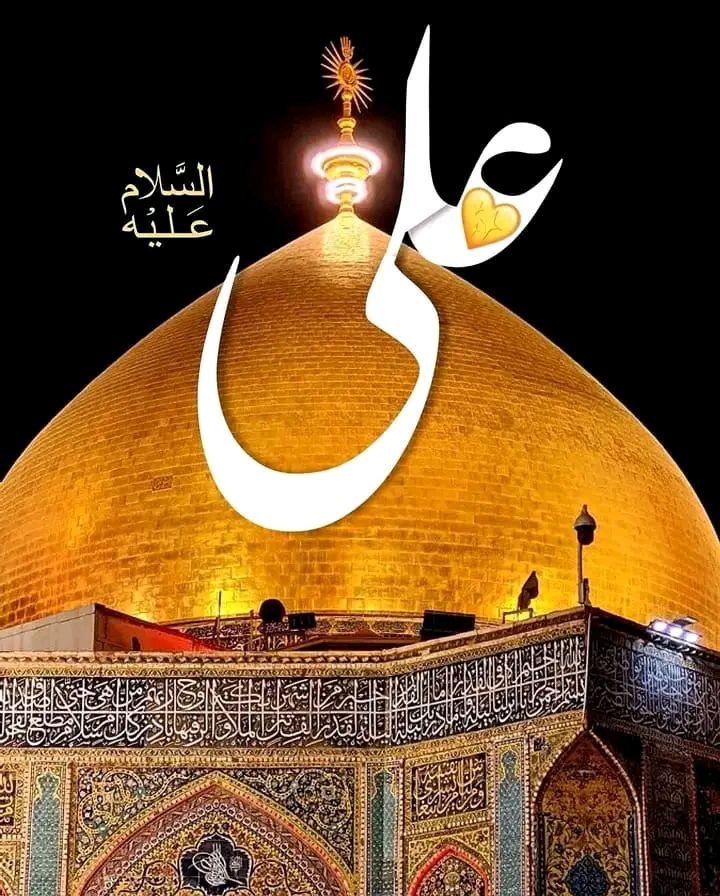
 Aal-e-Qutub Aal-e-Syed Abdullah Shah Ghazi