
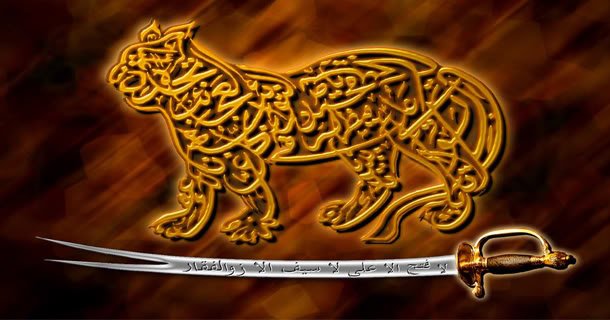


The Superiority of Ali as Revealed in the Qur’an
Since Ali was an ideal man, the one chosen by God to serve as a model to mankind, the Shi’ite traditions hold that some 300 verses of the Qur’an in which God has recognised his virtues, were revealed in Ali’s favour. Some of the most important verses are: –
59. O ye who believe! Obey Allah and obey the Apostle and those above you who are in authority; and if ye have a dispute concerning any matter, refer it to Allah and the Messenger if ye are (in truth) believers in Allah and the Last Day. That is better and more seemly in the end.” (4:59)

The commentators, while discussing the identity of those persons, who in this verse are described as “Those in authority above you’, maintain that they could not be any other save Ali and his descendants, the sinless Imams. The Sunnite traditions interpret them as the rulers of that time- a version which is rejected by the Shias on the ground that obedience to these secular rulers, who were fallible and whose decisions could be faulty, could not be enforced on believers, and subservience to them in wrongful acts being tantamount to the abetment of their impious actions. Hence, argue the , the Sinless Imams, inspired by divine knowledge are the only persons who could enforce Allah’s will and none save these can be the persons in authority.
33. Allah’s wish is but to remove uncleanliness far from you, O Folk of the (Prophet’s) household, and cleanse you with a thorough cleansing.” (33:33)
The commentators, on the authority of Ayesha, say that this verse was revealed to the Prophet early one morning when the Apostle of God was wrapped in a blanket in which he subsequently wrapped Fatima, Hasan, Hussain and Ali, the Prophet’s household as referred to in the above verse.
“61. And whoso disputeth with thee concerning him, after the knowledge which hath come unto thee, say (unto him): Come! We will summon our sons and your sons, and our women and your women and ourselves and yourselves. Then we will pray humbly (to our Lord) and (solemnly) invoke the curse of Allah upon those who lie.” (3:361)
This verse alludes to the deputation of the Christians of Najran who went to Medina to hold discussions with
the Holy Prophet on the truth of Islam. The Holy Prophet argued the case with them but, when all arguments were exhausted and they were still not convinced, he asked them to pray earnestly to invoke the curse of God on whichever side was lying. This verse refers to the fact that the Holy Prophet was accompanid by Ali, Fatima, Hassan and Hussain (people forming “the Prophet’s household”) and says that these came out as a party to conduct the “Mubalah” or religious discussion with the Christians. The Shias argue that this establishes the sanctity of Ali’s life otherwise the Prophet would not have called upon his daughter and sons to be witnesses
“3. And a proclamation from God and His Apostle to the people on the day of greater pilgrimage that Allah is free from obligation to the idola- .ters and (so is) His Messenger. So, if ye repent, it will be better for you: but if you are averse, then know ye that ye cannot escape Allah. Give tidings (O Muhammad) of a painful doom to those who disbelieve. (9:3)
This refers to an incident about the end of 631 A.D. when, during the absence of the Holy Prophet on an expedition to Tabuk, the idolatrous tribes, taking advantage of the Prophet’s absence, violated their treaties. The Holy Prophet ordered Ali to go on the “Greater pilgrimage” to Mecca and there announce publicly the verses of the Sura of “Immunity” in which God absolved the Muslims from all obligations under the treaties previously entered upon with the idolaters…
23. Say (O Muhammad unto mankind). I do not ask of you any reward for it but love for relatives and whoever earns good.” (42:23)
The traditions say that on the authority of Abdullah Ibn Abbas, at the time of the revelation of thisverse, when people asked the Holy Prophet as to who were the relatives alluded to in this verse, the Apostle of God said, “Verily they allude to Ali, Fatima, Hasan and Hussain.”
7. Thou art only a warner and a guide for every (13:7) people.”
On the authority of Abdullah Ibn Abbas, when someone, at the revelation of this verse asked the Holy Prophet as to what was the connotation of ‘Guide’ in this verse, he said, “Verily I am the warner and Ali is the guide.”
On another occasion, says a tradition, the Holy Prophet asked for some water to perform his ablutions. He then took Ali’s hand and having placed it on his chest said, I am the warner and then placing his own hand on Ali’s chest said, “Verily thou art the guide for all peoples. Thou art the inviter of the nations to truth and a commander of the believers in faith.” The traditions further argue that what can be said of Ali could be applied with greater emphasis to Ali’s descendants, the Imams, who were specifically initiated in the role of guide and accordingly vested with special authority.
“21. Nay!Do those who commit evil deeds suppose that we shall treat them like those who believe and do good-that their life and their death shall be equal? Bad is their judgment.” (45: 21)
Ibn Abbas says that the doers of good referred to in this verse are Ali, Humza and Ubaydah bin Harrith.
“17. Is he (to be counted equal with them) who relieth on a clear proof from his Lord and a witness from Him recitcth it, and before it was the Book of Moses, an example and a mercy? Such believe therein, and whoso disbelieveth therein of the clans, the Fire is his appointed place. So be not thou in doubt concerning it. Lo! it is the truth from thy Lord; but most of mankind believe not.”
(11: 17)
A’d Ibn Abdullah relates how, one day he witnessed Ali ascending the pulpit from where he delivered a sermon in which he said, “hardly is there a man from amongst the Quriash who has not been referred to in the Quran. At this some one rose up and asked Ali as to which was the verse of the Qur’an which alluded specifically to him. Then Ali recited the above verse and said it bore him reference.
your hearts . Now if both of you turn upto Allah repentant, it will be better for and you, already so inclined. But if you back up each other against him, surely Allah is his Helper and Gabriel and the righteous among the believers; and furthermore, all other angels too are his helpers.” (66: 4)
Ibn Abbas states that the Holy Prophet had also said that the righteous men alluded to as Helper in this verse referred to Ali.
“18. Is he who is a believer like unto him who is an evil-doer? Verily they are not equal.” (32:18)
Ibn Abbas states that this verse contains an allusion to Ali and Walid bin Utba, where the former is mentioned as a believer and the later referred to as a dis- believer.
“19. Do you hold the giving of drink to the pilgrims, and the maintenance of the Sacred Mosque soas equal to the works of him who believes in Other verses alluding to Ali’s superiority are:-
“7. Verily those who believe and do good works they are the best of creatures.” ” (98: 7)
Allah and the Last Day and striveth in the path of Allah? They are not at all equal in the sight of Allah. And Allah guides not the unjust people.” (9:19)
According to the tradition, the person referred to as “one who believes in God, and the Last Day and the one who fights in the way of God” is Ali.
“67. O Messenger (of God)! Convey to the people what has been revealed to thee from thy Lord; and if thou do it not thou hast not conveyed His Message at all. And Allah will protect thee from men. Surely, Allah guides not the disbelieving people.” (5:67)
According to the commentators, this verse alludes to the proclamation of the Holy Prophet at Ghaidar Khum where, according to their interpretation, Ali was declared the successor of God’s Apostle. Here the Holy Prophet is enjoined to give wide publicity to this divine injunction.
“207. And of men there is he who would sell himself to seek the pleasure of Allah and Allah is compassionate to His servants.” (2:207)
“16. Which is it, of the favours of your Lord, that ye deny? 17. The Lord of the two Easts and the Lord of two Wests! 18. Which is it, of the favours of your Lord that ye deny? 19. He has made the two bodies of water flow. They will one day meet. 20. There is now a barrier between them; they encroach not one upon the other. 21. Which, is it, of the favours of your Lord that ye deny? 22. There come out from them pearls and coral.” (55 16-22)
Uns bin Malik in his commentary on these verses says that the “two seas” here referred to allegorically, represent Ali and Fatima and their pearls and corals are Hasan and Hussain.
“83. My Lord! Bestow wisdom on me and join me with the righteous.” (26:83)
The “righteous” person here is Ali, in contradistinction to the arch-enemy of the Prophet, Abu Jahl, referred to in the next verse quoted below:-
“1. In the name of Allah, the Gracious, and the Merciful. 2. By the fleeting time. 3. Surely man is in a state of loss. 4. Except those who believe and do good works, and exhort one another to accept truth, and enjoin on each other to be steadfast and patient.” (103:1-4)
“1. By the star when it setteth. 2. Your comrade erreth not, nor is deceived. 3. Nor does he speak of his own desire.” (53:1-3)
The commentators allege that one day, the Holy Prophet was sitting amidst a circle of several Quraish when all of a sudden a star broke from the sky. At this, the Prophet said that the person in whose house it would fall, would be my “Wassi” (testator). It fell in Ali’s house and thus according to their interpretation he became the Holy Prophet’s testator.
“54. And He it is who created man from water, and hath appointed for him kindred by blood and kindred by marriage; and thy Lord is All-Powerful.” (25:54)
The relationship in blood and marriage, say the traditions can only refer to Ali, who was the first cousin and son-in-law of the Holy Prophet.
“47. And We shall remove whatever rancour may be in their breasts, so that they will become like brothers, seated on thrones, facing one another.” (15:47)
The Shi’ite traditions say that the Holy Prophet one day told Ali that he with his wife Fatima will rest with him in paradise on the Day of judgment.
“43. Establish worship, pay the poor rate and bow down your heads with those who bow (in worship).” (2:43)
The Shi’ite traditions claim that this verse was revealed to exalt the glory of the Holy Prophet and Ali, who were the first to bow down in prayers.
“41. And if We take thee away. We shall surely exact retribution from them.” (43: 41)
On the authority of Jabir ibn Abdullah it is stated that the Holy Prophet said that this revelation referred to Ali who would subsequently prove to be the avenger of wrong-doers after the Prophet’s death.
36. (This lamp of light) is lit in houses which Allah hath allowed to be exalted and that his name be remembered in them. There in is He glorified in the mornings and evenings.”
(24:36)
On the authority of Uns ibn Malik the Holy Prophet is stated to have said that the “houses” referred to in this verse included the house of Ali and Fatima.
“61. Is he, then, to whom We have promised a goodly promise the fulfilment of which he will meet, like the one whom We have provided with the good things of this life and then on the Day of Resurrection he will be of those who will be brought arraigned before God?” (28:61)
The commentators hold that this verse was revealed in favour of Ali and Fatima.
“55. Your friend is only Allah and His Messenger and the believers who observe prayer and pay the poor rate and bow down in prayers.” (5:55)
The traditions maintain that at one time, while Ali and the Holy Prophet were offering prayers in a Mosque, a supplicant came and said, “O God, bear witness that I have asked every one of the congregation to give me something in alms but none has offered anything.” Ali who prostrated on his prayer mat at that time held out his finger, which bore a ring and pointed out towards the beggar, who took it off. It was at this juncture that this verse was revealed. The Prophet is also said to have predicted that, like find Moses’s brother Aaron, his cousin Ali would support in his descendants.
“12. O ye Who believe! When you consult the Messenger in private, give alms before your consultation. That is better and purer for you. But if you do not find (the wherewithal) then lo! Allah is forgiving and Merciful.”
(58:12)
At the revelation of this verse, the Holy Prophet asked Ali to tell the people to give charity before seeking audience with him. Ali told the Prophet, that the people, being poor, could not give alms. Then the Prophet told Ali to persuade people to give just one
“Dinar” (the coin then prevalent in Arabia) in alms. When Ali said that they were unable to give even that much, the Prophet reduced the amount to half a dinar and when this was also objected to, the Prophet reduced the alms still further. It was thus in answer to the pleadings of Ali that the amount of charity was so fixed as to come within the reach of all and sundry.
“8. And you shall be divided into three groups; 9. First, those on the right hand-how lucky are those on the right hand; 10. Second, those on the left hand how unlucky are those on the left hand-11. Third, the foremost; they are the foremost; 12. Those are they who will have achieved nearness to God.”
(56:8-12)
The traditions allege that when Ibn Abbas asked the Holy Prophet the explanation of these verses, he replied that they alluded to Ali when on the Day of Resurrection the doom of men would be pronounced.
“58. Verily, those who malign Allah and His Messenger-Allah has cursed them in this world and in the Hereafter, and has prepared for them an abasing punishment. (33: 58)
According to Ibn Salman this verse was revealed when the hypocrites of Medina were harrasing Ali.
“181. And of those We have created there are people that guide men with truth and do justice therewith.” (7:181)
The traditions allege that Ali used to say that the Muslims would be divided into 73 sects, of which 72 sects would be doomed to hell and the right ones (i.e. the followers of Ali alone) would enter the Paradise.
“29. Those who believe and do right: Joy is for them and bliss their journey’s end.” (13:29)
This verse, according to the commentators, also alludes to Ali and his followers.
17007 “6. The Prophet is nearer to the believers than their own selves, and his wives are as mothers to them. And blood relations are nearer to one another, according to the Book of Allah, than the rest of the believers from among the Helpers as well as the Emigrants except that you show kindness to your friends. That also is written down in the Book (of nature).”
On the authority of Ibn Abbas it is related that this verse also, as does the one quoted next, relate to Ali.
47 “89. Whoso does a good deed shall have a better reward than its worth; and such are safe from terror that day. 90. And those who bring an ill deed shall be thrown down on their faces into the fire: Are you rewarded aught save what ve did?” (27:89-90)
57. And when the son of Mary (Jesus Christ) is cited as an example, lo! the people jeer there- at.” (43:57)
The Prophet is said to have told Ali one day that the later’s example would be like that of Jesus Christ. A. section of people would love him so much that it would willingly perish in hell-fire for him, while the otder section who would show hatred to him would be doomeh similarly.
“101. Lo! As for those for whom the promise of a good reward has already gone forth from us, these will be removed far from it”. (21:101)
372
“19. Then, as for him who is given his record in his right hand he will say, “come read my record.”
(69:19)
According to the commentators the one who will handle the record will be Ali.
“43. And We sent not as Messengers before thee but men to whom We sent revelation, so ask those who possess the Reminder, if know not. ye (16:43)
commentators add that the mention of “Zikar” or “Reminder” in this verse applies to learned men, especially to Ali.
32. Those who disbelieve and hinder men from the way of Allah and oppose the Messenger after guidance has become messenger to shall not harm Allah in the least; and He will make their work fruitless.” (47:32)
According to Imam Abu Jafar, this verse refers to those people who disputed with the Holy Prophet about Ali and his title to piety and succession.
“29. Muhammad is the Apostle of God. And those with him are firm against the dis- believers and merciful amongst themselves. Thou (O Muhammad) seest them bowing down and prostrating themselves in prayer, seeking grace from Allah and His pleasure.. Their mark is upon their faces, being the traces of prostrations. Such is their description in the Torah. And their description in the Gospel is like unto a seed-produce that sends forth its sprout, then makes it strong; it then becomes thick, and stands on its stem, delighting the sowers-that He
may cause the disbelievers to burn with rage at the sight of them. Allah has promised, unto those of them who believe and do good works, forgiveness and a great reward.” (48:29)
According to the commentary of Imam Abu Musa, this verse was revealcu in Ali’s favour.
“43. And those who disbelieve say, “Thou are not a Messenger” say “Sufficient is Allah as a witness between me and you, and so is he who possesses knowledge of the Book.” (13:43)
According to the interpretation of Muhammad bin Hanfia the phrase ‘Whosoever has the knowledge of the Book alludes to Ali.
*2. Those who disbelieve from among the people of the Book and the idolaters would not desist from disbelieving until there came to them clear evidence. 3. A Messenger from Allah, reciting unto them the pure scriptures. 4. There in are lasting commandments. 5. And those to whom the Book was given did not become divided until after clear evidence had come to them. (98:2-5)
The commentators assert that by the phrase “clear-proof” in these verses is meant the Holy Prophet and the phrase “clear evidence” designates Ali and his descendants.
“64. O prophet! Allah is sufficient for thee and (for) such of the believers as follow thee.”
(8:64)
According to Imam Muhammad Baqir, this verse was also revealed in Ali’s favour.
374
“3. (I swear) By the Even and the Odd.” (89:3)
According to the commentators, “Even” in this verse stands For Hasan and Hussain (sons of Ali) and “Odd” stands for Ali.
33. But Allah would not chastise them while thou wert among them, and Allah would not punish them while they sought forgiveness.” (8:33)
The commentators interpret “thou wert among them” as the descendants of Ali, who are the mainstay and the prop of God’s message on this earth.

 Aal-e-Qutub Aal-e-Syed Abdullah Shah Ghazi