
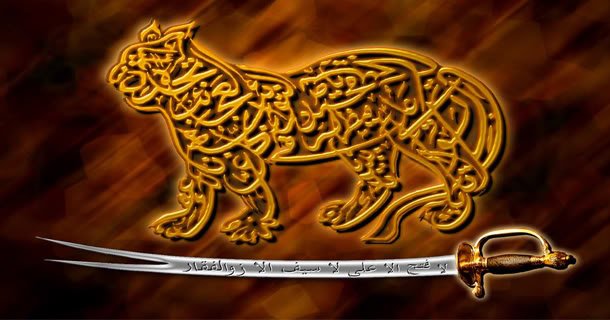


The Battle of the Camel or Khuraiba, the 10th Jamad-al-Thani 35 A.H. (December 4th, 656 A.D.)
The two armies were encamped in the Wadi-us-Saba or ‘Valley of the Lion’ near the village of Khuraiba outside Busra, facing each other. When the regicides from Ali’s army fell upon the confederate camp great confusion arose. Neither side knew which of them had played false and attempts by both Ali and Aishah to stop fighting failed. Aishah, on the advice of some of her followers, went so far as to mount her camel and ride and down the ranks, urging the men to up battle. Some chroniclers say that it is in commemoration of this effort of hers to stop fighting that the battle is called “Jamal” or “Camel”. cease
Behind Aishah, rode a warrior holding the Qur’an aloft, but he was killed by an enemy arrow, falling to the ground with the Holy Book. Meanwhile the fighting amongst the ranks grew ever fiercer. It was a terrible thing to see Muslims cutting the throats of their brother Muslims and the Arab world once again split into factions. Sir William Muir’ writing about the battle, points out the strange nature of the engage- ment:-
“It was a strange engagement-the first in which Muslims had crossed swords with Muslims. It resembled a battle of the old Arab times, only that, for tribal rivalry, were now substituted other passions. Clans were broken up, and it became in some measure a contest between the two rival cities. The Ban ar-Rabi’a of Kufa fought against the Banuu ar-Rabi’a of Busra, the Banu Modar of the one against the Banu Modar of the other, and so on, with the various tribes, and even with families, on one part arrayed against the other. The Kufan ranks were urged on by the regicides who felt that, unless they conquered, they were all doomed men. The fierceness and obstinacy of the battle can be only
1. Sir William Muir-The Caliphate, its Rise Decline and Fall p. 248 Publishers, John Grant, Edinburgh. Ed. 1924.
thus accounted for. One of the combatants tells us that “when the opposing sides came together breast to breast with a furious shock, the noise was like that of a washerman at the riverside.”
Death of Talha and Zubair
Sir William Muir then goes on to contrast the fury of Ali’s troops with the half hearted attitude of the Meccan leaders. “The attitude of the leaders was in marked contrast with the bitter struggle of the ranks. Zubair, half hearted after his interview with Ali, left the battlefield according to his promise, but while on his way to Mecca, Zubair came across the detachment cf one Hanif Ibn Qais, who had remained neutral in the course of war, and was watching the course of the battle, anxious to join forces at the eleventh hour with the conqueror. Hanif was more inclined towards Ali than towards any of the Meccan confederates and when he saw Zubair passing in front of him, ordered his men to chase him. One of Hanif’s soldiers, Amr, followed Zubair, overtook him, and brought him before his master. They came face to face and began to converse with each other. Realising that the time of prayers had come, Zubair began to offer them. When he prostrated himself, Amr with one blow of his sword chopped his head off from his body. So, say the Sunnite writers, fell Zubair, attaining the death of a martyr-a man who could not give up prayers in his last hours.
Talha, meanwhile, disabled by an arrow in the leg, had been carried to safety in Busra. The house where he lay was one of the last to hold out against Ali’s men but Talha was to live only a short while longer. Mortally wounded and feeling his end to be near, he sought to renew his allegiance to Ali, calling out to one of Ali’s men, who was passing hideout, to approach him. Asking he man to come nearer, Talha then said, “Stretch forth your hands so as to enable mine to be put forth in and thus will I renew the oath of allegiance which I have yours
already taken to Ali.” No sooner had he uttered these words than he gave up the ghost.
Carnage in the Battle of Camel
Back on the main field of battle Aishah continued to plead with their troops to stop the carnage, but in vain. The dead and the dying lay piled in heaps and the appalling slaughter continued, until, bereft of the leadership of Talha and Zubair, the frenzy of the Meccan confederates began to abate, and they began to take stock of their position. The battle, they suddenly realised had reached a critical stage for them, also the Mother of the Faithful was in grave, personal danger. The Meccans, now much sobered, began to form a cordon around Aishah’s camel. For the regicides of Ali’s army this camel now became the main target. Showers of arrows were loosed at the beast which, Ali quickly saw, had now become the rallying point for the Meccan forces. Wherever the camel stood, there the battle was waged most fiercely and over seventy confederates are said to have lost their hands while holding its bridle. As long as that animal was standing, Ali realised, would the battle continue. He therefore deputed one of his men to cut off its legs. The warrior slipped behind the camel, did as he was bidden, and the poor beast thudded to the ground. Within a very short time the bugle sounded the end of battle. Alí, as always, having proved himself a master tactician.. Aishah escaped with her life, although the litter in and Ali
which she had been sitting was so stuck with arrows and javelins that it looked like a hedgehog. It was lifted off the back of the dead beast and Aishah was borne to the safety of a nearby tent.
All’s treatment of Aishah
After the battle, Ali repaired to Aishah’s cam where he treated her with the greatest deference, said he, “respect must be shown to her because she is the spouse of the Holy Prophet in this life and in the life to come.’ Aishah, who had at this time, reached the age of forty five an age which by the Arab standards of the day might be considered advanced, was still very vigorous. When Ali, in his greeting to her said, “May the Lord show mercy to thee, and forgive thee for what you have done. “She retorted without the slightest sign of repentence, “And to thee, also”.
Aishah’s brother Muhammad son of Abu Bakr, who had fought bravely for Ali also went to Aishah’s camp to visit his sister and was overjoyed to discover that she had escaped without injury, though quick to point out to her how meaningless had been the conflict which she had done so much to provoke.
In the care of her brother, and under the command of his own two sons Ali then sent Aishah to Medina. She was shown every deference and given forty handmaids. Ali himself accompanied her retinue on foot for a short distance, before bidding her farewell. “It befits your dignity”, Ali said to her, “to remain in your house and not to meddle in politics or to share the rough life of the battlefield, nor to join any party in future which may tarnish the glory of your name, or become the authoress of a second rebellion.” To this Aishah replied, “By God! there existed no enmity between Ali and me, save a few petty domestic squabbles.” Ali replied, “Ye People! the Mother of the Faithful has spoken the truth. There existed no difference between her and me, except a few petty quarrels of the family.” led a life of seclusion,
On her return to Medina, Aishah devoting most of her time to the compilation of “Sunna” (traditions of the Holy Prophet) and becoming one of the chief sources of the Traditions or Table Talk of Muhammad (may peace be upon him). She is said to have died in 678 A.D., at the age of sixty-six.
Ali Grieves for the Fallen
With the capture of Aishah the battle soon came to aclose. Some of the Busarites had already gone over to Ali’s side, under the leadership of Ibn Qais, who had intercepted Zubair. Those that remained, rapidly lost heart and fled. Ali ordered his men not to pursue the fleeing enemy and his forces soon left the field, completely victorious.
Just before sunset, Ali went out to inspect the battleground, which was piled high with some ten thousand corpses. Among the fallen were many outstanding heroes of Islam who had fought in the wars of the Holy Prophet. Then they had been companions-in-arms of Ali, fighting with him on the same side, the side of Islam. Deeply moved, Ali offered funeral prayers for all the slain before they were laid in their graves.
When Amr, who had killed Zubair, came to Ali and, in the expectation of a great reward, presented him with the head of the rebel leader, the sight of the gory head of the old warrior, who had been a faithful friend of the Holy Prophet was too much for Ali to bear. Unable to hold back his tears, he said to Amr, “Verily your lot is hell-fire”. Amr greatly surprised at this unexpected turn of events replied with some heat, “You are an evil judge of men. If someone delivers you from your enemies, you pronounce the judgment of hell- fire on him; and if any one kills your followers he becomes the friend of the devil.” Bitterly resenting what he felt to be a great injustice, Amr then drew his sword and, without uttering another word plunged it into his own breast. So passed away the murderer of Zubair without any remorse for what he had done.
Sir William Muir’ on the Battle of the Camel
Sir William Muir comments on the Battle of Camel as follows:-
“The carnage in the ill-starred Battle of the Camel (for so it came to be called) was very great. The field was covered with 10,000 bodies in equal proportion on 1. Sir William Muir -The Caliphate, its Rise, Decline and Fall. p. 250.either side, and this, notwithstanding that the victory was not followed up. For Ali had given orders that no fugitive should be pursued, nor any wounded soldier slain, nor plunder siezed, nor the privacy of any house invaded. A great trench was dug, and into it the dead were lowered, friends and foes alike. Ali encamped for three days without the city, and himself performed the funeral service. It was a new experience to bury the dead, slain in battle not against the infidel but Believer fighting against Believer. Instead of cursing the memory of his enemies (too soon the fashion in these civil wars), Ali spoke hopefully of the future state of such as had entered the field, on whatever side, with an honest heart. When they brought him the sword of Zubair, he cursed the man who took his life; and, calling to mind the feats displayed by the brave man that wielded it in the carly battles of Islam, he exclaimed:-
“Many a time hath this sword driven care and sorrow from the Prophet’s brow. The Muslims might well mourn the memory both of Talha and Zubair, remembering how on the field of Uhud, the former had saved the life of the Holy Prophet at the peril of his own; and how often the latter had carried confusion into the ranks of the idolaters of Mecca.
Ali’s treatment of the people of Busra
Ali was determined to show mercy to the people of Busra, and, when some of his followers said, “Since the people of Busra had taken up arms against the lawful Caliph the survivors ought to be distributed as slaves. amongst the soldiers of the army”, Ali refused to accede to their request. “I cannot allow you”, said he “to make slaves of Muslims in “Dar-ul-Islam”. Whatever arms and equipment the Busarites brought on the battlefield to fight against us, can be treated as “Ghanima” (booty captured on the battlefield) but whatever lies in their homes belongs to them, and you are not entitled to any share in it.”

 Aal-e-Qutub Aal-e-Syed Abdullah Shah Ghazi