
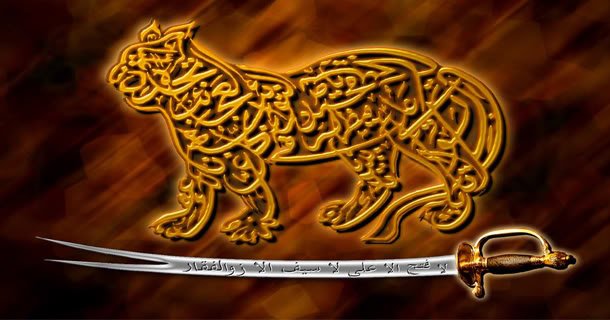


Ali Nurses the Holy Prophet
Nabi Pakﷺ (may peace be upon him) had remained in the rear, to direct operations when the Muslim soldiers were fighting in the front. He ﷺ was practically
alone when a squad of the Meccan forces, led by Ibn Qami’a, attacked him. He ﷺ was wounded. He lost two teeth, and the chain of his ﷺ helmet cut so deep in his cheek that the loss of blood rendered him unconscious. Umar and Abu Bakr carried him from the ditch where he was lying to a nearby cleft in the rock, to be looked after.
When Ali AlaihisSalam heard that his master had been wounded, his first thought was for the well-being of the Holy Prophet. He took water to him in his shield and dressed his wounds, taking no heed of the wounds that he himself had sustained in battle. Assured that the Holy Prophet ﷺ would recover he then returned to the Muslim forces who had been further demoralised by a rumour that the Holy Prophet ﷺ was dead. Abu Sufyan, exploiting this lie to the full could be heard saying at the top of his voice, “We are well rid of him” to which Umar shouted in reply, “He is alive and ready to meet you at any time”.
Heartened by this good news and encouraged by the return of Ali AlaihisSalam the Muslims now began to rally their scattered forces, with the result that the Quraishites did not seek to press their advantage any further. Instead of continuing to pursue the vanquished Muslims they turned round and went back to Mecca.
Meanwhile Nabi Pakﷺ repaired to the battlefield which was strewn with the corpses of the slain: He ﷺ ordered that none of the corpses should be moved, but that martyr’s tombs should be built on those very spots. where they lay.
The Qur’an alludes to the battle of Uhud:-
“152. Allah verily made good His promise unto you when ye routed them by His leave, until (the moment) when your courage failed you.and ye disagreed about the order and, ye dis- obeyed, after He had shown you that for which you long. Some of you desired the world, and some of desired the Hereafter. Therefore. He made flee from them, that He might try you. Yet now He hath forgiven you. Allah is Lord of Kindness to believers. you you
a 153. When ye climbed (the hill) and paid no heed to any one, while the Apostle, in your rear, was calling you (to fight). Therefore He rewarded you grief for (his) grief that (He might teach) you not to sorrow either for that which ye missed or for that which befell you. Allah is informed of what you do.” (3:152-153)
Those Muslim soldiers that survived had learnt a bitter lesson. Yet they might still rejoice, for the Holy Prophet was still alive to lead them and Islam would not perish. The heroism of Ali had kept the remnants of the Muslim force together and when the Quraishite victors had departed from the field to go back to Mecca they had left behind a band of Muslims more deter- mined than ever to preserve the of God. way

The Battle of Ditch. 627 A.D.
In 627 A.D. Abu Sufyan again invaded the Muslim capital of Medina this time with an army of 10,000 strong. The Meccan forces consisted of the men of the Banu Ghatfan, the Jewish tribes of the Banu Nadir, and their confederates and the Bedouin nomads of the desert. With such odds, Abu Sufyan felt proud and confident of victory. He was sure that the moment he met the Muslim army he would annihilate them, root and branch. Prophet Muhammad ﷺ (may peace be upon him) could muster only three thousand men and a cavalry of fifty ill-equipped horse, which left him no alternative but defence.
On the advice of his famous follower, the Persian, Salman, who was well acquainted with the condut of siege-warfare, the Holy Prophet agreed to dig a deep moat around the city of Medina, so wide that no enemy horse could leap across. The Muslims set to work, led by the Holy Prophet ﷺ himself. Stripped to the waist, perspiring in the extreme heat, his hair flowing over his shoulders, Ali worked day and night at the digging, flexing his mighty muscles to the rhythm of the songs his fellow-workers sang as they toiled to complete the excavation in time. Behind this moat the Muslim army took up its position.
The moat proved well-nigh impregnable, defying for several days all attempts by Abu Sufyan to get horse- men across it. The Meccan leader seeing the impossi- bility of taking Medina by storm, looked for another way to secure victory and began negotiations with the Jewish tribe of the Banu Qureiza. He offered them large bribes to desert Muhammad and deliver the city from within, into the hands of the Meccans.
“While waiting for the Banu Qureiza,” says Col Bodley, to make up their minds to deliver the city to him, Abu Sufyan had ordered a general assault on the moat. Three Quraishite warriors, Ikrima, the son of Abu Jahl, A’mr ibn wudh and Naufal, who had been the leader of the famous caravan which Ibn Jahsh had attacked during the sacred month before the battle of Badr, had managed to jump their horses over a narrow part of the moat. They had been followed by a few others. It was a tense moment for Nabi Pakﷺ and his men and might have led to defeat. But before. panic could spread, Ali AlaihisSalam and a group of swordsmen cut off the invaders, who thus found themselves trapped. There was a slight lull on both sides, broken by A’mr and his companions demanding the right to settle things by single combat.”
“Ali immediately sprang forward and faced A’mr. Ali was not afraid and flung himself at the Meccan, who had dismounted and waited, gorgeous in his armour, his white beard sweeping his cuirass. He came in low and, with a sweeping slash of his scimitar he cut off A’mr’s leg. The vener- able Quraishite stood for a moment, tottering on one foot, denouncing Ali and his family. Then, picking up the severed limb, he flung it at Ali with all his force. It was his last gesture. Ali was nearly stunned, but in a moment he had recovered and plunged his sword into A’mr. meantime other duels had been taking place.
In the Sa’d ibn Muad had been wounded, and Naufal, in Az-Zubair trying to retreat, had fallen in the moat. Ikrima had managed to get back to his side of the trench with a javelin wound. Some of the others had been killed, some had escaped. On the whole, therefore, what had been, so far, only hand to hand encounters in the battle for Medina had been a Muslim victory.”
Abu Sufyan’s greatly-desired alliance with the Jewish tribe of the Banu Qureiza did not in the end, materialise, owing to suspicion on both sides. Finally nature came to the help of the Muslims with drenching rain and icy winds. The tent-fires of the Meccans were extin- guished in the downpour and they were obliged to teke sodden, uncooked food. Their morale was already low when a wild storm of wind ripped up their tents. Abu Sufyan ordered a retreat at the dead af night leaving behind him, as witnesses to his ignominious defeat a number of dead animals and a few flattened tents.
Once more Islam and Medina had been saved by the superior valour of Ali AlaihisSalam. The Holy Prophet is said to have remarked on this occasion, “al-Mubarazat Ali bin Abu Talib, A’mr ibn Ubdu Yomu’l Khandiq afzal-o-min amali Ummati’l Yoma’ Qayama.” (Ali bin Abu Talib’s duel with A’mr bin Ubdu, on the day of the Battle of the Ditch, surpasses the prayers of the believers. that they would perform until the day of Resurrection.)

 Aal-e-Qutub Aal-e-Syed Abdullah Shah Ghazi