

Operations against the Banu Nadir (June to July 625 A.D.)
The defeat and expulsion of the Banu Qainuqa was felt keenly by the other Jewish tribes living in or around Medina. Kab bin Ashraf, the notorious poet of the Banu Nadir, began to lampoon Muhammad ﷺ (may peace be upon him) in verse. Not satisfied with these somewhat slight compositions, he next went to Mecca, where he composed elegies on the Meccan warriors who had been killed at Badr in an attempt to incite them to retaliate for their defeat on that occasion. On his return to Medina, he was killed by the Muslims but the work. of sowing discord was now taken up by another Jew of the Banu Nadir, Abu Rafi Sallam bin Abul Haqaiq. Abu Rafi who lived in the Jewish stronghold of Khyber, some
five day’s journey by camel to the north west of Medina, successfully incited the neighbouring Arab tribes of Sulaim, and Ghatafan to rise against the Prophet ﷺ
Continual threats of this nature made the defence of the city-state of Medina imperative, for the very exis- tence of the Islamic community was at stake. Chiefly relying on the support of Abdullah bin Ubayy, the leader of the “Hypocrites,” the Jews were now openly defying Nabi Pakﷺ authority and a call from him to mend their ways produced only a defiant answer.
By this time the numerous breaches of faith on the part of the Jewish tribes had placed them outside the protection of the defensive alliance into which, under the terms of the Medina charter, they had entered with Nabi Pakﷺ. The Holy Prophet ﷺ need have felt no compunction at making war upon them. Nevertheless, ever anxious to avoid useless bloodshed, Nabi Pakﷺ resolved to make one last effort at negotiation, deciding to go in person to their stronghold.
Accompanied by a small band of unarmed followers, he ﷺ set up camp just outside the walls of the Jewish citadel, but his desire to avoid the use of force was wrongly interpreted by the Jews as a sign of weakness and they treacherously plotted to kill him. The Prophet ﷺ getting news of their intention, which was for a Jewish soldier on the ramparts to hurl a stone at his forehead, decided to withdraw. He now realised that the Jews were des- perate and that conciliation would no longer be possible but, as his men were unarmed, he ﷺ decided to conceal his suspicions rather than precipitate a struggle in which all the advantages would be with the enemy.
Meanwhile Ali AlaihisSalam, alert as ever, received intelligence that a party of the Jews, led by Urwa bin Anis, meant to fall on the Muslims that night. Ali waited in conceal- ment and when, at nightfall the Jewish soldiery came out, intercepted them. In his first duel he sliced off Urwa’s head. He then continued to give battle to Urwa’s followers, fighting single-handed in the darkness until God sent succour in the form of Muslim soldiers, Abu
Duj’jana Ansari and Suheil ibn Hanif, who had come out to forage in the enemy territory. With the arrival of this unexpected reinforcement Ali AlaihisSalam found new strength, continuing to fight on until the major portion of the Jewish contingent had been killed and the remainder had fled back into the citadel.
Ali AlaihisSalam then returned to the Muslim camp to begin a siege of the Jewish stronghold, which according to Tabri, lasted for eleven days. When the Jews saw that total starvation faced them, they surrendered. They agreed. to evacuate the citadel, and once again the Muslims. allowed them a free passage to emigrate to Syria or else- where. They were allowed to take all their movables. with them except their arms but their immovable pro- property was distributed among the “Muhajarians” (Emigrants of Mecca) according to custom.
In these campaigns against the Jews Ali AlaihisSalam had, once again, played an inestimable part in saving the life of the Holy Prophet ﷺ and in routing the enemies of Islam.
Ali AlaihisSalam the Warrior
Much of the credit for the Muslim victories in these campaigns, as at Badr, must go to Ali AlaihisSalam Here he had already begun to show those heroic qualities that were to make his name a legend. Tales abound in Muslim literature of his impetuous courage, his mighty strength with sword and scimitar, and his dauntless valour. To his physical prowess were added qualities of mind and spirit that contributed still further to the terror in which he came to be held by the rank and file of the enemy. forces. Time and again he was to lead his warriors to victory when, to a lesser man, defeat would have seemed a certainty. Nothing would persuade him to leave the field of a battle no matter how hopeless a situation might be. He fought in all save one of the wars of the Holy Prophet ﷺ and his presence on the battlefield embodying as it did the very spirit of devotion to Islam, proved a continuous source of inspiration to the Muslim forces
under his command.
The Physical Appearance of Ali AlaihisSalam
Ali AlaihisSalam was not a tall man, but of middle height. Such records as exist describe him as muscular, broad, burly-an impressive rather than a handsome figure. He had, however, a superb head, with a face as noble as the man himself. His nose was straight and his mouth beautifully formed. His eyes were his most commanding feature, being full of light and lustre, and his whole being exuded a strong, personal magnetism. The mobility of his face reflected the recep- tive mind and fiery vigour of this warrior-hero but when his face was in repose all who came into contact with him received an ineffaceable impression of spirituality.
This intangible quality, this profound and magnetic personality remained with him as did his musical and commanding voice.
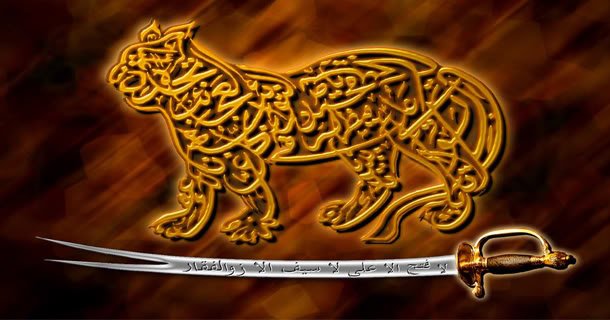
The Ali AlaihisSalam was hand- some, impetuous, full of fiery vigour, truly the “Haidar” or “lion” of Muslim heroes.
1. Dr. Will Durrant-The Age of Faith, p. 192. Publishers Simon and Schuster. Edition 1950.

 Aal-e-Qutub Aal-e-Syed Abdullah Shah Ghazi