

On Friday the seventeenth of Ramadan, the major battle at Badr took place.
It was the decisive battle that determined the fate of the Islamic alb nation and upon which the spiritual fate of humanity depended..com Allah called this battle ‘the Day of the Criterion’, as all the future conquests and victories that ensued, and all the nations and the governments that were established later, are indebted to the manifest victory on the battleground of Badr. He said, ‘If you believe in Allah and [in] that which we have revealed to our slave [the Prophet] on the Day of the Criterion: the day when the two forces met [in battle]’ [Qur’an 8: 41].
The expedition started when the Messenger of Allah ﷺ heard that Abu Sufyan ibn al-Harb was coming from the Levant [Shām] in a great caravan of Quraysh’s that was carrying their wealth and merchandise. With the ongoing war between the Muslims and the Qurayshi polytheists, Quraysh did not spare any effort in combating Islam, continuing to be an impediment in the way of [spreading the religion of] Allah and laying obstacles in the way of the Muslims, and spending their wealth and everything they possessed of power, might, weapons and horses in combating Islam and weakening the morale of the Muslims; indeed, their troops would reach the borders of Medina and its pastures.
When Allah’s Messenger ﷺ heard that Abu Sufyan – who was the most vehement enemy of Islam and the Messenger of Allah ﷺ was approaching from Shām and leading this caravan, he exhorted the people to come out to confront it; however, since it was merely a caravan and not an all-out war, he did not pay too much attention to it.
When news reached Abu Sufyan of the Messenger of Allah’sﷺ departure in pursuit of him, he sent a message back to Mecca, asking Quraysh for help in protecting him from the Muslims; his cry for help reached the people of Mecca, and so they prepared themselves and quickly arose with none of their nobles staying behind. They mobilised the Arab tribes around them, such that none of the sub-tribes of Quraysh stayed back except for a few; and they came with zeal and fury.
The Messenger of Allah, ﷺ among three hundred and thirteen men, set out quickly. They had only two horses and seventy camels: two to three men would take turns on a single camel; there being albiano distinction in that between a soldier and a commander, aom follower and a leader. Among them was the Messenger of Allah , Abu Bakr, ‘Umar and other senior Companions.
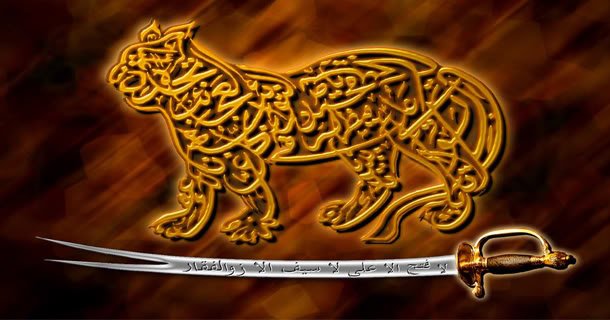
He gave the banner (liwa’) to Mus’ab ibn ‘Umayr, the flag (rāyah) of the Migrants to ‘Ali ibn Abi Țālib AlaihisSalam and the flag of the Supporters [Anṣār] to Sa’d ibn Mu’ādh.
Abu Sufyan heard that the Muslims had left [to confront them] and so he laid [his army] low and escaped to the seashore. When he saw that he had escaped and his caravan was safe, he wrote to Quraysh, telling them to return, as they had [only] set out to protect the caravan. They were about to return; however, Abū Jahl refused to let go of the fight. The Quraysh were between a thousand and more, and amongst them were their chiefs and leaders and their cavalry and brave men. The Messenger of Allah ﷺ said, ‘This is Mecca that has cast out to you its sons.’
On that night, Allah, the Mighty and Majestic, sent down rain, which came down heavily upon the polytheists and stopped them from advancing; whereas for the Muslims, it was a source of mercy, as it softened the ground, hardened the sand, made their feet firm
and strengthened their resolve; in His Most High’s words, ‘and He sent down upon you water from the sky to purify you with it, to remove from you Satan’s impurity and to make your hearts resolute and your feet firm’ [Qur’an 8: 11].
A tent was pitched for Allah’s Messenger ﷺ on a hillock wherein he could supervise the battle. He walked on the battlefield and began to point with his hand, saying, ‘This is the place where So- and-so will be killed; this is the place where So-and-so will be killed and this is the place where So-and-so will be killed, if Allah wills’; thus, not one of them met their final fate except that it was the spot to which he had pointed at.
When the polytheists appeared, and the two groups saw one another, the Messenger of Allah ﷺ said, ‘O Allah, this is Quraysh, who has come displaying its arrogance and pride, who has come forth waging war against you and disbelieving in your Messenger.’
The two groups took their positions. The Messenger of Allah ﷺ straightened the lines, and then, together with Abū Bakr, returned to the tent. The Messenger of Allah ﷺ was profusely beseeching, a humbly pleading and praying, saying, ‘O Allah, fulfil what you have promised me. O Allah, Your support,’ raising his hands to the air until his cloak fell off his shoulders; Abu Bakr began to console and take pity on him.
Then Allah’s Messenger ﷺ came out [of the tent] to the people and spurred them on to fight. The people crowded together, coming close to each other, and the polytheists came forth. Thereupon, Allah’s Messenger ﷺ said, ‘Rise to [attain] a garden, whose breadth is the heavens and the earth,’ as the people stood in their positions, determined and profusely remembering Allah. The Messenger of Allah ﷺ fought intensively and was the nearest to the enemy and the most heroic on that day. Allah sent down the Angels as a mercy and a reinforcement, and they fought the polytheists; in His Most High’s words, ‘When your Lord inspires the Angels, “I am with you, so consolidate those who believe; I shall cast terror in the hearts of those who disbelieve, so strike above the necks, strike them on every joint” [Qur’an 8: 12]. The young men vied with one another in who amongst them would attain martyrdom and felicity.
The battle ended with the believers victorious and with seventy of the disbelievers killed; amongst them the chief of polytheism Abū Jahl, ‘Utbah ibn Rabi’ah and his brother Shaybah and his son al-Walid; and seventy of the polytheists were taken prisoners.
Those martyred from amongst the Muslims of Quraysh were six, and of the Anṣār there were eight. The six from the Migrants were: ‘Ubaydah ibn al-Ḥārith, ‘Umayr ibn Abi Waqqās, Dhū al- Shimālayn, Aqil ibn al-Bukayr, Mahja’ the freed-slave of ‘Umar ibn al-Khaṭṭāb and Șafwän ibn Bayḍā’; and the eight from the Anṣār were: Sa’d ibn Haythamah, Mubashshir ibn ‘Abd al- Mundhir, Yazid ibn al-Ḥārith, ‘Umayr ibn al-Ḥumām, Rāfi ibn Mu’allā, Ḥārith ibn Suräqah, ‘Awf and Mu’awwidh the two sons of al-Harith, who are the sons of ‘Afrä’.

 Aal-e-Qutub Aal-e-Syed Abdullah Shah Ghazi