ACCOUNT OF THE DESPATCH OF EPISTLES BY THEAPOSTLE OF ALLAH, MAY ALLAH BLESS HIM, TO THECHIEFS, INVITING THEM TO JOIN THE FOLD OF ISLAM,AND WHAT THE APOSTLE OF ALLAH, MAY ALLAHBLESS HIM, WROTE TO THE PEOPLE OF ARABIA ANDOTHERS-1

He (Ibn Sad) said: Muhammad IbnUmar al-Aslami informed us; he
said: Mamar Ibn Rashid and Muhammad IbnAbd Allah related to me
on the authority of al-Zuhri, he on the authority of ‘Ubayd Allah Ibn
Abd Allah Ibn 'Utbah, he on the authority of IbnAbbas; (second chain)
he (Ibn Sad) said: Abu Bakr IbnAbd Allah Ibn Abi Sabrah related to
us on the authority of al-Miswar Ibn Rifàah; (third chain) he (Ibn Sad)
said: Abd al-Hamid Ibn Jafar related to us on the authority of his
father; (fourth chain) he (Ibn Sad) said:Umar Ibn Sulaymàn Ibn Abi
Hathmah related to us on the authority of Abu Bakr Ibn Abi Hathmah,
he on the authority of his grandmother al-Shifa; (fifth chain) he (Ibn
Sad) said: Abu Bakr IbnAbd Allah Ibn Abi Sabrah related to us on the
authority of Muhammad Ibn Yusuf, he on the authority of al-Sà’ib Ibn
Yazid, he on the authority of al-Ala Ibn al-Hadhrami; (sixth chain) he (Ibn Sa'd) said: Mu'adh Ibn Muhammad a1-Ansári related to us on the authority of Jafar Ibn Amr Ibn Jafar Ibn Amr Ibn Umayyah al Damri, he on the authority of one of his relatives, he on the authority of 'Amr Ibn Umayyah al-Damri; their narrations are mixed up; they said: When the Apostle of Allah, may Allah bless him returned from al Hudaybiyah in (the month of) Dhu al-Hijjah, 6 H. (April-May A.C. 628), he sent messengers to the chiefs inviting them to join the fold of Islam, and he wrote epistles to them. Then it was said to him: 0 Apostle of Allah ! verily, the rulers do not read but sealed epistles. Thereupon, the Apostle of Allah, may Allah bless him, got a silver ring prepared; its signet was also of silver in which was engraved Muhammad Rasul Allah (Muhammad, the Apostle of Allah) in three lines. Then he sealed the epistles with it. Six of the messengers set out, in one day, and this was in Muharram, 7 H. (May, A. C. 628). Everyone of the persons despatched, spoke the language of the people to whom he was sent. The first messenger whom the Apostle of Allah, may Allah bless him, sent was Amr Ibn Umayyah al-Damri, who was sent to al-Najáshi. He wrote two
epistles to him, in one of them he invited him to join the fold of Islam; it
contained the verses of the Qur’an. He (Negus) took the epistle of the
Apostle of Allah, may Allah bless him, and rubbed his eyes on it and
alighted from his throne and came to the ground in all humbleness. Then
he embraced Islam and bore witness to the truth, and said: I would have
gone to him if I could.
He wrote to the Apostle of Allah, may Allah bless him, about his
accepting, believing in, and embracing Islam at the hands of Jafar Ibn Abi Tàlib. In another epistle he (Prophet) had asked him to marry Umm Habibah Bint Abi Sufyan Ibn Harb to him (Prophet). She had migrated to Abyssinia with her husbandUbayd Allah Ibn Jahsh al-Asadi. There
he had embraced Christianity and had died. The Apostle of Allah, may
Allah bless him, had asked him in his letter to send back those of his
Companions who were there. He did accordingly and married Umm
Habibah Bint Abi Sufyan to him. [P. 16] and paid to her a dower of four
hundred dinars on his behalf. He ordered that the Muslims be provided
with necessaries and sent them in two boats with Amr Ibn Umayyah al Damri. He then sent for a vessel of ivory and placed in it the epistles of the Apostle of Allah, may Allah bless him, and said: Abyssinia will not cease receiving blessings as long as these letters are there. They said: The Apostle of Allah, may Allah bless him, sent Dahyah Ibn Khalifah al-Kalbi, who was one of the six (messengers) to Ceasar, inviting him to embrace Islam, and he wrote (and sent) another epistle to the governor (azim) of Busra to hand it over to Ceasar. The governor of Busra handed it over to Ceasar who happened to be at Emessa, as he was going on foot from Constantinople to Iliya (Jerushalem) in fulfilment of a vow. It was that in case the Romans overpowered the Persians he would go up to Iliya on foot. He (Caesar) read the epistle and then addressed the Roman grandees in a church at Emessa. He said: 0 people of Rome ! will you like guidance and prosperity, so that your kingdom may be stable and you may follow whatIsà Ibn Maryam had said. The Romans said:
What is it, your majesty? He said: Follow this Arabian Prophet. He (the
narrator) said: They ran away like wild asses, snorting and with their
crosses raised. When Caesar Heraclius saw this, he was disappointed as
to their joining the faith of Islam and became apprehensive of the safety
of his person and authority. So he consoled them and said: I said this to
test your stead-fastness in your religion and now I have seen what I like
most. They prostrated before him.
They said: The Apostle of Allah, may Allah bless him, sent Abd Allah Ibn Hudhafah al-Sahmi, one of the six {messengers) to Kisra, inviting him to embrace Islam; he also wrote an epistle to him.Abd
Allah said: I handed over the epistle of the Apostle of Allah, may Allah
bless him, to him. It was read to him. Then he took it and tore it (into
pieces). When the news reached the Apostle of Allah, may Allah bless
him, he said: O Allah: Tear (break) his kingdom (into pieces).
Kisra wrote to Badhan, who was his (ámil) over Yaman, asking him to send two sturdy persons to the man who was in al-Hijàz and to bring information about him. Thereupon, Badhan sent Qahramanah with another man with a letter. They came to al-Madinah and handed over Bàdhán's letter to the Prophet, may Allah bless him. The Apostle of Allah, may Allah bless him, smiled and invited them to embrace Islam while they were trembling (with fear). Thereupon, he (Prophet) said: Retire today and come tomorrow and I shall inform you what I want (of you). They came on the following day and he said to them: Inform your master that my Lord has killed Kisra last night at the seventh hour. It was Tuesday, 10th First Jumada', 7 H. (13th September, A.C. 628). Verily, Allah, the Blessed, the Great, made his (Kisrá s) son, Shiruyah overpower and kill him. They returned to Milan with this (information), and he and his sons, who were in Yaman, joined the fold of Islam. They said: The Apostle of Allah, may Allah bless him, sent Hatib Ibn Abi Baltaah al-Lakhmi, one of the six (messengers) to al-Muqawqis, the
ruler of Alexandria, [P. 17] the cheif of the Copts, inviting him to
embrace Islam; he also wrote an epistle for him. He (Hatio) delivered the
epistle of the Apostle of Allah, may Allah bless him, to him. He read it
and called it a blessing, and then placing it in a vessel of ivory he sealed it
and handed it over to his slave-girl. He sent this reply to the Prophet,
may Allah bless him; I knew that a prophet was yet to appear, but I
thought he would rise in Syria. However, I have shown due honour to
your messenger and I am sending two slave-girls, who command respect
among the Copts, and a mantle and a mule for riding, as presents to you.
There was nothing in it besides this, and he did not embrace Islam. The
Apostle of Allah, may Allah bless him, accepted his presents, the two
slave girls, Mariyah, subsequently the mother of Ibrahim, the son of the
Apostle of Allah, may Allah bless him, and her sister Shirin, and the
white she-mule, like which there was not one in Arabia in those days, and
that was Duldul. The Apostle of Allah, may Allah bless him, said: The
mischievous person was niggardly because of his sovereignty which
however will not last.
Hatib said: He extended respect and hospitality to me and I stayed
there for five days.
They said: The Apostle of Allah, may Allah bless him, sent Shujá Ibn Wahb al-Asadi, one of the six (messengers), to al-Harith Ibn Abi Shimr al-Ghassani inviting him to embrace Islam; he also wrote an epistle for him. Shuja said: I approached him when he was at Ghutah of
Damascus making preparations for the reception of Ceasar who had
come from Emessa to Iliya. I waited for two or three days at his door and
said to his hájib: I am the messenger of the Apostle of Allah, may Allah
bless him. He said: You will not see him till such and such a day has
passed. The hájib who was a Roman, bearing the name, Muri, asked
about the Apostle of Allah may Allah bless him. I described the qualities
of the Apostle of Allah, may Allah bless him, and explained to him what
he preached; he could not control weeping. He said: I have read the
Gospels and I have seen the description of this Prophet and so I believe in
him and have faith in him, but I fear al-Harith will slay me. He extended
respect and good hospitality to me. Al-Harith appeared one day and
placed the diadem on his head. He granted me permission (to wait on
him) and I delivered to him, the epistle of the Apostle of Allah, may Allah
bless him. He read it and threw it away, and said: Whoever disputes with
me about my country I shall march against him even though he be in
Yaman and shall send men to bring him to me. He continued repeating
such imaginary words. He then stood up and ordered his horses to be
shoed, and said to me: Convey to your master what you have seen. He
also wrote (a letter) to Caesar containing information about me and what
he intended to do. Caesar wrote to him (in reply) not to march against
him (Prophet) but to show regard to him; he also asked him to join him
(Caesar) at-Iliya. When he received this reply to his letter he called me
and inquired: When do you intend to go back to your master. I said:
Tomorrow. He ordered hundred mithqàl (A mithqual is equal to 4-1/2
mashahas, or about 67 grains) of gold to be given to me. Muri came to me
and gave orders for my provisions and clothes and said: Convey my
respects to the Apostle of Allah, may peace be on him. Then I returned to
the Prophet and informed him (about my journey). Thereupon, he said:
His sovereignty is lost. Then I conveyed Muri’s greetings and narrated
what he had told me. On this the Apostle of Allah, may Allah bless him,
said: He was true. Al-Harith [P. 18] Ibn Abi shamir died in the year of
Victory (of Makkah).
They said: Farwah Ibn ‘Amr al-Judhami was Caesar’s governor (in
Amman) in the land of al-Balqa. The Apostle of Allah, may Allah bless him, did not write (any epistle) to him. But Farwah embraced Islam and wrote about his joining the fold of Islam to the Apostle of Allah, may Allah bless him. He sent a messenger from among his people, named Mas'ud Ibn Sad with a present. The Apostle of Allah, may Allah bless
him, read his letter, accepted his present and wrote a reply. He gave to
Masud twelve ounces and a half (of silver) equal in value to five hundred dirhams. They said: The Apostle of Allah, may Allah bless him, sent Salit Ibn 'Amr al-Amiri, one of the six (messengers), to Hawdhah Ibn Ali al Hanafi, inviting him to embrace Islam. He also sent an epistle to him. When he (messenger) reached there, he (Hawdhah) welcomed him and entertained him. He read the epistle of the Prophet, may Allah bless him, and sent a reply which was much below his dignity; he wrote to the Prophet, may Allah bless him: To what you invite is good and noble but I am the poet of my people and their preacher. The Arabs fear me on account of my position; share with me a part of your affairs, so that I may follow you. He gave a suitable reward to Salit IbnAmr and dressed
him in clothes from Hajar. He (Salit) brought all these things to the
Prophet, may Allah bless him, and informed him of what he had said. He
read his letter and said: If he had asked for the flowing of water, I would
not have given him; may he perish! When he (the Prophet) returned after
the Victory (of Makkah), Gabriel came and informed him that he
(Hawdhah) had died.
They said: The Apostle of Allah, may Allah bless him, sent ‘Amr Ibn
al-‘As, in (the month of) Dhu al-Qadah, 8 H. to Jayfar and 'Abd sons of al-Julanda. They belonged (to the tribe) of al-Azd, and Jayfar was their ruler. He invited them to join the fold of Islam and wrote an epistle for them, and sealed it. 'Amr said: When I reachedUman, I dicided to
(approach) ‘Abd who was more forbearing of the two and of more
pleasing manners. I said to him: I am the messenger of the Apostle of
Allah, may Allah bless him, sent to you and to your brother. He said: My
brother is to be preferred because of his age and sovereignty. I shall
conduct you to him so that he may read the letter. I waited for several
days. Then he called me, and I entered and delivered the sealed letter to
him. He broke the seal and read it upto the end. Then he handed it over
to his brother who also read it like him; but I found his brother more
courteous than him. He said: Leave me today and come tomorrow. On
the next day I returned to him, and he said to me: I have thought over the
acceptance of your invitation, but I shall become the weakest of the
Arabs if I make another person master of my territory. Then I said: 1 am
leaving tomorrow. When he became sure of my return, he called me; I
appeard before him. He and his brother accepted Islam. They believed in
the Prophet, may Allah bless him, and allowed me to collect sadaqah and
to rule and he supported me against those who opposed me. As for the
sadaqah, I collected it from the wealthy persons among them and paid to
the poor. I remained there till the news of the death of the Apostle of
Allah, may Allah bless him, reached us.
[P. 19] He (Ibn Sad) said: The Apostle of Allah, may Allah bless him, on his return from al-Jiirranah, sent al-Ala Ibn al-Hadrami to al Mundhir Ibn Sawa al-Abdi who was in al-Bahrayn, inviting him to join the fold of Islam. He (Prophet) wrote an epistle to him, and in reply he (al Mundhir) informed him of his joining the fold of Islam and testifying (to the truth of his mission). (He added): I read your epistle before the people of Hajar, some of whom liked Islam and joined its fold while others disliked it. In my country there are Magians, and Jews also, so give your orders about them. The Apostle of Allah, may Allah bless him, wrote to him: As long as you do your work efficiently, you will not be removed. He who continues to remain a Magian or a Jew, shall pay jizyah. The Apostle of Allah, may Allah bless him, wrote an epistle to the Magians of Hajar presenting Islam to them. In case they declined the offer, they would have to pay jizyah and their women would not be married (to Muslims) and the meat of animals slaughtered by them would not be eaten (by Muslims). The Apostle of Allah, may Allah bless him, sent Abu Hurayrah with al-A1á al-Hadrami, and advised him to
treat them well.
The Apostle of Allah, may Allah bless him, wrote for al-`A1á the
rates of zakáh on camels cows, sheep, fruits and other properties. He
read the epistle of the Prophet to the people and realized their, sadaqahs.

Hadith Fazail e Manaqib e Maula Ali AlaihisSalam.

*1. Rasool Allah ﷺ Ne Farmaya:-*
Mera Parwardigar Mujhe Raat Ko Aasman Le Gaya Aur Ali Ke Bare Me Mujhe 3 Cheezo Ki Wahi Ki – Ali Parhezgaro Ka Peshwa, Momineen Ka Wali Aur Noorani Chehro Ke Rehbar Hain.

📚 *Reference* 📚
Mustadrak, Al Hakim, Jild 3, Safa 138.

*2. Rasool Allah ﷺ Ne Farmaya:-*
Me Ilm Ka Shehar Hun Ali Uska Darwaza Hain, Jisko Shehar Me Aana Ho Wo Darwaze Se Aaye.

📚 *Reference* 📚
*1.* Mustadrak, Al Hakim, Jild 3, Safa 127.
*2.* Kanzul Ummal, Jild 13, Safa 148.

*3. Rasool Allah ﷺ Ne Farmaya:-*
Jiska Me Maula Hun Uska Ali Mola Hain.

📚 *Reference* 📚
Tirmizi, Jild 5, Safa 398.

Iske Alawa Ye Hadees 150 Se Zada Alag Alag Sanado Se Riwayat Huyi Hain.

*4. Rasool Allah ﷺ Ne Farmaya:-*
Mere Bad Jo Cheeze Bais e Ikhtalaf Hogi Unme Ali Ki Adalat Sabse Behtareen Hain.

📚 *Reference* 📚
Kanzul Ummal, Jild 13, Safa 120.

*5. Rasool Allah ﷺ Ne Farmaya:-*
Lashkar Rawana Karte Waqt Huzoor ﷺ Ne Farmaya: Khudaya Mujhe Us Waqt Tak Mout Na Dena Jab Tak Ali Ko Dubara Dekh Na Lu’n.

📚 *Reference* 📚
Tirmizi, Jild 13, Safa 178.

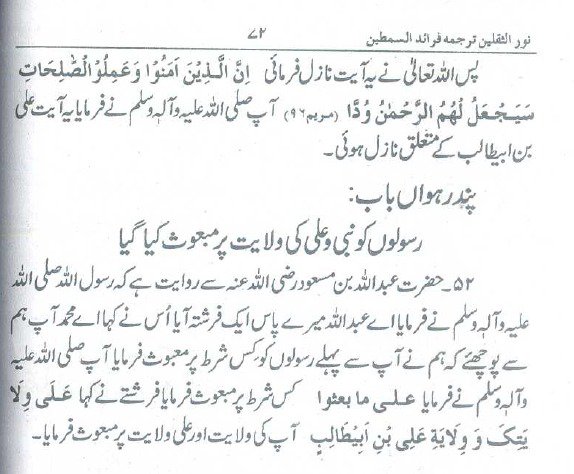
Rasulo Ko Nabi SAWS aur Ali AS Ki Wilayat Par Mabo’os Kiya Gaya..,,,

Rasulo Ko #Nabi SAWS Va #Ali AS Ki #Wilayat Par Mabo’os Kiya Gaya..,,,

Hazrat #Abdullah bin Maso’ood RA Se Riwayat Hai Ke #Rasulullah SAWS Ne Farmaya :

Aye #Abdullah RA, Mere Paas Ek Farishta Aaya, Usne Kaha Aye #Muhammad SAWS AAP Ham Se Puchhiye Ke Hamne Aapse Pehle #Rasulo Ko Kis Shart Par Mabo’os Farmaya…????
على ما بعثوا
(Kis Shart Par Mabo’os Farmaya?)
#Farishte Ne Kaha:-
عَلَى وِلا يَتِكَ وَ وِلَايَةِ عَلِى بُنِ ابِيُطَالِبِ
(Aap ki #Wilayat Aur #Ali ki Wilayat Par Mabo’os Farmaya….,

Page no:- 72
Topic – 52
Fraid ul Simtain fi Fazayil al Murtaza wal Batool wal Sibtain by Imam ibrahim bin muhammad al jwaini r.a ( Arabi )..,

Writer :- Shaikh e Khurasan, Mohaddis e Kabeer, Ibrahim bin Muhammad bin Al Maveed Abi Bakr Jovaini 822 Hijri

Noor us Saqalain ( Urdu Translation )
Translator:- Allama Safdar Raza Qadri

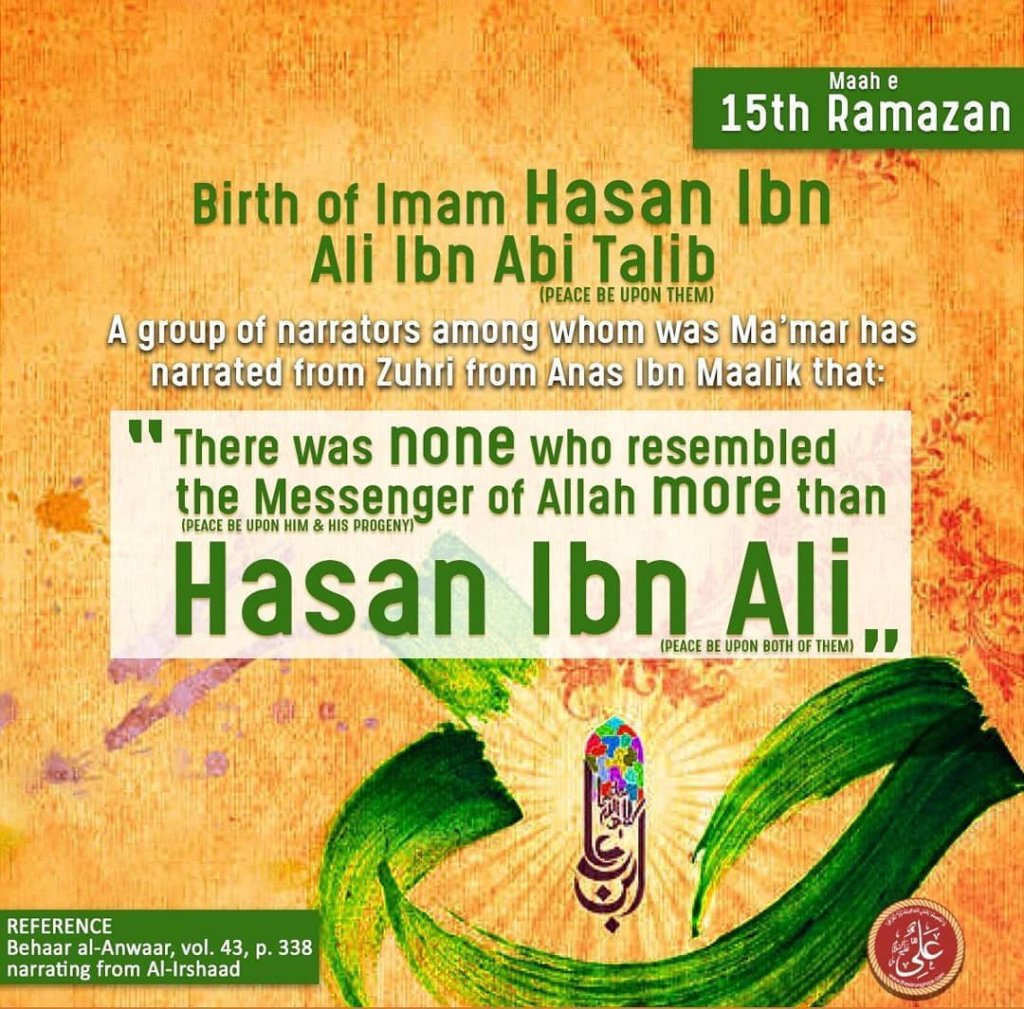
Imam Hasan AlahisSalam: Spiritual Side

Spiritual Side

The excellent preparation which was provided for the grandson of the Holy Prophet [s], helped his spiritual entity to sublimate. His closeness to Allah, and his chment to Him was a source of awe and respect.

Following are a few narratives which shed light on this side of his character:

Imam al-Sadiq [a] said:

“Hasan bin Ali [a] was certainly the most true worshipper, ascetic and merited man among the people of his time.”

Rawdhat al-Waideen (Orchard of the Preachers) mentions that whenever “Hasan would do his ablution, he would tremble and his face would turn pale. He was asked about it, and he replied: ‘It is only natural that one who stands in the presence of the Lord of the Throne turns ashen, and trembles…””

Imam al-Sadiq [a] is also reported to have said:

“Hasan bin Ali [a] had certainly gone to Hajj twenty-five times on foot. He shared his property with Allah twice…or three times.”

Ali bin Jadh’an, and Abu Na’im report in Hulyat al-Awaliya (Ornament of the Saints) and Tabaqat bin Sa’d (Castes of bin Sa’d) that Imam Hasan had given all his money to the needy twice, seeking Allah’s pleasure, and had given half his money to the needy three times. He would even give a single shoe and retain the other, and give a single sandal and retain the other. When he approached the door of the mosque, he would say: ‘O Lord! Your guest is at Your gate. O Generous! The transgressor has come to You. Forgive me my ugly deeds with Your Generosity. O Generous!’

When he remembered death he wept. When he thought of the grave he wept. When he thought of the Resurrection and Day of Judgement he gasped so deeply and painfully that he fainted because of it.

When he recited the Qur’an and came across a verse addressing the faithful by these words: ‘O you who believe…,’ he said: ‘Here I am, my Lord, here I am…’


ABU TALIB IBN E ABD AL MUTALLIB part 7


There are many such traditions that are contradictory to one another. Considering the contradictons, the correctness of the tradition under review is questionable. Another valid reason is that the narrators too are not dependable. From the first tradition it appears that the Verse was revealed six years after the demise of Abu Talib, because the Battle of Ohod was fought in the year 3 H. and he had expired three years prior to the Hijra. Hazrat Ayesha’s version suggests that the Verse was revealed around three to four years after the death of Abu Talib because she was married in 1H which was the period about three or four years after the demise of Abu Talib. In this event the Verse cannot concern Abu Talib since, at the time of its revelation, he was no more in the world. And, after a person’s death, neither there is need of guidance for him nor any reason for his refusing to take advice! And, if it is presumed that the Verse was revealed on many occasions, it cannot be accepted till there is a positive proof of the events.

Fourthly, even if the Verse is accepted to have been revealed concerning Abu Talib, no doubt can be cast as to his Faith because the manner is the same as the Verse “Maa ramaita iz ramait walakinallahrami” O Prophet! When you threw the arrow, it was not you, but Allah has thrown it. In this verse there is contradiction of rami with the words maa ramait and with iz ramait there is affirmation. Affirmation because the event was performed at the hands of the Prophet (s.a.), and contradiction because in actual fact the act emanated from Allah.. So, in the Verse there is affirmation of the guidance and contradiction as well. It means that apparently the guidance was through the Prophet (s.a.)’s preaching and instructions, but in reality it was the result of Allah’s help and support. The reason is that Allah is the fountainhead of Guidance. If His consent is not available, none can achieve the state of guidance! The Prophet, in this process of guidance is only the medium. Now, the Verse doesn’t mean that the Prophet (s.a.) cannot guide
those whom he considers his friends, or he cannot influence them with his guidance. The meaning is that those whom the Prophet holds friends too are guided by Allah to the path of Faith. This view is supported by other verses of the Holy Quran, like:

“Laisa alaika hadahum wa lakin Allah yahdi main yasha

O Prophet (s.a)! Responsibility of guiding these people

is not on you, Allah gives guidance to those He wants to.

This illustrates that the guidance of Abu Talib to the path of Virtue was not only because of The Prophet (s.a.)’s guidance, but Allah’s Wish was there. This Verse adds confirmation to Abu Talib’s Faith rather than contradicting it. The services that he rendered to Islam are a positive proof of his Faith, and Allah’s Wish has been his motivating factor in all these efforts!

The fifth point is that if the Verse is accepted to have been revealed concerning Abu Talib, then it is confirmed that The Prophet (s.a) held him in great regard as a friend, which fact is a part of history. The Prophet (s.a.) expressed affection for Aqeel ibne Abu Talib because of the love for his father:

“I consider you a friend on two counts. Firstly because of my relationship with you. Secondly because of the love for Abu Talib who had affection

for you. “”

Tareeq e Islam Zahbi, Vol 2, Page 233

This love for Abu Talib is a positive proof of his Faith.because the Prophet (s.a.) couldn’t possibly have befriended or loved any infidel or hypocrite. Therefore Allah says:

“Those who believe in Allah and the Day of Judgement,

You will not find them befiriending the enemies of Allah and His Prophet, Even if they are their fathers, sons, brothers or men of their Tribe.

When Muslims are asked not to brfriend the infidels and polytheists, even when they are their own kin, how is it possible that the Prophet (s.a.) kept extremely friendly and affectionate relations with Abu Talib! An infidel and polytheist is an enemy of Allah. How could an enemy of Allah be a friend of the Prophet (s.a.), whom Allah Himself has called a Habeeb or Dear Friend! When the love and affection between the Prophet (s.a.) and Abu Talib is irrefutable, there remains no doubt about the Faith of the latter.

Sixthly, it doesn’t stand to reason, according to Darayat (or the discipline of higher knowledge), that how could a person be an infidel who, all his life, stood like a wall in the support of the Prophet (s.a.), openly supported the cause of Islam, announced in crowds of the Qureish that Mohammed (s.a.)’s Faith was the best, acknowledged Mohammed (.s.a) like the prophets of yore and was never intimidated by any force while taking sides with the Prophet (s.a.)

The third tradition in this series is that a person heard Ibne Abbas say that the Verse, “wa hum yanhauna anhu wa yaoona anhu” is revealed about Abu Talib, and to ascribe it to him the meaning of the Verse is taken that “although he prevented the Prophet (s.a.) from the infidels harming him, he

“”

himself maintained a distance from the prophet (s.a.)” In his view the condition of Abu Talib with regard to the Prophet (s.a.) was the same that he did protect Mohammed( s.a.) from his enemies, didn’t profess the Faith himself! This tradition too is weak and not worth acceptance.

First of all there is no continuity of the narrators of this tradition. The name of the person who was the medium between Ibne Abbas and the narrator Habib ibne Abi Thabit has not been mentioned. When the narrator himself had not heard it directly from Ibne Abbas, nor has he mentioned the name of the first person who had heard and communicated to him, how could the narrative be accepted as concerning Abu Talib. The narrative is doubtful because the narrator, Habib ibne Thabit, is a cheat andexaggerator according to scholars of Ilm al Rijal. Secondly, the place and time of revelation of the Verse is indicative that it is about a group of infidels and polytheists that attributed the Quran to “Asateer al Awwaleen- Stories of people of Old Times” Therefore the author of “Kashaf” and Allama Baidawi have written that Abu Sufian, Walid, Otba, Shaiba, Abu Jahl, Nazr Ibne Harith and some other persons heard the Prophet (s.a) recite the verses of the Quran, they asked Nazr bin Harith as to what Mohammed was reciting? He replied that it was Asateer al Awwaleen. This is mentioned in the first part of the Verse, “wa yaqool allazeena kafaru an hial asateer al awwaleen-the infidels say that these are stories of people gone by and nothing else” In the last part of the Verse it is mentioned that they will be destroyed because of their waywardness and misdeeds—“wa an yahlekoona illa anfusahum wamaa yashooroon- they expose themselves to destruction and have no sense.” Between these two parts of the Verse there is “wa hum yanhoona anhu wa yanaoona anhu”. If the meaning of Yanhoona anhu is taken as ‘they prevent the Prophet (s.a.) from harms way, the entire Verse becomes disconnected and its continuity becomes disturbed. The verse talks about things that are shameful and deserving of condemnation and because of them their destruction is definite. But protecting the Prophet (s.a.) from harm is a virtuous act and has no connection with the first and last parts of the Verse, Therefore the translation of “wa hum yanhoona anhu” as “they prevent people from following the Prophet (s.a.) and listening to the recitation of the Quran” will be correct and meaningfully coordinated with the first and last part of the Verse.

Therefore Ibne Kathir and Fakhr ud Deen Razi have preferred the same meaning of the Verse and have written that this Verse is revealed about the polytheists who used to stop people following the Prophet (s.a.) and obstruct them from hearing the recitation of the Quran. Therefore, as long as it is not confirmed that Abu Talib came in the way of people following the teachings of the Prophet (s.a.) and hearing the readings of the Quran, his being the subject of the Verse cannot be established. The fact has been accepted by all, friend and foe, that Abu Talib had never asked anyone not to listen to the recitation of the Book nor even suggested to the people not to follow the Prophet(s.a)’s teachings. In fact he never differed with the ideas and teacings of Mohammed (s.a.) He spent his entire life in the protection and promotion of the Prophet’s Creed. In view of this, they will be dishonest, who do Tahreef Manawi (Misinterpret the Meaning) of the Verse to http://www.alhassanain.org/english

discredit Abu Talib. They try to break the earlier and latter part of the Verse and make a futile effort to try to prove that Abu Talib was an infidel and that he strived to maintain a distance from the Prophet. When did Abu Talib ever turn away from the Prophet (s.a) and abstain from helping and defending him?!

The fourth tradition is the one that is narrated by Abbas ibne Abd al Mutallib. He told to the Prophet (s.a.) that Abu Talib was busy in supporting and helping him. Will he get any reward for these efforts or all his troubles would go in vain? The Prophet (s.a.) said that Abu Talib is up to his knees in the Hell and that if he (the Prophet (s.a.) had not interceded, he would be in the lower echelons of the Hell!

This tradition too is concocted and false.

Firstly this tradition is attributed to Abbas, who is also credited with the tradition that Abu Talib, at the instance of The Prophet (s.a.) recited the Kalima of Unity of Allah and departed from this world. Will there be any weight in the traditions of contradictory nature narrated by one person and also concerning only one individual!

Furthur, there is a marked difference in the meaning of this and other tradiotions of this genere. In one tradition it is said that intercession has been made by the Prophet (s.a.) on behalf of Abu Talib and he is in the upper echelon of the Hell and in another tradition it is said that intercession will be made on the Day of Reckoning and in yet another tradition it is recorded that there is diminution of retribution but there is no mention of the Prophet (s.a.)’s intercession.. With this handling of the traditions, they become doubtful and unacceptable.

Thirdly, the narrators of these traditions were liars, unreliable and scheming. Therefore, Dahbi writes in Meezan al Aitadal about the narrators, and says about Sufian that he– Yaktab anil kaazabeen – copies traditions from liars. He writes about Abdul Malik ibne Omair that —saii al hifz—his memory is not good. Similarly he makes such negative remarks on some other narrators who are Majhool al Haal and not dependable according to Ulema e Rijaal. Depending on such narrators, neither can one draw any conclusion about the Faith or infidelity of any person, nor can a surmise be made whether the person will be Hell-bound or deserve the Reward of the Heaven!

Fourthly, this tradition mentions that in view of Abu Talib’s unstinted support to the cause of Islam the Prophet (s.a.) made intercession on his behalf and his retribution was reduced, while in regard to the infidels and polytheists there is no question of either any intercession or reduction of retribution! Therefore Allah says:

“We shall chase the sinners to the Hell like the thirsty animals And seeking intercession at that time will not be in their Choice but of those who have borne witness to Allah’s Unity (Tawheed)” At another place Allah says: “Those who became infidels for them there is Hellfire. They will neither end nor will they die. There won’t be any diminution in their Retribution.”