Imaam’s Family Lineage (Father’s Side): Muhammad bin Idriss bin al-Abbas bin Usman bin Shafi’ ibn al-Sa’ib bin Ubaid bin ‘Abd Yazid bin Haashim bin al-Muttalib bin ‘Abd Manaaf bin Qusayy bin Kilaab bin Murrah. The Imaam’s Lineage connects with the Prophet Muhammad (Sallallahu Alaihi Wa Sallam)’s Lineage from ‘Abd Manaaf bin Qusayy.
Imaam’s Family Lineage (Mother’s Side): Fatimah bint ‘Abdullah bin al-Hasan bin al-Hussain ibn Ali bin Abi Talib. The relations of the mother say that the only two to be born Haashimi in the family lineage were Hadhrat Ali bin Abi Talib and al-Imaam Al-Shafi’ee.
Place of Birth: Imaam Shafi’ (RA) was born in the year 150 A.H. the year the Great Imaam Abu Hanifah had passed away in. He was born in Ghizza (Asqalaan) in Palestine. When he was two year old his mother took him to a tribe in al-Hijaz who were dwellers of the country of Yemen. His mother kept him there until he reached the age of ten years. A time came when she felt that the family was in jeopardy of being forgotten and wasted so she took her son (Imaam Shafi’ee) to Makkah.
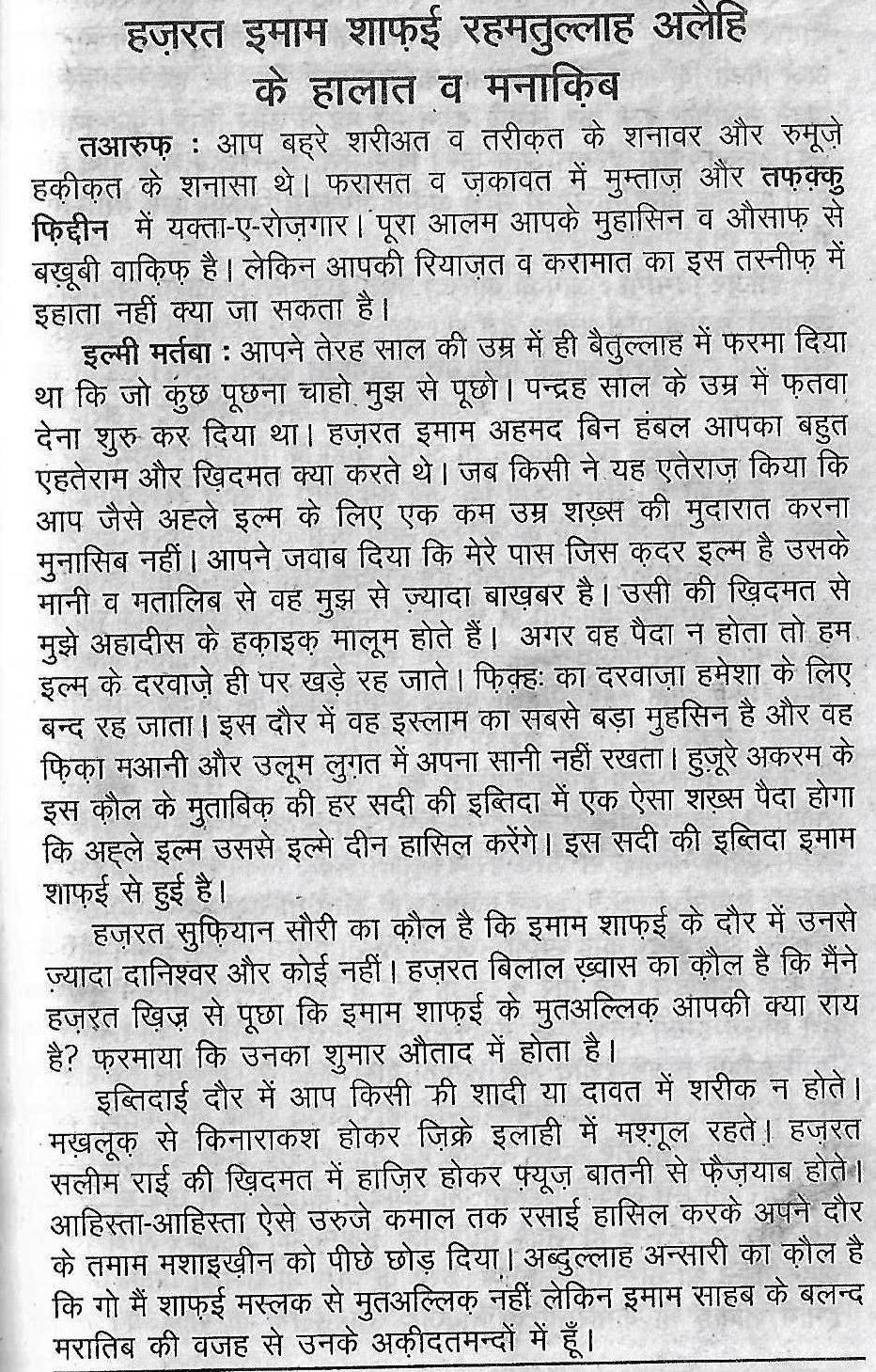
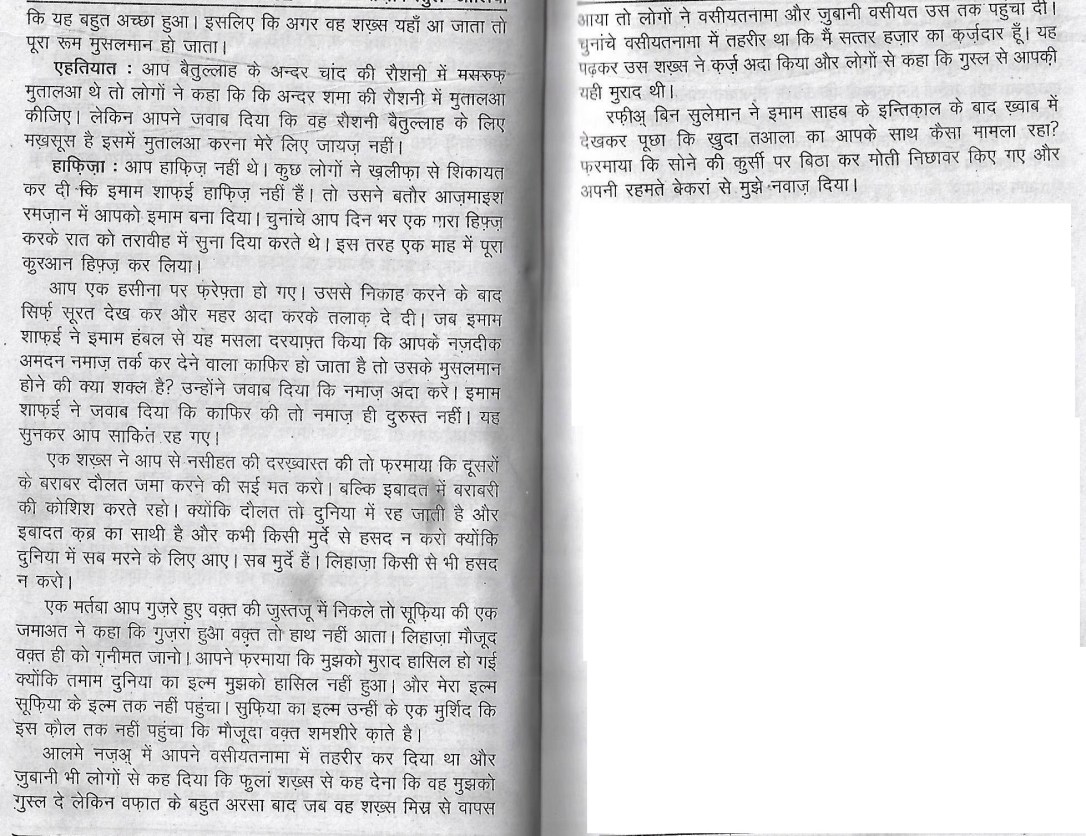
His Education: The Imaam was from a very poor family in his youth and when he was sent to school his family could not afford to pay the teacher for his teachings. The teacher used to inadequately teach the children and anytime he taught something inadequately and then left the children, the Imaam would seize the opportunity and teach them the teacher’s lesson and suffice the children. When the teacher would see this and he understood that the Imaam was doing it he let him continue to do so. This way the Imaam would suffice his tuition through satisfying the teacher by teaching the children his lesson. This continued and the Imaam learned the whole Qur’an by the time he reached seven years.
The Imaam himself used to say: “After I finished learning the Qur’an I would go to the Masjid and sit with the Scholars the sayings of the Prophet Muhammad (Sallallahu Alaihi Wa Sallam) and Islamic matters. I used to live in Makkah among tent dwellers in such a state of poverty that I could not even afford to by paper to write, so I would write on bones instead.”
It is also reported that the Imaam used to recite Hadith in the Masjid of the Prophet (Sallallahu Alaihi Wa Sallam) at the age of thirteen years old. It is also reported that the Imaam’s voice was very melodious and sweet. Al-Haakim reports by the authority of Bahr bin Nasr saying: “When we wanted to cry we would say come let us go to this young Muttalibee man to hear him recite the Qur’an. We would reach him and he would initiate his recitation until when the people would start falling down in front of him and the sounds of everyone weeping and yelling could be heard by him he would stop.”
His Teachers: Among his eminent teachers were:
1. Muslim bin Khalid al-Zangi (a Mufti of Makkah during the year 180 A.H. (796 A.D.)
2. Sufyaan bin Uyainah al-Hilaali (one of the three distinguished scholars of that time in Makkah)
3. Ibrahim bin Yahya (a scholar of Madinah)
4. Malik bin Anas (Imaam Shafi’ee used to recite Hadith to Imaam Malik after the memorizing of his book, Muwatta Imaam Malik). The Imaam stayed in Madinah until Imaam Malik passed away in the year 179 A.H. (790 A.D.)
5. Wakee’ bin al-Jarraah bin Maleeh al-Kofi
6. Muhammad bin Hasan al-Shaibaani (a scholar of Busrah, and distinguished student of the Great Imaam Abu Hanifah (RA)
7. Hammaad bin Usama al-Haashimi al-Kofi
8. Abdul-Wahhab bin Abdul-Majeed al-Busri
His Marriage: He married Hameedah bint Nafi’ bin Unaisah bin ‘Amr ibn Usman bin Affan.
Some Distinctive Characteristics:
1. His eloquent style of speech and abundant knowledge of the Arabic language
2. His Family Lineage-as a set standard reported by al-Hakam bin ‘Abdil-Muttalib that the Prophet (Sallallahu Alaihi Wa Sallam) said, “Indeed Banu Haashim and Banu al-Muttalib are the same (ie. of the same family lineage). (Ibn Majah, 22, Kitaabul-Wasaaya/46 Chapter Division of Khumus/ Hadith No. 2329
3. Complete memorization of the Qur’an with recognition of its rules and its implications in all aspects of Islamic Knowledge of which others during his time did not yet reach to
4. His deep foresight in Hadith and comprehension of authentic and defective narrations
5. His understanding in the principles of Hadith and Fiqh
6. His rulings in Hadith Mursal (incompletely transmitted narrations) and completely transmitted narrations.
7. Imaam Ahmed bin Hanbal used to say about Imaam Shafi’ee, “Our napes were in the hands of the Companions of Abu Hanifah (RA) when it came to hadith (ie. we were inclined to them more) until we saw Imaam Shafi’ee, he was the most knowledgeable in the Book of Allah and the Sunnah of Rasulullah (Sallallahu Alaihi Wa Sallam) that he would even suffice one who was not well informed in Hadith.
8. Al-Karaabeesi says about the Imaam, “Al-Shafi’ee was a mercy from Allah upon the followers of the Prophet (Sallallahu Alaihi Wa Sallam).
9. Al-Humaidee says, “We used to want to refute the arguments of the Ashab-ul-Ra’iy, but we were not well informed to do so until Imaam Shafi’ee came along and opened up the way for us.
10. Ibn Raahway was asked, “How did Imaam Shafi’ee compose all these books at such a young age?” He replied, “Allah SWT made him intelligent and mature minded in just his youth.”
11. Rabi’ says, “We were just sitting awhile in the Knowledge Circle of Imaam Shafi’ee after the Great Imaam’s demise when a Bedouin Arab came along and said asked about where is the sun and moon of this circle. When we told him that he had passed away he started weeping heavily, and then said may Allah have mercy upon him and forgive him for verily he was one who opened up the veils of proofs through his explanations and closed the mouths of his disputer and opponent. He used to wash the blackened faces of their shame and disgrace and opened the closed doors with intellect and understanding. Then he turned away and left.”
His Humbleness:
Al-Hasan bin Abdul-Aziz al-Jarwi al-Misri reported form Imaam Shafi’ee used to say, “I have never debated with someone who I want to make a mistake, nor do I possess any knowledge that I want to keep to myself, rather that it should be with all and not just related to me.”
He also said, “I have never debated with someone who I want to make a mistake. And I have never debated someone except I say to them, O’ Allah, put the truth in his heart and on his tongue. If I am on the truth he will follow me, and if he is on the truth then I will follow him.”
A Scholar of Quraish:
Imaam Ahmed bin Hanbal is reported to have said, “When I am questioned about some matter that I do not know of I say to myself Imaam Shafi’ee knows about this and he will have some say in it, because he is an ‘Alim (Scholar) of Quraish. And the Prophet (Sallallahu Alaihi Wa Sallam) said, An Alim of Quraish fills the earth with knowledge.” (al-Manaaqib, Lil-Baihaqi, Vol. 1, Page 54)
Al-Raazi says, “This Hadith is attainable by a man who possesses three characteristics: 1. that he is from Quraish 2. that he has abundant knowledge among religious scholars 3. that his abundant knowledge will indeed reach from east to west of the world
After saying this Al-Raazi says, “The man described above is no other than Al-Shafi’ee.” (Musnad of Abu Dawood Al-Tabalusi, p. 39-40)
The Imaam is from Quraish and the following other Ahadith (narrations) are indications towards him:
1. Abdullah bin Masood (RA) narrates from the Prophet (Sallallahu Alaihi Wa Sallam) as saying, “Do not curse at the Quraish, for verily a scholar from there fills the earth with knowledge. O’Allah, you have made their first taste your punishment, now make the last of them taste your gift and favor.” (Musnad of Abu Dawood Al-Tabalusi, p. 39-40)
2. Abu Hurairah (RA) narrates that the Prophet (Sallallahu Alaihi Wa Sallam) said, “O’Allah, Guide the Quraish, for verily a scholar from there fills the earth with knowledge. O’Allah, just you have made them taste your punishment, now let them taste your gift and favor.” He made this supplication three times. (al-Khateeb fee al-tarikh, V.2, P.61)
3. Imaam Al-Shafi’ee is Quraishi and Muttalibi. One hadith says, “Indeed Banu Haashim and Banu al-Muttalib are the same (ie. of the same family lineage). The Prophet (Sallallahu Alaihi Wa Sallam) then put his fingers of both hands together. (Al-Sunan al-Kubra’, V.6, P.340)
4. In one narration the Prophet (Sallallahu Alaihi Wa Sallam) said, “Indeed, at the beginning of every hundred years Allah SWT sends a reformer of this Ummah who will revive the Ummah in religion. (Al-Mustadrik, V.4, P.522, Al-Khateeb fee al-tarikh, V.2, P.61)
His Children:
First Child’s Name: Abu Usman, Muhammad (was a judge in Madinah, grew up in Syria) Second Child’s Name: Fatimah Third Child’s Name: Zainab His Going to Egypt: The Imaam went to Egypt in the year 199 A.H. (814/815 A.D.) during the beginning of the Mamun Khilafah. He went back to Baghdad for a month then again returned to Egypt and stayed until his demise in the year 204 A.H. (819/820 A.D.)
His Writings and Books:
1. Al-Risalah al-Qadeemah (Kitaabul-Hujjah)
2. Al-Risalah al-Jadeedah
3. Ikhtilaaful-Hadith
4. Ibtaal-al-Istihsaan
5. Ahkaam-ul-Qur’an
6. Biyaadhul-Fardh
7. Sifatul-al-Amr wal-Nahiy
8. Ikhtilaaf Malik wal-Shafi’ee
9. Ikhtilaaf-al-Iraqiyeen
10. Ikhtilaaf Muhammad bin Hasan
11. Fadha’il Quraish
12. Kitaabul-Umm 13. Kitaabul-Sunan
His Demise:
The Imaam became very sick at the end of his life with hemmariodal pain and passed away in Egypt on Thursday night after Isha’ Prayer after performing Maghrib Prayer on the last day of Rajab. We was buried in Cairo, Egypt on Friday in the year 204 A.H. (819/820 A.D.) His Masjid in Cairo can be visited in the Imaam Al-Shafi’ee Neighborhood. May Allah be pleased with him. Ameen. Translated by Adil Khan on 11th of Shabaan, 1422 A.H. from Kitaabul-Umm, Printed in Beirut, Lebanon.
Imam Shafie RadhiAllahu Anhu
Abu Abdullah Muhammad ibn Idris ash-Shafi’e (767 – January 20, 820) commonly called Imam al-Shafe’i or fully, Muhammad ibn Idris ibn al-Abbas ibn Uthman ibn Shafi’i ibn al-Sa’ib ibn ‘Ubayd ibn Abd Yazid ibn Hashim ibn al-Muttalib.
Imam Shafi’e RadhiAllahu Anhu was born in 767 in Asqalan, Gaza. His father died when he was two, afterwitch he and his mother Umm al Hasan moved to Makkah where they lived in extreme poverty.
Many stories have been related about his life. It is said that he memorized the Quran at by age seven and by ten he had memorized the Muwatta of Imam Malik RadhiAllahu Anhu. He was a recognised mufti at the age of fifteen. He recited the entire Quran daily and twice a day during the month of Ramadan. Some accounts claim he was very handsome, that his beard did not exceed the length of his fist, and that it was very black.
He was also an accomplished archer, poet, and orator. Some accounts claim there were a group of Bedouin who would come to his lectures just to listen to his eloquent use of the language. He was given the title of Nasir al Sunnah, the defender of the sunnah.
His teachers included Malik ibn Anas RadhiAllahu Anhu and Muhammad ibn al Hasan al Shaybani RadhiAllahu Anhu, whom he studied under in Madinah and Baghdad. During the reign of Harun Rashid, he had an appointment as a judge in Najran. His dedication to justice, even when if it required criticizing the governor, caused him some problems, and he was falsely accused of aiding the Alawis in a revolt. At this time, al Shaybani was the chief justice, and his defense of ash-Shafe’i, coupled with ash-Shafe’i’s own eloquent arguement, convinced Harun Rashid to dismiss the charge, and to direct al Shaybani RadhiAllahu Anhu to take Imam Shafi’i RadhiAllahu Anhu to Baghdad.
He was asked why he used a walking stick. He replied, “To remind myself that I am on a journey out of this life.” He died at the age of 53 on January 20, 820 and was buried in al-Fustat, Egypt. Salahuddin al Ayyubi built a madrasa on the site.
The Jurisprudence of Imam Shafe’i RadhiAllahu Anhu In Baghdad, he developed his first madhab, influenced by the teachings of both Imam Abu Hanifa and Imam Malik . Thus, his work there is known as al Madhab al Qadim lil Imam as Shafe’i, or the old school of ash-Shafi’i.
Sheikh Nuh Ha Mim Keller writes, “When the persecution arose over the uncreatedness of the Qur’an, he spoke to Imam Ahmad ibn Hanbal RadhiAllahu Anhu and they mutually agreed that rather than risk the loss of both Islam’s living mujtahids, they should part company, Imam Shafi’i RadhiAllahu Anhu travelling with his books and belongings to Cairo, and Imam Ahmad RadhiAllahu Anhu remaining in Iraq.” In less than four years Imam Shafi’i RadhiAllahu Anhu had re-established his second school of fiqh, which is transmitted in his work Kitab al Umm.
Apocryphal accounts claim that Imam Ahmad RadhiAllahu Anhu said of Imam Shafi’i RadhiAllahu Anhu, I never saw anyone adhere more to hadith than Imam Shafi’i RadhiAllahu Anhu. No one preceded him in writing down the hadith in a book. Imam Ahmad RadhiAllahu Anhu is also claimed to have said, Not one of the scholars of hadith touched an inkwell nor a pen except he owed a huge debt to Imam Shafi’i RadhiAllahu Anhu.
Among the books that Imam Shafi’i RadhiAllahu Anhu wrote is al Risala, the first book wherein he examined usul al-fiqh (sources of jurisprudence): the Qur’an, the Sunnah, qiyas (analogy), and ijma’ (scholarly consensus). He also divided innovation into good and bad, based on the recorded saying of Umar RadhiAllahu Anhu about tarawih. He authored more than 100 books. Imam al Shaybani RadhiAllahu Anhu said, If the scholars of hadith speak, it is in the language of Imam Shafi’i RadhiAllahu Anhu.
Imam Shafi’i RadhiAllahu Anhu’s followers include some of the foremost scholars of Islam, such as: Imam al Bukhari, Imam Muslim, Imam Abu Dawud, Imam Tirmidhi, Imam Nasa’i, Imam Ibn Majah, Imam Bayhaqi, Imam al Hakim. Other great followers of the Shafi’i madhab were: ibn Hibban, Imam Suyuti, al Dhahabi, Imam al Ghazali, and Al-Nawawi.
The school of Imam Shafi’i RadhiAllahu Anhu is followed in many places throughout the world, including Egypt, Jordan, Palestine, Indonesia, Malaysia, Thailand, Philippines, Yemen, Iraq, southern India and among the Kurdish people. Today, many English speaking Muslims are introduced to the madhab of Imam Shafi’i RadhiAllahu Anhu through the translated works Umdat as Salik (Reliance of the Traveller) and al Maqasid, both done by Sheikh Nuh Ha Mim Keller.


 Aal-e-Qutub Aal-e-Syed Abdullah Shah Ghazi