
Hazrat Syed Farid Uddin Qadri
All the chroniclers including Ghulam Mohi-Uddin Sufi or Zia Uddin Zia relate about him in brief. Some don’t mention his date of birth whereas others the revelation and miracles. His biographical sketch, under the circumstances, is difficult to draw. With limited resources on our hands, we make an endeavor:
Parentage
Syed Muhammad Farid Uddin Alias Shah Saheb, was born to Syed Mustafa, a descendant of Sheikh Abdul Qadir Jilani of Baghdad, in the 1000 Hijri (i.e. 1551 AD).
Biographical Sketch
Dr. Sufi Mohi-uddin Sufi, compiler of Kaiser, draws his biographical in the following words:
Syed Muhammad Farid Uddin son of Syed Mustafa, a descendant of Sheikh Abdul Qadir of Baghdad, was born in 1000 Hijri (1551 AD) After completion of his studies he set out on an extensive tour, offered the Haj at Mecca. Saw Sheikh Jalal Uddin Al-Maghribi in Mecca and Sheikh Mohi Uddin Qadri in Egypt reached the Sindh from Baghdad and from thence to Agra towards the close of Shah Jehan’s reign. Raja Jai Singh ascended the throne, in 1674, was the ruler of Kishtwar. Farid Uddin with his followers: Dervish Muhammad, Shah Abdal, Syed Baha Uddin Sa’ani and Yar Muhammad reached Kishtwar for the propagation of Islam in 1075 Hijri corresponding to 1664 AD. He was seventy-five at the time.
Propagation of Islam
He offered Islam to the Raja but failed to impress him, built a monastery and busied whole heartily in the service and propagation of the Faith. After the death of Raja Jai Singh his son Kirat Singh, succeeded him, who embraced Islam under assumed name of ‘Sa’adat-yar Khan and a large number of his subjects followed their King and turned to Islam.
Arrival in Kishtwar
From Delhi, he reached Kishtwar via Deeng-batal. The daughter of the landlord of Deeng-batal was greatly impressed by the piety of the sage and married him and assumed the name Roshan-dil. He stayed there for seven days. He consummated his marriage for the second time with the daughter of Shah Noor Ali, the lumberdar of village Nagori of Doda town and gave her name, Malahat Beg.
From there he traveled via Bhandar-kot to Kishtwar. Raja Jai Singh was highly impressed with his character and pious life and had a house built for him near his palace.
His off springs
He had three sons: Syed Anwar Uddin died at an age of two and a half years; Syed Akhyar Uddin and Syed Ansar Uddin were saints bestowed with revelations and miracles. Syed Asrar Uddin, real brother of Syed Anwar Uddin, was a born saint and exhibited wondrous revelations at an early age. Shah Sahib did not approve of him and prayed to God for his demise.
One day he gave him bowls full of water and asked him to drink water form it. The son declined. He reiterated: “This is your father’s order.” Asrar Uddin held the cup, covered his head with a sheet and drank it. He died soon after.
His other son, Akhyar Uddin, proceeded to Gurdaspur, under the orders of his father to be admitted as a follower by Syed Badar-Uddin Sa’mani; returned to Kashmir after the death of his father stayed at the Shrine of Sultan-Ul-Arifeen Sheikh Hamza for seven years and died there.
Revelations and Miracles
Hazrat Farid Uddin exhibited numerous miracles:
1. The Raja approached him with the request to stop the earthquake. He prayed and the earthquake subsided.
2. A blind man came and prayed for the eyesight. He said, “It is nice to pray both for eye-sight and subjugation,” and touched his face with his hand. The man not only received the eyesight but the insight also.
Quotes
- The true seeker should tread the highway of love fearlessly and patiently.
- The Sheikh is one who observes the Shairah and his inner self is exposed to the Divine.
Death
He is said to have died in the year 1733 AD but we think 1710 AD is more probable. His tomb stands in the center of Kishtwar town, and his infant son Syed Anwar Uddin, lies buried by his side. Syed Asrar Uddin’s tomb is on the other side of the town facing Chogan. He died at the age of eighteen, on the prayer of his father. Syed Akhyar Uddin lies interned in the outer adjoining room of the Shrine.
Hazrat Syed Asrar-Uddin
On one side of the town of Kishtwar stands the mausoleum of Hazrat Syed Farid Uddin Qadri and on the other lies buried his son, Syed Asrar Uddin. Both attract large numbers of people. Syed Asrar Uddin holds a unique place among the sages of Kashmir.

ROZA SHARIF HAZRAT ASRAR UDDIN QADRI (KISHTIWAR,JAMMU)
Parentage
Syed Asrar Uddin son of Hazrat Syed Farid Uddin Qadri, was a descendant of Hazrat Sheikh Abdul Qadir Jilani of Baghdad. His mother also descended from the great Sage of Baghdad and was a pious and God fearing lady. He inherited the divinity from his forefathers.
Revelations and Miracles
He was a born saint and began to show miracles at an early age. Yar Muhammad writes about him:
“A son was born and started talking. His hallo grew like the full moon, showed miracles, brought deeds to life, made walls move and foretold. The name of the prince was Asrar Uddin.”
He was destined to get what he received but just exhibited prior to time. Of the miracles borne by the words of mouth were to bring to life the dead only son of a Hindu, to grant eyesight to the born blinds, to make the wall move, and to relieve people of deadly diseases.
His father Hazrat Farid Uddin did not like his activities and prayed to God for his early death. Having been annoyed with the excessive show of miracles by Syed Asrar Uddin. Farid Uddin called his son, offered him water in a bowl, and asked him to drink it. Asrar Uddin declined. On being told that it was his father’s wish, he took the cup, covered the head with a sheet, drank it, and died. Najam Uddin records it as 25 Shaaban 1097 Hijri.
His grave
Syed Asrar Uddin’s grave lies on the other side of Kishtwar town facing Chogan which is the widest and flourishing meadow of the Kishtwar region where people, from every caste and creed, flock to pay their respects to the great departed mystic saint.
Durbar-E-Faridia Kishtwar
Hazrat Shah Mohd Farid ud-Din was born in 1000 H at Baghdad. In the tradition of Gousia dynasty, he began to obtain relegious education in his childhood and learnt the Quran by rote. After reaching the age of discretion he performed Haj and visited the splendid mausoleum. He met the great mystic and respected scholar, Jalal-ud-Din Arbi with whose company he reached the stage of contemplation from the stage of struggle. From Mecca the Shah went to Hazrat Sheikh Mohi-ud-Din Qadri of Egypt, where he took further lessons in spritual education. With this divine soul he joined the Qadriya order. In his bloom of youth he received orders from his great ancestor, Hazrat Gous ul Azam,
in a dream that he should go to Kishtwar and spread the light of Islam in that area infested with infidelity and heresy. Therefore the Shah started his journey. There were some of his mystic companions and his first wife Shahzada Bibi also with him. They entered the state of Jammu and Kashmir through Bhimbar (Rajouri) route. He reached Dengbatal via Nowshera and Budhal. He stayed there for some time and started religious propagation. He gained popularity within a short time so much so that ruler of that place, Lashkar Rai gave his daughter, Roshan Dil, in marriage to the resolute Shah, to stop him there.
After performing religious duties in Doda for two and a half years, the hilly locality situated on the banks of the Chenab is named Faridabad. From Nagri (Doda) the Shah reached Thakrie area of Kishtwar through Bharth and Sidh-wan. Crossing Kuriya and Bhandarkoot rivers Hazrat Shah reached Kishtwar He spent his first night near Drangwajhi. As the heir to great Prophet and religious preacher, he transformed the whole cultural, social and religious scenario of Kishtwar area. Kishtwar became the spiritual centre of District Doda and the whole area began to come within Islamic fold.
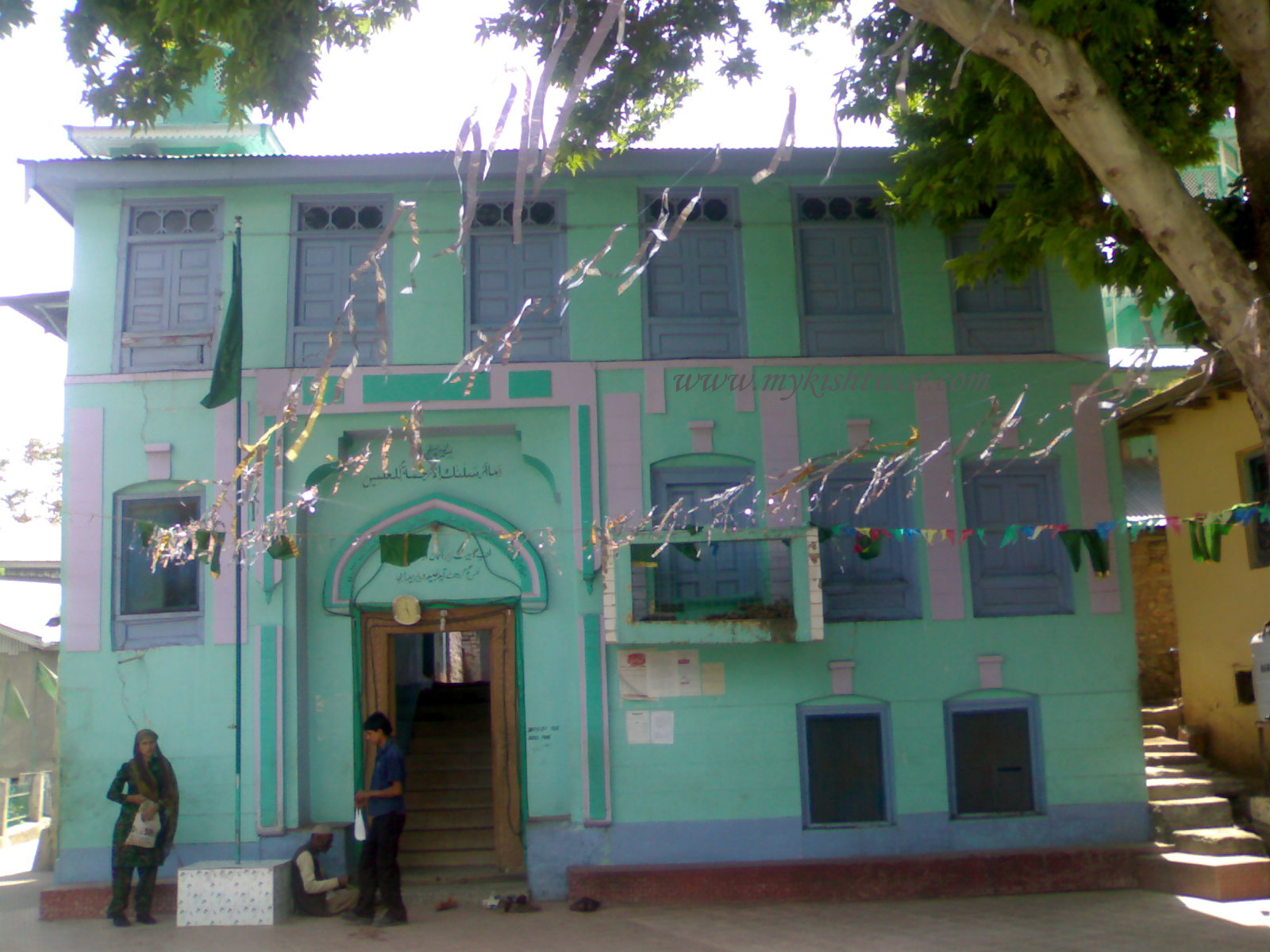
In Durbar-e-Faridia, Roza Faridia, i.e. grave of Shah Farid-ud-Din is towards thw west of the inner drawing room while that of Shah Akhyar-ud-Din is in the outer drawing room. Shah Anwar-ud-Din is buried to the east of Roza Faridia. All the three wives are buried in a closet at the feet of Shah Farid-ud-Din. Hazrat Darvesh Mohd and Yaar Mohd were buried in the courtyard. 7th of Haar is celebrated as “URS” of Shah Farid-ud-Din every year in which thousands of pilgrims coming from all over the state and the adjoining states participate. Beside Namaz, religious discourse and other rituals, sacred relics of Shah Sahibare also displayed. These include the Turban and the cap inherited from Gous-ul-Azam, a sword, a staff, two shirts of Shah Farid-ud-Din and Shah Akhyar-ud-Din, the sacred hair of all the three sons of the Shah, earthen sangpa (foot cleaner), a silver fish, the hockey stick of Asrar Sahib, the stamp of Shah Farid-ud-Din, eight long caps, comb, an instrument resembling hand, which was used to scratch his back and a tool used during prayers. The sharp Sword of Shah did not kill anyone. No blood flowed.
One distinctive aspect of Shah Sahib’s personality was that in his company deliberations would go on good conduct, piety, God-realization and human brotherhood with no criticism of other faiths. For the seekers of divine knowledge, the Durbaars of Shah Farid-ud-Din and Shah Asra-ud-Din are a source of inspiration, divine bounties and a treasure house of God’s favors.
Durbaar-E-Asraria
On the south eastern corner of Chowgan stands the sacred and famous shrine of Shah Asrar-ud-Din, son of Shah Farid-ud-Din and born to his wifr from Baghdad, Zahida Bibi in 1667 A.D. About Shah Asrar-ud-Din, it is said in Rozat-ul-Aarfin of Peer Zia-ud-Din that he was a born saint and would talk to his mother even when he was in her womb. Soon people who came to his contact were attracted towards him. He performed miracles to th
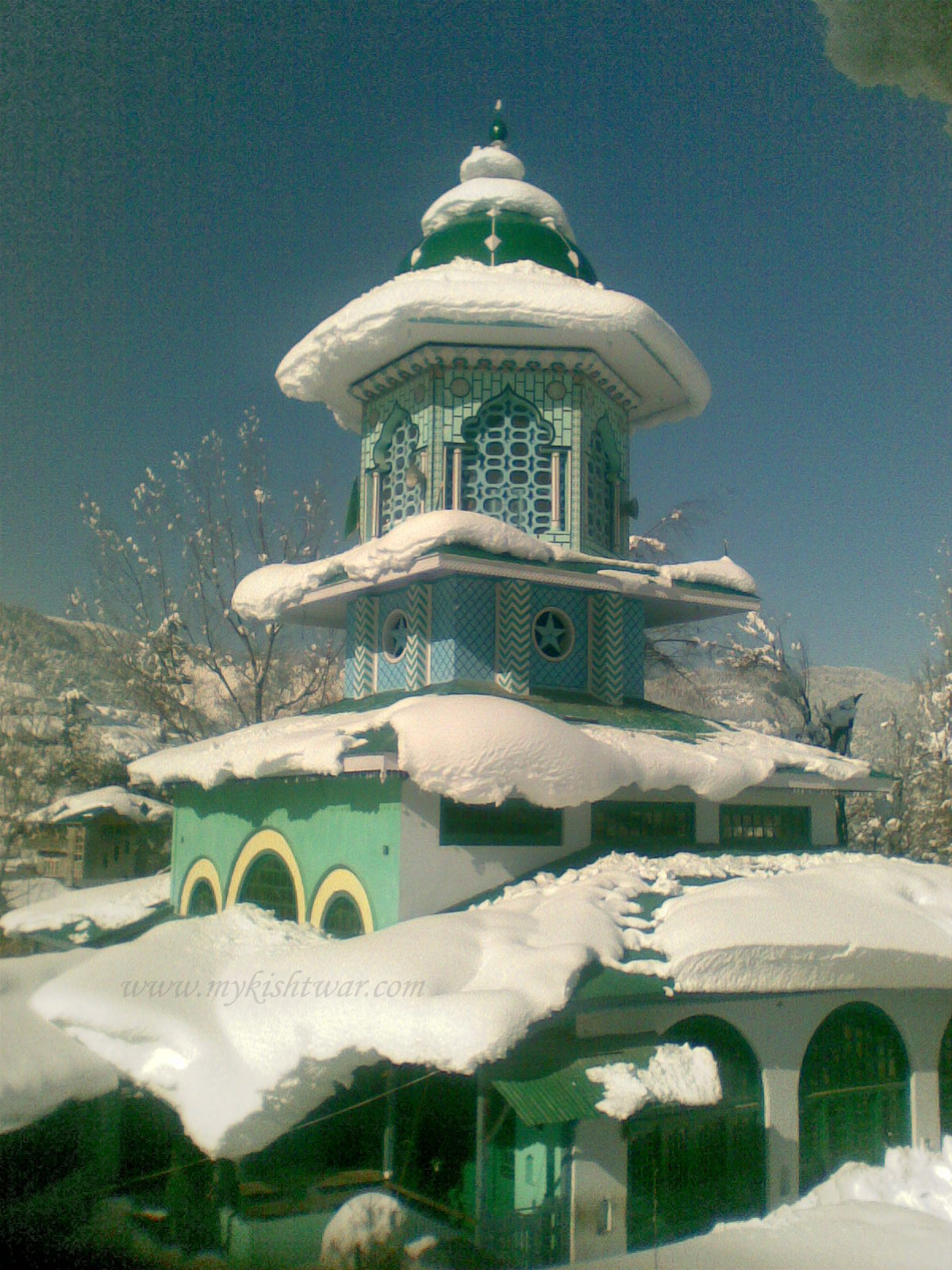
e astonishment of all. He began foretelling the future events, making the walls to walk and bringing the dead back to life. When his father, Hazrat Shah Farid-ud-Din witnessed manifold miracles I his son, he prayed to God that he call his son back to him. Mon 25th of Kartik he ordered Syed Bahud-ud-Din to bring a cup full of sugar candy syrup. Reciting Quranic hymns he blew over the syrup and ordered Sgag Asrar-ud-Din to drink it. Like an obedient son, he soon drank it. Surprisingly he was no more in this world and was thus, called back by God. He was eighteen then.
Hazrat Shah Asrar-ud-Din Wali brought many incurable patients and aggrieved people into Islamic fold by his miracles. For having traversed the ideal goal, he saved a Kishtwari man from being murdered. The miracle is as follows:
“One day he was sitting in his closet when a lady fell on his feet weeping. Asrar Sahib asked her why she was doing so. She replied that her husband had gone out of his home for business and for many days nothing was heared of him. She was much perturbed and he said: “Your husband is all right and has left for Azimabad from Delhi today. He is resting under a tree at present. After travelling for two more stages unidentified thieves would behead him.” On hearing this women began to wail and weep more by which Asrar Sahib came into his majesty. Pointing towards India he told the women, “Go back to your home at once.” The Women ran to her house and saw her husband talking to the family members. When asked he said that during his journey he felt asleep under a tree when an invisible hand lifted him and put him there. He was told of the reality. At that very instant he resolved to serve the Hazrat for the rest of his life and spent all his life in service of the holy Asrar.”
In this way Asrar-ud-Din became popular among all the people. His love of mankind, and the religious tolerance established shining examples. He had a magnetic attraction in his personality. He was proficient in discourses and in removal of difficulties.
So his “URS” is celebrated on 25th Kartik every year with great devotion and fanfare. After his death, he was taken to Chowgan for Namaz-e-Jinaza and burial on reaching the upper end of the Chowgan, his dead body became too heavy to lift. So, under the orders of his father, he was laid to rest there. A grand tomb was erected on his grave. Thousands of devotees visit the shrine for seeking blessings of this great saint and especially on the day of “URS” the mammoth
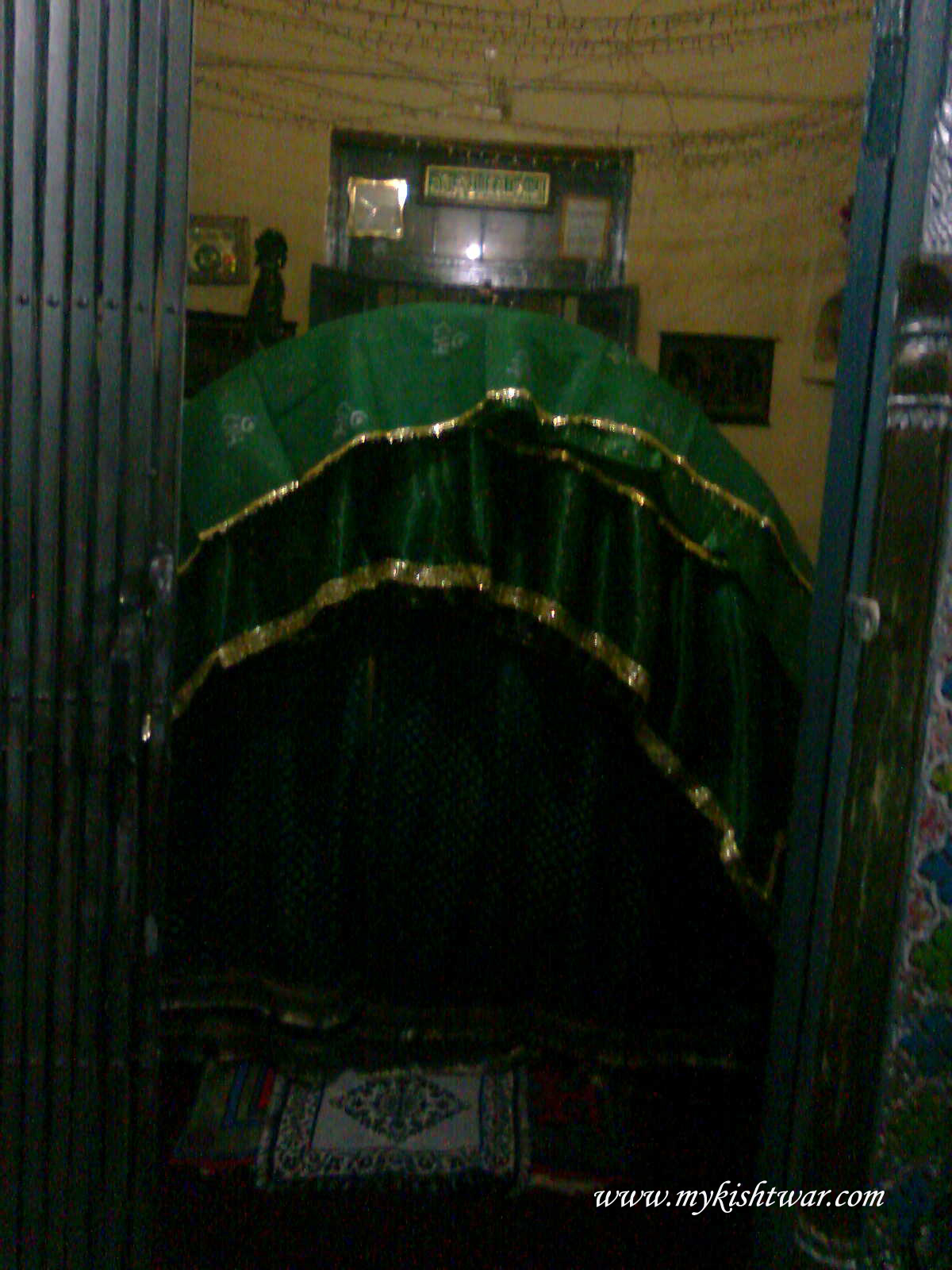
gathering speaks of the devotion of his followers.
According to Syed Nijam-ud-Din, Shah Akhyar Sahib became the first Caliph after the death of Hazrat Shah Mohd. Farid-ud-Din Baghdadi. It is revealed from the history of Kishtwar that Hazrat Akhyar spent most part of his life in the service of religion and completed the mission for which his father had left his native place Baghdad and came to Kishtwar. He started his education at the age of seven and studied under Hafiz Abul Qasim up to twelve years of age. He held the great office at Caliphate. After Caliphate he spent six years in Kashmir and died at the age of 65. His body was brought from Kashmir to Kishtwar and buried in the outer drawing room of khanqahe Farifiya. His annual Urs is celebrated on 7th Phagan.
The Urs of Anwar Sahib is celebrated on 3rd of Phagun that 14th or 15th of Feburary.
The grave of Shah Anwar-ud-Din is buried towards the east of Roza Faridiya (inner closet). Cloth is spread over both the graves of Farid0ud0Din an Anwar-ud-Din and the pilgrims have to enquire from the attendants or Majawar’s.
Shahzada Bibi, Mai Roshan Dil and Mai Malahat are buried in the closet at the foot of Hazrat Shah. Hazrat Darvesh Mohmad and Hazrat Yar Mohmad are buried in the courtyard of Faridiya shrine. The grave of Hazrat Syed Baha-ud-Din is situated towards the south of the grave of Asrar Sahib in the courtyard of Durbar-e-Asrariya.
SHRINE OF SHAH ABDAL AT DUGGA
Dugga is a small village, 3 kms away from Kishtwar on Kishtwar-Synthen-Anantnag Highway, Here is the Shrine of Shah Abdal, one of the close associates of Hazarat Shah Farid-ud-din. He was, formerly the ruler of Sindh but renounced his kingdom after his contact with Shah Sahib. He was one of the four disciples, who accompanied Shah Farid-ud-din from Baghdad to Kishtwar to accomplish the mission of propagating Islam entrusted to them by God. Hazrat Abdal was more educated than any other four associates and was therefore, entrusted with the responsibility of correspondence pertaining to Shah Fari-ud-din Sahib. After his death he was buried at Village Dugga where devotees throng for prayers at his shrine. Thousands of pilgrims visit this shrine at the time of URS falling on 20th Haar (Bikrami) every year. In distrcit Kishtwar, there are many other shrines situated in dachhan area (Swed-Panzdhara), Astangam, Hanzal and Brain (Marwah area), where the relics of Shahs exist. There are two graves of saints situated in the village Pohi (Kishtwar)and Kijai (Paddar), whose details could not be known. There is a shrine of Baba Dawood Gahni in Basmina (Warwan) and that of Sheikh Zain-ud-Din in Sokhni also.
SHRINE OF HAZRAT ZAIN SHAH AT BHANDAROOT AND VILLAGE RAKNA
Hazrat Sheikh Zain-ud-din Rishi, a great spiritual luminary after the patron saint of Kashmir, Hazarat Sheikh Noor-ud-din Noorani also known as “Nand Rishi” is said to have taken birth at village Rakna, 3kms away from Bhandarkoot, a small village 12kms away from Kishtwar on Kishtwar-Synthen Anantnag Highway, in a Rajput family. The family, later on embraced Islam under the influence of Sheik Noor-ud-din Noorani. Telling about the spiritual status of his disciple, Hazrat Sheikh Noor-ud-din has said, “My dear Zain-ud-din is chaste. He did so well that the disciple surpassed his master. O God, bless me with the similar status”.
During the early days of his becoming disciple of Hazrat Sheikh Noor-ud-din Noorani, he absorbed himself in deep meditation in a small cave on the bank of Chenab at Bhandarkoot. A shrine has now been erected at this site, where devotees pay their obeisance to this great soul. After prayers they offer cocks, sheep and goat to the shrine and partake of meals along with relatives and friends in the premises of the shrine. Another famous shrine built in memory of Hazrat Zain-ud-din Sahib is at village Rakna of Palmar, about five kms. Ascending distance from Bhandarkoot. Here the pilgrims are shown relics of Saint Zain-ud-din. One of there is a wooden bread which the great saint used to tie on his belly in order to console his hunger after the long periods of fast which would last even for a month. This point to the great degree of abstinence from material world observed by this noble soul. It is said that Zain shah sahib also toured Marwah and Warwan valleys to preach Islam before the arrival of Shah Farid-ud-din Sahib. He converted a big chunk of population to Islamic faith in Chhatroo, Dachhan, Marwah and Warwan. He also went to Tibet and Ladakh to convert people to Islamic faith. Sheikh Zain-ud-din Sahib has a number of followers not only in Doda region, but from Kashmir valley also. His “URS” is celebrated at village Rakna of Palmar. The date coincides with the famous URS of Hazrat Noor-ud-din Noorani at Aishumuqam; Anantnag, During night people burn wooden lamps. The ceremony is called ‘Zahi’ locally. This is held in March/April every year with the arrival of Spring.
Darvesh Shaban Sahib, an illiterate person, lived in village Sarkot situated at the western end of Chowgan. With the glance of Hazrat Asrar, he became a Mujzoob (saint). Master Bashir Ahmed Sheikh Sarkoti and Ghulam Rasool Kamgar Kishtwari have written a booklet of 16 pages, in which they have given a brief introduction of Darvesh, mendicant Shaban Sahib. It is revealed that he was one of the great saints of his times. Shaban Sheikh had been brought up with lawful daily bread. He spent his time tending cattle.
Intoducing Shaban Sahib, Ishrat Kashmiri has also written as follows:-
“Hazrat Shaban Joo Majzoob was born in Sarkoot (Kishtwar) in 1212 H. His grandfather, Puran Sheikh, was a Brahmin of Hatta, who had converted to Islam after observing some spiritual miracles of a saint. Shaban sahib would take sheep and goats for grazing like other peasents. One day he fell unconscious at Katwani. It is generally beleived that he was blessed by Hazrat Syed Shah Asrar-ud-Din. He was at a very high pedestal in spiritualism despite being illiterate. He would speak so intelligently like a great scholar that great practicing would be astonished. He died at the age of 110 on Sunday te 9th of Jamadi ul Awal 1323.”
======================================================================
Annual Urs Sharief of Hazarat Shah Asrar-Ud-Din Sahib was celebrated with religious fervour in Kishtwar district of Chenab valley.
One of the most revered saints of Kishtwar, Shah Asrar represents the common cultural heritage and mutual love between various communities of this area.

Every year thousands of devotees from all walks of life and different religions and regions throng the famous shrine of Shah Asrar-Ud Din Sahib in Kishtwar to pay their reverence to the pious saint and seek his blessings. Locally the Urs is known as 25 Katak as it falls on 25th of Kartik month of Vikrami Samvat.
 Aal-e-Qutub Aal-e-Syed Abdullah Shah Ghazi