Blog

Hazrat Bibi Maham pak

Bibi Maham Khadija bint Musa Kazim being the daughter of Imam Musa Kazim is a part of Ahl Al-Bayt–Prophet Mohammad‘s Household.During the Abbasid caliphate Ahl Al-Bayt suffered much and were always the target of Abbasid oppression, Bibi’s father and his followers were subjected to imprisonment and torture, and were under constant surveillance by the agents of caliphs.After the murder of Imam Musa Kazim, at the hands of Harun Al-Rashid,the imamate was transferred to his son Ali Al-Reza.The persecution of the descendants of Ali bin Abi Talib did not stop at the murder of Bibi Maham’s father but only grew more severe during the imamate of her brother, Imam Ali Al-Reza, and soon he too was poisoned and killed by the then caliph Mamun Al-Rashid.As a result of such maltreatment and torment, Hashemites at the time were forced to migrate to far-off regions. Whilst most siblings, like Bibi Masoumeh Qum, migrated to Faris(modern day Iran), and some, like Bibi Heybat, migrated to Azerbaijan, Bibi Maham migrated to the Sindh region where she spent her last days. Like the rest of her seventeen sisters, Bibi Khadija bint Imam Musa Kazim could not get married as well because of the mass murder and imprisonment of the male descendants of Prophet Mohammad, because only a Syed(those from the lineage of Prophet Mohammad) male marry a Syed female.

In Sindh: Life & Death
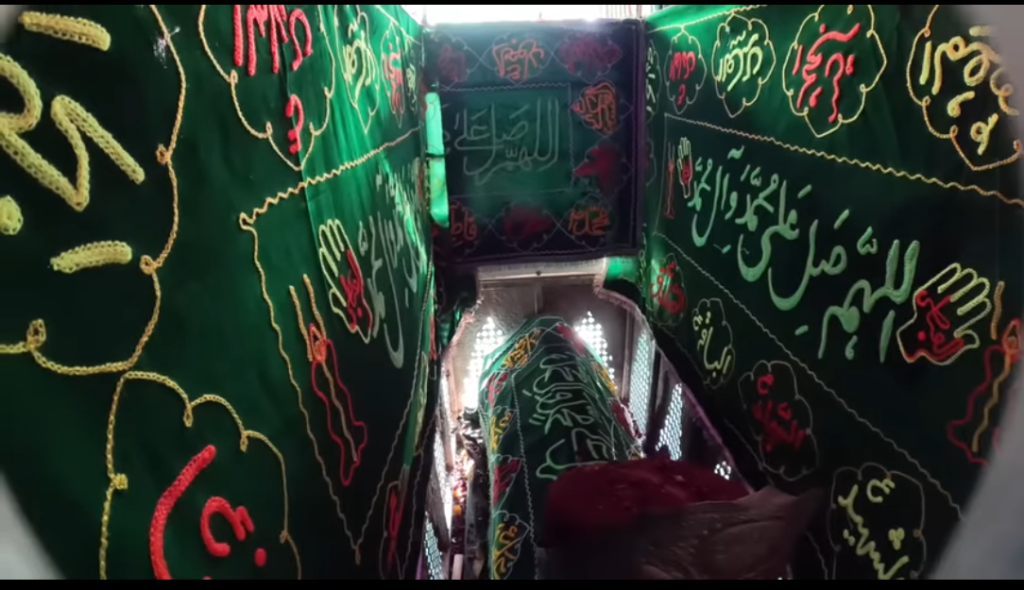
Deduced from her gravestone’s inscription, Bibi Maham’s arrival in Indian Subcontinent is estimated to be somewhere between 128 A.H and 170 A.H(745 CE and 786 CE) .Bibi Maham Khadija on the orders of her father journeyed, for a safe haven, towards the land of Sindh until she reached Agham Kot which, like the city of Thatta, was the center of Sindhi civilization at the time.Abbasid caliphate in pursuit of the children of Imam Musa Kazim sent an army comprised of Clan of Tameem to capture and eventually murder the caravan.Due to the danger that the forces of Banu Tameem posed the name of Bibi Khadija bint Imam Musa Kazim was kept hidden by the local devotees and the lady was referred to as “Bibi Maham” or “The Lady who shone bright like the full-moon”. But Abbasid-sent-Banu-Tameem soon found out about the lady and her convoy and, like her father, Bibi Maham and the group that accompanied her were too poisoned.
Holy Shrine

The grave of Bibi Maham was discovered, not long ago, in 2002 by historians and a shrine was built upon it in 2009. In 2010, historical details of the grave were first published in a sindhi editorial called Mahana Parado by its chief editor, Abdul Sattar Dars.The ancient persian inscription on the grave dates it back to 170 A.H which makes it the oldest grave in the ancient Agham Kot graveyard.Since its inception, the grave has been visited by numerous researchers and scholars alike who have verified the discovery.

The Shrine presently consists of burnt bricks and lime plaster, topped with a tier and girder roof. Its dimensions measure 10 meters by 5.5 meters, featuring a south-facing entrance. The tomb located within the Shrine measures 4 meters by 5.5 meters. The courtyard surrounding the Shrine contains four graves, while three additional graves are located within the tomb. Furthermore, the interior of the tomb has been refurbished with contemporary tiles. As of now, Ministry of Awqaf has authenticated the grave and has taken over the shrine with the promise of a bigger shrine to soon be built.

https://www.facebook.com/share/v/1AubbjZHx2/

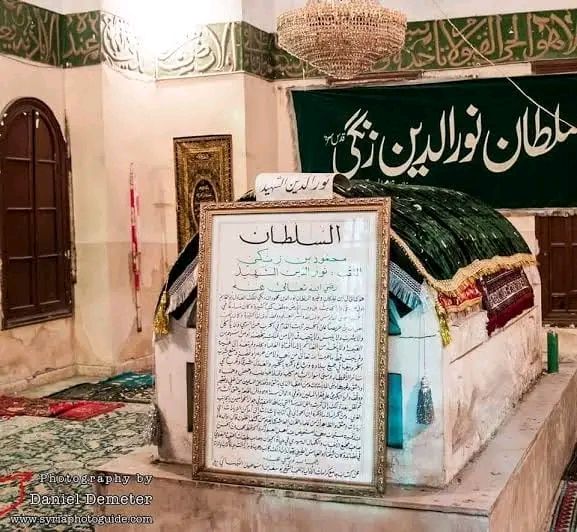
The Mentor of the Conqueror of Bayt al-Maqdis

⚔️ “The Mentor of the Conqueror of Bayt al-Maqdis” ⚔️

🌺 Nur al-Din Zangi (may Allah have mercy on him) 🌺

⬅️ Lineage, Name, and Birth
Nur al-Din Zangi’s full name was Nur al-Din Mahmud ibn Imad al-Din Zangi. He was a great Muslim ruler, a Mujahid, a just king, and a sincere servant of Islam.
He belonged to the Zangi dynasty. His father, Imad al-Din Zangi, was a brave and valiant commander who began the struggle against the Crusaders.
Birth
Nur al-Din Zangi was born in 1118 CE. From childhood, signs of piety, seriousness, and leadership were clearly visible in him.
He was raised in an environment where religion, jihad, and justice were given central importance.
⬅️ Early Training and Religious Inclination
Nur al-Din Zangi acquired knowledge of the Qur’an, Hadith, and Fiqh, and at the same time became skilled in military arts.
He was not only a military commander, but also a ruler with the temperament of a scholar.
For him, religion was not merely an idea; rather, it was a practical system which he wished to implement in every sphere of life.
⬅️ Jihad Against the Crusaders
Nur al-Din Zangi carried forward the mission of his father and made jihad against the Crusaders the purpose of his life.
He fought many successful battles against the Crusaders in Syria and its surrounding regions, and raised the morale of the Muslims.
Under his leadership, a new spirit was awakened among the Muslims, and the passion for jihad was revived once again.
⬅️ System of Justice and Fairness
Nur al-Din Zangi’s greatest distinction was his justice.
He established such a system in his kingdom where the oppressed received justice, the oppressor was punished, and the law was equal for all.
He himself lived a simple life and was extremely careful regarding the Bayt al-Mal (public treasury).
⬅️ Religious Services and Reform
Nur al-Din Zangi did not focus only on warfare, but also made religious reform his mission.
He established madrasas, mosques, and religious centers, supported the scholars, and worked to spread Islamic teachings.
He also strove against innovations and corrupt beliefs, and promoted the Sunnah.
⬅️ The Training of Salah al-Din Ayyubi
Nur al-Din Zangi’s greatest achievement was not only his conquests, but also the preparation of a great leader.
He gave opportunity to a great commander like Salah al-Din Ayyubi, nurtured him, and brought him forward.
It was this very Salah al-Din who later became the conqueror of Bayt al-Maqdis.
It can be said that had Nur al-Din Zangi not existed, perhaps the great liberation of Bayt al-Maqdis would not have appeared in history in the same way.
⬅️ The Aspiration for Bayt al-Maqdis
Nur al-Din Zangi’s greatest desire was the liberation of Bayt al-Maqdis.
For this purpose, he had a beautiful minbar prepared that was meant to be installed in Masjid al-Aqsa.
But destiny had decreed otherwise, and he did not live to witness that moment.
Later, that same minbar was installed in Bayt al-Maqdis by Salah al-Din Ayyubi, as though the student fulfilled the dream of his teacher.
⬅️ Personality and Character
Nur al-Din Zangi was a complete Islamic ruler: devoted in worship, just, brave, and simple in nature.
He spent his nights in worship, and his days in jihad and the service of the people.
His heart carried the pain of the Ummah, and his eyes held the dream of the liberation of Bayt al-Maqdis.
⬅️ Passing Away
Nur al-Din Zangi passed away in 1174 CE in Damascus.
With his passing, the Muslim Ummah lost a great leader, but his mission remained alive.
Indeed, to Allah we belong and to Him we shall return.
⬅️ Legacy and Message
The life of Nur al-Din Zangi teaches us that true success lies not only in conquests, but also in building character.
A true leader is one who leaves behind light even after he is gone.
Justice, religion, and sincerity are the foundations of a strong state.
He planted a seed whose fruit the entire Ummah later saw in the form of Salah al-Din Ayyubi.
🤲 May Allah Almighty grant us the sincerity, justice, and concern for the Ummah that He granted to Nur al-Din Zangi, and may He bless us with such leaders who restore the Ummah to honor once again.
Amin thumma Amin, by the الوسيلة of Sayyid al-Mursalin ﷺ
If you want, I can also make it into a more elegant Islamic English style for posting.