Qura’an Kya Kahta Hai Maula Ali ع Kon ? *_Ayat 01:_* *_﷽_* قُل لَن يُصيبَنا إِلّا ما كَتَبَ اللَّهُ لَنا هُوَ مَولانا ۚ وَعَلَى اللَّهِ فَليَتَوَكَّلِ المُؤمِنونَ *_“Tum Farmao Hume Na Pahuchega Magar Jo Allah Ne Hamare Liye Likh Diya, Wo Hamara Maula Hai, Aur Musalmano Ko Allah Hi Par Bharosa Chahye”_* _(Al Quran Surah 09 Tawbah Ayat : 51)_ *_Ayat 02 :_* *_﷽_* بَلِ اللَّهُ مَولاكُم ۖ وَهُوَ خَيرُ النّاصِرينَ *_“Beshak Allah Tumhara Maula Hai aur Sabse Badkar Madadgaar Hai”_* _(Surah Al Imraan Ayat 150)_ *_In dono upar bayan karda Ayat Me Padhe To Pata Chalega_* _Lafz Maula_ *_Allah ﷻ Ne Apne Liye Farmaya Ke Mai Maula Hoon Maula Hona Allah ﷻ ki Sifaat Hai To Wahabi Kharji Aur Nasbi Yehi Aayat Pesh Karte Hai Aur Kehte Milenge Dekho Maula Allah ki sifaat hai Aapne Bando Ko Maula maan Liya hai par Laa ilmi muttala ki kami hai ab aaye Dekhe Aage Qura’an ki Aayat Bina Dakar Hazam kar jaate Hai Ab Aage Padhe Allah ﷻ Ne Aur Kisko Maula Banaya Hai._* _Ayat 03 :_ *_﷽_* ا *_ا عَلَيهِ فَإِنَّ اللَّهَ هُوَ مَولاهُ وَجِبريلُ وَصالِحُ المُؤمِنينَ ۖ وَالمَلائِكَةُ بَعدَ ذٰلِكَ ظَهيرٌ_* _“To Beshak Allah Unka Madadgaar Hai Aur Jibril Aur Nek Imaan Waale Aur Iske Baad Farishte Madad Par Hai”_ *_(Surah No 66 Surah Tahrim Ayat 04)_* _Is Aayat e Mubarika me Allah ﷻ Ne Musalmano Ke Liye Apne Bando Ko bhi Maula Kaha Hai Nek Imaan waale Zibril ع Bhi Ab Bataye kya Nek Imaan waalo me Maula Ali ع Nahi Hai ?_ *_Kya Natiza Niklega is Aayat Aur Upar Bayan karda 02 Aayat ka Maane ye niklega k Allah ﷻ Ka Maula hona Uski Apni SIFAAT Jaati hai Aur Bando Ka Maula Hona Allah ﷻ Ki Ata Se Hai._*
_Pata Chala Qura’an ki wo 03 Aayat Me Maula Allah ﷻ Hai Aur Bando ko Bhi Maula Bana Diya Hai Allah ﷻ Ne par Ab Aaye Dekhe Qura’an Me Ke Ye Badmazhab Maula Maante Kyu Nahi Bando Ko Khud Ayat e Mubarika ne saaf saaf khol diya hai bas Padhe Aur Aina Dekh Le Hum Tabseera Nahi karnge Yaha._ *_Ayat 04 :_* *_﷽_* ذٰلِكَ بِأَنَّ اللَّهَ مَولَى الَّذينَ آمَنوا وَأَنَّ الكافِرينَ لا مَولىٰ لَهُم *_“Aur Isliye Ke Musalmano ka Maula Allah Hai Aur Kafiro ka Koi Maula Nahi”_* _(Al Quran Surah 47 Muhammad Ayat :11)_ *_Samajh Aagaya Ke Maula Unka Nahi Hai Jo Kaafir Hai Imaan Waalo Ke Liye Allah ﷻ Bhi Maula Hai Aur Maula Ali ع Bhi Maula Hai Aur jinke Pass imaan hi Nahi Hai unka koi Maula Nahi hai._* _Likha To Saaf Hai Bas Padh Ke Samajhne ki Der Hai._
Imam Sadiq (as): *Ghadeer e Khum ke din ka Roza agar koi Qayamat tak zinda rahe to poori umr ke barabar hai aur is din ka Roza Khuda ke nazdeek 100 qubool-shuda Hajj aur Umrah ke barabar hai aur yehi wo din hai jo Azeem Eid mein shumaar hota hai.* (Maula Ali Ki Shaan Mein 1000 Ahadees, p356)
Imam Sadiq (as): *…Is (Eid e Ghadeer) ke din bajaaye jaane wala amal 80 mahino’n ke amal ke barabar hai…* *(…A good deed performed on this (Eid e Ghadeer) day is equal to the deeds of 80 months)* (Sawaabul Aamaal o Iqaabul Aamaal, p161; Sawaabul Aamaal o Iqaabul Aamaal, p110 (English))
*_2_* _Jiska Mai ﷺ Maula Hun USKA Ali ع Maula Hai_
*_Hadees_* _Hazrat Shuaba Bin Kuhayl رض Se Riwayat Karte Hai Ki Maine Abu Tufail رض Se Suna Ki Abu Sareeha رض Ya Zayd Bin Arqam رض Se Marwi Hai Ki Huzoor Nabi E Akram ﷺ Ne Farmaya :_ *_مَنْ كُنْتُ مَوْلاَهُ فَعَلِيٌّ علی مَوْلاَهُ_* _Jis Ka Mai ﷺ Maula Hun Us Ka_ _Ali Maula ع Hai.”_
_References :-_
*_📚(Jamai Tirmizi ,Vol :05, Pg :📖 398, Kitab 📗 No 49_*
*_📚Kitabul Manakib, Hadees : 4078 “English No : 3713)_*
_Is Hadees Ko Beshumar Muhadiseen Ne Apni Apni Kutoob e Hadees Me Alag Alag isnaad ke saath Likha Magar Ye Sabne Nakl Kiya Hai Agar Sirf Hawale Dene Lag Jaaye To Aap is post mein Hawale Bhi Na Gin sake to isliye maine Hindi mein bhi post banaya hai usmein bhi bahut jyada Hawale [Reference] Diye Hai yaha Chand Hawala Mulahiza kare._
_Reference :-_
*_📚(Imam Nasai Al Khasais E Ali Ibn Abu Talib Pg 📖:44, Hadees : 33)_*
*_📚(Imam Hakim Al Mustadrak ,Vol :03, Pg 📖: 34, Hadees : 4652)_*
*_📚(Imam Tabrani Al Mujam Ul Kabir, Vol : 12, Pg 📖 : 470, Hadees : 12593)_*
*_📚(Imam Tabrani Al Mujam Ul Ausat, Vol : 01, Pg 📖:229, Hadees : 348)_*
*_📚(Ahlehadees Ke Sabse Bade Muhadis Shaykh Albani Ne_* *_Silsila Al Hadees As Sahih Vol : 04, Pg 📖 : 331, Hadees : 1750)_*
_Kul 17 Hawale Diye Hai Aur Bhi Bahot Hai Hindi Me Bhi Post Hai use bhi pura Padhiye Us Mein ke Hawale [Reference] Bahut jyada hai Aur Scan Page Ke Sath Hai_
‘(नहीं) बल्कि आप लोगों का खून मेरा खून और आप लोगों की बर्बादी मेरी बर्बादी है। मैं आपसे हूं और आप मुझसे हैं। जिससे आप लड़ेंगे, उससे मैं लडूंगा, और जिससे आप सुलह करेंगे, उससे मैं सुलह करूंगा।’
बैअत की ख़तरनाकी की दोबारा याद देहानी
बैअत की शर्तों के बारे में बातचीत पूरी हो चुकी और लोगों ने बैअत शुरू करने का इरादा किया, तो पहली पंक्ति के दो मुसलमान जो 11 नबवी और 12 नबवी में मुसलमान हुए थे, एक-एक करके उठे, ताकि लोगों के सामने उनकी ज़िम्मेदारी और ख़तरनाकी को अच्छी तरह स्पष्ट करें और ये लोग मामले के सारे पहलुओं को अच्छी तरह समझ लेने के बाद ही बैअत करें। इससे यह भी मालूम करना था कि क़ौम किस हद तक कुर्बानी देने के लिए तैयार है |
इब्ने इस्हाक़ कहते हैं कि जब लोग बैअत के लिए जमा हो गए, तो हज़रत अब्बास बिन उबादा बिन नज़ला ने कहा-
‘तुम लोग जानते हो कि इनसे (इशारा नबी सल्लल्लाहु अलैहि व सल्लम की ओर था) किस बात पर बैअत कर रहे हो ?’
आवाज़ें : जी हां।
हज़रत अब्बास रज़ि० ने कहा, तुम इनसे लाल और काले लोगों से लड़ने पर बैअत कर रहे हो। अगर तुम्हारा यह ख्याल हो कि जब तुम्हारे मालों का सफाया कर दिया जाएगा, और तुम्हारे सज्जन क़त्ल कर दिए जाएंगे, तो तुम इनका साथ छोड़ दोगे, तो अभी से छोड़ दो, क्योंकि अगर तुमने उन्हें ले जाने के बाद छोड़ दिया, तो यह दुनिया और आखिरत की रुसवाई होगी और अगर तुम्हारा यह ख्याल है कि तुम माल की तबाही और सज्जनों के क़त्ल के बावजूद वायदा निभाओगे, जिसकी ओर तुमने उन्हें बुलाया है, तो फिर बेशक तुम इन्हें ले लो, क्योंकि खुदा की क़सम, यह दुनिया और आखिरत की भलाई है।’
इस पर सब ने एक आवाज़ होकर कहा-हम माल की तबाही और सज्जनों के क़त्ल का खतरा मोल लेकर इन्हें कुबूल करते हैं। हां, ऐ अल्लाह के रसूल सल्लल्लाहु अलैहि व सल्लम ! हमने यह वायदा निभाया, तो हमें इसके बदले में क्या मिलेगा ?
आपने फ़रमाया, जन्नत ।
लोगों ने अर्ज़ किया, अपना हाथ फैलाइए।
हिशाम 1/442 आपने हाथ फैलाया और लोगों ने बैअत की।
हज़रत जाबिर रज़ियल्लाहु अन्हु का बयान है कि उस वक़्त हम बैअत करने उठे तो हज़रत असद बिन जुरारा ने, जो इन सत्तर आदमियों में सबसे कम उम्र थे—आपका हाथ पकड़ लिया और बोले-
‘यसरिब वालो! तनिक ठहर जाओ ।
हम आपकी सेवा में ऊंटों के कलेजे मार कर (यानी लम्बा-चौड़ा सफ़र करके) इस यक़ीन के साथ हाज़िर हुए हैं कि आप अल्लाह के रसूल हैं | आज आपको यहां से ले जाने का मतलब है, सारे अरब से दुश्मनी, तुम्हारे चुने सरदारों का क़त्ल और तलवारों की मार, इसलिए अगर यह सब कुछ बरदाश्त कर सकते हो, तब तो इन्हें ले चलो, और तुम्हारा बदला अल्लाह पर है और अगर तुम्हें अपनी जान प्यारी है, तो इन्हें अभी से छोड़ दो। यह अल्लाह के नज़दीक ज्यादा क़ाबिले कुबूल बहाना होगा। 2
बैअत पूरी हो गई
बैअत की धाराएं पहले ही तै हो चुकी थीं, एक बार इस नाजुक काम का स्पष्टीकरण भी हो चुका था। अब यह ताकीद आगे की गई तो लोगों ने एक आवाज़ होकर कहा-
असद बिन जुरारह ! अपना हाथ हटाओ, खुदा की क़सम ! हम इस बैअत को न छोड़ सकते हैं और न तोड़ सकते हैं 13
इस जवाब से हज़रत असद को अच्छी तरह मालूम हो गया कि क़ौम किस हद तक इस राह में जान देने को तैयार है।
वास्तव में हज़रत असद बिन जुरारह, हज़रत मुसअब बिन उमैर रज़ि० के साथ मिलकर मदीने में इस्लाम के सबसे बड़े प्रचारक थे, इसलिए स्वाभाविक रूप से ही वही इन बैअत करने वालों के धार्मिक नेता भी थे और इसीलिए सबसे पहले उन्हीं ने बैअत भी की।
चुनांचे इब्ने इस्हाक़ की रिवायत है कि बनू नज्जार कहते हैं कि अबू उमामा असद बिन जुरारह सबसे पहले आदमी हैं जिन्होंने आपसे हाथ मिलाया। और
4. इब्ने इस्हाक़ का यह भी बयान है कि बनू अब्दुल अशहल कहते हैं कि सबसे पहले
इसके बाद आम बैअत हुई।
हज़रत जाबिर रज़ियल्लाहु अन्हु का बयान है कि हम लोग एक-एक आदमी करके उठे और आपने हमसे बैअत ली और उसके बदले जन्नत की खुशखबरी दी । ‘
बाक़ी रहीं वे औरतें, जो इस मौक़े पर हाज़िर थीं, तो उनकी बैअत सिर्फ जुबानी हुई। अल्लाह के रसूल सल्लल्लाहु अलैहि व सल्लम ने कभी किसी अनजानी औरत से मुसाफ़ा नहीं किया। 2
बारह नक़ीब
बैअत पूरी हो चुकी तो अल्लाह के रसूल सल्लल्लाहु अलैहि व सल्लम ने यह प्रस्ताव रखा कि बारह सरदार चुन लिए जाएं, जो अपनी-अपनी क़ौम के ‘नक़ीब’ हों, और इस बैअत की धाराओं को लागू करने के लिए अपनी क़ौम की ओर से वही ज़िम्मेदार और मुकल्लफ़ हों।
आपका इर्शाद था कि आप लोग अपने भीतर से बारह नक़ीब पेश कीजिए, ताकि वही लोग आपकी अपनी-अपनी क़ौम के मामलों के ज़िम्मेदार हों। आपके इर्शाद पर तुरन्त ही नक़ीबों का चुनाव अमल में आ गया। नौ खज़रज से लिए गए और तीन औस से। नाम इस तरह हैं-
खज़रज के नक़ीब 1. असद बिन जुरारा बिन अदस,
2. साद बिन रबीअ बिन अम्र
3. अब्दुल्लाह बिन रुवाहा बिन सालबा,
4. राफ़ेअ बिन मालिक बिन अजलान,
5. बरा बिन मारूर बिन सख
6. अब्दुल्लाह बिन अम्र बिन हराम,
7. उबादा बिन सामित बिन कैस.
अबुल हैसम बिन तैहान ने बैअत की और हज़रत काब बिन मालिक कहते हैं कि बरा बिन मारूर ने की (इब्ने हिशाम 1/447) मेरा विचार है कि संभव है बैअत से पहले नबी सल्ल० से हज़रत अबुल हैसम और बरा की जो बातें हुई थीं, लोगों ने उसी को बैअत मान लिया हो, वरना उस वक़्त आगे बढ़ाए जाने के सबसे ज़्यादा हक़दार हज़रत असद बिन जुरारह ही थे। वल्लाहु आलम ।
1. मुस्नद अहमद, 3/322
2. देखिए सहीह मुस्लिम बाब कैफीयतुबै अतिन्निसाइ 2/131
The Sermon at Ghadir-E-Khum and the Last Declaration
Bidding farewell to his native city of Mecca, the Prophet set out for Medina on the 14th Zilhajj, 10 A.H., accompanied by the same congregation of Muslims.
Now as his swift camel sped on with its long swinging strides, a life of tireless toil was nearing its end, a mission of mercy and devotion was approaching its culmination. and the seeds of Divine dispensation were about to begin. to bear fruit. His mien and bearing showed the signs of sublime peace, coupled with an overwhelming sense of gratitude and an insatiable yearning for his Creator and Cherisher.
Yet on close scrutiny, his serene features could not have failed to disclose the signs of deep contemplation as if he was weighing the pros and cons of some momentous decision.
What could be the cause of this restlessness? Had he not accomplished all that he had set his mind to do? The Unity and Justice of God had been convincingly instilled into the hearts of men; the belief in the angels, the
Scriptures, the Prophets, the resurrection of the dead, and the Day of Judgment had all been authoritatively expounded.
But with the meticulous thoroughness of his genius, Prophet Muhammad realised that the most important part of his task still remained unfulfilled, and it was this which made him restless at the moment of his greatest triumph. He saw that the sands of time were running out and the cup of his life was filled almost to the brim. This being so, the most important task was to ensure the continuity of his life’s work by someone endowed with all the moral values which he had upheld, or else all his miraculous achievements during the twenty-three years of his apostolic ministry stood in danger of being irretrievably undone. It was a matter of prime importance that Divine guidance should continue after him and that the Divine sovereignty should be exercised by the chosen ones of God, to be appointed by the Prophet.
He had already designated his Ahl-ul-Bait on several occasions, as the Ark of Noah, the strong rope of God, the door of forgiveness, the purified ones, and made the love of these holy ones incumbent upon his followers. He had similarly, on many occasions, pointed out Ali as “My brother and Successor”, “The door of the city of knowledge”, “The most equitable judge”, “The embodiment of faith”, and having the position in relation to himself as “Aaron was to Moses”.
Were these pronouncements in the course of time going to be forgotten, misinterpreted or ignored by his followers after him? Could the Prophet allow them to be set aside by power-seekers? He knew that he had to make a final and unchallengeable declaration regarding his successor. The choice of the appropriate moment,
however, depended not on him but on Divine Inspiration. With these thoughts in his mind he marched on towards Medina.
As he arrived at Ghadir-e-Khum, suddenly the signs of a revelation appeared. The voice of Archangel Gabriel was heard saying:
“O thou esteemed Messenger, impart the guidance that has been revealed unto thee”, and in order to impress the urgency of the command, Gabriel went on to say:
“For if thou doeth it not, thou hast not imparted Hist Message at all”:
and again in the same breath to allay his fears and misgivings the angel added:
“God will protect thee from the evil designs of men”, (Ch. 5 verse 67)
It is held that the Prophet had already been commanded to proclaim Ali as his successor, but he had postponed the announcement for some suitable occasion to avoid misinterpretation.
*It refers to the Commandment contained in Sura XCIV of the Quran, which says:
1. Have We not opened thy breast for thee? 2. And put off thy burden from thee. 3. Which galled thy back? 4. 5. And have We not raised thy name for thee? Then verily, with trouble cometh ease. 6. Verily, along with trouble cometh ease; 7. And when thou art eased, set up (thy successor). 8. And turn to thy Lord with fervour.
In the 7th verse. God has commanded the Prophet to appoint his successor.
On hearing this imperious command, the Prophet made up his mind instantly. He motioned the muezzin Bilal to stop and recite the Azan with the words. “Hayya ala Khair il’amal” (hasten towards the best of deeds). for. surely the acceptance thereof was to be a crucial event upon which the perpetuity of the Prophet’s Mission depended.
As the Prophet pulled up his reins, the whole entourage came to a halt. Those who had gone ahead were summoned back and those who followed gathered round casting inquiring glances at each other. The Prophet soon diss mounted and ordered his followers to clear the ground. The pebbles and thorns that lay scattered about were promptly brushed aside. Others, on receiving his express directions, began to untie the saddles from the backs of their camels, and to pile them one on top of another. so as to make a pulpit. The arrangements thus completed. the throng squatted upon the bare ground, some spreading their cloaks below to protect themselves from the burning sand, others holding up their handkerchieves to shield their eyes from the sun’s glare, for it was nearly midday.
The people having clustered round the pulpit, the Prophet stepped forward and on his right was Ali, whose turban, black in colour, with its ends hanging over both of his shoulders, was arranged by the Prophet himself. Then obeying the Divine Injunction to the letter, he addressed the multitude in the following memorable words!
“All praise belongs to God. In Him do I put my faith and from Him do I crave support. Him do I trust and His I Sayid Safdar Husain.
protection seek against the malice of our souls and evils of our deeds. The misguided have no guide save Him, and those who are guided by Him can never go astray. I bear witness that there is no one worthy of worship save Him and that I, Muhammad, am His slave and Messenger.”
“O ye folk, behold, the All-knowing God hath informed me that the days of my life are coming to an end and the time is fast approaching when I shall be called away from your midst towards the eternal abode. But you and I, each one of us is answerable unto God for all things are duc. unto Him from us. What then do you say?”
And the listeners answered, “we bear witness that thou hast done thy duty and never stinted to guide and advise us according to the Divine Will.”
“Then do ye bear witness”, asked the Prophet, “to the Unity of God and the Apostleship of this servant of God, who now speaks to you by His command, and do ye not hear witness that the resurrection and judgment, heaven and hell and the life hereafter are certainties?”
And they all answered, “Yea, verily Yea.”
“Now then”, continued the Prophet, “Listen to me carefully; I have been commanded to tell you that I will soon be taken away from your midst, but I leave unto you my Legacy of two grand precepts, each of which surpasses the other in its grandeur-God’s Holy Book (The Quran) and my Ahl-ul-Bait (my irrevocable Progeny, consisting of Ali, Fatima, Hasan and Husain). Never shall they separate from one another until they reach me in Heaven at the Fountain of Kausar, and so long as you will adhere unto both my legacies, you will never be led astray after me. Therefore, O ye folk, it is my last Will and Testament unto
you that you should always remain faithful to the Holy Quran and my Ahl-ul-Bait as true Muslims until death.”
By these portentous words all those who loved their teacher and benefactor were moved to tears.
And he continued, “Do not lag too far behind them and do not walk ahead of them, for in either event you will go astray. But follow them and walk in their footsteps and they will guide you along the Straight Path.”.
Then he asked, “Who do you think is more worthy of obedience than your souls?”
And they answered, “God and His messenger know best.”
And he continued, “Lo! God is my Master, and am I not worthy of obedience from you?”
And they all said, “Yea, verily Yea.”
Then the Prophet bent down and lifted up Ali in his hands, showing him to the crowds on all sides of the pulpit, and proclaimed,
مَنْ كُنْتُ مَوْلاهُ فَهذا عَلى مَولاهُ
“Mun Kunto Maulaho fe haaza Ali-yun Maulah”
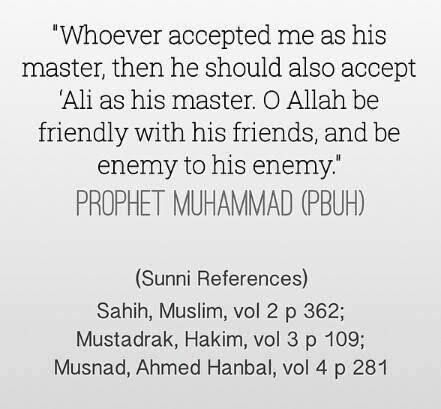
“Of whomsoever I am the Master (Maula), this Ali is his Master (Maula)”. So saying the Prophet raised up his hands heavenwards and prayed, “O our God, love those who will love Ali, despise those who will despise him; support those who will support him; and reject those who will reject him. 1 **
1 Suyuti has reported thus: “O God! Befriend him who is a friend of Ali, and be an enemy to him who is an enemy to Ali.”
Announcing this thrice, he got down from the raised platform, and seated Ali in a tent, where the people did him homage. Omar bin Al-Khatab was the first to congratulate Ali and to acknowledge him ‘Guardian of all Believers
Saying “Bakhin bakhin laka ibne Abi Talib Asbahta Maulayee Wa Maula kulla Momineen wa Mominaatin.” “Greetings be to thee O son of Abu Talib! Thou hast dawned as my Leader and the Leader of all faithful men and women,”
After the men, came all the women to congratulate Ali. At the conclusion of this installation ceremony, the Holy Prophet asked the congregation, ‘Have I not truly and faithfully delivered unto you the Message?”
And they answered, “Yea, verily Yea.”
Then the Prophet said, “Go now, and let those who have been present here today repeat and convey to those who are absent all that they have seen and heard.”
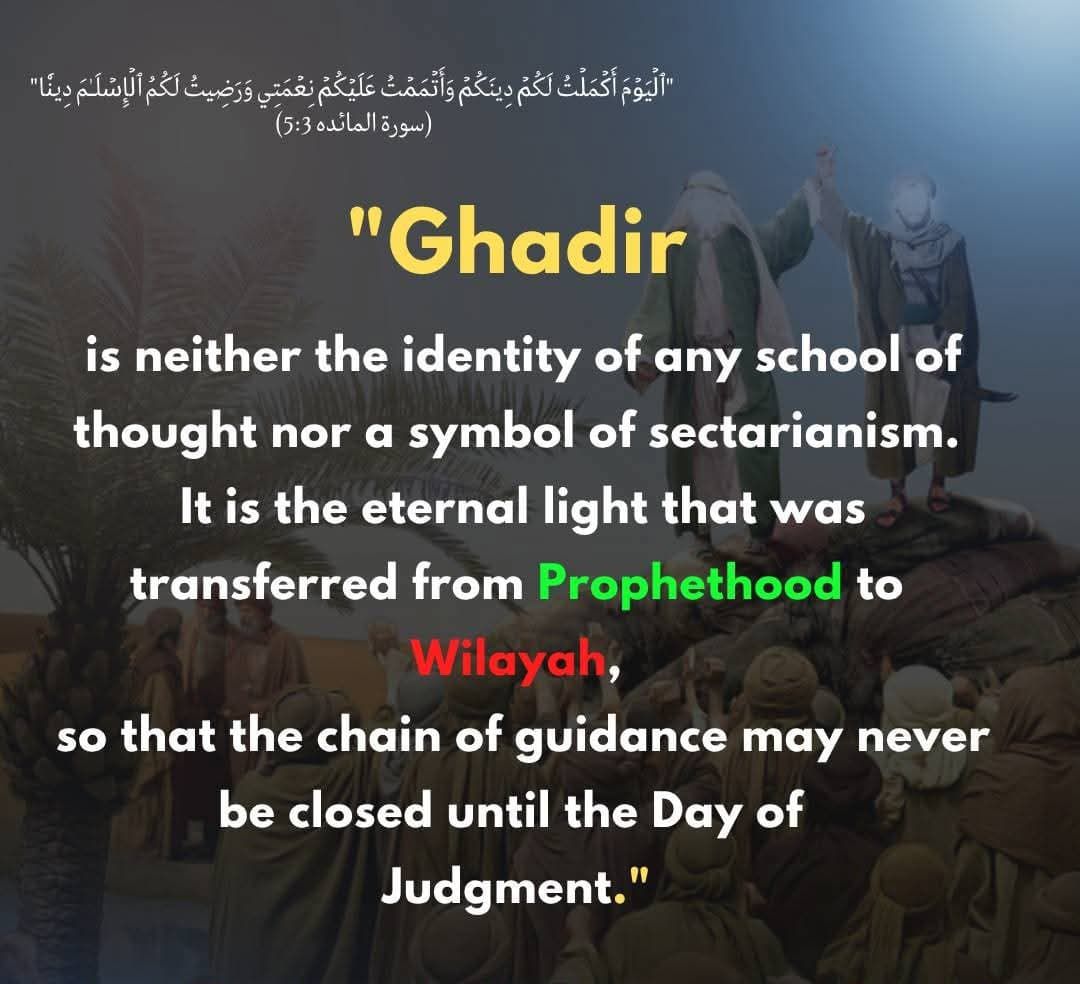
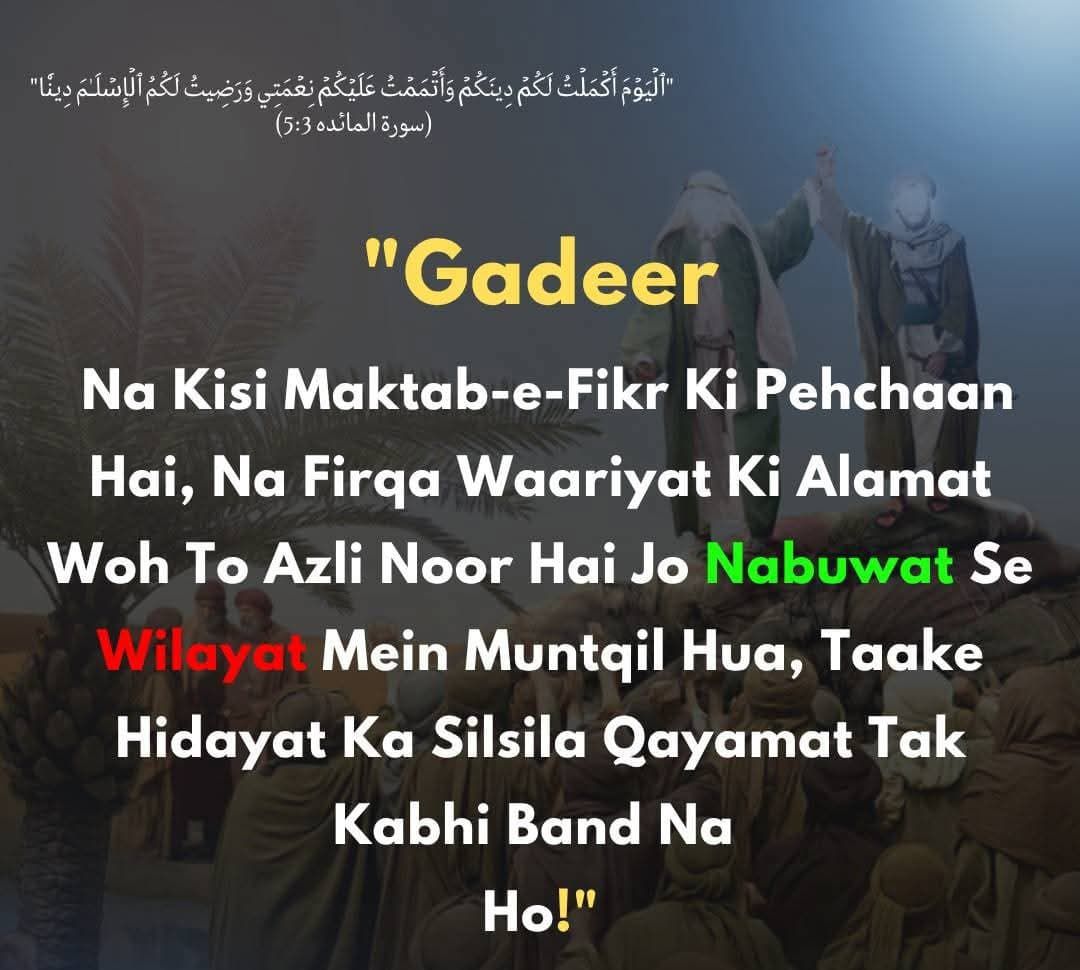
At this moment the Divine Inspiration again descended upon our Holy Prophet with the memorable words that read, “This day have I perfected unto you your religion and completed upon you My Blessings, and I am well- pleased with Islam as your religion.” (Ch. 5. Verse 3).
The tone and purpose of these two religious revelations.. firstly, the verse commanding the Prophet to deliver the Message with the warning that any omission on his part would be a complete failure of his mission, and secondly, this last revelation, declaring the Lord’s pleasure at the
I Mishkat Khasais Nasai; Rawdzat-al-Ahhab; Rawdzat-al-Safa.
fulfilment of the task, clearly indicate that they relate to some matter of prime importance and not merely to some abstruse detail of ritual. It is only in the light of the Hadith-e-Ghadir that these two passages of the Holy Quran can be properly understood in their true importance and full significance. By consensus of the exegesis these two verses were revealed after the Prophet’s last pilgrimage.
Authentic Proofs
In Mishkat, a tradition of Bara’a Bin Azib and Zaid is quoted here for further clarification from the Musnad of Ahmed Ibn Hanbal The Companions state, “We were accompanying the Apostle on his journey. When we reached the oasis of Ghadeer-e-Khum, the announcer called ‘Assalato Jamia’, (come to congregational prayer). The earth under the trees was swept for the Apostle. Then after the Zohar prayer was over, the Apostle held the hand of Ali Ibn Abi Talib and said, “O people! Do you know that according to every believer I am superior to his soul?” All of them replied, ‘It is a fact, O Messenger of Allah! To every believer you are superior to his soul’. Then the Apostle said, ‘Ali is also the Lord of him whose Lord I am. O Allah! Befriend him who befriends Ali and be alien to him who is alien to Ali. Thereafter Omar met Ali and said, “Hail to thee! O son of Abu Talib, today you become the Lord of all believing men and women
.”
Wahidee in Asbab-un-Nuzool; Suyuti in Tafseer-e- Durr-i-Mansoor, Shaukani in Tafseer Fathul Qadir and Sidecq Hasan Khan in Fathul Bayan mention a tradition noted by Ibn Abi Hatim and other scholars from Abu Saeed Khudri in which it is stated that the verse “O Messenger! Make known what has been revealed unto you by
” your Lord and if you do not do so you have not made known your message.” The Quran Ch. 5, verse 67-was revealed on the occasion of the event at Ghadir-e-Khum in honour of Ali. Moreover in another tradition which. has been quoted by Aini in his annotation of Sahech Bukharee, this verse is paraphrased as “O Messenger ! Proclaim the order which your Lord has passed and revealed unto you in honour of Ali Ibn Abu Talib.” So when this verse was revealed the Apostle held Ali by his hand and said, “Ali is also Lord of him who has taken me as his Lord.”
Many similar quotations are given by historians and the names of a few are mentioned below:-
Abul Fida, Ibn Khallakan in Wafiyat-ul-A’ yaan; Hakim in his Mustadrak; Nasace in Kitabul Khasais; Ibn Hajar Makki in Sawaiq-i-Muhriqa; Rawdzat-ul-Ahbab; Naishapuri in Tafseer Gharaibul Quran, Hafiz Ibn Mardwaih and Hafiz Abu Naeem from Abu Saeed Khudri.
Muhammad Ibn Saalim Hanafi remarks in his marginal note on Sirajul Muneer-i-Azeezee, an annotation of Jam’i Sagheer of Suyuti, that when the Apostle delivered his speech “Ali is also the Lord of him who has me for his Lord, and some of the people inquired of the Holy Prophet, Was it not sufficient for us to profess the ‘Creed of evidence, say our prayers and give alms with strict regularity, that the superiority and Lordship of Abu Talib’s son is now being imposed upon us? Do you commission us in this matter of your own accord, or is it ordered by Allah?” The Apostle replied, “By Him other than whom there is no one to be worshipped, this is the order of Allah”.
Tafseer-o-Sa’labi, Noor-ul-Absar, Seerat-ul-Halabiyah and Mustadrak relate that when on that day a man named
Haris, son of No’man Fihri refused to acknowledge Ali as his leader and disputed with the Holy Prophet on this matter and said, “O Allah! If this be truly Thy Command then either rain down stones from heaven upon Muhammad or punish us.” A large stone fell upon him from heaven so that he was killed, just as the army of Abraha and their elephants had been killed before.
The following verse was revealed on that occasion:-
“A questioner asked for the inevitable punishment to befall the disbelievers which no one can avert”. (Chapter 70 Verse 1-2.)
The great research scholar, Allama Sayed Hamid Hus- sain Kintoori, has written a book in two volumes called. Abaqatul-Anwar on the investigation of the innumerable sources through which the Hadith-e-Ghadir has come down to us. In recent years the eminent Alim, Ayat-Ullah Shaikh Abdal Husain-al-Ameeni of Najaf has listed the names of one hundred and ten companions of the Holy Prophet who have reported this tradition as eye-witnesses and eighty-three Tabe’in who heard it from their elders and three hundred and fifty-nine Ulema of all sects, arranged chronologically through each of the centuries since the time of the Prophet up to the present day, who have recorded the sermon of Ghadir-e-Khum in their books and acknowledged its authenticity. Ayatullah-al-Aminis major opus ‘Al-Ghadir”, is a classic of erudition and painstaking research. The book establishes beyond doubt, whatever the criterion of verification adopted, the overwhelming incontrovertibility of the event of Ghadir i.c. the nomination of Ali. It also firmly prescribes the injunction that if ever any tradition is to be believed, the Hadith-e- Ghadir holds the first claim to acceptance.
It will be readily vouched by every scholar of the Arabic language that the word ‘Maula’ in its meaning is far superior to the word Caliph. A Caliph is only a successor to one in any office, but a “Maula” means the Lord and Master of everything. In using the word ‘Maula’ for Ali, the Apostle of God intended to convey the Divine Will that after him. Ali should be held in the same position as he himself was for the people.
The Holy Quran says:
“And neither doth he speak of (his own) inclination. It (the wording) is naught but a revelation revealed (unto him) (Chapter 53, Verse 3 and 4).
Ali was undoubtedly the chosen and declared successor of the Holy Prophet from the beginning of his Prophetic Career. Now he had the distinction of being to the Muslims what the Holy Prophet was to them; which meant that Ali was to be treated in place of (Successor to) the Prophet after his death.”
Shah Ali Hasan Jaisi, a great celebrated Sunni Suli, has made the meaning of the word “MAULA as implied in the declaration, very clear in his couplet in Persian:
عبث در معنی من کنت مولیٰ میروی ہر سو على مولی به آن معنی که پیغمبر بود موشے
“Abus dar maance-ay mun kunto Maula mee ravce hersoo, Ali Maula ba-on mance keh Paigamber boo-ood Maula”.
1 Tabari, Ibne Athir; Abul Fida, Amir Ali
Translation:
“In vain doth thou wander in all directions in interpreting the word Maula (Master).
Ali is in the same sense Maula (Master) as was the Holy Prophet Maula (Master).”
Philosophers, commentators of the Quran, poets, historians and seekers of truth all unanimously acknowledge this vital tradition as an established fact. The valley of Ghadir-e-Khum owes its fame to this single, unique and unforgettable event, on it the survival of the guidance of Islam depends, and so long as there remains a single grain of sand from that parched and arid wilderness, it will rise and proudly describe how the Prophet of Mercy once trod upon that ground, how he lifted up the worthiest of his disciples and proclaimed him as the Amir-ul-Mominin. for there was no one worthier than him and his descendants the eleven Imams, to defend, expound and propagate Islam’s immortal teachings to the world.
The Holy Prophet has said:
“I am the last of the Apostles of Allah (Khatam-un- Nabeeyeen) O Ali, whilst you are the last of the successors to the Prophets.” (Khatam-ul-Waseeyeen).
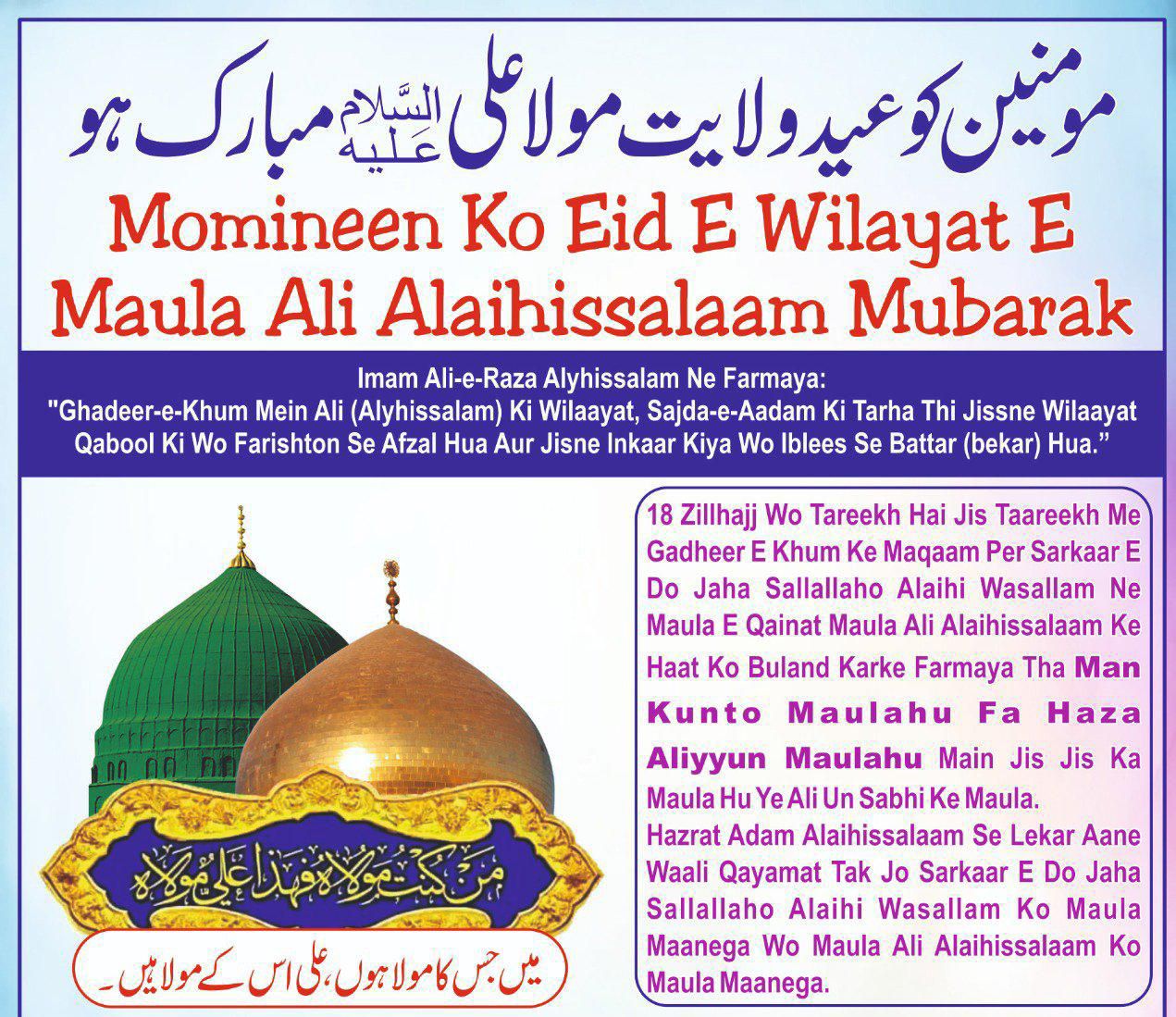
Eid e Ghadeer Elaan e wilayat e Maula Ali Ul Murtuza (Alehissalaaam)
Kaun hain hamare Ali?
Ali wo Jiske liye RasoolAllah SallAllahu Alaihi wa Aalihi wa Sallam ne farmaya: Aadam Alaihissalam ki takhleeq se 14 hazaar saal pehle Mai aur Ali Allah ki Bargah me Ek Noor they
Ali wo Jiske liye RasoolAllah SallAllahu Alaihi wa Aalihi wa Sallam ne farmaya: Ali ko Meri Mitti se banaya gaya
Ali wo Jiske liye RasoolAllah SallAllahu Alaihi wa Aalihi wa Sallam ne farmaya: Mai aur Ali Ek He Nasab se Hain
Ali wo Jiske liye RasoolAllah SallAllahu Alaihi wa Aalihi wa Sallam ne farmaya: Mai aur Ali Ek He Darakht se Paida Hue Hain(yaani Ek He Shajra, Ek He Nasab)”
Ali wo Jiske liye RasoolAllah SallAllahu Alaihi wa Aalihi wa Sallam ne farmaya: Ali ka Gosh Mera Gosh hai aur Ali ka Khoon Mera Khoon hai
Ali wo Jiske liye RasoolAllah SallAllahu Alaihi wa Aalihi wa Sallam ne farmaya: Ali Mujhse hai aur Mai Ali se Hun.”
Ali wo Jiske liye RasoolAllah SallAllahu Alaihi wa Aalihi wa Sallam ne farmaya: Ali Mere liye aise hai jaise Harun Alaihissalam Musa Alaihissalam keliye
Ali wo Jiske liye RasoolAllah SallAllahu Alaihi wa Aalihi wa Sallam ne farmaya: Mai Ilm ka Shehar hun Ali Uska Darwaza hai, jisko is Shehar me aana ho wo darwaze se aaye
Ali wo Jiske liye RasoolAllah SallAllahu Alaihi wa Aalihi wa Sallam ne farmaya: Jiska Mai Maula Hun uska Ali Maula Hai
Ali wo Jiske liye RasoolAllah SallAllahu Alaihi wa Aalihi wa Sallam ne farmaya: Tum dono jahan me Mere Bhai ho
Ali wo Jiske liye RasoolAllah SallAllahu Alaihi wa Aalihi wa Sallam ne farmaya: Ali Mere Jaisa Hai (ka Nafsi)”
Ali wo Jiske liye RasoolAllah SallAllahu Alaihi wa Aalihi wa Sallam ne farmaya: Ali Mere liye aise hai Jaise Mera Sar Mere Jism keliye!
Ali wo Jiske liye RasoolAllah SallAllahu Alaihi wa Aalihi wa Sallam ne farmaya: Ay Allah! Jo Ali se Muhabbat karey Tu usse Muhabbat kar aur jo Is se bugz rakhe Tu us se bugz rakh.
Ab bhi aankh khuli ya aur batayen “Kaun Hain hamare Maula Ali?”
Alaihim Afdalus Salawatu was Salaam
Imam Ahmad ibn Hanbal, al-Fada’il al-sahaba, vol.2, pg.663 H#1130 from Abdur-Razzak, from Mu’amar, from al-Zuhri, from Khalid ibn Mu’dan, from Zadan, from Salman al-Farsi. (RadiAllahu Anhum) Imam-al Tabari, al Riyad al Nadirah, vol.2, pg.163- 164 and vol.3 pg.154 Mustadrak al-Hakim, vol.2 pg.609 Imam-al Jawzi in Tadhkirat Al-ashy khawass, pg.46 Musnad al-Firdaus, H#4176 (its mentions 4000 years instead of 14000 years) Tarikh Damishq ibn Asakir, Vol.3, Pg.154 Imam Dhahabi Mizan al-itidal, vol.1 pg.235 Imam al-Razi in Zayn al Fata fi tafsir Surat Hal ata Imam Ahmad ibn Hanbal in Zawaid manaqib Amir al Muminin, manuscript. This tradition has also been narrated by also Ibn Mardawayh, Ibn Abd al Barr, al Khatib al Baghdadi, Ibn al Maghazili, al-Asimi, Shiruyah al Daylami and others from Imam Ali Alaihissalam, Hazrat Salman , Abu Dharr , Anas ibn Malik, Jabir ibn Abd Allah and other companions (RadiAllahu Anhum Ajmaeen) Musnad Ahmad bin Hanbal, vol.4 pg.66 Tabrani, Mujam al Awsat, 6/162,163 #6085 Haysami, Majma uz Zawaid, 9/168 Imam Alusi in Tafsir Ruh al-Ma’ani, Vol.6 pg.186 Imam Tabarani in Mujam al awsat, vol.3 Tirmidhi, vol.13 pg.178 Mujam al awsat Tabarani, vol.3 Manaqib al-Maghazili, pg.122 Asad Al-Ghaba ibn Atheer, vol.4 pg.26 Riyadh Al-Nadhira Tabari, vol.2 pg.216 Manaqib Khawarizmi, ch.14, pg.87 Tabrani Mujam al Kabir, 12/18, #12341 Haysami, Majma uz Zawaid, 9/111 Sahih Bukhari (Baab) Tirmizi, Jaame al Sahih, 5/632, #3712 Ibne Hibban, Sahih, 15/373, #6929 Hakim, Mustadrak, 3/119, #4579 Nasayi, Sunan al Kubra, 5/132, #8484 Ibne Abi Shaibah, Musannaf, 6/372,373, #32121 Abu Ya’ala, Musnad, 1/293, #355 Tabrani, Mujam al Kabir, 18/128, #265 Sahih Bukhari, 4/1602, #4154 Sahih Muslim, 4/1870, 1871, #2404 Tirmzi, Jaame as Sahih Hakim, Mustadrak Ye Hadees-e-Pak 150 se zyada alag alag sanado se riwayat hui hai hamari Ahle Sunnat ki kitabo me. Batao kitne refence chahiye. Tirmizi, Jaame as Sahih, 5/636, #3720 Hakim, Mustadrak, 3/15, #4288 Sunan al-kubra Nasai, vol.7 #8403 Fazail e sahaba Ahmad, vol.2 #966 Khasais e Ali Nasai, pg.63 #71 Musnad ibn abi Shaybah, vol.6 #32077 Mustadrak Hakim, vol.3 pg.141 Al-Jami Suyuti, vol.1 pg.583 Sawaiq al-muharriqa Haythami, pg.125 Tarikh Baghdad Al-Baghdadi, vol.1 pg.51 Hilyat ul-Awliya Asfahani, vol.1 pg.182 Al-Riyadh Al-Nadihra Tabari, vol.2 pg.219 Manaqib, Khawarizmi, ch.14, pg.91 Tabrani, Mujam al Kabir, 2/357, #6505 Haysami, Majma uz Zawaid, 9/106 Hisamuddin Hindi, Kanzul Ummal, 13/138,139, #36437 Ibne Asakir, Tarikh e Damishq al Kabir, 45/179
( मैं जिस जिस का वली अली भी उसका वली) “रसूलुल्लाह सल्ल0
हज़रत अम्मार इब्ने यासिर रदिअल्लाहु अन्ह अरजा से रिवायत है आं हज़रत सल्ल0 ने फरमाया जहां तौहीद ओ रिसालात की तस्दीक करो वहां वहां मेरे भाई अली की विलायत तस्दीक करो (सही मुस्लिम जिल्द 3 सफा 96….108
हजरत ए अबु दरदा रदिअल्लाहु अन्ह अरजा से रिवायत है रसूलल्लाह सल्ल0 ने फरमाया ए लोगो अली की विलायत सफीना ए नजात है कहीं तुम भी मुकर ना जाना जैसे मूसा के बाद हारून का इन्कार किया था कौम ने और बो हमेशा बर्बाद रहें (खसाएसे अली जिल्द 2 सफा 156 इमाम नसाई
साबित बिन क़ैस रदिअल्लाहु अन्ह अरजा से रिवायत है रसूलल्लाह सल्ल0 ने फरमाया मैं इस फानी दुनिया को अनक़रीब अलविदा कहूंगा साबित बिन क़ैस ने अर्ज़ किया या रसूलुल्लाह सल्ल0 हम आपके बाद किसके सहारे रहेंगे तब आप सल्ल0 ने फरमाया मैं तुम्हारे दरमियान अली को हुज्जत छोड़े जा रहा हूँ उसकी इत्तेबाअ करना विलायत की पैरवी करना अनक़रीब फिर तुम्हारा विलायते अली इब्ने अबी तालिब पर इम्तेहान होगा तारिख ए दमिश्क जिल्द 1 सफा 119( मैं जिस जिस का वली अली भी उसका वली) “रसूलुल्लाह सल्ल0
हज़रत अम्मार इब्ने यासिर रदिअल्लाहु अन्ह अरजा से रिवायत है आं हज़रत सल्ल0 ने फरमाया जहां तौहीद ओ रिसालात की तस्दीक करो वहां वहां मेरे भाई अली की विलायत तस्दीक करो (सही मुस्लिम जिल्द 3 सफा 96….108
हजरत ए अबु दरदा रदिअल्लाहु अन्ह अरजा से रिवायत है रसूलल्लाह सल्ल0 ने फरमाया ए लोगो अली की विलायत सफीना ए नजात है कहीं तुम भी मुकर ना जाना जैसे मूसा के बाद हारून का इन्कार किया था कौम ने और बो हमेशा बर्बाद रहें (खसाएसे अली जिल्द 2 सफा 156 इमाम नसाई
साबित बिन क़ैस रदिअल्लाहु अन्ह अरजा से रिवायत है रसूलल्लाह सल्ल0 ने फरमाया मैं इस फानी दुनिया को अनक़रीब अलविदा कहूंगा साबित बिन क़ैस ने अर्ज़ किया या रसूलुल्लाह सल्ल0 हम आपके बाद किसके सहारे रहेंगे तब आप सल्ल0 ने फरमाया मैं तुम्हारे दरमियान अली को हुज्जत छोड़े जा रहा हूँ उसकी इत्तेबाअ करना विलायत की पैरवी करना अनक़रीब फिर तुम्हारा विलायते अली इब्ने अबी तालिब पर इम्तेहान होगा तारिख ए दमिश्क जिल्द 1 सफा 119








 Aal-e-Qutub Aal-e-Syed Abdullah Shah Ghazi